📅 Published: January 18, 2026
🔄 Last Updated: March 20, 2026
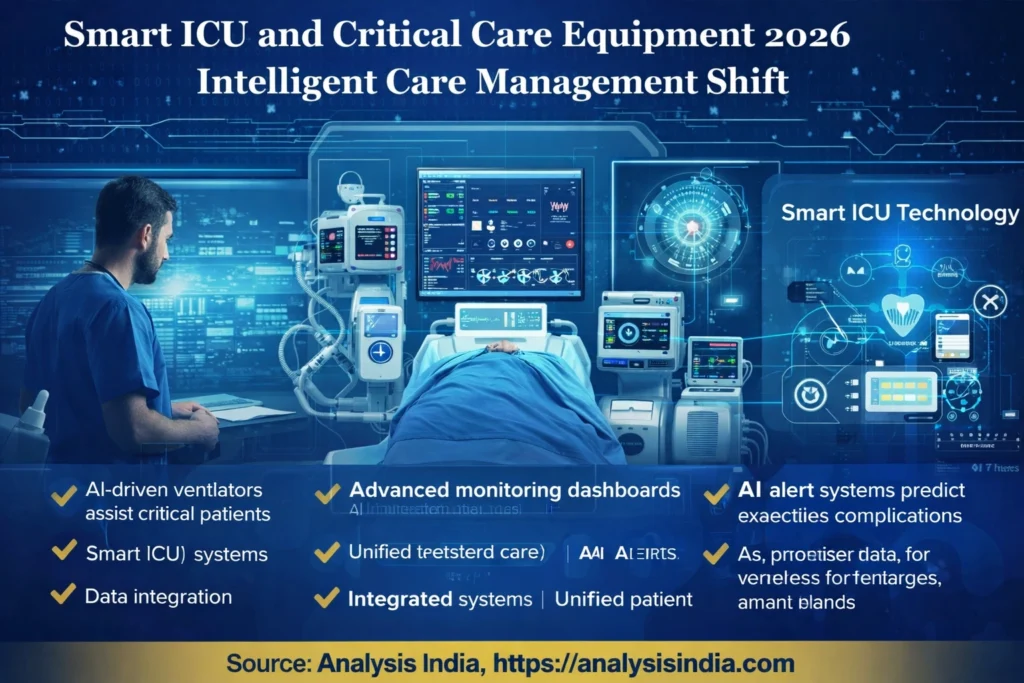
Analysis India: Smart ICU and Critical Care Equipment are becoming a central part of hospital infrastructure in 2026 as healthcare systems focus on improving patient safety and treatment efficiency in intensive care units. Smart ICU and Critical Care Equipment include AI driven ventilators, real time monitoring dashboards, and intelligent alert systems that support faster clinical decisions.
These technologies help doctors track patient vitals continuously and respond quickly to sudden health changes. Hospitals are adopting Smart ICU and Critical Care Equipment to manage growing ICU demand caused by ageing populations and complex medical conditions. Digital transformation in critical care is also supported by better hospital IT systems and cloud based data platforms. Together these changes are reshaping how critical care is delivered in modern hospitals.
Intensive care units handle the most vulnerable patients who require constant monitoring and immediate intervention. Traditional ICU systems often rely on manual observation and fragmented data sources. Smart ICU and Critical Care Equipment now integrate multiple patient signals into unified dashboards. AI systems analyse trends in vital signs and predict potential complications. This allows medical teams to act before conditions become life threatening. As a result Smart ICU and Critical Care Equipment are improving both response time and care quality.
Rising Demand for Smart ICU and Critical Care Equipment
Healthcare systems are facing rising pressure to expand ICU capacity due to increasing chronic illnesses, respiratory disorders, and post surgical complications. Critical care teams must manage high risk patients with limited staff and resources.
Smart ICU and Critical Care Equipment help automate patient monitoring and reduce manual workload for nurses and doctors. AI driven systems continuously analyse heart rate, oxygen levels, blood pressure, and respiratory data. This allows early detection of patient deterioration.
Hospitals are also focused on reducing ICU mortality and length of stay. AI powered alert systems notify clinicians when patients show early signs of distress. Digital dashboards provide real time insights into patient conditions across multiple beds. Improved connectivity and hospital data integration support seamless information flow. Because of these factors Smart ICU and Critical Care Equipment are becoming essential in modern critical care environments.
Market research supports this trend. According to Fortune Business Insights, the global critical care equipment market reached USD 46.8 billion in 2024 and is expected to grow steadily as hospitals invest in smart ICU technologies. This reflects strong demand for Smart ICU and Critical Care Equipment worldwide.
Critical Care Equipment Market Snapshot
| Segment | Year | Market Value | Source |
|---|---|---|---|
| Critical Care Equipment | 2024 | USD 46.8 Billion | Fortune Business Insights |
Global Investment and Market Expansion
Investment in Smart ICU and Critical Care Equipment is increasing as hospitals modernise their intensive care infrastructure. Medical device companies are expanding research into AI powered ventilators, patient monitoring systems, and predictive alert tools. Governments are also funding digital health programs to strengthen hospital readiness for future health emergencies.
North America leads adoption due to advanced hospital networks and high ICU demand. Europe follows closely with strong healthcare digitisation programs. Asia Pacific is expanding rapidly as new hospitals are built and ICU capacity increases. Smart ICU and Critical Care Equipment are now used in tertiary hospitals, trauma centres, and emergency care units.
According to MarketsandMarkets, the global smart ICU market is projected to grow significantly by Smart ICU integration and digital patient monitoring systems. The growth is driven by increasing ICU admissions and the need for better patient management tools.
Smart ICU Market Forecast
| Segment | Year | Market Value | Source |
|---|---|---|---|
| Smart ICU Solutions | 2028 | Strong growth trend | MarketsandMarkets |
What Defines Smart ICU and Critical Care Equipment
Smart ICU and Critical Care Equipment include intelligent medical devices designed to support real time patient monitoring and treatment in intensive care settings. AI driven ventilators automatically adjust airflow and oxygen levels based on patient needs. Smart monitoring dashboards display continuous vital signs for multiple patients. Alert systems notify clinicians about abnormal trends.
These systems integrate data from ventilators, infusion pumps, and bedside monitors into one platform. Doctors can view patient status remotely and respond quickly. AI algorithms help identify risk patterns before emergencies occur. Smart ICU and Critical Care Equipment improve coordination between ICU staff and reduce response delays.
Manufacturers focus on reliability, safety, and regulatory compliance. These devices are designed to support clinical judgement and enhance patient care.
AI Driven Ventilators in Critical Care
AI driven ventilators are a key part of Smart ICU and Critical Care Equipment. These devices automatically adjust ventilation settings based on real time lung performance and oxygen saturation levels. This reduces the risk of lung injury and improves respiratory support for critically ill patients.
Ventilators now use machine learning models to detect breathing irregularities. Alerts are generated when patient conditions worsen. This allows faster medical intervention. AI driven ventilators also reduce the workload for ICU staff by automating routine adjustments.
GE Healthcare, Philips Healthcare, and Medtronic offer advanced ventilator systems used in major hospitals. These devices support better respiratory management in ICU environments.
Smart Monitoring Dashboards for ICU Management
Smart ICU dashboards provide a central view of patient vitals across multiple beds. Doctors and nurses can monitor heart rate, oxygen levels, blood pressure, and temperature in real time. AI systems highlight patients at higher risk.
Dashboards integrate data from different devices into one screen. This improves clinical visibility and reduces information overload. Staff can respond faster to critical changes. Remote access allows specialists to review patient data from other hospital departments.
Philips IntelliVue and Cerner ICU platforms are widely used for smart monitoring. These systems support faster decision making and better coordination in critical care units.
Intelligent Alert Systems Improving Patient Safety
Intelligent alert systems are a core feature of Smart ICU and Critical Care Equipment. These systems analyse patient data continuously and send alerts when abnormal trends appear. This helps prevent sudden health deterioration.
AI reduces false alarms by focusing on meaningful patterns rather than single abnormal readings. This improves staff trust in alerts. Early warnings allow timely medical action.
Hospitals using smart alert systems report improved ICU response times and reduced emergency events.
Workflow Automation in Intensive Care Units
Automation improves ICU efficiency by reducing manual documentation and monitoring tasks. Smart ICU and Critical Care Equipment automatically record patient data into hospital systems. This saves time for nurses.
Automated systems also support medication tracking and equipment usage. This improves safety and reduces errors. ICU teams can focus more on direct patient care.
According to Healthcare IT News, hospitals using smart ICU technologies report better workflow efficiency and staff productivity.
Real World Use Cases
Philips Healthcare uses AI powered ICU monitoring systems that integrate patient data into smart dashboards. Hospitals report faster clinical responses and better patient tracking.
Medtronic provides AI enabled ventilators that adapt to patient breathing patterns. These systems improve respiratory care in ICUs.
GE Healthcare offers intelligent monitoring solutions that support early risk detection in critical care.
These examples show how Smart ICU and Critical Care Equipment improve ICU management.
Benefits for Healthcare Systems
Smart ICU and Critical Care Equipment improve patient safety and treatment accuracy. Continuous monitoring reduces the risk of unnoticed complications. AI driven alerts support faster interventions.
Hospitals can manage ICU capacity more efficiently. Staff workload is reduced. Patient outcomes improve.
The World Health Organization supports digital health tools that strengthen critical care systems. Smart ICU technologies align with this goal.
Market Growth Driven by AI and Digital Monitoring
The growth of Smart ICU and Critical Care Equipment is driven by rising ICU admissions and demand for advanced patient monitoring. Hospitals are replacing manual systems with digital dashboards and AI alert tools. Cloud platforms support real time data access.
MarketsandMarkets reports strong growth in smart ICU technologies due to improved hospital digitisation. Fortune Business Insights highlights rising investment in critical care equipment.
Updated Market Forecast
| Segment | Year | Market Value | Source |
|---|---|---|---|
| Critical Care Equipment | 2024 | USD 46.8B | Fortune Business Insights |
| Smart ICU Solutions | 2028 | Growth phase | MarketsandMarkets |
Adoption Is Rising but Challenges Remain
Despite strong demand, Smart ICU and Critical Care Equipment adoption faces challenges. High costs, system integration, and staff training are key barriers. Hospitals also need clear clinical guidelines for AI usage.
However planning activity is increasing. Many hospitals are upgrading ICU infrastructure. Digital ICU programs are expanding across regions.
Healthcare leaders see smart ICU systems as long term investments.
Future Outlook for Smart ICU Technologies
Smart ICU and Critical Care Equipment will continue evolving. AI models will improve risk prediction. Remote ICU monitoring will expand. Integration with electronic health records will strengthen data sharing.
Costs will decline over time. Adoption will grow in emerging markets. AI will support personalised critical care.
Conclusion
Smart ICU and Critical Care Equipment are transforming intensive care management in 2026. AI driven ventilators, monitoring dashboards, and alert systems improve patient safety and response times. Market data shows strong investment growth. Hospitals benefit from better workflows and outcomes. As technology advances, Smart ICU and Critical Care Equipment will become essential in modern critical care.
Frequently Asked Questions
What is Smart ICU and Critical Care Equipment
Smart ICU and Critical Care Equipment refers to advanced medical systems that use AI driven monitoring real time dashboards and intelligent alert tools to support patient care in intensive care units. These systems help doctors track vital signs continuously and respond faster to critical situations.
How does Smart ICU technology improve patient safety
Smart ICU technology improves patient safety by providing real time monitoring early warning alerts and automated clinical support. This allows healthcare teams to detect complications quickly and take timely action for critical patients.
What types of equipment are used in Smart ICUs
Smart ICUs use AI assisted ventilators patient monitoring systems digital dashboards smart infusion pumps and intelligent alert platforms. These tools work together to improve care coordination and clinical decision making.
Why is Smart ICU and Critical Care Equipment important in 2026
Smart ICU and Critical Care Equipment is important in 2026 because hospitals are managing more complex medical cases and ageing populations. These technologies help improve efficiency reduce response time and enhance overall critical care quality.
How do Smart ICU systems support doctors and nurses
Smart ICU systems support doctors and nurses by automating data collection providing real time insights and generating alerts for abnormal patient conditions. This reduces manual workload and improves clinical accuracy.
Is Smart ICU technology used in modern hospitals
Yes Smart ICU technology is increasingly used in modern hospitals to improve patient monitoring streamline workflows and enhance critical care delivery through digital health systems.