📅 Published: February 5, 2026
🔄 Last Updated: February 13, 2026
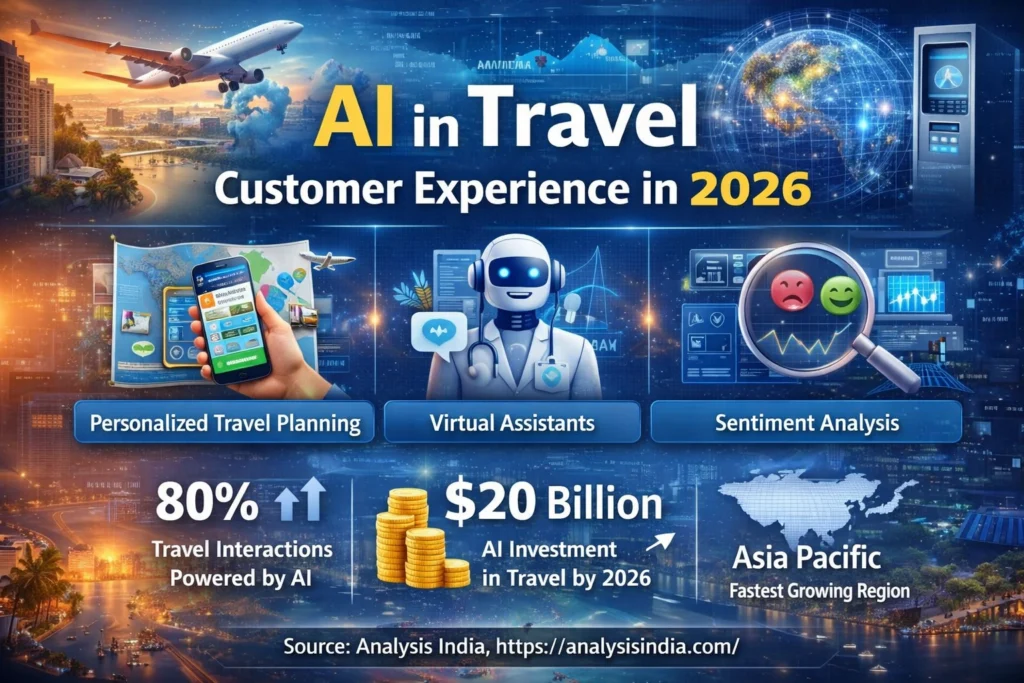
Analysis India: AI in travel customer experience is transforming how travelers plan, book, and experience journeys in 2026. Travel and hospitality companies face rising expectations from digital first customers who demand personalization, instant support, and seamless service across channels. Artificial intelligence is becoming a core enabler of these experiences, reflecting wider AI market adoption trends in 2026 across global industries
Travelers today expect tailored recommendations, real time assistance, and emotionally aware service. Traditional travel planning and customer service models struggle to meet these expectations consistently. AI in travel customer experience offers scalable and data driven solutions.
In 2026, artificial intelligence is embedded across personalized travel planning, virtual assistants, and sentiment analysis platforms. According to McKinsey and Company, travel companies using AI driven customer experience tools achieve higher customer satisfaction and loyalty.
What Is AI in Travel Customer Experience
AI in travel customer experience refers to the use of artificial intelligence to improve how travelers interact with airlines, hotels, travel platforms, and tourism services. It covers the entire travel journey from discovery to post trip engagement.
In 2026, AI in travel customer experience shifts from automation to intelligent orchestration. AI systems analyze traveler preferences, behavior, and feedback to deliver relevant and timely interactions.
Technologies such as machine learning, natural language processing, and predictive analytics support these systems. AI enhances human service rather than replacing it.
According to Gartner, over 80 percent of travel customer interactions are influenced by AI driven systems by 2026.
Global Market Overview for AI in Travel Customer Experience
This global expansion in AI for travel customer experience reflects extensive industry-wide AI adoption trends documented across sectors, from healthcare to retail and finance in 2026. Travel recovery and digital transformation fuel investment in AI platforms.
According to Statista, global AI spending in travel and hospitality is projected to exceed USD 20 billion by 2026. Customer experience related applications represent a major share of this investment.
Key growth drivers include mobile travel planning, online reviews, social media influence, and demand for personalized experiences. AI enables travel brands to respond at scale.
Travel companies also use AI to optimize operational efficiency while enhancing guest satisfaction.
Regional Market Insights
North America
North America leads in AI in travel customer experience adoption in 2026. Airlines, hotel chains, and online travel agencies invest heavily in AI driven personalization.
According to Deloitte, AI powered recommendation engines are widely used by major travel platforms in the region.
Expedia Group uses AI to personalize travel search and recommendations. Leadership has stated that AI helps travelers find relevant options faster while improving booking confidence.
Strong digital ecosystems support advanced AI deployment.
Europe
Europe focuses on trust and transparency in AI in travel customer experience. Data privacy regulations shape AI strategies.
According to European Travel Commission, AI driven virtual assistants and sentiment analysis tools are widely adopted by hospitality brands.
Accor Hotels uses AI to personalize guest experiences and analyze feedback. Company executives emphasize that AI improves guest satisfaction while respecting data privacy.
Explainable AI remains a priority in European travel markets.
Asia Pacific
Asia Pacific is the fastest growing region for AI in travel customer experience. Mobile first travelers and digital tourism platforms drive adoption.
According to PwC, countries such as China, Japan, Singapore, and India lead in AI based travel assistants.
Trip.com Group uses AI to support personalized travel planning and real time assistance. Leadership notes that AI improves traveler engagement across digital channels.
High travel volumes accelerate innovation in this region.
Middle East and Africa
The Middle East adopts AI in travel customer experience through smart tourism initiatives.
According to World Tourism Organization, AI powered guest services are deployed in major tourism hubs such as the UAE.
Emirates Airline uses AI for customer service and personalization. Executives highlight that AI enhances traveler experience across booking and travel stages.
Africa shows emerging adoption focused on mobile travel platforms.
Latin America
Latin America uses AI in travel customer experience to improve accessibility and engagement.
According to Amadeus travel insights, AI driven chat and recommendation tools support online travel platforms in Brazil and Mexico.
Travel companies focus on multilingual virtual assistants and customer feedback analysis.
Personalized Travel Planning with AI
Personalized travel planning is a core pillar of AI in travel customer experience. Travelers expect recommendations aligned with preferences and budgets.
In 2026, AI analyzes past trips, browsing behavior, and contextual data to suggest destinations, hotels, and activities. These recommendations update dynamically.
According to Boston Consulting Group, AI personalization increases traveler engagement and booking conversion.
Booking Holdings uses AI to personalize travel planning experiences. Leadership states that AI helps travelers discover options they might otherwise miss.
Personalization builds emotional connection and trust.
Virtual Assistants Enhancing Travel Experience
Virtual assistants are a visible component of AI in travel customer experience. They support travelers before, during, and after trips.
In 2026, AI virtual assistants handle booking queries, itinerary changes, and travel alerts. They understand natural language and context.
According to Juniper Research, AI travel assistants reduce customer service response time significantly.
Airbnb uses AI powered support tools to assist guests and hosts. Company leadership highlights that AI improves responsiveness while maintaining human support where needed.
Virtual assistants ensure continuous engagement.
Sentiment Analysis and Emotional Intelligence in Travel
Sentiment analysis plays a growing role in AI in travel customer experience. Travel decisions are highly emotional.
In 2026, AI analyzes reviews, social media posts, and feedback to understand traveler sentiment. These insights guide service improvements.
According to Forrester, sentiment analysis helps travel brands identify issues early and respond proactively.
Marriott International uses AI to analyze guest feedback across channels. Executives note that sentiment insights improve service quality and guest loyalty.
Emotion aware AI strengthens brand perception.
Trust and Responsible AI in Travel Customer Experience
In 2026, travel companies adopt responsible AI practices focused on transparency and consent, reflecting broader responsible AI adoption across industries.
In 2026, travel companies adopt responsible AI practices focused on transparency and consent.
Hilton Hotels emphasizes responsible AI use in guest facing systems. Leadership highlights that trust drives repeat bookings.
According to OECD, tourism organizations increasingly align AI systems with ethical standards.
Clear communication about AI use builds confidence.
Integration of AI Across the Travel Journey
AI in travel customer experience spans discovery, booking, travel, and post trip stages.
According to Forrester, integrated AI platforms improve journey consistency and satisfaction.
Travel brands invest in unified data platforms to ensure seamless experiences.
Challenges in AI Driven Travel Customer Experience
Challenges include data integration, bias in recommendations, and over automation risks.
Travel companies address these challenges through governance and human oversight.
According to KPMG, balanced AI strategies deliver sustainable customer experience outcomes.
Future Outlook for AI in Travel Customer Experience Beyond 2026
Beyond 2026, AI in travel customer experience will become predictive and emotionally aware.
AI travel companions will support travelers throughout journeys with contextual guidance.
Sustainable and responsible tourism will benefit from AI insights.
Frequently Asked Questions
What is AI in travel customer experience
AI in travel customer experience refers to the use of artificial intelligence to improve how travelers interact with travel and hospitality brands. It includes personalized travel planning, virtual assistants, and sentiment analysis. In 2026, AI helps deliver faster support, tailored recommendations, and seamless travel journeys.
How does AI enable personalized travel planning
AI enables personalized travel planning by analyzing traveler preferences, past trips, and real time behavior. In 2026, AI systems recommend destinations, hotels, and activities that match individual needs. This improves decision making and creates a more relevant and engaging travel experience.
What role do virtual assistants play in travel customer experience
Virtual assistants play a key role in travel customer experience by offering real time support across booking and travel stages. In 2026, AI virtual assistants handle itinerary updates, cancellations, and alerts. They provide instant responses and improve service availability for travelers.
How is sentiment analysis used in travel and hospitality
Sentiment analysis is used in travel and hospitality to understand traveler emotions and opinions. In 2026, AI analyzes reviews, feedback, and social media content. These insights help travel brands improve services, resolve issues early, and enhance overall customer experience.
Can AI improve customer satisfaction in travel
AI can improve customer satisfaction in travel by delivering personalized experiences and timely assistance. In 2026, AI driven insights help travel companies anticipate traveler needs. This leads to smoother journeys, faster issue resolution, and stronger emotional connection with customers.
Is AI in travel customer experience safe for users
AI in travel customer experience is safe when implemented with responsible data practices. In 2026, travel companies focus on transparency, data protection, and ethical AI use. These measures help protect traveler information and build trust in AI driven travel services.
Which regions lead in AI adoption for travel customer experience
North America, Europe, and Asia Pacific lead in AI adoption for travel customer experience. In 2026, Asia Pacific shows rapid growth due to mobile travel platforms. Europe emphasizes data privacy, while North America leads large scale AI deployment across travel brands.
What challenges exist in AI driven travel customer experience
Challenges include data integration, algorithm bias, and over automation risks. In 2026, travel companies address these challenges through governance frameworks and human oversight. Balancing AI efficiency with personal service is essential for sustainable customer experience.
What is the future of AI in travel customer experience after 2026
After 2026, AI in travel customer experience will focus on predictive and emotionally aware services. AI travel companions will guide travelers throughout journeys. These systems will support personalized planning, real time assistance, and more meaningful travel experiences.
Conclusion
AI in travel customer experience in 2026 reshapes how travelers plan and experience journeys. Personalized travel planning, virtual assistants, and sentiment analysis improve engagement and satisfaction.
Global adoption shows strong momentum. Travel companies that invest responsibly in AI gain loyalty and competitive advantage.
Artificial intelligence is enhancing travel experiences while keeping human connection central.