📅 Published: February 19, 2026
🔄 Last Updated: February 19, 2026
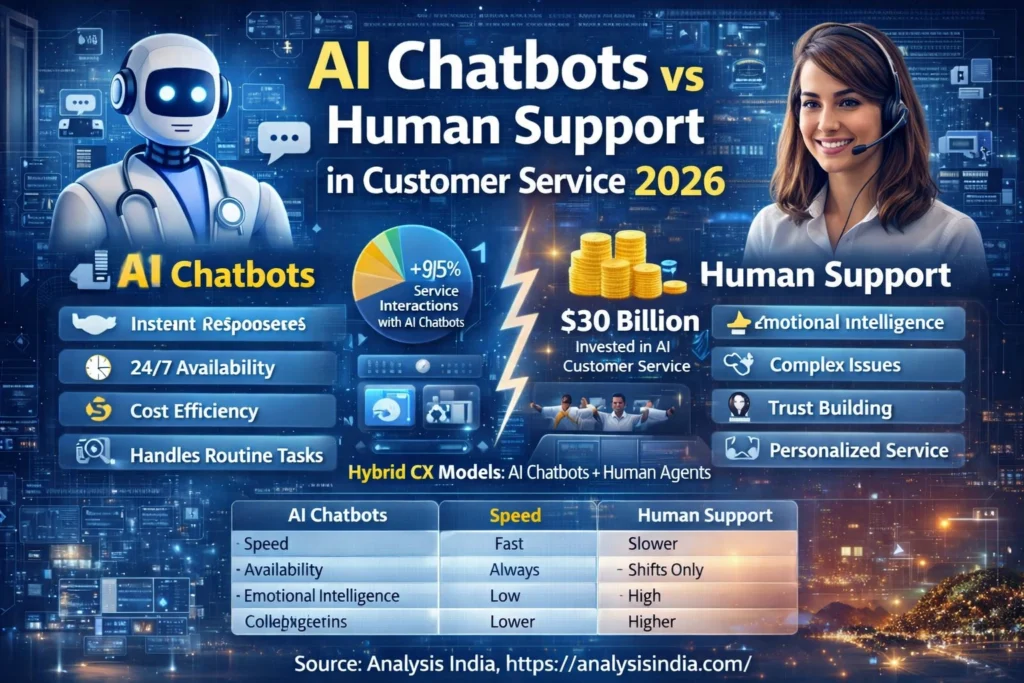
Analysis India: AI chatbots in customer service are now a central part of customer experience strategies in 2026. Businesses across industries deploy chatbots to manage rising customer interactions, reduce response time, and deliver consistent support across digital channels. At the same time, human support remains critical for empathy, complex problem solving, and trust building.
The debate is no longer about AI chatbots replacing human agents. The real question is how AI chatbots in customer service and human support can work together to create a balanced and effective customer experience.
Customers expect instant responses and accurate information. They also value understanding, empathy, and contextual support. AI chatbots excel at speed and scale, while human agents excel at emotional intelligence. Hybrid customer experience models are emerging as the most sustainable approach. The rapid growth of AI chatbots in customer service reflects broader AI market analysis 2026 industry adoption trends, where enterprises are increasing investments in automation and intelligent systems across sectors.
What Are AI Chatbots in Customer Service
AI chatbots in customer service are artificial intelligence powered conversational systems designed to interact with customers through text or voice interfaces. They use technologies such as natural language processing, machine learning, and contextual understanding.
In 2026, AI chatbots move beyond scripted responses. They understand intent, sentiment, and conversation flow. These chatbots integrate with CRM, billing, and order management systems to resolve issues in real time.
AI chatbots in customer service operate across websites, mobile apps, messaging platforms, and voice assistants. They are available at all times and handle large interaction volumes efficiently.
According to Gartner, more than 85 percent of customer service interactions are influenced by AI chatbots by 2026.
Global Market Overview for AI Chatbots in Customer Service
The global market for AI chatbots in customer service continues to expand rapidly in 2026. Organizations view chatbots as a strategic investment rather than a cost cutting tool.
According to Statista, global spending on AI powered customer service solutions is projected to exceed USD 30 billion by 2026. Chatbots represent a major share of this investment.
Key growth drivers include digital customer engagement, rising service volumes, labor shortages, and customer demand for instant support. AI chatbots help organizations scale service without compromising availability.
Regulators and enterprises also emphasize responsible AI use to maintain transparency and trust.
Core Use Cases of AI Chatbots in Customer Service
AI chatbots in customer service are used across multiple touchpoints and industries in 2026. Below are the most common use cases.
Common Use Cases Table
| Use Case | Role of AI Chatbots in Customer Service |
|---|---|
| Customer inquiries | Answer FAQs and provide instant information |
| Order tracking | Share real time order and delivery status |
| Account support | Handle balance checks and profile updates |
| Appointment scheduling | Book, reschedule, and confirm appointments |
| Technical support | Guide users through basic troubleshooting |
| Feedback collection | Capture customer feedback after interactions |
According to McKinsey and Company, AI chatbots resolve a large share of routine customer queries without human intervention.
Benefits of AI Chatbots in Customer Service
AI chatbots in customer service offer several operational and experience related benefits. These benefits drive widespread adoption across sectors.
Key Benefits Analysis
AI chatbots provide instant responses, reducing customer wait times significantly. Customers receive support at any time without dependency on business hours.
Chatbots deliver consistent information, reducing errors caused by manual handling. They scale easily during peak demand periods.
According to IBM, AI chatbots improve service efficiency and allow human agents to focus on higher value interactions.
Benefits Summary Table
| Benefit | Impact on Customer Experience |
|---|---|
| 24 by 7 availability | Continuous customer support |
| Faster response time | Improved satisfaction |
| Scalability | Handles high interaction volumes |
| Cost efficiency | Optimized support operations |
| Consistency | Uniform service quality |
Bank of America uses AI chatbots to support millions of customer interactions. Leadership has stated that chatbots improve service speed while maintaining quality.
Limitations of AI Chatbots in Customer Service
Despite advancements, AI chatbots in customer service have limitations that organizations must address.
AI chatbots struggle with complex emotional situations. They may misinterpret nuanced language or customer frustration.
In 2026, chatbots still depend heavily on data quality and training. Poor data leads to poor responses.
According to Forrester, over reliance on AI chatbots without escalation paths can frustrate customers.
Limitations Overview Table
| Limitation | Customer Impact |
|---|---|
| Limited empathy | Reduced emotional connection |
| Complex issue handling | Requires human escalation |
| Data dependency | Accuracy depends on training data |
| Trust concerns | Customers may prefer human agents |
Customers often expect human support when issues involve financial loss or emotional stress.
Human Support in Customer Experience
Human support remains essential in customer experience despite AI progress. Human agents provide empathy, judgment, and creative problem solving.
In 2026, human support focuses on complex, sensitive, and high value interactions. Agents handle escalations, complaints, and personalized resolutions.
According to Harvard Business Review, human interaction remains a key driver of trust and loyalty.
American Express emphasizes human support for premium customers. Leadership highlights that personal interaction strengthens customer relationships.
AI Chatbots vs Human Support Comparison
The comparison between AI chatbots in customer service and human support highlights why hybrid models are necessary.
Comparison Table
| Aspect | AI Chatbots in Customer Service | Human Support |
|---|---|---|
| Speed | Instant responses | Slower but contextual |
| Availability | Always available | Limited by shifts |
| Emotional intelligence | Limited | High |
| Cost | Scalable and efficient | Higher operational cost |
| Complexity handling | Low to medium | High |
| Personal judgment | Rule based | Experience driven |
This comparison shows that neither approach alone delivers optimal customer experience.
Rise of Hybrid Customer Experience Models
Hybrid customer experience models combine AI chatbots in customer service with human support. This approach leverages the strengths of both.
In 2026, AI chatbots handle initial interactions, routine queries, and data collection. Human agents take over when complexity or emotion increases.
According to Accenture, hybrid CX models deliver higher customer satisfaction than AI only or human only approaches.
Salesforce promotes hybrid service models through AI assisted agent tools. Executives state that AI augments human performance rather than replacing it.
How Hybrid CX Models Work in Practice
Hybrid models follow a structured flow. AI chatbots act as the first point of contact. They gather information and resolve simple issues.
When required, the chatbot escalates the case to a human agent with full context. This reduces repetition and improves resolution time.
Customers benefit from speed without losing human connection.
Trust, Transparency and Responsible AI Use
Trust plays a critical role in AI chatbots in customer service. Customers should know when they interact with AI.
In 2026, organizations adopt responsible AI frameworks to ensure transparency and ethical use.
According to OECD, clear disclosure and escalation options improve customer trust in AI systems.
Microsoft emphasizes responsible AI in conversational systems, highlighting fairness and accountability.
Future Outlook for AI Chatbots in Customer Service Beyond 2026
Beyond 2026, AI chatbots will become more conversational and emotionally aware. Advances in sentiment detection will improve responses.
Chatbots will proactively assist customers based on behavior patterns.
Hybrid CX models will remain the dominant approach, balancing automation and empathy.
Frequently Asked Questions
What are AI chatbots in customer service
AI chatbots in customer service are artificial intelligence powered systems that interact with customers through text or voice. They use natural language processing to understand queries and provide responses. In 2026, AI chatbots support tasks such as answering questions, order tracking, and appointment scheduling across digital channels.
How do AI chatbots improve customer experience
AI chatbots improve customer experience by providing instant responses and round the clock support. In 2026, they handle routine queries quickly and consistently. This reduces waiting time and allows human agents to focus on complex issues that require personal attention and empathy.
What are the main use cases of AI chatbots in customer service
Common use cases include handling customer inquiries, tracking orders, managing appointments, and providing basic technical support. In 2026, AI chatbots also collect feedback and guide customers through self service options, improving efficiency and overall service quality.
What are the limitations of AI chatbots in customer service
AI chatbots have limitations in handling emotional or complex situations. They may struggle with nuanced language or uncommon issues. In 2026, chatbots still require human escalation paths to ensure customers receive accurate and empathetic support when needed.
Why is human support still important in customer experience
Human support remains important because human agents provide empathy, judgment, and problem solving skills. In 2026, customers prefer human interaction for sensitive issues or complex cases. Human support helps build trust and strengthens long term customer relationships.
What is a hybrid customer experience model
A hybrid customer experience model combines AI chatbots in customer service with human support. In 2026, chatbots handle routine interactions while human agents manage complex or emotional cases. This approach balances efficiency with empathy and delivers better customer satisfaction.
Do customers prefer AI chatbots or human support
Customer preference depends on the situation. In 2026, customers prefer AI chatbots for quick tasks and human support for complex problems. Hybrid models give customers the flexibility to move between AI and human agents based on their needs.
How do hybrid CX models benefit businesses
Hybrid CX models help businesses improve service efficiency while maintaining quality. In 2026, AI chatbots reduce workload and operational pressure, while human agents focus on value driven interactions. This leads to better customer satisfaction and optimized support operations.
What is the future of AI chatbots in customer service after 2026
After 2026, AI chatbots will become more conversational and emotionally aware. They will proactively assist customers based on behavior patterns. Hybrid customer experience models will continue to dominate, combining automation with human expertise.
Conclusion
AI chatbots in customer service play a vital role in modern customer experience strategies. They deliver speed, scalability, and consistency. Human support delivers empathy, judgment, and trust.
The future of customer experience lies in hybrid models that combine AI chatbots and human agents effectively. Organizations that design balanced CX strategies gain loyalty and long term value.
Artificial intelligence is not replacing human support. It is reshaping how support is delivered.