📅 Published: February 10, 2026
🔄 Last Updated: March 20, 2026
Introduction to AI Market Analysis 2026
AI market analysis in 2026 reflects a structural transformation in how artificial intelligence is embedded within global business ecosystems. Artificial intelligence is no longer positioned as an experimental or optional technology. It is increasingly treated as a core operational and strategic capability across industries.
Organizations today deploy AI across customer engagement platforms, analytics systems, operational workflows, and decision-support frameworks. AI initiatives are no longer confined to innovation teams. They are governed at the enterprise level with defined objectives, performance indicators, and accountability structures.
This shift reflects a broader change in how businesses perceive value creation. AI is not only used to automate tasks but also to enhance insight generation, improve service quality, and support long-term strategic planning. As a result, AI adoption is becoming deeply integrated into organizational design.
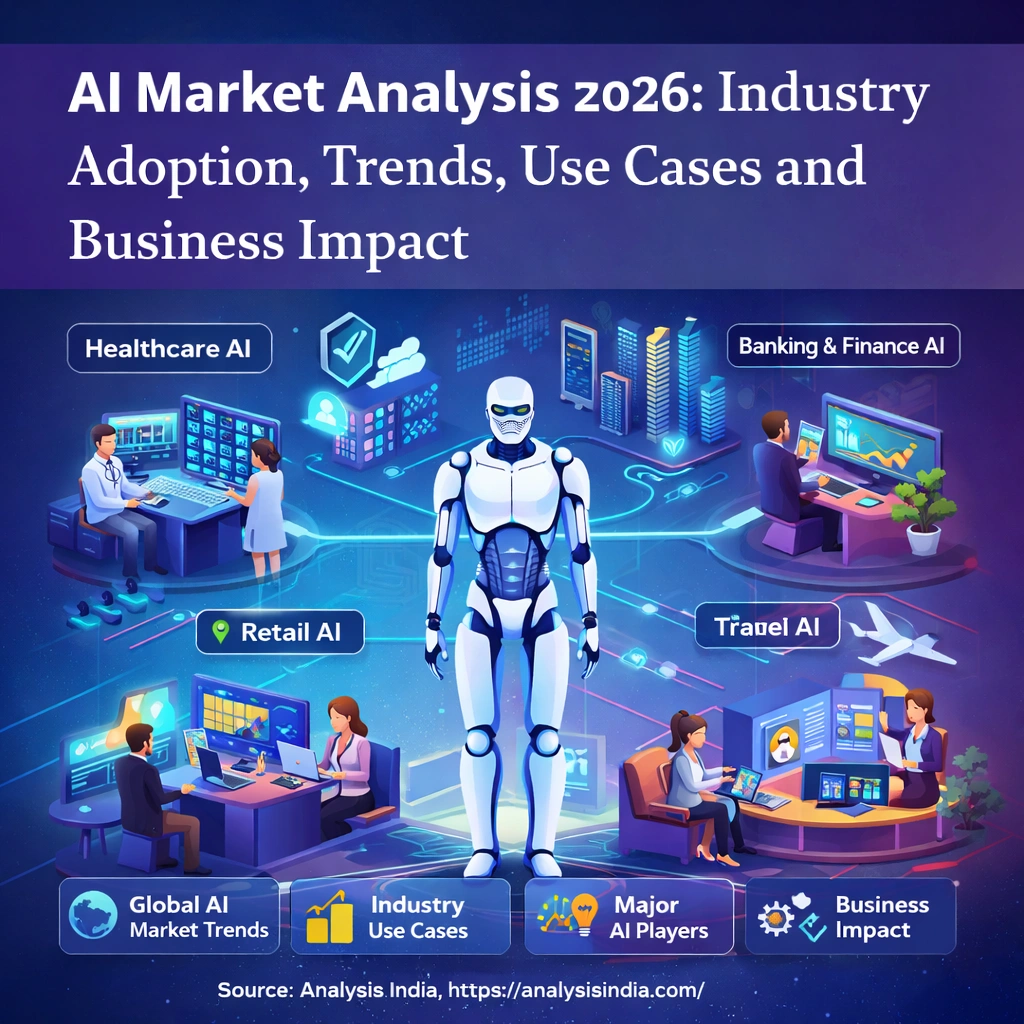
This AI market analysis provides a comprehensive view of industry adoption patterns, evolving trends, practical use cases, and the business impact of artificial intelligence. It also serves as a foundational pillar to connect detailed AI market studies across multiple sectors.
Evolution of the Global AI Market
The global AI market has evolved significantly over the past decade, building on early artificial intelligence fundamentals such as rule-based automation and basic analytics. These early systems delivered limited value due to data constraints and fragmented deployment models.
As digital transformation initiatives expanded, organizations began generating larger volumes of structured and unstructured data. Improvements in computing power and cloud infrastructure enabled more advanced AI models and scalable deployment. This shift accelerated AI adoption beyond niche use cases.
AI market analysis shows that the market has now entered a maturity phase. Enterprises expect AI systems to integrate with existing platforms, deliver consistent performance, and align with governance requirements. The emphasis has shifted from experimentation to reliability, scalability, and enterprise-wide impact.
This evolution has transformed AI from a standalone technology into an embedded layer within business systems, influencing how organizations operate and compete.
Key Drivers Shaping the AI Market
Several interconnected drivers continue to shape AI market growth. One of the most significant drivers is the rapid expansion of digital data across industries. Customer interactions, operational processes, and connected devices generate continuous data streams that support AI-driven insights.
Cloud infrastructure plays a critical role by enabling flexible and scalable AI deployment. Organizations no longer need extensive on-premise infrastructure to run AI workloads. Cloud-based AI platforms reduce complexity and accelerate time-to-value.
AI market analysis also highlights rising customer expectations as a major adoption driver. Customers increasingly expect personalized, responsive, and seamless experiences across channels. AI enables organizations to meet these expectations at scale while maintaining operational efficiency.
Competitive pressure further accelerates adoption. As AI becomes embedded across industries, organizations view AI as a strategic necessity rather than a competitive advantage.
AI Market Adoption Across Industries
AI adoption varies across industries depending on digital maturity, regulatory complexity, and business priorities. Industries with strong digital touchpoints often prioritize customer-facing AI applications. Asset-intensive industries may focus more on operational intelligence and predictive analytics.
AI market analysis reveals a growing convergence in adoption approaches. Rather than deploying isolated AI tools, organizations increasingly pursue integrated AI strategies that span departments and functions. This approach maximizes value and reduces fragmentation.
Industry adoption is also influenced by organizational readiness. Leadership commitment, data governance, and workforce capabilities play critical roles in determining AI success. As a result, AI adoption is as much an organizational challenge as a technological one.
AI in Customer Experience Market
Customer experience is one of the most prominent application areas in AI market analysis. Organizations deploy AI to understand customer behavior, personalize engagement, and improve service consistency across channels.
AI-powered customer experience systems integrate data from websites, mobile apps, contact centers, social platforms, and physical locations. This unified view enables organizations to track customer journeys end-to-end.
AI market analysis shows that customer experience initiatives often serve as the entry point for broader AI adoption. Improvements in engagement and service quality create visible business impact, encouraging further investment in AI capabilities.
As competition intensifies, AI-driven customer experience is becoming a baseline expectation rather than a differentiator.
Predictive and Personalized AI for Customer Engagement
Predictive AI enables organizations to anticipate customer needs by analyzing behavioral patterns, transactional data, and contextual signals. This capability supports proactive engagement strategies rather than reactive service models.
Personalization driven by AI allows organizations to tailor content, offers, and interactions to individual preferences. AI systems continuously refine personalization based on real-time feedback and evolving behavior.
AI market analysis indicates that predictive and personalized engagement improves relevance across marketing, sales, and support functions. These capabilities also support long-term relationship building rather than transactional interactions.
As AI models mature, predictive engagement is becoming more accurate and more deeply integrated into customer experience platforms.
AI in Healthcare Market Analysis
Healthcare is a critical segment within the AI market due to its scale, complexity, and regulatory requirements. Healthcare organizations adopt AI to improve patient engagement, streamline administrative workflows, and support clinical decision-making.
AI applications in healthcare include appointment scheduling, patient communication, care coordination, diagnostics support, and operational analytics. These applications help providers manage increasing demand and resource constraints.
AI market analysis emphasizes the importance of trust and transparency in healthcare adoption. AI systems are designed to augment healthcare professionals rather than replace clinical judgment.
Healthcare AI adoption reflects a cautious but steady approach, balancing innovation with accountability and patient safety.
AI in Banking and Financial Services Market
Banking and financial services are among the most mature AI adopters. Financial institutions deploy AI across customer engagement, fraud detection, risk management, compliance, and operational efficiency.
AI market analysis highlights trust as a central factor in financial AI adoption. Explainable AI models and governance frameworks are critical to ensuring compliance with regulatory standards.
AI-driven insights enable financial institutions to understand customer behavior more deeply, personalize services, and manage risk effectively. These capabilities support both growth and stability within the financial sector.
As digital banking expands, AI continues to shape how financial services are delivered and managed.
AI in Retail Market Trends
Retail AI adoption focuses on responding to changing consumer behavior and delivering seamless omnichannel experiences. Retailers use AI for demand forecasting, inventory optimization, pricing strategies, and personalized marketing.
AI market analysis shows that retailers increasingly integrate AI across supply chains, digital storefronts, and physical stores. This integration improves alignment between supply and demand.
Retail AI strategies emphasize agility and responsiveness. AI enables retailers to adapt quickly to market changes while maintaining consistency across channels.
As consumer expectations evolve, AI becomes central to retail competitiveness.
AI in Travel and Tourism Industry
The travel and tourism industry leverages AI to enhance personalization, optimize operations, and improve customer engagement. AI-driven systems support itinerary planning, dynamic pricing, customer communication, and experience customization.
AI market analysis indicates that travel organizations prioritize AI solutions that improve engagement across the entire customer journey. This includes pre-travel planning, in-trip support, and post-travel interactions.
As digital travel ecosystems expand, AI plays a central role in connecting services, partners, and customers seamlessly.
AI Adoption in Small and Medium Enterprises
Small and medium enterprises represent a growing share of the AI market. Cloud-based AI tools reduce barriers to adoption by lowering costs and complexity.
AI market analysis shows that SMBs focus on practical use cases such as customer engagement, marketing automation, sales analytics, and operational insights.
Ease of implementation and immediate relevance drive adoption decisions. AI adoption enables SMBs to compete more effectively with larger organizations.
Enterprise AI Strategy and Organizational Readiness
Enterprise AI strategy has evolved from experimentation to structured capability building. Organizations align AI initiatives with digital transformation goals and leadership priorities.
AI market analysis highlights the importance of organizational readiness. Data maturity, workforce skills, and change management influence adoption outcomes.
Cross-functional collaboration between technology, business, and operations teams is essential for successful enterprise AI deployment.
Role of Data in the AI Market
Data is the foundation of AI value creation. Organizations invest in data integration, quality management, and governance to support AI initiatives.
AI market analysis shows that fragmented data environments limit AI effectiveness. Unified data platforms enable scalable and accurate AI deployment.
Data privacy and security considerations shape how organizations design and manage AI systems.
Cloud Infrastructure and AI Platforms
Cloud infrastructure underpins modern AI adoption. Cloud based AI platforms provide scalable computing resources, development tools, and integration capabilities.
AI market analysis highlights the growing importance of platform-based AI solutions that support enterprise-wide deployment.
These platforms enable organizations to manage AI consistently across departments while maintaining governance and security. Improvements in computing power and cloud infrastructure enabled more advanced AI models and scalable AI deployment across industries.
Major Players in the Global AI Market
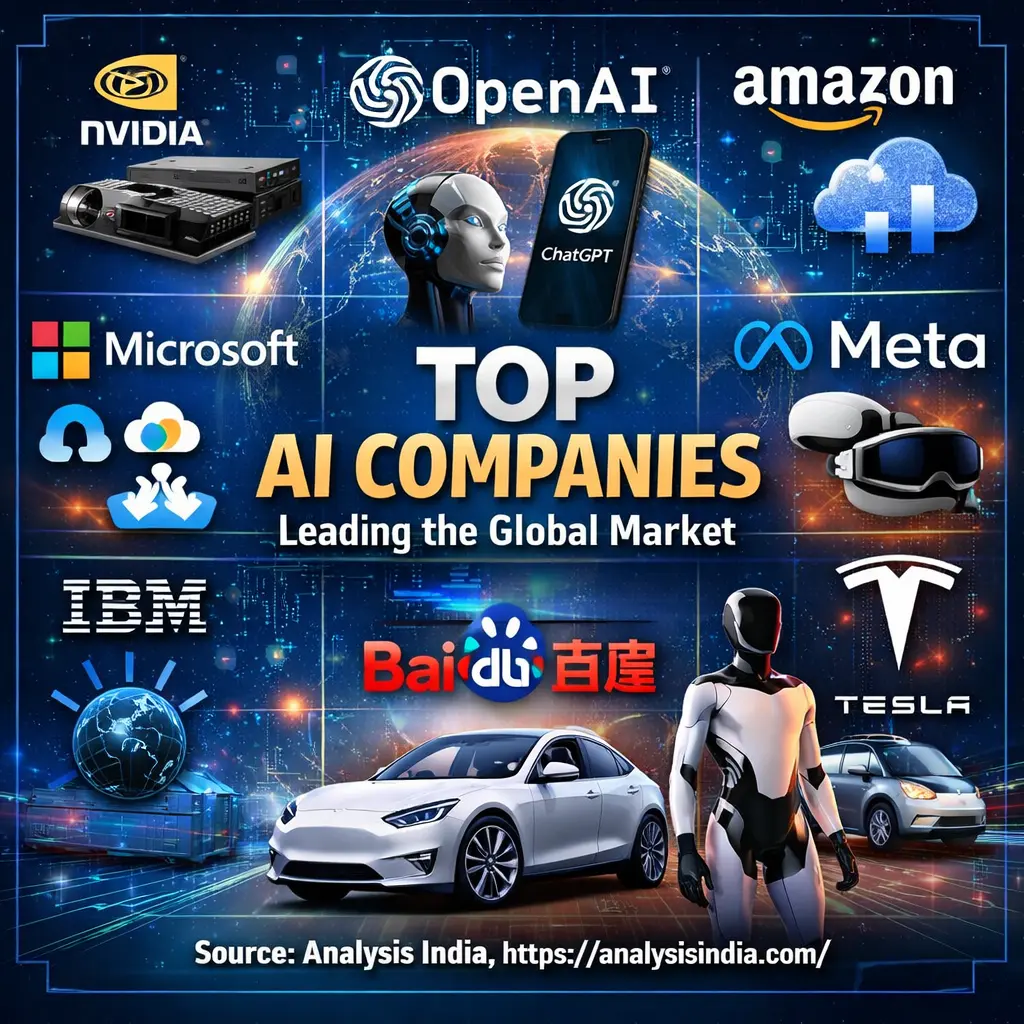
The AI market includes global technology providers, enterprise software companies, and specialized AI vendors. Large providers offer AI platforms, cloud infrastructure, and foundational models.
Enterprise software companies embed AI into business applications, accelerating adoption across industries. Specialized vendors focus on customer experience, healthcare analytics, financial automation, and industry intelligence.
AI market analysis shows increasing collaboration among these players, forming interconnected ecosystems rather than isolated solutions.
Industry Ecosystems and Partnerships
AI adoption is increasingly ecosystem-driven. Organizations collaborate with technology providers, data partners, and industry specialists to accelerate deployment.
AI market analysis highlights interoperability and integration as key ecosystem requirements. Partnerships reduce implementation complexity and support scalable adoption.
Ecosystem participation enables faster innovation and shared value creation.
Regulatory and Governance Considerations
Regulation and governance shape AI adoption across industries. Organizations must address compliance, transparency, and accountability as AI systems influence decisions.
AI market analysis shows that responsible AI frameworks are becoming standard practice. Governance structures define acceptable use, risk management, and oversight.
Balancing innovation with compliance is a key challenge for AI adopters.
Challenges and Constraints in AI Market Adoption
Despite growth, organizations face challenges such as data silos, integration complexity, and talent availability.
AI market analysis highlights organizational resistance and change management as common barriers. Leadership commitment is critical to overcoming these challenges.
Ethical considerations and trust building are essential for sustainable AI adoption.
Business Impact of AI Across Industries
AI business impact extends beyond automation. AI supports strategic planning, innovation, and competitive differentiation.
Organizations use AI insights to identify opportunities, optimize operations, and strengthen customer relationships.
AI market analysis shows that embedding AI into core processes delivers long-term value.
Future Outlook of the AI Market Beyond 2026
The future AI market will focus on deeper integration rather than surface-level adoption. AI will function as an embedded layer within enterprise systems.
Responsible AI, governance, and ecosystem collaboration will shape long-term adoption strategies.
Organizations balancing innovation with accountability will be best positioned for future growth.
Conclusion
AI market analysis 2026 confirms that artificial intelligence has become a foundational component of modern business strategy. Adoption spans healthcare, banking, retail, travel, and small businesses, driven by diverse use cases and operational needs.
As AI technologies mature, organizations must focus on strategic integration, responsible deployment, and long-term value creation. This pillar content serves as a central hub for understanding AI market dynamics and supports internal linking across all AI Market Analysis posts on analysisindia.com.
Frequently Asked Questions (FAQ)
What is AI market analysis?
AI market analysis examines how artificial intelligence is adopted across industries, including key trends, use cases, major players, and business impact. It helps organizations understand where AI is being applied, how it influences operations and decision-making, and how the overall AI market is evolving over time.
Why is AI market analysis important in 2026?
AI market analysis is important in 2026 because artificial intelligence has moved from pilot projects to enterprise-wide adoption. Businesses now rely on AI for customer experience, analytics, automation, and strategic planning, making market-level insights essential for informed decision-making and long-term competitiveness.
Which industries are leading AI adoption?
Industries leading AI adoption include healthcare, banking and financial services, retail, travel and tourism, and enterprise services. These sectors use AI to improve customer engagement, optimize operations, enhance analytics, and deliver more personalized and efficient services across digital and physical channels.
How is AI used in customer experience across industries?
AI is used in customer experience to analyze customer behavior, personalize interactions, automate support processes, and predict customer needs. Organizations deploy AI across websites, mobile apps, contact centers, and physical touchpoints to deliver consistent, relevant, and responsive engagement throughout the customer journey.
Who are the major players in the AI market?
Major players in the AI market include global technology companies, cloud service providers, enterprise software vendors, and specialized AI solution providers. These organizations offer AI platforms, infrastructure, and industry-specific solutions that support adoption across healthcare, finance, retail, travel, and enterprise environments.
What is the future outlook of the AI market beyond 2026?
The future AI market is expected to focus on deeper integration within enterprise systems rather than isolated applications. Responsible AI practices, governance frameworks, and ecosystem partnerships will shape adoption, enabling organizations to embed AI more securely and strategically into long-term business operations.