📅 Published: April 8, 2026
🔄 Last Updated: October 4, 2026
Introduction
The China Liquid Biopsy Cancer Screening Market is rapidly emerging as one of the most influential segments within the global oncology diagnostics landscape. As cancer incidence continues to rise across China, the demand for early detection technologies and non-invasive diagnostic solutions has significantly accelerated. Liquid biopsy, which enables cancer detection through blood samples, is transforming how clinicians approach cancer screening, monitoring, and personalized treatment strategies.
China’s healthcare ecosystem is undergoing a strong transition toward precision medicine. Government support, technological innovation, and increasing healthcare investments are collectively driving the adoption of advanced diagnostic tools such as liquid biopsy. The market is not only expanding in urban centers but is also gradually penetrating tier-2 and tier-3 cities, making cancer diagnostics more accessible.
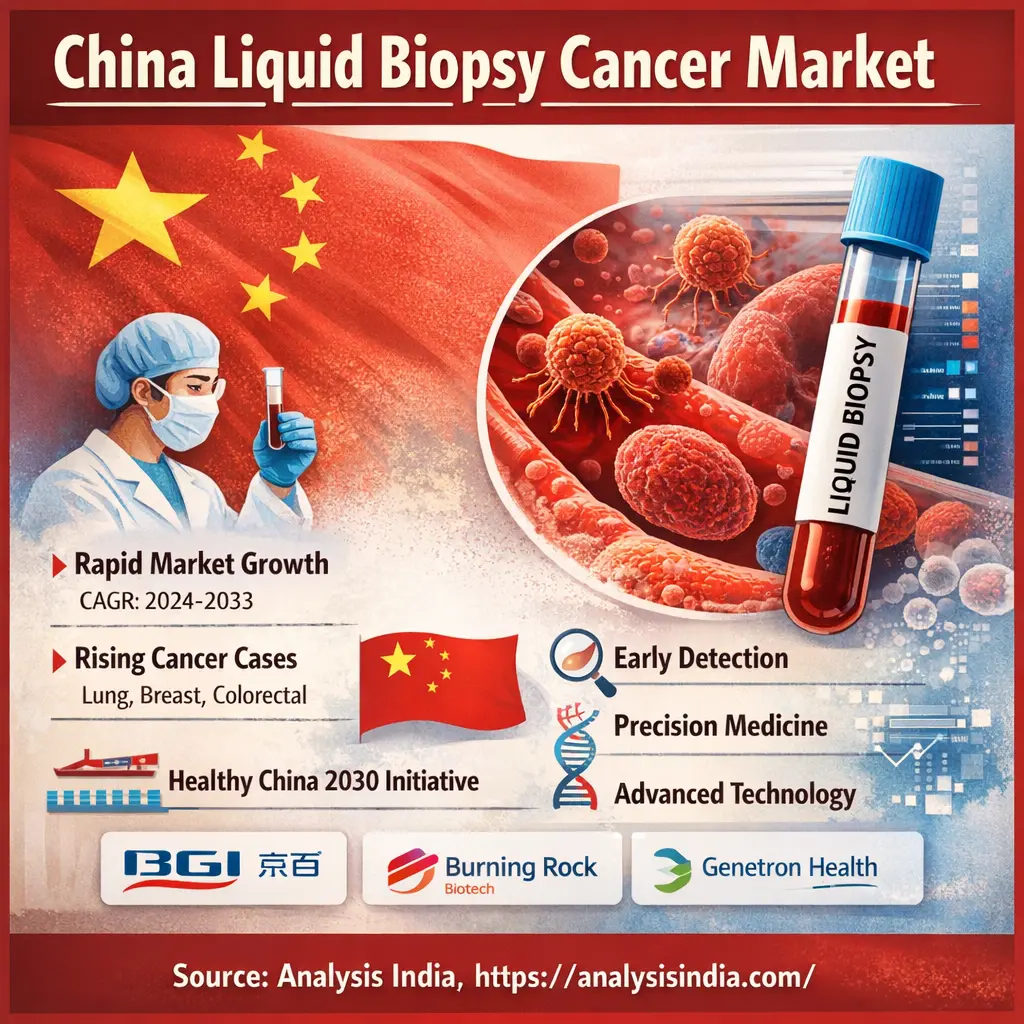
To understand the global context, you can explore the Global Liquid Biopsy Cancer Screening Market and regional insights from the United States Liquid Biopsy Cancer Screening Market, offering a comprehensive deep dive into China’s evolving landscape.
China Liquid Biopsy Cancer Screening Market Size and Forecast
The China Liquid Biopsy Cancer Screening Market is experiencing consistent and strong growth, driven by increasing cancer incidence, advancements in genomic technologies, and supportive government initiatives.
According to industry analysis and data sourced from Frost and Sullivan, the market is projected to expand steadily over the forecast period.
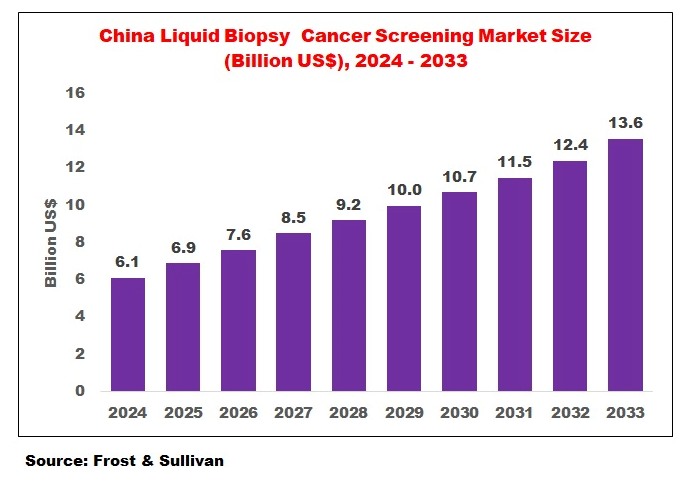
The steady increase in market size highlights the growing adoption of liquid biopsy technologies across China. The market nearly doubles over the forecast period, reflecting strong demand and continuous innovation.
The China Liquid Biopsy Cancer Screening Market demonstrates a clear upward trajectory, with consistent year on year growth. This growth is not driven by a single factor but rather a combination of structural healthcare improvements and technological advancements.
From 2024 to 2033, the market expands significantly, indicating strong penetration of liquid biopsy solutions in clinical practice. The rise from 6.1 billion US dollars in 2024 to 13.6 billion US dollars by 2033 reflects increasing acceptance among healthcare providers and patients.
This growth trend aligns with broader developments discussed in the Cancer Screening Market Growth Trends Insights, where early detection technologies are becoming essential in reducing cancer burden.
Market Dynamics Driving Growth
Rising Cancer Burden in China
The increasing incidence of cancer is one of the primary drivers of the China Liquid Biopsy Cancer Screening Market. Lung cancer remains the most prevalent cancer type in China, followed by colorectal and gastric cancers. The need for early detection solutions is critical, as late-stage diagnoses remain common.
Liquid biopsy provides a non-invasive alternative to traditional tissue biopsy, making it suitable for repeated testing and monitoring. This advantage is particularly valuable in managing chronic and aggressive cancers.
Advancements in Genomic Technologies
China has made significant advancements in genomic sequencing technologies. The decreasing cost of next-generation sequencing (NGS) has enabled broader adoption of liquid biopsy tests.
Domestic companies are developing innovative platforms that are tailored to the Chinese population. These advancements are enhancing the accuracy and reliability of cancer detection.
Government Support and Healthcare Reforms
The Chinese government is actively promoting precision medicine through national initiatives. Investments in biotechnology and healthcare infrastructure are supporting the growth of the China Liquid Biopsy Cancer Screening Market.
The Chinese government has prioritized cancer screening under its “Healthy China 2030” initiative. Subsidies for innovative diagnostics, faster regulatory approvals, and integration of liquid biopsy into national screening programs are accelerating adoption.
Regulatory agencies are also streamlining approval processes for innovative diagnostic tools, encouraging both domestic and international companies to expand their presence in China.
China Liquid Biopsy Cancer Screening Market Segmentation Analysis
By Biomarker Type
The China Liquid Biopsy Cancer Screening Market is segmented by biomarker type into circulating tumor DNA, circulating tumor cells, and exosomes, each playing a distinct role in cancer detection and monitoring. Circulating tumor DNA has emerged as the most widely adopted biomarker due to its high sensitivity in detecting genetic mutations associated with cancer. This technology allows clinicians to identify tumor specific alterations without the need for invasive tissue sampling, making it particularly useful for early detection and treatment monitoring.
Circulating tumor cells also contribute significantly to the market by providing insights into cancer metastasis and disease progression. These cells help in understanding tumor biology and are often used in advanced research and clinical applications. Exosomes, on the other hand, are gaining attention for their ability to carry molecular information such as RNA and proteins, offering additional opportunities for non invasive diagnostics.
The increasing focus on biomarker innovation is closely aligned with broader developments highlighted in the cancer screening market growth trends insights, where advanced molecular diagnostics are reshaping early detection strategies.
By Application
In terms of application, the China Liquid Biopsy Cancer Screening Market is categorized into early cancer detection, treatment monitoring, and recurrence detection. Early detection represents a significant share of the market as healthcare providers prioritize identifying cancer at its initial stages. Liquid biopsy enables detection even before clinical symptoms appear, improving survival outcomes and reducing treatment complexity.
Treatment monitoring is another critical application, allowing clinicians to track how patients respond to therapies in real time. This capability supports personalized treatment adjustments and enhances the effectiveness of targeted therapies. Recurrence detection is also gaining importance, as liquid biopsy provides a reliable method to identify cancer relapse without repeated invasive procedures.
These applications demonstrate how liquid biopsy is becoming an integral component of modern oncology workflows, supporting continuous patient management and improved clinical outcomes.
By Cancer Type
The segmentation by cancer type within the China Liquid Biopsy Cancer Screening Market includes lung cancer, breast cancer, colorectal cancer, and liver cancer. Lung cancer dominates this segment due to its high incidence in China and the urgent need for early detection solutions. Liquid biopsy plays a vital role in identifying genetic mutations associated with lung cancer, enabling targeted therapy selection.
Breast cancer and colorectal cancer are also significant contributors to market demand, with increasing awareness and screening programs driving adoption. Liver cancer, which is prevalent in China due to factors such as hepatitis infections, further strengthens the demand for non invasive diagnostic tools.
The diversity of cancer types addressed by liquid biopsy highlights its versatility and importance in comprehensive cancer management.
Competitive Landscape
The China Liquid Biopsy Cancer Screening Market is characterized by intense competition among domestic and international players. Chinese biotechnology companies are actively developing innovative solutions tailored to local patient populations, leveraging their understanding of regional healthcare needs. These companies are focusing on affordability and scalability, making liquid biopsy more accessible across different regions.
At the same time, global companies are entering the Chinese market through partnerships and collaborations, bringing advanced technologies and expertise. This competitive environment is fostering innovation and driving continuous improvements in diagnostic accuracy and efficiency.
Regional Insights
Regional analysis of the China Liquid Biopsy Cancer Screening Market reveals strong adoption in tier one cities such as Beijing, Shanghai, and Shenzhen, where healthcare infrastructure is highly advanced. These cities serve as hubs for research and innovation, supporting the rapid deployment of new diagnostic technologies.
However, the market is gradually expanding into tier two and tier three cities, driven by government initiatives and increasing awareness about cancer screening. This expansion is critical for improving healthcare access and addressing disparities between urban and rural regions.
Insights from the China cancer screening market analysis further emphasize the growing integration of advanced diagnostics into nationwide screening programs.
Comparison with Other Regional Markets
China’s market differs significantly from other regions in terms of scale, regulatory environment, and competitive dynamics.
For comparison, explore related cluster articles:
United States Cancer Screening Market 2033
Japan Cancer Screening Market 2033 Growth
South East Asia Cancer Screening Market 2033
These comparisons highlight China’s unique position as both a high-demand and high-innovation market.
Integration with Cancer Screening Ecosystem
The China Liquid Biopsy Cancer Screening Market is becoming an essential part of the broader cancer screening ecosystem. Liquid biopsy complements traditional screening methods by providing additional molecular insights that enhance diagnostic accuracy. This integration supports earlier detection and more effective treatment planning.
Comparative perspectives from the Japan cancer screening market growth analysis and the South East Asia cancer screening market trends highlight how regional markets are adopting similar approaches, reinforcing the global shift toward advanced diagnostics.
Challenges in the China Liquid Biopsy Cancer Screening Market
The China Liquid Biopsy Cancer Screening Market faces several challenges that could impact its growth trajectory. One of the primary challenges is the cost of advanced diagnostic technologies, which can limit adoption in less developed regions. Although prices are gradually decreasing, affordability remains a key concern.
Regulatory complexity is another challenge, as companies must navigate evolving approval processes to bring new products to market. Additionally, the lack of standardized protocols for liquid biopsy testing can lead to variability in results, affecting clinical confidence and adoption.
Future Opportunities
The China Liquid Biopsy Cancer Screening Market presents significant opportunities for growth and innovation. One of the most promising areas is the development of multi cancer early detection tests, which can identify multiple cancer types from a single blood sample. This advancement has the potential to transform screening programs and improve early detection rates across the population.
Another important opportunity lies in the integration of artificial intelligence with liquid biopsy technologies. AI driven analytics can enhance data interpretation, improve diagnostic accuracy, and support personalized treatment strategies. This combination of technologies is expected to play a crucial role in the future of oncology.
Increasing healthcare investments and government support will continue to drive market expansion, enabling broader access to advanced diagnostics. Public awareness campaigns are also contributing to higher adoption rates, as more individuals recognize the importance of early cancer detection.
As outlined in the global liquid biopsy cancer screening market report, China’s growing role in innovation and adoption is expected to influence global trends and shape the future of cancer diagnostics.
Conclusion
The China Liquid Biopsy Cancer Screening Market is set to achieve strong growth through 2033, supported by technological advancements, increasing healthcare investments, and rising demand for early detection. The market’s expansion reflects a broader shift toward precision medicine and non invasive diagnostics.
With a projected market size of 13.6 billion US dollars by 2033, China is poised to become a leader in liquid biopsy innovation. This growth not only improves patient outcomes but also strengthens the global oncology diagnostics ecosystem.
Frequently Asked Questions
What is the China Liquid Biopsy Cancer Screening Market size in 2033?
The market is projected to reach 13.6 billion US dollars by 2033.
What drives the China Liquid Biopsy Cancer Screening Market?
Key drivers include rising cancer incidence, technological advancements, and government support.
Which segment dominates the market?
Circulating tumor DNA based tests dominate due to high accuracy and adoption.
What is the future outlook?
The market is expected to grow steadily with increasing integration of precision medicine and advanced diagnostics.