📅 Published: June 9, 2026
🔄 Last Updated: June 9, 2026
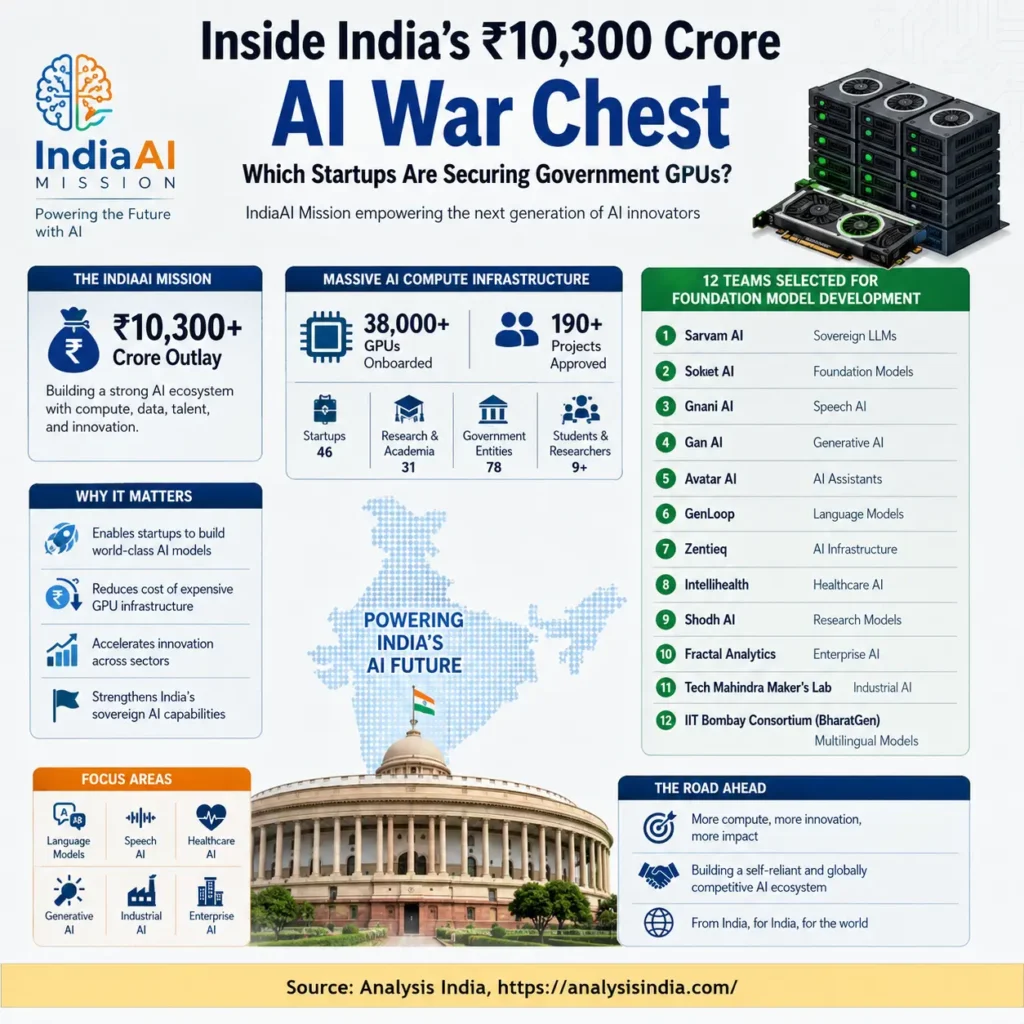
India’s artificial intelligence ecosystem has entered a transformative phase with the launch and expansion of the IndiaAI Mission, a government-backed initiative valued at more than ₹10,300 crore. As nations across the world compete to build sovereign artificial intelligence capabilities, India is taking a strategic approach by investing in AI infrastructure, compute resources, datasets, and foundational model development. The latest development under the IndiaAI Mission has attracted significant attention from the technology sector after the government revealed a list of startups and organizations selected to receive access to government-funded AI compute resources.
The announcement represents one of the most important milestones in India’s AI journey. Building advanced artificial intelligence models requires enormous computing power, often costing millions of dollars in GPU infrastructure. For many startups, access to high-performance GPUs remains one of the biggest barriers to innovation. Through the IndiaAI Mission, the government aims to bridge this gap by providing subsidized compute infrastructure that enables startups, researchers, and academic institutions to train and deploy large-scale AI models.
The selected startups are expected to play a critical role in developing India’s next generation of language models, speech AI systems, healthcare AI applications, and enterprise AI solutions. Their success could determine how quickly India can establish itself as a global AI powerhouse while reducing dependence on foreign AI platforms.
Understanding the IndiaAI Mission
The IndiaAI Mission was launched to create a comprehensive AI ecosystem that supports innovation, research, entrepreneurship, and infrastructure development. Unlike conventional funding programs, the mission focuses on creating foundational resources that can be shared across startups, research institutions, and public organizations.
Artificial intelligence development requires access to three major resources: high-quality datasets, advanced computing infrastructure, and skilled talent. While India possesses a large talent pool and growing startup ecosystem, access to affordable AI compute has historically been limited. Most organizations rely on expensive cloud infrastructure offered by global providers, making large-scale model development financially challenging.
The IndiaAI Mission addresses this challenge by creating a national AI compute infrastructure supported by thousands of GPUs. This initiative is expected to reduce costs for startups and accelerate innovation across multiple sectors including healthcare, finance, manufacturing, education, agriculture, and public services.
The government’s long-term vision extends beyond supporting individual companies. The objective is to build sovereign AI capabilities that reflect India’s linguistic diversity, cultural context, and economic priorities. This includes supporting the development of large language models trained on Indian languages and datasets.
Readers interested in the broader AI industry transformation can also explore our analysis on Top 10 AI Companies Leading the Global AI Market, which highlights how major AI firms are shaping the future of artificial intelligence worldwide.
Why GPU Infrastructure Matters in Artificial Intelligence
GPU infrastructure has become the backbone of modern artificial intelligence. Training advanced language models, multimodal systems, and generative AI applications requires massive parallel processing capabilities that traditional CPUs cannot provide efficiently.
Over the past few years, the demand for GPUs has surged due to the rapid growth of generative AI technologies. Companies developing large language models often require thousands of GPUs operating continuously for weeks or months. This has created a global shortage of AI compute resources and significantly increased infrastructure costs.
For startups, these expenses can be prohibitive. Many promising AI companies possess strong technical expertise but lack the financial resources needed to access large-scale computing infrastructure. Government-funded AI compute under the IndiaAI Mission aims to solve this challenge by democratizing access to advanced AI infrastructure.
The initiative effectively allows startups to focus on innovation rather than infrastructure procurement. This approach mirrors successful national AI strategies implemented by several leading economies seeking to strengthen domestic AI ecosystems.
The growing demand for advanced AI infrastructure is part of a much larger transformation taking place across global industries. Organizations worldwide are increasing investments in artificial intelligence to improve productivity, automate operations, and develop innovative digital products. Our comprehensive AI Market Analysis 2026 highlights the latest adoption trends, industry growth forecasts, and the key sectors driving the next phase of AI expansion. The findings demonstrate why government-backed initiatives such as the IndiaAI Mission are becoming increasingly important for fostering domestic innovation and supporting emerging AI startups.
GPU Expansion Under the IndiaAI Mission
One of the most significant achievements of the IndiaAI Mission has been the rapid expansion of AI compute capacity. The government initially announced plans to build a large GPU infrastructure network. Since then, the available compute resources have expanded substantially through partnerships with infrastructure providers and technology organizations.
IndiaAI Compute Infrastructure Overview
| Component | Details |
|---|---|
| Total Mission Value | ₹10,300+ Crore |
| AI Compute Initiative | National GPU Infrastructure |
| Primary Objective | Affordable AI Compute Access |
| Target Users | Startups, Researchers, Academia |
| Focus Areas | Foundation Models, AI Applications |
| Strategic Goal | Sovereign AI Development |
The scale of this infrastructure initiative demonstrates India’s commitment to becoming a global AI innovation hub. By lowering entry barriers for startups, the government is creating conditions that encourage experimentation and model development across diverse sectors.
Startups Selected for Government-Funded AI Compute
The IndiaAI Mission has identified a group of startups and organizations that will receive support for developing advanced AI systems. These entities represent a broad spectrum of AI applications ranging from language models to healthcare solutions.
Selected Organizations Under IndiaAI Mission
| Startup/Organization | AI Focus Area |
| Sarvam AI | Sovereign Large Language Models |
| Soket AI | Foundational AI Models |
| Gnani AI | Speech and Voice AI |
| Gan AI | Generative AI Applications |
| Avatar AI | AI Assistants |
| GenLoop | Language Model Development |
| Zentieq | AI Infrastructure Solutions |
| Intellihealth | Healthcare AI |
| Shodh AI | Research-Oriented AI Models |
| Fractal Analytics | Enterprise AI |
| Tech Mahindra Maker’s Lab | Industrial AI Applications |
| BharatGen Consortium (IIT Bombay) | Multilingual Foundation Models |
These organizations have been selected because of their potential to contribute to India’s AI ecosystem and support the nation’s broader objective of technological self-reliance.
Sarvam AI and India’s Sovereign AI Ambitions
Among the selected organizations, Sarvam AI has emerged as one of the most closely watched participants. The company has positioned itself at the center of India’s efforts to develop indigenous large language models capable of serving diverse linguistic communities.
India’s multilingual environment presents unique challenges for AI development. While many global models perform exceptionally well in English, support for Indian languages remains limited. Sarvam AI aims to address this gap by developing AI systems optimized for India’s linguistic and cultural landscape.
The availability of government-funded GPU compute significantly enhances the company’s ability to train advanced models. Large-scale language model development requires extensive computational resources, making access to subsidized infrastructure a major competitive advantage.
The rise of indigenous AI companies supported by the IndiaAI Mission reflects a broader global movement toward sovereign artificial intelligence development. While Indian startups focus on building AI systems tailored for local languages and markets, major international players continue to shape the global AI ecosystem through significant investments in infrastructure and research. Readers seeking a deeper understanding of the competitive landscape can explore our analysis of the Top AI Companies Leading the Global AI Market, which examines the organizations influencing the future direction of artificial intelligence worldwide.
BharatGen and Multilingual AI Development
The BharatGen initiative, led by IIT Bombay and associated partners, represents another critical component of India’s AI strategy. Unlike commercial AI ventures focused primarily on market opportunities, BharatGen seeks to create foundational AI technologies that support multiple Indian languages and use cases.
India is home to hundreds of languages and dialects, creating one of the most complex linguistic environments in the world. Developing AI systems that can effectively understand and generate content across these languages requires specialized training datasets and substantial computational resources.
Government-supported AI compute enables BharatGen to accelerate model training and improve language coverage, potentially creating one of the most comprehensive multilingual AI ecosystems globally.
AI Startups Driving Sector-Specific Innovation
The selected startups collectively represent a diverse range of industries and applications. Healthcare AI, speech technology, enterprise automation, and industrial AI are all receiving support through the IndiaAI Mission.
Healthcare-focused companies such as Intellihealth are leveraging artificial intelligence to improve diagnostics, patient monitoring, and clinical decision-making. The healthcare sector presents enormous opportunities for AI adoption due to increasing demand for efficient and scalable solutions.
Speech AI innovators such as Gnani AI are addressing challenges related to voice recognition, multilingual communication, and conversational AI. These technologies are particularly important in a country where millions of people prefer interacting in regional languages.
Enterprise AI firms including Fractal Analytics are helping businesses deploy artificial intelligence for operational efficiency, predictive analytics, and decision support systems. Their participation demonstrates how the IndiaAI Mission supports both foundational research and practical commercial applications.
Several startups selected under the IndiaAI Mission are focused on industrial automation, enterprise intelligence, and manufacturing applications. These innovations are expected to accelerate the adoption of AI-driven operational technologies across factories and production facilities. Similar advancements are already transforming manufacturing environments through predictive maintenance, intelligent quality control, and autonomous decision-making systems. Our detailed post on AI Driven Smart Factories explores how artificial intelligence is reshaping modern manufacturing and creating more efficient industrial ecosystems.
Funding Analysis and Strategic Impact
Although government-funded AI compute differs from direct financial grants, the economic value of GPU access can be substantial. Training advanced AI models often involves infrastructure expenses running into crores of rupees.
By subsidizing compute resources, the IndiaAI Mission effectively provides indirect funding that allows startups to allocate more capital toward research, product development, hiring, and market expansion.
Strategic Benefits for Selected Startups
| Benefit Area | Expected Impact |
| GPU Access | Reduced Infrastructure Costs |
| Faster Model Training | Accelerated Innovation |
| Research Expansion | More Experiments and Iterations |
| Product Development | Faster Commercialization |
| Competitive Positioning | Improved Market Readiness |
| Talent Attraction | Stronger Research Teams |
The economic implications extend beyond individual startups. Successful AI companies create jobs, attract investment, generate intellectual property, and contribute to national competitiveness.
Building India’s AI Infrastructure Ecosystem
The IndiaAI Mission is not solely about startups. It is part of a larger effort to create a sustainable AI infrastructure ecosystem capable of supporting long-term innovation.
Historically, much of the world’s AI infrastructure has been concentrated in a few countries and technology giants. India’s strategy focuses on ensuring domestic organizations have access to the resources necessary for independent AI development.
This includes investments in compute infrastructure, data repositories, research programs, and startup incubation. Together, these initiatives create a foundation that supports innovation across academia, industry, and government.
For readers interested in how AI is transforming industrial operations, our detailed report on AI Driven Smart Factories: The Future of Global Manufacturing in 2026 explores how intelligent automation is reshaping manufacturing worldwide.
How Government GPUs Could Change the Competitive Landscape
Access to affordable AI compute has become one of the most important competitive differentiators in the global AI industry. Organizations with superior infrastructure can train larger models, conduct more experiments, and bring products to market faster.
The IndiaAI Mission seeks to level the playing field by ensuring promising startups are not constrained by infrastructure limitations. This approach has the potential to create a more dynamic and competitive AI ecosystem where innovation is driven by ideas rather than access to capital.
As more startups gain access to government-funded compute resources, India may witness a surge in indigenous AI products designed specifically for domestic and emerging market needs.
Challenges Facing India’s AI Startups
Despite the opportunities created by the IndiaAI Mission, several challenges remain. Competition from global AI companies continues to intensify. Talent acquisition remains difficult as demand for AI researchers and engineers exceeds supply.
Data quality and availability also remain important considerations. Successful AI development requires not only computing power but also access to high-quality datasets that accurately represent real-world conditions.
Furthermore, startups must balance research ambitions with commercial viability. Building advanced AI models is only one part of the journey; creating sustainable business models and achieving market adoption are equally important.
The Future of the IndiaAI Mission
The availability of affordable AI compute infrastructure will likely encourage innovation across multiple sectors beyond enterprise software and foundational models. Industries including tourism, transportation, hospitality, and customer service are increasingly leveraging artificial intelligence to improve personalization and operational efficiency. As startups gain access to government-supported GPU resources, more industry-specific AI applications are expected to emerge. Our analysis of AI in Travel Customer Experience 2026 highlights how intelligent technologies are transforming customer engagement and redefining user experiences across the travel sector.
The selection of 12 startups marks the beginning rather than the conclusion of India’s AI infrastructure initiative. As compute capacity expands and additional organizations gain access to resources, the ecosystem is expected to grow significantly.
Future developments may include expanded GPU infrastructure, additional startup cohorts, enhanced dataset repositories, and deeper collaboration between industry and academia. Together, these efforts could establish India as one of the world’s leading AI innovation centers.
The success of the IndiaAI Mission will ultimately be measured by its ability to create globally competitive AI companies, accelerate research breakthroughs, and deliver meaningful societal impact.
The IndiaAI Mission is part of a broader global effort to strengthen national AI capabilities through investments in infrastructure, research, and talent development. According to the official IndiaAI platform, the initiative focuses on creating a comprehensive ecosystem that supports foundational model development, AI innovation, and accessible compute resources for startups and researchers. Readers interested in tracking official announcements, policy updates, and future AI programs can visit the IndiaAI Mission portal, which serves as the primary source for government-led artificial intelligence initiatives in India.
Why the IndiaAI Mission Matters for India’s Digital Future
The IndiaAI Mission represents a strategic investment in the country’s technological future. By providing government-funded AI compute to selected startups, the initiative addresses one of the most significant barriers facing AI innovators today.
The selected organizations span diverse industries and technologies, reflecting the broad potential of artificial intelligence across the economy. Their progress will be closely watched by investors, policymakers, researchers, and technology leaders.
As AI becomes increasingly central to economic growth and global competitiveness, initiatives like the IndiaAI Mission could play a defining role in shaping India’s position within the international technology landscape. Through strategic infrastructure investments, startup support, and a focus on sovereign AI development, India is laying the foundation for the next generation of AI innovation.