Introduction: The Rise of Artificial Intelligence in Small Businesses
The rapid rise of AI adoption in Indian SMBs mirrors broader AI market adoption trends in 2025, where enterprises globally integrate intelligent systems to boost efficiency and competitiveness. Artificial intelligence is no longer seen as a futuristic concept but as a practical tool that drives efficiency, innovation, and customer engagement. Research from LinkedIn shows that by 2025 almost all Indian SMBs are either investing in or planning to adopt AI solutions. This remarkable shift highlights how AI has become a necessity for survival and success in today’s competitive market.
For India’s small businesses, which contribute significantly to the national economy, embracing AI is opening new opportunities. From automating supply chains to personalizing marketing campaigns, AI adoption in Indian SMBs is creating a foundation for sustainable growth and digital transformation.
Confidence in AI Adoption Among Indian SMBs
The confidence of business leaders in AI adoption in Indian SMBs is striking. A LinkedIn study reveals that more than nine out of ten SMB leaders expect growth in the coming year. This optimism is rooted in the belief that AI enhances operational efficiency, protects profit margins, and accelerates digital transformation.
Take the example of Lenskart, a leading eyewear retailer based in Mumbai. The company uses AI‑powered inventory management systems that reduce overstock and stockouts. This not only improves customer satisfaction but also boosts revenue growth. With more than half of SMBs viewing AI and automation as essential to compete, the urgency for adoption is clear.
Tier Two Cities Driving AI Adoption in Indian SMBs
AI adoption in Indian SMBs is not limited to metropolitan centers. Smaller tier two cities such as Chandigarh, Jaipur, and Ahmedabad are emerging as leaders in this transformation. Chandigarh reports complete adoption of AI among SMBs, while Jaipur and Ahmedabad show readiness levels above ninety percent.
A fintech startup in Jaipur called Cashfree uses AI‑driven chatbots to provide seamless customer service. This has helped the company expand its user base quickly and efficiently. These examples demonstrate how tier two cities are becoming hubs of technological innovation, supported by affordable cloud solutions and government initiatives.
AI Adoption in Marketing and Sales
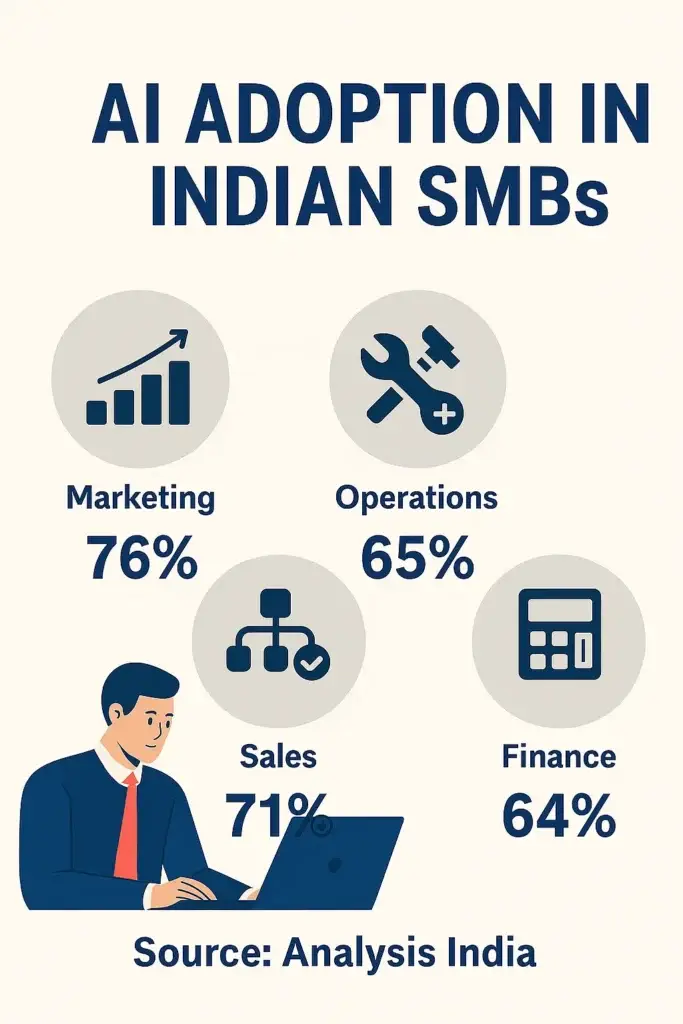
Marketing and sales functions are among the most visible areas of AI adoption in Indian SMBs. Research shows that most small businesses now use AI marketing tools to run targeted campaigns. These tools allow companies to analyze customer behavior, personalize promotions, and improve engagement.
Nykaa, a global cosmetics brand with strong presence in tier two cities, applies AI analytics to customize promotions. This approach has strengthened customer loyalty and increased sales. In the sales domain, Bengaluru‑based IT firm Freshworks employs AI‑driven forecasting tools to improve conversion rates. Reports suggest improvements of up to thirty percent, showing how AI adoption in Indian SMBs is reshaping customer acquisition strategies.
Operational Efficiency Through AI Adoption in Indian SMBs
Operational efficiency is another area where AI adoption in Indian SMBs is making a significant impact. Businesses are using AI for supply chain optimization, predictive analytics, and automation of routine tasks.
Sula Vineyards, a food and beverage manufacturer in Pune, applies AI‑powered predictive maintenance to reduce machine downtime and operational costs. Many SMBs also rely on AI chatbots to handle customer queries. This allows employees to focus on complex tasks, improving service quality and reducing workload. The adoption of AI in operations is helping small businesses achieve efficiency levels that were once possible only for large corporations.
Digital Transformation as a Survival Strategy
Digital transformation has become critical for more than half of Indian SMBs. AI adoption in Indian SMBs is central to this transformation, enabling businesses to build resilient and innovative models.
Full Circle Books, a bookstore chain in Delhi, integrated AI‑powered e‑commerce and digital payment platforms during the pandemic. This move resulted in a forty percent boost in sales. The example shows how SMBs are embracing digital tools to survive and thrive in challenging times. AI adoption in Indian SMBs is not just about efficiency but about creating new opportunities for growth and resilience.
AI Adoption Across Diverse Sectors
AI adoption in Indian SMBs is diverse and spans multiple sectors. In healthcare, diagnostic firms in Nagpur use AI for faster and more accurate testing. In retail, jewellers in Surat employ AI to forecast demand trends and manage inventory more effectively. Textile manufacturers in Coimbatore apply AI to detect fabric defects, improving quality control and reducing waste.
These examples highlight how AI adoption in Indian SMBs is not confined to one industry. From healthcare to manufacturing, businesses are finding innovative ways to apply AI for better outcomes.
Talent and Skills: The Human Side of AI Adoption in Indian SMBs
Technology alone is not enough. AI adoption in Indian SMBs requires skilled talent to implement and manage solutions. Jaipur’s digital education programs are supplying trained professionals to local businesses. Companies such as Aarohi Digital, which specializes in AI‑powered marketing, benefit from this talent pool.
Investing in talent is as important as investing in technology. Without skilled professionals, SMBs cannot fully leverage the potential of AI. The human side of AI adoption in Indian SMBs ensures that technology is applied effectively and responsibly.
Challenges in AI Adoption in Indian SMBs
Despite enthusiasm, AI adoption in Indian SMBs faces challenges. High costs, lack of awareness, and cybersecurity concerns are common barriers. Many small businesses struggle to afford advanced AI solutions.
Government initiatives are helping to overcome these challenges. The Meghraj cloud platform provides affordable AI services to SMBs. This reduces cost barriers and makes technology accessible to smaller firms. Awareness campaigns and training programs are also addressing knowledge gaps.
Government and Policy Support for AI Adoption in Indian SMBs
Government support plays a crucial role in AI adoption in Indian SMBs. Initiatives such as Digital India and Startup India provide funding, infrastructure, and training. These programs are particularly focused on tier two cities, where digital inclusion is expanding rapidly.
High‑speed internet and cloud service availability are being extended to smaller cities. This ensures that SMBs across India can access the tools they need for digital transformation. Policy support is creating an environment where AI adoption in Indian SMBs can flourish.
Future Outlook: AI Adoption in Indian SMBs as the Backbone of Growth
The future of AI adoption in Indian SMBs looks promising. Emerging technologies such as blockchain, internet of things, and 5G are combining with AI to create powerful solutions. Some SMBs already use AI‑powered IoT devices for real‑time tracking and blockchain for transparent supply chains.
These innovations position Indian SMBs for global competition. AI adoption in Indian SMBs will continue to fuel growth, efficiency, and innovation. The next decade is set to be one of confident expansion driven by technology.
Conclusion: A Confident Decade Ahead
Looking ahead, the future of AI adoption across industries will continue shaping how Indian SMBs innovate, compete, and deliver value at scale in 2026 and beyond. With nine out of ten SMBs betting on AI, the growth phase ahead looks strong. Real gains in marketing, operations, and customer engagement demonstrate AI’s role in success. Tier two cities are leading innovation, proving that growth is no longer limited to metro centers.
AI adoption in Indian SMBs has become a strategic imperative. It is not just a tool but the backbone of future growth. As businesses continue to embrace AI, India’s economy will benefit from stronger, more resilient, and more innovative small businesses.