
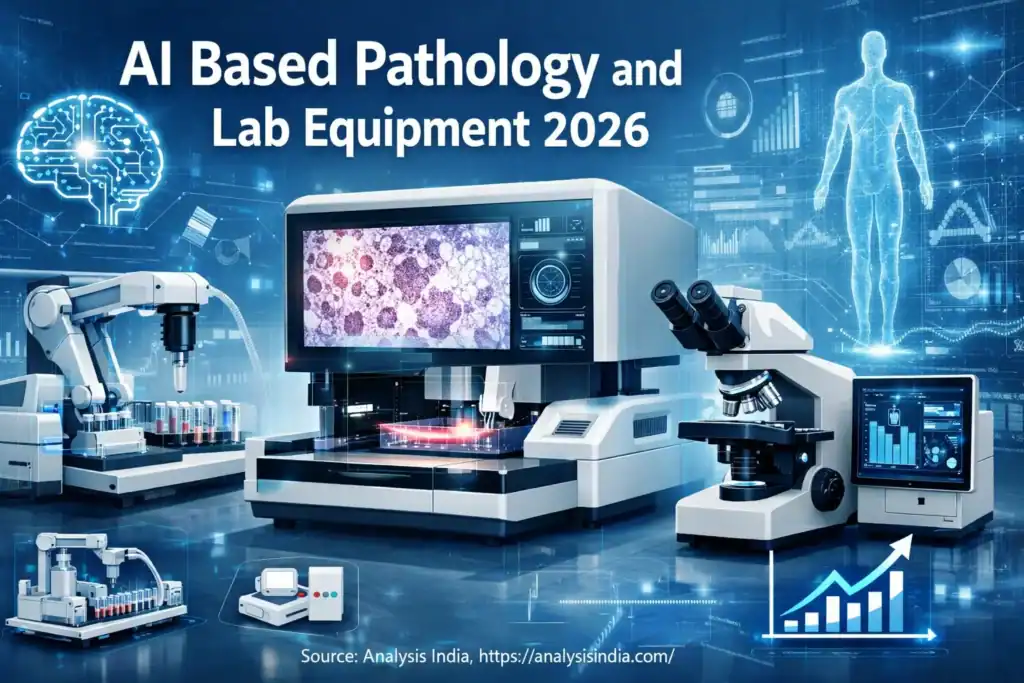
Analysis India: AI Based Pathology and Lab Equipment are becoming a defining force in modern healthcare in 2026 as laboratories focus on improving diagnostic speed, accuracy, and operational efficiency. These advanced systems use artificial intelligence to analyse blood, tissue, and cellular samples with high precision. Automated microscopes, digital pathology scanners, and smart lab analysers now support pathologists in detecting disease patterns more consistently than traditional manual methods. Hospitals and diagnostic centres increasingly rely on AI Based Pathology and Lab Equipment to manage rising test volumes while maintaining strict quality standards. Stronger IT infrastructure and digital health integration have made it easier to deploy these systems across healthcare networks. Together, these changes are reshaping how pathology services deliver timely, reliable, and scalable diagnostic results.
Pathology laboratories process millions of samples every year, and the workload continues to grow as populations age and chronic diseases become more common. Traditional manual examination methods are time consuming and can be affected by human fatigue, which increases the risk of errors in complex cases. AI powered tools now support image interpretation, sample classification, and structured report generation. These systems help reduce turnaround times and improve diagnostic confidence for clinicians. By standardising many routine processes, AI Based Pathology and Lab Equipment allow pathologists to focus on difficult or high risk cases. As healthcare systems continue to modernise, these technologies are becoming essential components of laboratory operations worldwide.
Rising Demand for AI Based Pathology and Lab Equipment
Healthcare systems face growing pressure to deliver faster and more accurate diagnostics due to ageing populations and the rising burden of chronic diseases. Diagnostic departments must handle larger sample volumes without compromising quality or patient safety. AI Based Pathology and Lab Equipment help automate routine laboratory processes such as slide scanning, image analysis, and data interpretation. This automation allows laboratories to process more samples in less time while maintaining consistent accuracy. As a result, hospitals can improve efficiency without expanding staff numbers.
Hospitals are also focused on reducing diagnostic errors in complex conditions such as cancer, infectious diseases, and blood disorders. AI algorithms can detect subtle visual patterns in tissue samples that may be difficult to identify through manual review alone. Improved internet connectivity, cloud storage, and digital imaging systems have further accelerated the adoption of digital pathology solutions. These technological improvements make it easier for laboratories to store, analyse, and share large volumes of diagnostic data. Because of these combined factors, AI Based Pathology and Lab Equipment are now becoming standard tools in many modern laboratories.
Market data confirms this rising demand. According to Grand View Research, the global digital pathology market reached USD 1.1 billion in 2024 and continues to expand as more healthcare providers adopt AI supported diagnostic tools. This growth reflects increasing confidence in AI systems and their ability to support clinical decision making. The expanding market also shows that laboratories view AI Based Pathology and Lab Equipment as long term investments rather than short term upgrades.
Digital Pathology Market Snapshot
| Segment | Year | Market Value | Source |
|---|---|---|---|
| Digital Pathology | 2024 | USD 1.1 Billion | Grand View Research |
Global Investment and Market Expansion
Investment in AI Based Pathology and Lab Equipment is rising steadily as healthcare systems move toward automated and data driven diagnostics. Medical technology companies are increasing their spending on AI research for pathology and laboratory systems. Governments and public health organisations are also supporting digital health infrastructure to improve healthcare efficiency and accessibility. These combined efforts are creating a strong foundation for large scale AI adoption in diagnostic services.
North America and Europe currently lead in AI based pathology adoption because of advanced healthcare systems and strong regulatory frameworks. However, Asia Pacific markets are expanding rapidly as hospital networks grow and diagnostic capacity increases. AI powered pathology tools are now being used not only in hospitals, but also in diagnostic laboratories, research centres, and academic institutions. This widespread use highlights the growing importance of AI Based Pathology and Lab Equipment across the global healthcare ecosystem.
Market forecasts further confirm this expansion. According to MarketsandMarkets, the global AI in healthcare market is expected to reach USD 102.7 billion by 2028, with pathology and lab automation forming a major share of this growth. At the same time, Fortune Business Insights estimates that the lab automation market alone could reach USD 8.3 billion by 2026. These projections show that AI Based Pathology and Lab Equipment are becoming a major investment priority for healthcare organisations worldwide.
AI and Lab Automation Market Forecast
| Segment | Year | Market Value | Source |
|---|---|---|---|
| AI in Healthcare | 2028 | USD 102.7 Billion | MarketsandMarkets |
| Lab Automation | 2026 | USD 8.3 Billion | Fortune Business Insights |
What Defines AI Based Pathology and Lab Equipment
AI Based Pathology and Lab Equipment include intelligent systems designed to analyse medical samples using artificial intelligence. Automated microscopes digitally scan tissue slides and identify abnormalities with high precision. Smart lab analysers process blood and urine samples using AI driven algorithms that detect unusual patterns. Digital pathology scanners convert physical slides into high resolution images for computer assisted review.
These tools support faster diagnosis and more standardised reporting across laboratories. Many systems integrate directly with hospital information platforms, allowing seamless data exchange between departments. AI software highlights suspicious areas in tissue samples, helping pathologists focus on critical regions. This improves diagnostic confidence while maintaining clinical oversight. Importantly, these technologies are designed to support medical professionals rather than replace them.
Manufacturers prioritise accuracy, safety, and regulatory compliance when developing AI Based Pathology and Lab Equipment. Devices undergo extensive validation to ensure reliable performance in clinical environments. This focus on quality helps build trust among healthcare providers and supports wider adoption.
Automated Microscopes in Pathology Workflows
Automated microscopes play a central role in AI Based Pathology and Lab Equipment systems. These devices scan pathology slides automatically and capture detailed digital images of tissue samples. AI software then analyses these images to identify cancer cells, infections, and structural tissue changes. This reduces the need for lengthy manual microscope examination.
By highlighting areas of concern, automated microscopes allow pathologists to focus on the most important regions of each slide. This improves efficiency and reduces visual fatigue. Automated systems also apply consistent diagnostic standards across cases, which helps improve reporting accuracy.
Companies such as Phhttps://www.philips.co.in/healthcare/diagnostic-and-clinical-informatics/digital-pathologyilips Digital Pathology and Leica Biosystems provide AI enabled microscope platforms used in major hospitals. Research published in Nature Medicine shows that AI assisted pathology improves diagnostic accuracy in breast and prostate cancer assessments. These findings demonstrate the clinical value of automated microscopy in modern healthcare.
Smart Lab Analysers for Faster Testing
Smart lab analysers use artificial intelligence to interpret laboratory results more quickly and accurately. These machines analyse blood chemistry, infection markers, and genetic indicators. AI algorithms flag abnormal values and prioritise urgent cases for faster clinical response. This helps doctors make timely treatment decisions.
Automation reduces manual data entry and minimises reporting errors. Test results are uploaded directly to hospital systems, making them immediately available to clinicians. AI Based Pathology and Lab Equipment improve workflow efficiency by reducing delays between sample processing and diagnosis.
Roche Diagnostics and Abbott Laboratories offer AI powered analysers used in hospitals worldwide. According to Abbott, AI enhanced analysers can reduce test processing time by up to 30 percent. Faster testing improves patient outcomes and supports better resource management.
AI Improving Diagnostic Accuracy
AI Based Pathology and Lab Equipment improve diagnostic accuracy through continuous learning from large medical datasets. AI models are trained on millions of pathology images, allowing them to recognise tumour patterns and tissue abnormalities. This supports earlier detection of diseases such as cancer.
Human error can occur in repetitive or complex diagnostic tasks. AI provides consistent analysis across all samples, reducing variability. It can also help identify rare conditions that may be missed during manual review. AI supports medical judgement rather than replacing clinicians.
Research from The Lancet Digital Health shows that AI assisted pathology can match or exceed human performance in specific diagnostic tasks. These results strengthen confidence in the clinical reliability of AI tools.
Workflow Automation in Laboratories
Automation is one of the biggest advantages of AI Based Pathology and Lab Equipment. Tasks such as slide scanning, sample tracking, and report generation are now handled digitally. This reduces the manual workload for laboratory staff.
Laboratories can process more samples without increasing staffing levels. AI systems manage data efficiently and reduce paperwork. This improves operational efficiency and service quality.
According to Healthcare IT News, laboratories using AI automation experience faster reporting and higher productivity. Workflow optimisation is a key reason why many labs are investing in AI technologies.
Real World Use Cases
Philips Digital Pathology uses AI to analyse digital pathology slides for cancer detection and tumour classification. Pathologists rely on AI insights to improve diagnostic accuracy. Hospitals report smoother workflows and faster reporting.
Roche Diagnostics provides smart lab analysers for blood and infection testing. These machines deliver fast and reliable results, helping doctors make informed treatment decisions. These real world examples show how AI Based Pathology and Lab Equipment improve diagnostic workflows.
Benefits for Healthcare Systems
AI Based Pathology and Lab Equipment reduce diagnostic delays and improve accuracy. Automation supports rising patient volumes without compromising care quality. Digital integration improves data sharing between departments.
Hospitals benefit from faster diagnosis and better patient outcomes. Lab staff can focus on complex cases rather than routine tasks. Healthcare systems become more efficient and cost effective.
The World Health Organization confirms that digital health tools improve healthcare delivery and patient safety. AI Based Pathology and Lab Equipment support these goals.
Market Growth Driven by Digital Pathology and Lab Automation
The expansion of AI Based Pathology and Lab Equipment is closely linked to growth in digital pathology and lab automation. Hospitals are replacing glass slides with whole slide imaging and AI assisted review systems. Cloud platforms support large image files and remote collaboration.
Labs are also automating chemistry, hematology, microbiology, and tissue handling. This enables scalable workflows for high sample volumes. Together, these trends position AI Based Pathology and Lab Equipment as long term infrastructure investments.
MarketsandMarkets projects the digital pathology market will grow from USD 1.46 billion in 2025 to USD 2.75 billion by 2030. The lab automation market is expected to rise from USD 5.97 billion in 2024 to USD 9.01 billion by 2030. Another research firm Grand View Research estimates lab automation could reach USD 18.39 billion by 2033.
Market Forecast
| Segment | Year | Market Value | Source |
|---|---|---|---|
| Digital Pathology | 2025 | USD 1.46B | MarketsandMarkets |
| Digital Pathology | 2030 | USD 2.75B | MarketsandMarkets |
| Lab Automation | 2024 | USD 5.97B | MarketsandMarkets |
| Lab Automation | 2030 | USD 9.01B | MarketsandMarkets |
| Lab Automation | 2033 | USD 18.39B | Grand View Research |
Adoption Is Still Early but Planning Is Rising
Despite strong market growth, adoption of AI Based Pathology and Lab Equipment remains uneven. High costs, data storage needs, system integration, and staff training remain challenges. Many labs also seek stronger clinical guidelines before using AI for routine diagnosis.
However, surveys show increasing interest. A CAP Today roundtable estimated digital pathology adoption at around 10 percent. A Labcorp 2024 Pulse of the Lab Leader survey found that 33 percent of lab leaders have started or plan to implement digital pathology. The same survey reported that 31 percent expect AI and automation to transform lab management in the next three to five years. These results show that AI Based Pathology and Lab Equipment are becoming a strategic priority.
Survey Snapshot
| Metric | Value | Population | Source |
|---|---|---|---|
| Digital pathology adoption | 10% | Lab leaders | CAP Today |
| Started or plan digital pathology | 33% | 115 US lab experts | Labcorp |
| Expect AI driven transformation | 31% | 115 US lab experts | Labcorp |
Awareness Is High but Training Remains Limited
Awareness of AI Based Pathology and Lab Equipment is high, but formal training remains limited. Hospitals delay adoption until governance and legal accountability frameworks are clear. Labs also worry about data security and workflow disruption.
Most early AI use focuses on research support and case prioritisation rather than full automation. A 2025 Indian survey reported that 88.4 percent of pathologists recognised AI’s importance, but only 6.5 percent had formal training and 16.7 percent had used AI diagnostically. A 2025 global survey found only 15 percent of respondents used AI tools daily. This confirms cautious but growing engagement.
Future Outlook
AI Based Pathology and Lab Equipment will continue evolving. AI models will become more advanced. Predictive diagnostics will improve. Integration with electronic health records will strengthen data flow.
As costs fall, adoption will expand in developing regions. AI will support personalised medicine and earlier disease detection. Automated diagnostics will become standard in modern laboratories.
Conclusion
AI Based Pathology and Lab Equipment are reshaping diagnostic workflows in 2026. Automated microscopes and smart lab analysers improve speed, accuracy, and efficiency. Market data confirms strong global growth. Surveys show rising planning activity despite early adoption challenges. As training and governance improve, AI Based Pathology and Lab Equipment will become essential tools for modern diagnostics.
Frequently Asked Questions (FAQ)
1. What is AI based pathology?
AI based pathology uses artificial intelligence to analyze blood, tissue, and cellular samples digitally. It helps laboratories detect diseases faster with higher accuracy and consistent results.
2. How does AI improve lab equipment performance?
AI improves lab equipment by automating image analysis, reducing manual errors, and enabling smart diagnostics. This leads to faster reporting and better workflow efficiency.
3. Is AI replacing human pathologists?
No. AI supports pathologists by assisting with data analysis and pattern recognition. Final medical decisions are still made by trained professionals.
4. What types of lab equipment use AI in 2026?
AI is used in digital microscopes, pathology scanners, hematology analyzers, molecular diagnostic systems, and smart laboratory software platforms.
5. Why is AI important for modern diagnostics?
AI helps handle high test volumes, improves diagnostic accuracy, and enables faster patient care, making it essential for modern healthcare systems.