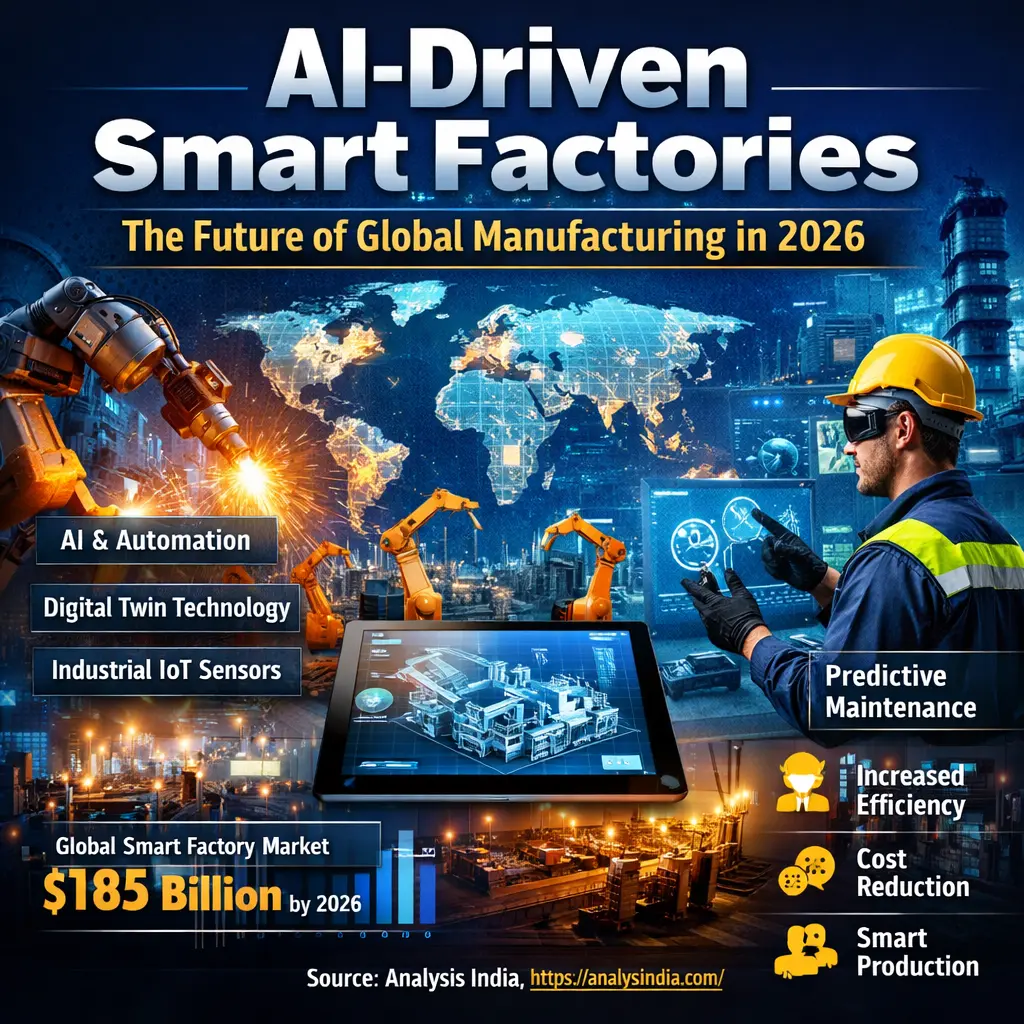
Analysis India: AI Driven Smart Factories are rapidly transforming the global manufacturing ecosystem in 2026. Industrial companies across North America, Europe, and Asia Pacific are investing heavily in artificial intelligence driven production systems to improve operational efficiency and build resilient supply chains. Smart factories combine machine learning, industrial IoT sensors, robotics, and predictive analytics to create connected production environments that operate with minimal human intervention.
Manufacturing leaders such as Siemens, General Electric, Bosch, and Samsung Electronics are already deploying advanced AI systems inside their industrial plants. These technologies enable real time monitoring of production equipment, automated quality control, and predictive maintenance strategies that reduce downtime and improve productivity. As global industries accelerate digital transformation initiatives, AI driven smart factories are becoming a central pillar of modern manufacturing strategy.
For global industrial leaders, the shift toward smart factories is no longer optional. It is now a strategic requirement to maintain competitiveness in a rapidly evolving manufacturing landscape.
What Are AI Driven Smart Factories
AI Driven Smart Factories refer to manufacturing environments where artificial intelligence technologies manage and optimize production processes. These factories rely on interconnected digital systems that analyze massive operational datasets and automatically adjust production workflows.
Unlike traditional industrial plants that rely heavily on manual supervision, smart factories integrate advanced technologies such as:
- Artificial intelligence algorithms
- Industrial Internet of Things sensors
- robotics and automation platforms
- cloud computing infrastructure
- predictive analytics systems
These digital capabilities allow manufacturing facilities to operate with higher accuracy, faster production cycles, and improved resource utilization.
Companies investing in AI driven smart factories are able to improve decision making across their entire production network. AI algorithms analyze equipment performance, supply chain conditions, and product quality metrics to optimize factory operations in real time.
Why AI Driven Smart Factories Are Rising in 2026
The rapid adoption of AI driven smart factories is driven by several global industry trends. Manufacturing organizations are facing increasing pressure to improve efficiency, reduce operational risks, and meet sustainability targets.
Several key factors are accelerating smart factory adoption worldwide.
1. Increasing Industrial Automation
Manufacturing companies are integrating robotics and AI automation systems to reduce production costs and improve manufacturing accuracy. Automated production lines supported by machine learning algorithms can quickly detect product defects and adjust production parameters.
2. Predictive Maintenance Systems
Predictive maintenance powered by artificial intelligence allows manufacturers to monitor equipment performance continuously. AI systems identify early warning signals of machine failures and schedule maintenance activities before costly breakdowns occur.
3. Supply Chain Optimization
AI driven smart factories improve supply chain coordination by connecting production systems with logistics networks and inventory management platforms.
For example, external research from World Economic Forum smart manufacturing initiatives highlights how AI technologies are helping manufacturers build more resilient and adaptive industrial ecosystems.
4. Sustainability and Energy Efficiency
Manufacturers are under increasing pressure to reduce industrial carbon emissions. Smart factories enable companies to monitor energy consumption patterns and optimize resource usage across production facilities.
Key Technologies Powering AI Driven Smart Factories
AI driven smart factories rely on a combination of advanced digital technologies that work together to create intelligent production systems.
Artificial Intelligence and Machine Learning
Artificial intelligence forms the core of smart factory systems. AI algorithms analyze manufacturing data and continuously improve operational efficiency by identifying patterns and optimizing workflows.
Major technology companies such as IBM, Microsoft, and Google Cloud are developing industrial AI platforms designed specifically for manufacturing applications.
Industrial Internet of Things
Industrial IoT sensors collect real time operational data from factory equipment. These sensors track temperature levels, machine vibrations, production speeds, and product quality metrics.
This data enables AI platforms to monitor factory performance continuously.
Digital Twin Technology
Digital twin technology creates virtual replicas of manufacturing equipment and production systems. These virtual models allow engineers to simulate production scenarios and identify efficiency improvements without disrupting actual operations.
Advanced Robotics
Collaborative robots are increasingly being used in smart factories to assist human workers with repetitive or hazardous tasks.
These robots can adapt to changing production requirements and improve manufacturing flexibility.
Global Smart Factory Market Overview
The global adoption of AI driven smart factories is expanding rapidly as industrial companies accelerate digital transformation investments.
| Market Segment | Industry Trend |
|---|---|
| Industrial Automation | Rapid adoption of AI driven production systems |
| Robotics Integration | Increasing use of collaborative robots |
| Digital Twin Platforms | Growing simulation based manufacturing models |
| Industrial IoT Networks | Expansion of connected factory devices |
| Predictive Analytics | Data driven production optimization |
According to multiple industry reports, the smart factory ecosystem is expected to become one of the fastest growing segments within the global manufacturing technology sector.
Global Smart Factory Market Size and Growth Analysis
The rapid expansion of AI Driven Smart Factories is supported by strong investment growth across the global manufacturing technology ecosystem. Governments and multinational companies are investing heavily in industrial automation, artificial intelligence platforms, robotics, and connected factory infrastructure.
According to multiple global industry research organizations, the Global Smart Factory Market is experiencing consistent double digit growth as manufacturers accelerate digital transformation initiatives. Increasing adoption of industrial IoT sensors, predictive maintenance platforms, and AI driven production systems are key factors driving this market expansion.
Smart factories are becoming essential for modern industrial operations because they enable real time production monitoring, advanced automation, and data driven decision making. These capabilities help manufacturers reduce operational costs while improving production efficiency and product quality.
Global Smart Factory Market Size
| Year | Market Size | CAGR | Source |
|---|---|---|---|
| 2024 | USD 141.5 Billion | — | Global Market Insights |
| 2025 | USD 156.6 Billion | — | Global Market Insights |
| 2026 | USD 185.03 Billion | — | Fortune Business Insights |
| 2030 | USD 272.64 Billion | ~10% | Grand View Research |
| 2032 | USD 271.98 Billion | 10.87% | Maximize Market Research |
| 2034 | USD 384.38 Billion | 9.60% | Fortune Business Insights |
Sources: Global Market Insights, Fortune Business Insights, Grand View Research, Maximize Market Research.
Global Smart Factory Market Growth
The strong growth of the AI Driven Smart Factories market is being fueled by several structural changes in the global manufacturing sector. Companies across automotive, electronics, pharmaceuticals, and semiconductor industries are transitioning toward fully automated and digitally connected production environments.
Increasing Adoption of Industrial Automation
Industrial automation technologies such as robotics, AI powered production systems, and automated quality inspection platforms are transforming factory operations. Manufacturing companies are investing heavily in intelligent automation solutions to increase production efficiency and reduce operational risks.
Research from Grand View Research estimates that the global smart factory market could reach approximately USD 272.64 billion by 2030, supported by growing demand for automation and data driven manufacturing processes.
Rapid Expansion of Industrial IoT Infrastructure
Industrial Internet of Things networks are enabling factories to collect real time operational data from production equipment. Sensors embedded in manufacturing machines allow companies to monitor production performance, detect equipment failures, and optimize resource usage.
According to Global Market Insights, the smart factory market reached approximately USD 141.5 billion in 2024 and is expected to exceed USD 255 billion by 2030, reflecting strong global demand for connected factory infrastructure.
Growing Investment in AI and Predictive Analytics
Artificial intelligence platforms are increasingly being used to analyze large manufacturing datasets and optimize production processes. AI systems can automatically detect inefficiencies in factory operations and adjust production workflows to improve productivity.
Industry research from Fortune Business Insights indicates that the smart factory market could expand from USD 185.03 billion in 2026 to more than USD 384 billion by 2034, highlighting the growing importance of intelligent manufacturing technologies.
Industry 4.0 and Industry 5.0 Transformation
The ongoing transition toward Industry 4.0 and Industry 5.0 manufacturing frameworks is also accelerating smart factory adoption. These industrial models integrate artificial intelligence, robotics, cloud computing, and advanced analytics to create fully connected manufacturing ecosystems.
Research from Maximize Market Research suggests the global smart factory industry could grow at nearly 10.87% CAGR between 2025 and 2032, driven by increasing demand for intelligent automation and real time production optimization systems.
Regional Insights in the Global Smart Factory Market
The growth of AI driven smart factories is particularly strong across several key manufacturing regions.
Asia Pacific
Asia Pacific currently leads the global smart factory market due to strong manufacturing capabilities in countries such as China, Japan, South Korea, and India. Government programs promoting industrial automation and digital manufacturing are accelerating adoption in this region.
North America
North America remains one of the largest technology innovation hubs for smart manufacturing. Major companies such as General Electric, IBM, and Rockwell Automation are developing advanced industrial AI platforms and automation systems.
Europe
European manufacturing leaders including Siemens, Bosch, and Schneider Electric are investing heavily in sustainable smart factory solutions that integrate energy efficient production systems and digital twin technologies.
Why This Market Growth Matters for Global Manufacturing
The expansion of the AI Driven Smart Factories market indicates a fundamental transformation in the way products are manufactured worldwide. Traditional factories are gradually evolving into intelligent production environments where machines communicate, analyze operational data, and optimize production processes autonomously.
Smart factory technologies enable manufacturers to achieve several critical objectives:
- improve production efficiency
- reduce machine downtime through predictive maintenance
- optimize energy consumption
- enhance product quality through automated inspection
- strengthen supply chain resilience
As global industries move toward fully digital manufacturing ecosystems, the adoption of AI driven smart factories will play a crucial role in shaping the future of industrial innovation.
Leading Companies Building AI Driven Smart Factories
Several multinational corporations are investing heavily in AI driven manufacturing technologies.
Siemens
Siemens operates several advanced smart factories that utilize digital twin simulations and AI powered production optimization systems.
Bosch
Bosch has developed intelligent manufacturing facilities where AI algorithms monitor production quality and detect defects automatically.
General Electric
General Electric has integrated industrial AI systems across multiple manufacturing plants to improve operational reliability and equipment performance.
Samsung Electronics
Samsung Electronics is building highly automated semiconductor manufacturing facilities that rely on AI analytics to optimize production precision.
These global companies are demonstrating how AI driven smart factories can dramatically improve productivity and operational resilience.
Benefits of AI Driven Smart Factories
The adoption of AI driven smart factories provides multiple advantages for industrial companies.
Improved Operational Efficiency
AI systems analyze production data continuously and identify inefficiencies that human operators may overlook.
Reduced Equipment Downtime
Predictive maintenance capabilities allow manufacturers to detect equipment problems early and avoid costly production interruptions.
Higher Product Quality
Automated quality control systems can inspect thousands of products per hour with exceptional accuracy.
Increased Manufacturing Flexibility
Smart factories can quickly adapt production processes to changing market demand and customer requirements.
Industry 5.0 and Human AI Collaboration
The future of global manufacturing is closely tied to the emergence of Industry 5.0, which focuses on collaboration between advanced automation systems and skilled human workers.
Instead of replacing human workers, AI driven smart factories enable employees to focus on higher value tasks such as innovation, product design, and strategic planning.
Human expertise combined with intelligent automation creates a balanced industrial ecosystem that enhances productivity while preserving workforce skills.
Future Outlook for AI Driven Smart Factories
The next decade will likely witness rapid expansion of AI driven smart factories across multiple industries including automotive, electronics, pharmaceuticals, and aerospace manufacturing.
Emerging technologies such as edge computing, generative AI, and autonomous robotics will further enhance smart factory capabilities.
Industrial analysts expect that global manufacturing will increasingly rely on intelligent digital ecosystems where machines communicate, analyze data, and optimize production independently.
Companies that adopt AI driven smart factories early will gain significant competitive advantages in efficiency, innovation, and operational resilience.
Conclusion
AI Driven Smart Factories are reshaping the future of global manufacturing in 2026. By combining artificial intelligence, industrial IoT systems, and advanced robotics, manufacturers are building highly efficient and intelligent production environments.
These smart factories are enabling companies to reduce operational risks, improve product quality, and respond rapidly to evolving market demands.
As Industry 5.0 technologies continue to evolve, AI driven smart factories will play a critical role in shaping the next generation of global industrial innovation.
FAQ: AI Driven Smart Factories
What are AI Driven Smart Factories?
AI Driven Smart Factories are modern manufacturing facilities that use artificial intelligence, industrial IoT sensors, and automation technologies to monitor and optimize production processes. These factories analyze real time data to improve efficiency, reduce downtime, and enhance product quality.
Why are AI Driven Smart Factories important in global manufacturing?
AI Driven Smart Factories are important because they help manufacturers increase productivity, reduce operational costs, and improve supply chain efficiency. By using AI and predictive analytics, companies can detect equipment failures early and optimize production workflows.
What technologies power AI Driven Smart Factories?
Several technologies enable AI Driven Smart Factories, including artificial intelligence, industrial Internet of Things, robotics, cloud computing, and digital twin technology. These technologies work together to create connected and intelligent manufacturing systems.
Which industries are adopting AI Driven Smart Factories?
Industries such as automotive, electronics, aerospace, pharmaceuticals, and semiconductor manufacturing are rapidly adopting AI Driven Smart Factories to improve production efficiency and maintain global competitiveness.
What is the future of AI Driven Smart Factories?
The future of AI Driven Smart Factories is closely linked to Industry 5.0 and advanced automation. Manufacturers are expected to integrate AI, robotics, and human expertise to build intelligent production ecosystems that enhance innovation and operational resilience.
How large is the global smart factory market?
The global smart factory market is expanding rapidly due to growing demand for automation and AI powered manufacturing systems. Industry research indicates the market could exceed USD 384 billion by 2034, supported by strong investments in digital manufacturing technologies.