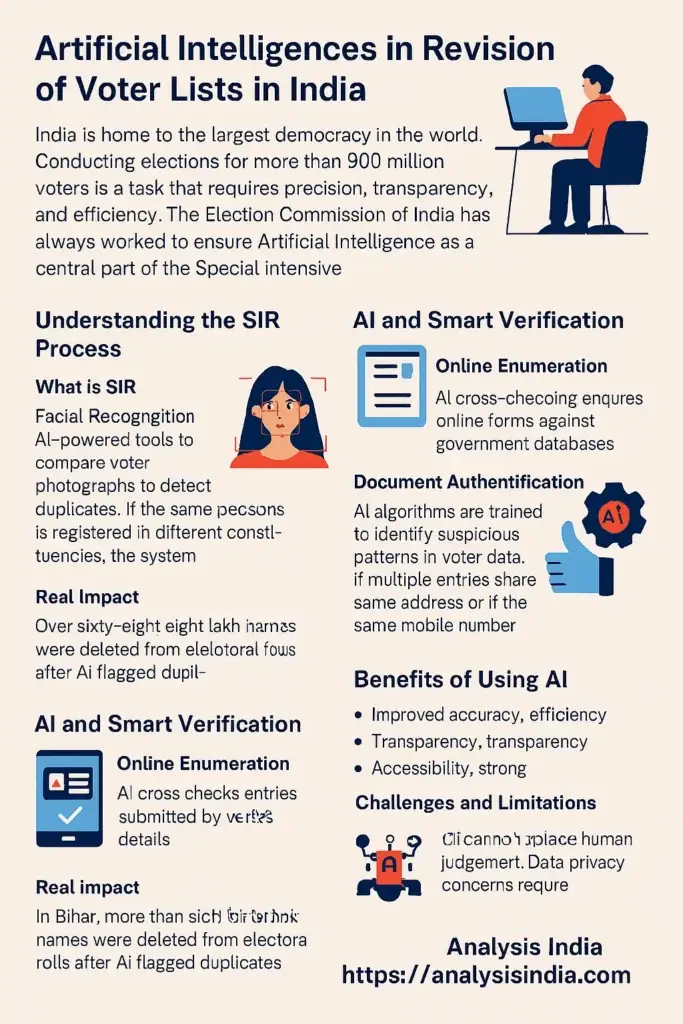
Analysis India: India is home to the largest democracy in the world. Conducting elections for more than 900 million voters requires precision, transparency and efficiency. The Election Commission of India has always worked to ensure free and fair elections. Yet the massive scale of the exercise makes it difficult to maintain accuracy in voter lists. To meet this challenge the Commission has introduced AI for SIR, the Special Intensive Revision process. Artificial Intelligence now plays a central role in improving voter list management.
Beyond voter list revision, AI for SIR is also being applied to digital voter identification, facial recognition, smart verification and social media monitoring. These AI-driven tools support the Election Commission’s mission to enhance transparency and security in the 2025 elections.
Understanding the SIR Process
What is SIR
The Special Intensive Revision is an annual exercise where the Election Commission updates and verifies electoral rolls. It ensures that every eligible citizen is included and that duplicate or fake entries are removed. Traditionally, this was done manually by Booth Level Officers who visited households and checked documents.
Challenges in SIR
The biggest challenge has always been the scale of the exercise. Millions of voters across states make manual verification prone to errors and delays. Duplicate entries were common, especially in cases where people moved between states or registered in multiple constituencies. AI has now been introduced to make this process more reliable.
To address this challenge, the Commission has adopted AI for SIR, the Special Intensive Revision process. AI for SIR helps streamline voter list management by identifying duplicates, correcting errors and improving overall data quality. The use of AI for SIR ensures faster and more reliable updates to electoral rolls, especially in densely populated regions.
AI for SIR in Identifying Duplicate Voters
Facial Recognition
AI powered facial recognition tools compare voter photographs to detect duplicates. If the same person is registered in different constituencies, the system flags the entry. For example, during the 2025 SIR exercise, AI detected cases where students had registered both in their home state and in their university city.
Pattern Recognition
AI algorithms are trained to identify suspicious patterns in voter data. If multiple entries share the same address or if the same mobile number is linked to several voter IDs, the system highlights these anomalies. This allows Booth Level Officers to focus on cases most likely to be fraudulent.
Real Impact
In Bihar, more than sixty eight lakh names were deleted from electoral rolls after AI flagged duplicates. This shows how technology is reshaping voter list management and improving transparency.
AI and Smart Verification
Online Enumeration Forms
Citizens can now submit forms online to confirm their details. AI performs smart verification by cross checking entries against Aadhaar and other government databases. In Rajasthan, voters submitting forms online had their details instantly verified, reducing manual errors.
Document Authentication
AI systems authenticate documents submitted by voters. If a voter uploads an Aadhaar card or driving license, AI checks the format and consistency with other records. This speeds up approval and reduces fake submissions.
Role of Booth Level Officers with AI
Human and Machine Collaboration
While AI plays a crucial role in detecting anomalies, Booth Level Officers remain central to the process. AI provides flagged cases, but BLOs must physically verify details by visiting households. This combination of human judgment and machine intelligence ensures fairness.
Reducing Workload
AI reduces the workload of BLOs by filtering out clean entries and highlighting only suspicious ones. In Kerala, BLOs used AI generated lists to prioritize verification in urban areas where duplicate entries were more common.
AI in Other Election Commission Services
Digital Voter ID
The Election Commission now issues digital voter IDs known as e EPIC. AI ensures that only verified entries receive these IDs, reducing fraud and making voter identification easier.
Voter Helpline Chatbots
AI powered chatbots answer queries about voter registration, polling booths, and election schedules. This improves accessibility for citizens, especially in rural areas.
Social Media Monitoring
AI tools monitor social media platforms for misinformation and fake news during elections. During the 2024 Lok Sabha elections, AI flagged thousands of misleading posts, helping the Commission respond quickly.
Predictive Analysis
AI can also be used for predictive analysis of voter turnout. By studying past data and current trends, AI models forecast turnout levels in different regions. This helps the Commission allocate resources more effectively, such as deploying security forces or arranging additional polling booths.
Benefits of Using AI
AI improves accuracy by detecting duplicates and fake entries. It increases efficiency by reducing manual workload and speeding up verification. Transparency is enhanced as fraudulent entries are flagged automatically. Accessibility is improved through digital voter IDs and chatbots that empower citizens with information.
Challenges and Limitations
AI cannot replace human judgment. Booth Level Officers are still required to physically verify voter details. The use of facial recognition and document verification raises concerns about data privacy. Strong safeguards are needed to ensure voter data is protected. AI also requires strong digital infrastructure, which may not be available in all regions. Rural areas with limited internet access may face challenges in adopting AI based services.
Future of AI in Indian Elections
AI applications will expand in the future. Real time monitoring of polling booths, automated counting of votes, and advanced security checks are possible. Combining AI with blockchain technology could further enhance transparency by creating tamper proof records of voter data and election results. The Election Commission will also need to train its staff and raise awareness among voters about the role of AI to ensure smooth adoption.
Conclusion
The Election Commission of India has taken a bold step by integrating Artificial Intelligence into the Special Intensive Revision process and other services. AI has already shown its potential in identifying duplicate voters, verifying documents, and improving transparency. While challenges remain, the benefits are undeniable. By combining human judgment with machine intelligence, the Commission is building a stronger and more reliable electoral system. This not only ensures free and fair elections but also strengthens the foundation of democracy in India.