
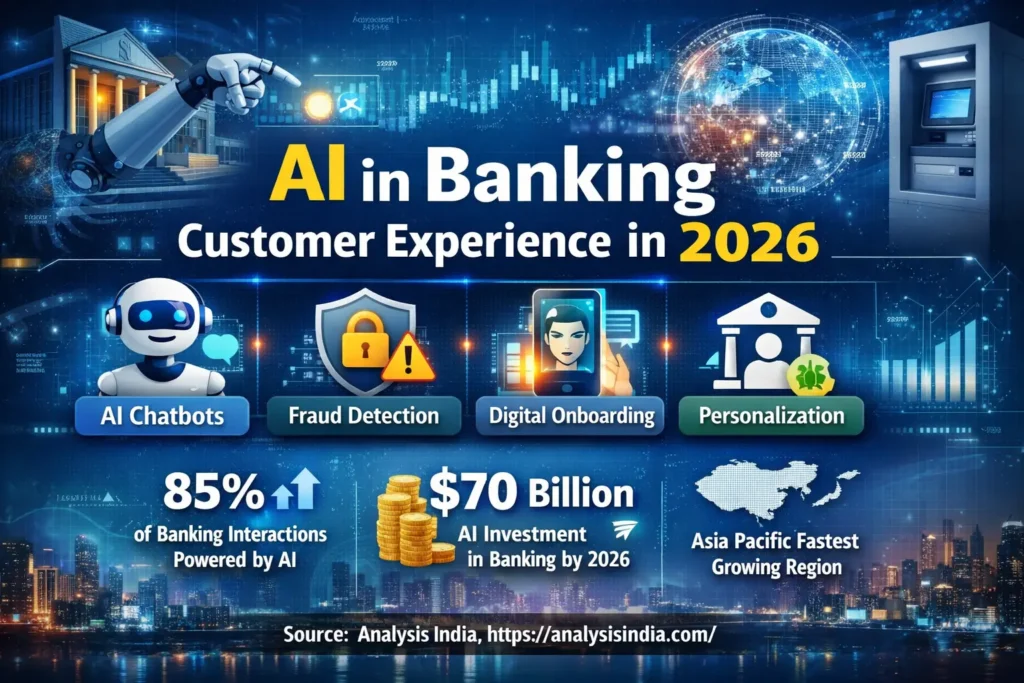
AI in banking customer experience is entering a decisive phase in 2026. Banks across the world are no longer testing artificial intelligence as an experiment. They are deploying it at scale to reshape how customers interact with financial institutions. From AI chatbots to fraud detection and from digital onboarding to hyper personalization, artificial intelligence is now central to modern banking strategy.“ AI in banking customer experience reflects broader AI market adoption trends in 2026, as financial services integrate intelligent systems to improve personalization, fraud detection, and digital engagement
Global banks face rising customer expectations. Users demand instant responses, secure transactions, and personalized services across digital channels. Traditional customer service models struggle to meet these demands at scale. This is where AI in banking customer experience delivers measurable value.
In 2026, artificial intelligence in banking is driven by data maturity, cloud adoption, regulatory clarity, and customer trust. According to McKinsey and Company, banks that invest deeply in AI powered customer experience see stronger engagement, better retention, and operational resilience.
This article explores how AI in banking customer experience is evolving in 2026. It covers chatbots, fraud detection, digital onboarding, trust building, and personalization. It also provides global and regional market insights, forecasts, and real company examples with leadership statements.
What Is AI in Banking Customer Experience
The transformation in banking aligns with AI adoption across industries in 2026, where customer experience and operational efficiency are key investment drivers These technologies include machine learning, natural language processing, computer vision, and predictive analytics.
In 2026, AI in banking customer experience focuses on proactive engagement rather than reactive support. Banks use AI to anticipate customer needs, prevent issues, and deliver relevant financial guidance in real time.
Key applications include conversational AI, behavioral analytics, intelligent fraud prevention, and automated onboarding systems. These tools operate across mobile apps, websites, call centers, and branch systems.
According to Gartner, more than 80 percent of customer interactions in banking are influenced by AI systems in 2026. This influence may not always be visible to the user but it shapes decisions, recommendations, and service flows.
Global Market Overview for AI in Banking Customer Experience
The global market for AI in banking customer experience continues to grow steadily in 2026. Banks view AI not as a cost saving tool only but as a growth and trust enabler.
As per IDC, global spending on AI solutions in banking is projected to exceed USD 70 billion in 2026. Customer experience related use cases account for a significant share of this investment.
Key growth drivers include digital first customers, rising fraud complexity, open banking frameworks, and competition from fintech platforms. AI helps traditional banks stay relevant while scaling services efficiently.
Banks are also aligning AI initiatives with environmental and social governance goals. Responsible AI and explainable AI are becoming mandatory for customer facing systems.
Regional Market Breakdown
North America
North America remains the largest market for AI in banking customer experience in 2026. Banks in the United States and Canada lead in AI maturity and investment.
According to Statista, more than 75 percent of Tier one banks in North America use AI driven chatbots and personalization engines. Fraud detection systems powered by AI are deeply integrated with payment networks.
JPMorgan Chase continues to expand its AI capabilities across customer support and risk management. CEO Jamie Dimon stated that AI enables the bank to deliver faster service while maintaining strong governance and customer trust.
Regulatory clarity and strong cloud infrastructure support AI adoption in this region.
Europe
Europe shows strong growth in AI in banking customer experience with a focus on trust and compliance. Banks operate under strict data protection rules such as GDPR which shapes AI deployment strategies.
According to European Central Bank research, AI adoption in customer onboarding and transaction monitoring has increased significantly by 2026.
HSBC uses AI powered personalization engines to deliver region specific financial insights to customers. A senior HSBC executive noted that AI helps balance personalization with privacy.
European banks invest heavily in explainable AI to ensure transparency in customer interactions.
Asia Pacific
Asia Pacific is the fastest growing region for AI in banking customer experience. Mobile first populations and high digital adoption drive innovation.
According to PwC, banks in China, India, Singapore, and Australia lead in conversational AI and biometric onboarding.
DBS Bank is widely recognized for its AI driven customer experience strategy. CEO Piyush Gupta stated that AI allows DBS to anticipate customer needs and deliver seamless digital journeys.
In India, AI based onboarding using video verification and facial recognition reduces account opening time significantly.
Middle East and Africa
The Middle East and Africa region shows emerging adoption of AI in banking customer experience. Governments support digital banking initiatives and smart city programs.
According to Deloitte, banks in the UAE and Saudi Arabia deploy AI chatbots in multiple languages to serve diverse populations.
Emirates NBD uses AI to personalize digital banking offers and improve fraud prevention. Leadership emphasizes that AI strengthens trust in digital channels.
Latin America
Latin America adopts AI in banking customer experience to improve financial inclusion. AI driven onboarding helps banks reach unbanked populations.
According to World Economic Forum, AI based credit and onboarding systems support access to banking in Brazil and Mexico.
Banks focus on mobile AI assistants and fraud detection due to rising digital payments.
AI Chatbots Transforming Banking Customer Experience
AI chatbots are one of the most visible elements of AI in banking customer experience in 2026. They handle millions of customer interactions daily across channels.
Modern banking chatbots go beyond scripted responses. They understand intent, context, and sentiment. They provide personalized financial insights and guide users through complex processes.
According to Juniper Research, AI chatbots in banking reduce response time while improving customer satisfaction metrics globally.
Bank of America continues to enhance its AI assistant Erica. A company executive stated that Erica helps customers make informed financial decisions while maintaining privacy standards.
AI chatbots now integrate with core banking systems, payment platforms, and CRM tools. This integration allows seamless issue resolution without human escalation in many cases.
AI Powered Fraud Detection and Customer Trust
Fraud detection is a critical pillar of AI in banking customer experience. Customers expect security without friction.
In 2026, AI fraud detection systems analyze transaction behavior in real time. They identify anomalies and prevent fraud before customers notice issues.
According to Visa, AI driven fraud detection significantly improves authorization accuracy while reducing false declines.
Mastercard uses AI to monitor global payment networks and protect cardholders. Company leadership emphasizes that trust is the foundation of customer experience.
Banks also use AI to educate customers about potential risks through proactive alerts and insights.
Digital Onboarding with Artificial Intelligence
Digital onboarding is a major focus area for AI in banking customer experience in 2026. Customers expect quick and secure account opening.
AI enables identity verification using biometrics, document analysis, and behavioral signals. These systems reduce manual checks while improving accuracy.
According to Accenture, AI driven onboarding improves conversion rates and reduces drop offs in digital channels.
Standard Chartered uses AI based onboarding systems across multiple markets. A senior leader stated that AI helps deliver consistent onboarding experiences while meeting local regulations.
AI also supports onboarding personalization by tailoring product recommendations based on customer profiles.
Personalization at Scale Using AI
Personalization is no longer optional in banking customer experience. AI makes personalization scalable and relevant.
In 2026, banks use AI to analyze spending patterns, life events, and financial goals. This data powers personalized offers, alerts, and advice.
According to Boston Consulting Group, banks that deploy AI personalization see stronger engagement and loyalty metrics.
Citibank uses AI to deliver contextual insights through its digital platforms. Leadership highlights that personalization must always align with customer consent.
AI personalization also supports financial wellness initiatives by guiding customers toward better financial decisions.
Building Customer Trust with Responsible AI
Trust is central to AI in banking customer experience. Customers want transparency and fairness in AI driven interactions.
Banks invest in responsible AI frameworks in 2026. These frameworks ensure explainability, bias mitigation, and data governance.
According to OECD, financial institutions lead in adopting ethical AI standards.
ING Group emphasizes responsible AI in customer facing systems. Executives state that trust is earned through transparency and accountability.
Banks also communicate clearly when customers interact with AI systems.
Integration of AI Across Banking Channels
AI in banking customer experience operates across channels in 2026. Customers move seamlessly between mobile apps, websites, call centers, and branches.
AI ensures consistency across these touchpoints. Customer context travels with the user across channels.
According to Forrester, omnichannel AI improves customer satisfaction and operational efficiency.
Banks invest in unified AI platforms rather than isolated tools.
Challenges in AI Driven Banking Customer Experience
Despite progress, challenges remain. Data quality, regulatory compliance, and customer skepticism require attention.
Banks address these challenges through robust governance, continuous training, and customer education.
According to KPMG, banks that align AI strategy with business and ethics achieve sustainable outcomes.
Future Outlook for AI in Banking Customer Experience Beyond 2026
Looking ahead, financial services will continue AI innovation, consistent with the future of AI adoption across industries, where predictive analytics and automation drive differentiation. Beyond 2026, AI in banking customer experience will evolve toward predictive and autonomous services.
AI will act as a financial companion, offering guidance based on life goals and market conditions.
Banks will focus on emotional intelligence in AI systems to improve empathy and trust.
Frequently Asked Questions
What is AI in banking customer experience
AI in banking customer experience refers to the use of artificial intelligence to improve how customers interact with banks. It includes AI chatbots, fraud detection, digital onboarding, and personalized services. In 2026, AI helps banks deliver faster support, better security, and more relevant financial interactions.
How does AI improve banking customer experience in 2026
AI improves banking customer experience in 2026 by enabling real time assistance, predictive insights, and automated services. Artificial intelligence analyzes customer behavior to personalize interactions. This reduces waiting time, improves service accuracy, and creates a smoother digital banking journey across multiple channels.
What role do AI chatbots play in banking customer experience
AI chatbots play an important role in banking customer experience by providing instant responses to customer queries. In 2026, these chatbots understand intent and context. They help with account information, transactions, and guidance, improving customer satisfaction while reducing operational pressure on banks.
How is AI used for fraud detection in banking
AI is used for fraud detection in banking by analyzing transaction patterns and identifying abnormal behavior. In 2026, AI powered fraud detection systems work continuously in real time. This helps banks prevent fraudulent activity while ensuring genuine customer transactions remain smooth and uninterrupted.
Is AI based digital onboarding safe for banking customers
AI based digital onboarding is safe when supported by strong security and compliance frameworks. In 2026, banks use artificial intelligence for identity verification, document analysis, and biometric checks. These technologies improve onboarding speed while maintaining customer trust and regulatory standards.
How does AI support personalized banking experiences
AI supports personalized banking experiences by analyzing spending habits, financial goals, and customer preferences. In 2026, AI delivers tailored recommendations, alerts, and insights. This level of personalization improves engagement and helps customers make more informed financial decisions.
Can AI in banking customer experience help build customer trust
AI in banking customer experience can help build customer trust when used responsibly. Transparent systems, data protection, and explainable AI decisions increase confidence. In 2026, banks focus on ethical AI practices to ensure customers feel secure when using AI driven banking services.
Which regions are leading in AI driven banking customer experience
North America, Europe, and Asia Pacific are leading regions in AI driven banking customer experience. In 2026, Asia Pacific shows rapid growth due to mobile banking adoption. Europe focuses on trust and regulation, while North America leads large scale AI deployment.
What challenges do banks face with AI in customer experience
Banks face challenges such as data quality issues, regulatory requirements, and customer awareness. In 2026, these challenges are addressed through responsible AI frameworks, better governance, and customer education. Overcoming these barriers is essential for sustainable AI driven customer experience.
What is the future of AI in banking customer experience after 2026
The future of AI in banking customer experience includes predictive services and intelligent financial guidance. After 2026, AI will act as a digital financial companion. It will help customers plan, save, and invest with personalized insights based on real life financial behavior.
Conclusion
AI in banking customer experience in 2026 represents a strategic transformation. It reshapes how banks interact with customers through chatbots, fraud detection, digital onboarding, personalization, and trust building.
Global and regional adoption shows strong momentum. Banks that invest responsibly in AI gain competitive advantage while strengthening customer relationships.
Artificial intelligence is not replacing human banking. It is augmenting it with intelligence, speed, and relevance.