AI in healthcare customer experience reflects wider AI market adoption trends in 2026, where healthcare providers and enterprises invest heavily in personalized, predictive, and intelligent services. Healthcare providers are under constant pressure to improve patient engagement, reduce waiting time, and deliver consistent care across physical and digital channels. Artificial intelligence is helping healthcare organizations meet these expectations at scale.
Patients today expect healthcare services to be accessible, personalized, and responsive. Long appointment delays, fragmented communication, and lack of follow up reduce patient satisfaction. Traditional healthcare systems struggle to address these challenges efficiently. AI in healthcare customer experience offers a structured solution.
In 2026, artificial intelligence is deeply integrated into patient engagement platforms, AI scheduling systems, remote monitoring tools, and diagnostic workflows. According to McKinsey and Company, healthcare organizations using AI for customer experience achieve stronger patient trust and operational efficiency.
This article explores how AI in healthcare customer experience is evolving in 2026. It focuses on patient engagement, AI scheduling, remote monitoring, and diagnostics driven customer experience. It also presents global and regional insights, forecasts, and real company examples.
What Is AI in Healthcare Customer Experience
AI in healthcare customer experience refers to the use of artificial intelligence technologies to improve how patients interact with healthcare providers across their care journey. This includes appointment booking, communication, diagnosis support, monitoring, and follow up care.
In 2026, AI in healthcare customer experience moves beyond automation. It focuses on predictive engagement, proactive care, and personalized patient journeys. AI systems analyze patient data to anticipate needs and deliver timely interventions.
Technologies such as machine learning, natural language processing, and computer vision play a key role. These tools support healthcare staff while improving patient satisfaction and trust.
According to Gartner, more than 70 percent of patient interactions are influenced by AI driven systems in healthcare by 2026.
Global Market Overview for AI in Healthcare Customer Experience
The global market for AI in healthcare customer experience continues to expand steadily in 2026. Healthcare providers invest in AI to improve patient outcomes and manage rising service demand.
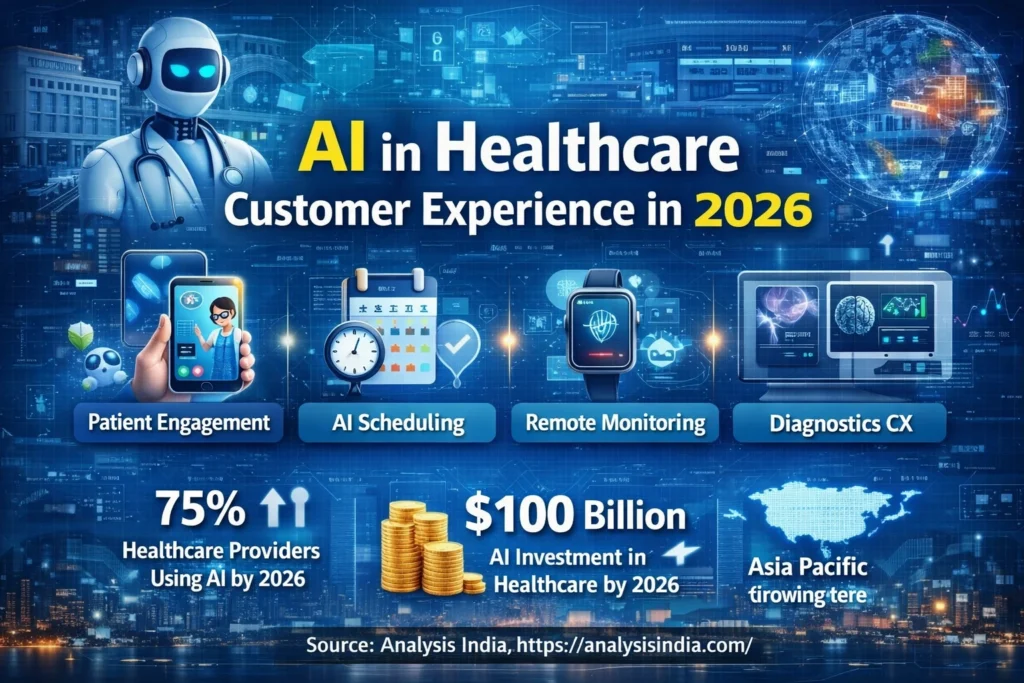
According to Statista, global spending on AI in healthcare is projected to cross USD 100 billion by 2026. A significant portion of this investment targets patient experience solutions.
Key growth drivers include aging populations, chronic disease prevalence, telehealth adoption, and digital health platforms. AI helps healthcare systems scale without compromising care quality.
Healthcare regulators increasingly support responsible AI adoption. Transparency and patient data protection are central to deployment strategies. These developments mirror industry-wide AI adoption trends, as enterprises in finance, travel, retail, and healthcare align investments toward customer experience innovations.
Regional Market Insights
North America
North America leads in AI in healthcare customer experience adoption in 2026. Healthcare systems in the United States and Canada use AI extensively for scheduling, engagement, and diagnostics support.
According to Accenture, AI driven patient engagement tools are widely adopted by large hospital networks.
Mayo Clinic uses AI to improve appointment scheduling and diagnostic workflows. Leadership at Mayo Clinic has stated that AI supports clinicians while improving patient experience and care coordination.
Strong digital infrastructure and investment capacity drive adoption in this region.
Europe
Europe focuses on trust based AI in healthcare customer experience. Data protection regulations shape AI implementation.
According to European Commission health research, AI powered patient engagement platforms are increasingly used in public healthcare systems.
NHS England deploys AI for appointment scheduling and triage support. Senior NHS leaders highlight that AI reduces patient waiting time while maintaining care quality.
Explainable AI and patient consent remain priorities in Europe.
Asia Pacific
Asia Pacific shows the fastest growth in AI in healthcare customer experience. Mobile health adoption and large patient volumes drive innovation.
According to PwC, countries such as China, India, Japan, and Singapore lead in AI based remote monitoring and engagement tools.
Apollo Hospitals in India uses AI for patient engagement and diagnostics support. Leadership notes that AI improves access to care and operational efficiency.
Asia Pacific healthcare providers invest heavily in AI driven telemedicine platforms.
Middle East and Africa
The Middle East and Africa region adopts AI in healthcare customer experience through national digital health initiatives.
According to Deloitte, AI powered scheduling and patient engagement tools are deployed in the UAE and Saudi Arabia.
Cleveland Clinic Abu Dhabi uses AI to support patient engagement and care coordination. Executives emphasize that AI enhances patient trust in digital healthcare services.
Latin America
Latin America adopts AI in healthcare customer experience to improve access and efficiency.
According to World Health Organization regional data, AI supported telehealth platforms expand healthcare reach in Brazil and Mexico.
Healthcare providers focus on AI driven appointment management and patient communication.
AI Driven Patient Engagement in Healthcare
Patient engagement is a core component of AI in healthcare customer experience. Engaged patients follow care plans more effectively and report higher satisfaction.
In 2026, AI driven engagement platforms deliver personalized reminders, health education, and follow up messages. These systems adapt communication based on patient behavior and preferences.
According to Harvard Business Review, AI driven patient engagement improves adherence and continuity of care.
Kaiser Permanente uses AI to engage patients through digital channels. Company leadership states that AI enables proactive communication and stronger patient relationships.
AI also supports multilingual engagement, improving accessibility for diverse populations.
AI Scheduling Enhancing Healthcare Experience
AI scheduling is transforming healthcare customer experience by reducing wait times and improving appointment management.
In 2026, AI scheduling systems analyze provider availability, patient urgency, and historical data. They optimize appointment allocation dynamically.
According to McKinsey, AI scheduling improves resource utilization while reducing patient no show rates.
Cleveland Clinic uses AI to optimize appointment scheduling. Leadership highlights that AI improves patient flow and clinician efficiency.
Patients benefit from faster booking and flexible rescheduling options.
Remote Monitoring and Continuous Patient Experience
Remote monitoring is a major growth area within AI in healthcare customer experience. It extends care beyond hospital walls.
In 2026, AI powered remote monitoring devices track vital signs and symptoms in real time. AI systems analyze this data to detect early warning signals.
According to Deloitte, remote monitoring improves chronic disease management and patient confidence.
Philips Healthcare uses AI driven monitoring platforms to support home based care. Company executives state that AI helps deliver continuous and personalized care experiences.
Remote monitoring strengthens patient trust and reduces hospital visits.
Diagnostics and AI Driven Customer Experience
Diagnostics play a critical role in healthcare customer experience. Delayed or unclear diagnosis negatively impacts patient trust.
In 2026, AI supports diagnostics by assisting clinicians with image analysis and decision support. AI improves accuracy and speed without replacing medical judgment.
According to Nature Medicine, AI driven diagnostics support better patient communication and care planning.
Siemens Healthineers uses AI in diagnostic imaging workflows. Leadership emphasizes that AI enhances diagnostic confidence and patient experience.
Faster diagnostics improve patient satisfaction and care outcomes.
Trust and Ethical AI in Healthcare Customer Experience
Trust is fundamental to AI in healthcare customer experience. Patients expect transparency and data protection.
In 2026, healthcare providers adopt responsible AI frameworks. These frameworks ensure explainability, fairness, and patient consent.
According to OECD, healthcare organizations lead ethical AI adoption due to regulatory oversight.
Johnson and Johnson emphasizes ethical AI in patient facing systems. Executives highlight that trust drives long term patient engagement.
Clear communication about AI use builds confidence.
Integration of AI Across the Patient Journey
AI in healthcare customer experience operates across the entire patient journey. From discovery to follow up care, AI ensures continuity.
According to Forrester, integrated AI platforms improve patient satisfaction and operational efficiency.
Healthcare providers invest in unified data platforms to support seamless AI driven experiences.
Challenges in AI Driven Healthcare Customer Experience
Despite progress, challenges remain. Data interoperability, workforce training, and patient acceptance require attention.
Healthcare providers address these challenges through governance frameworks and education initiatives.
According to KPMG, organizations that align AI strategy with patient needs achieve sustainable outcomes.
Future Outlook for AI in Healthcare Customer Experience Beyond 2026
Beyond 2026, AI in healthcare customer experience will become more predictive and personalized.
AI will support preventive care and personalized treatment pathways. Digital health companions will guide patients continuously.
Healthcare systems will focus on emotional intelligence in AI interactions.
Frequently Asked Questions
What is AI in healthcare customer experience
AI in healthcare customer experience refers to the use of artificial intelligence to improve how patients interact with healthcare providers. It includes patient engagement tools, AI scheduling, remote monitoring, and diagnostics support. In 2026, AI helps healthcare organizations deliver faster, more personalized, and more reliable care experiences.
How does AI improve patient engagement in healthcare
AI improves patient engagement by delivering personalized communication, reminders, and health guidance. In 2026, AI systems analyze patient behavior and preferences to send timely updates. This helps patients stay informed, follow care plans, and feel more connected throughout their healthcare journey.
What role does AI scheduling play in healthcare customer experience
AI scheduling improves healthcare customer experience by reducing waiting time and appointment delays. In 2026, AI scheduling systems match patient needs with provider availability. This leads to faster bookings, fewer missed appointments, and smoother care coordination for both patients and healthcare staff.
How is AI used in remote patient monitoring
AI is used in remote patient monitoring to track vital signs and health data in real time. In 2026, AI analyzes this data to identify early health risks. This enables proactive care, reduces hospital visits, and improves patient confidence in ongoing healthcare support.
How does AI improve diagnostics and patient experience
AI improves diagnostics by assisting clinicians with image analysis and decision support. In 2026, AI helps deliver faster and more accurate diagnostic insights. This reduces patient anxiety, shortens diagnosis time, and improves overall trust in healthcare services.
Is AI in healthcare customer experience safe for patients
AI in healthcare customer experience is safe when implemented with strong data protection and ethical frameworks. In 2026, healthcare providers focus on transparency, patient consent, and explainable AI. These practices help protect patient data and build long term trust in AI driven healthcare systems.
Which regions are leading in AI healthcare customer experience adoption
North America, Europe, and Asia Pacific are leading in AI healthcare customer experience adoption. In 2026, Asia Pacific shows rapid growth due to digital health platforms. Europe emphasizes trust and regulation, while North America leads large scale AI deployment in healthcare systems.
What challenges exist in AI driven healthcare customer experience
Challenges include data integration issues, staff training, and patient awareness. In 2026, healthcare organizations address these challenges through governance frameworks, education, and responsible AI practices to ensure smooth and sustainable adoption of AI driven customer experience solutions.
What is the future of AI in healthcare customer experience after 2026
After 2026, AI in healthcare customer experience will focus on predictive and preventive care. AI will act as a digital health companion, supporting personalized treatment plans and continuous engagement. This will improve patient outcomes and strengthen trust in digital healthcare services.
Conclusion
AI in healthcare customer experience in 2026 represents a major shift in how care is delivered and experienced. Patient engagement, AI scheduling, remote monitoring, and diagnostics driven customer experience redefine healthcare interactions.
Global adoption shows strong momentum. Healthcare providers that invest responsibly in AI gain trust, efficiency, and improved patient outcomes.
Artificial intelligence is enhancing healthcare experience while keeping patients at the center of care.