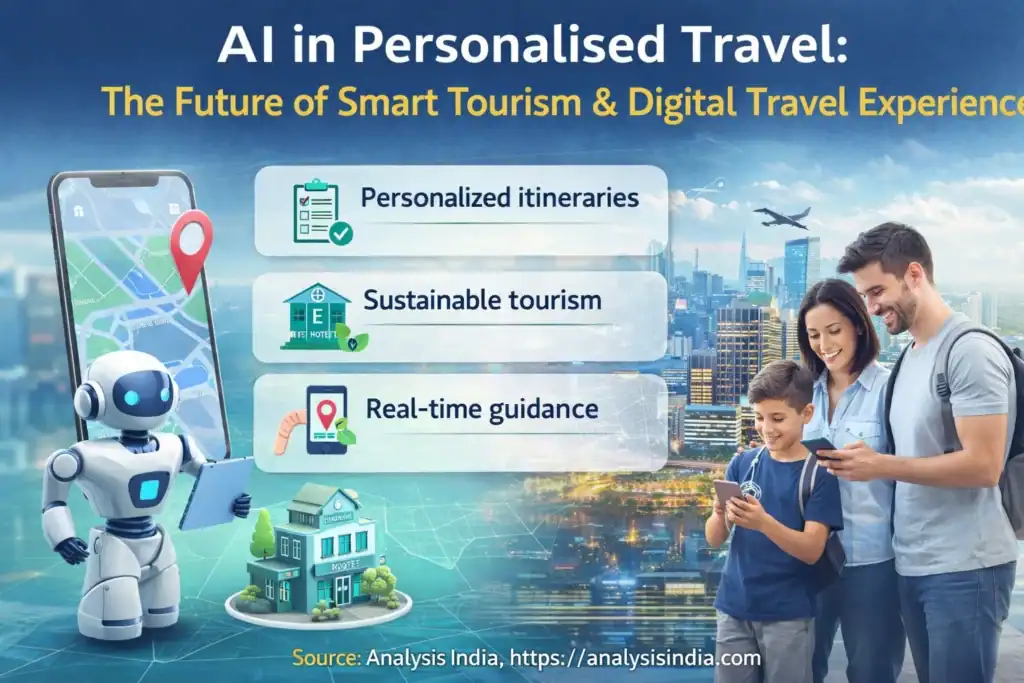
Analysis India: AI in personalised travel is reshaping global tourism in 2026 as travelers expect faster planning, smarter recommendations, and seamless digital experiences. Modern travelers now want personalised itineraries, real time guidance, and convenient service across every stage of the journey. Travel companies are using artificial intelligence to improve customer experience and operational efficiency. The surge in AI-powered personalized travel planning reflects broader AI market adoption trends in 2026, as industries worldwide leverage intelligent data systems to improve customer engagement and real-time recommendations.
McKinsey reports that 71 percent of consumers expect personalised interactions from brands, and 76 percent feel frustrated when this does not happen. These expectations are influencing how airlines, hotels, and travel platforms design their digital services. Phocuswright estimates that the global travel market will reach around 1.67 trillion dollars in 2026, supported by strong growth in online bookings. AI in personalised travel is no longer a future concept and is now a practical business tool for smart tourism development.
Global AI Driven Travel Demand Is Rising Rapidly
Global demand for AI powered travel solutions is increasing because digital booking continues to grow across regions. Phocuswright reports that global travel gross bookings reached nearly 1.6 trillion dollars in 2024 and are expected to cross 1.8 trillion dollars by 2027. Online travel bookings grew by 9 percent in 2024 and are projected to account for almost two thirds of all travel bookings by 2027. This digital shift supports AI in personalised travel because artificial intelligence works best in data rich online environments. Travelers are increasingly using mobile apps, digital assistants, and smart platforms for trip planning. Travel companies are investing in AI driven customer support, recommendation engines and pricing tools to meet this demand. AI in personalised travel helps brands understand traveler intent and deliver more relevant travel experiences.
AI in Tourism Market Size and Growth
The AI in tourism market has shown strong expansion over recent years. According to Grand View Research, the global AI in tourism market was valued at 3.373 billion dollars in 2024. The same report estimates the market will reach 4.255 billion dollars in 2025. Long term growth is supported by increasing adoption of AI in booking platforms, hotel operations, and destination management systems. Grand View Research projects a compound annual growth rate of 26.7 percent from 2025 to 2030, with the market reaching 13.868 billion dollars by 2030. This growth reflects rising demand for real time pricing, itinerary optimisation and automated customer service. AI in personalised travel continues to attract investment because it improves both traveler satisfaction and business performance.
AI in Tourism Market Forecast
| Year | Market Value USD Billion |
|---|---|
| 2024 | 3.373 |
| 2025 | 4.255 |
| 2030 | 13.869 |
Source: Grand View Research
Global and Regional AI Travel Market Trends
Regional growth patterns show that AI in personalised travel is expanding worldwide. Grand View Research reports that North America generated AI in tourism revenue of 1.307 billion dollars in 2024. The United States alone contributed 922.9 million dollars in the same year. The U.S. AI in tourism market is projected to reach 3.893 billion dollars by 2030. Europe is also expected to show strong growth, with AI in tourism revenue projected at 3.492 billion dollars by 2030. India represents an emerging market, with revenue of 109.9 million dollars in 2024 and a projected value of 595 million dollars by 2030. These figures show that AI in personalised travel is becoming a global standard rather than a regional trend. Investment in smart tourism platforms is increasing across both developed and emerging markets.
Regional AI in Tourism Snapshot
| Region or Country | Market Data |
|---|---|
| North America | 2024 revenue USD 1.307 billion |
| United States | 2024 revenue USD 0.923 billion, 2030 projection USD 3.893 billion |
| Europe | 2030 projection USD 3.492 billion |
| India | 2024 revenue USD 0.110 billion, 2030 projection USD 0.595 billion |
Source: Grand View Research
AI Powered Travel Planning Improves Personalised Trip Design
AI powered travel planning tools are helping travelers save time and receive more accurate recommendations. These systems analyse travel history, search behaviour, budget range, destination preferences, and trip pace. Travel platforms such as Google Travel and Booking.com use AI to recommend flights, hotels, and attractions. McKinsey reports that 71 percent of consumers expect personalised interactions, which supports the growing use of AI in trip planning. AI reduces the need for manual research and improves itinerary relevance. Travelers now receive customised suggestions for accommodation, dining, and activities based on their interests. AI in personalised travel also helps travel companies improve conversion rates and customer loyalty by offering timely and relevant recommendations.
Smart Tourism and Destination Digitisation
Smart tourism platforms showcase industry-wide AI adoption trends, as mobile-first travelers increasingly expect seamless, contextual experiences at every stage of their journey. Smart tourism is expanding as destinations invest in digital infrastructure to improve visitor experience. Digital travel passes, navigation tools, and real time alerts are becoming common in major tourist cities. Phocuswright estimates that by 2027 nearly two thirds of global travel bookings will be made online. This shift increases the importance of smart tourism platforms that provide real time information and personalised guidance. Cities use digital tools for crowd management, transport planning and safety monitoring. AI in personalised travel supports these systems by predicting visitor demand and recommending alternative routes or attractions. Smart tourism improves efficiency while enhancing traveler satisfaction.
AI and Sustainable Tourism Demand
Sustainability is becoming an important factor in travel decision making. Booking.com reported in 2024 that 45 percent of travelers consider sustainable travel important, even if it is not always the main booking priority. The same research found that 28 percent of travelers feel tired of hearing about climate change messaging. This means travel brands need to promote sustainability in a practical and user friendly way. AI can help by highlighting eco friendly hotels, low emission transport options, and local experiences without complex messaging. AI in personalised travel allows sustainability information to be integrated naturally into the booking journey. This supports responsible tourism while keeping the user experience simple and efficient.
Booking.com Sustainable Travel Survey Highlights
| Survey Metric | Value |
|---|---|
| Sustainability is important but not primary | 45 percent |
| Travelers tired of climate change messaging | 28 percent |
Source: Booking.com Sustainable Travel Research
AI and Purpose Driven Travel Trends
Purpose driven travel focuses on positive impact, community support, and cultural respect. Booking.com research conducted across 34 countries found that 53 percent of travelers are conscious of tourism impact on local communities and the environment. The same study reported that 69 percent of travelers want to leave destinations in better condition than when they arrived. These insights show growing interest in responsible tourism. AI in personalised travel can support this trend by recommending community based experiences, local businesses, and certified tourism providers. It can also promote less crowded destinations and off peak travel options. This allows travelers to enjoy meaningful experiences without additional effort.
Purpose Driven Travel Indicators
| Survey Metric | Value |
|---|---|
| Travelers conscious of tourism impact | 53 percent |
| Travelers want to leave places better | 69 percent |
Source: Booking.com Research
AI and the Experience Economy in Tourism
The experience economy is playing a larger role in modern travel. GetYourGuide reports that travel experiences grew by 33 percent compared to 2019 levels. Online travel agencies in the experiences segment grew by 188 percent over the same period, while overall travel growth was 16 percent. This shows strong demand for local tours, cultural activities, and unique experiences. AI in personalised travel helps match travelers with suitable experiences based on interest, timing, and location. AI also supports pricing and inventory management for experience providers. This strengthens destination economies and improves traveler satisfaction.
Experiences Market Momentum
| Metric | Value |
|---|---|
| Travel experiences growth since 2019 | 33 percent |
| Experiences OTAs growth since 2019 | 188 percent |
| Overall travel growth since 2019 | 16 percent |
Source: GetYourGuide Travel Trend Tracker
Wellness Travel and Smart Tourism Integration
Wellness travel continues to grow as travelers prioritise physical and mental health. Nova One Advisor estimates the global wellness tourism market was valued at 815.6 billion dollars in 2022. Wellness focused travel includes yoga retreats, spa resorts, nature therapy, and mindfulness programs. AI in personalised travel helps recommend wellness destinations based on traveler goals and seasonal conditions. Smart tourism platforms integrate wellness suggestions into digital itineraries. Wellness travelers often prefer quieter locations and longer stays, which supports sustainable destination management. AI makes wellness travel planning easier and more personalised.
Wellness Tourism Market Reference
| Year | Market Value USD Billion |
|---|---|
| 2022 | 815.6 |
Source: Nova One Advisor
AI Adoption Trends Among Travelers
AI adoption varies by age group and region. A UK travel survey reported by The Guardian found that 18 percent of adults aged 25 to 34 use AI tools to inspire travel planning. Fewer than 3 percent of people over 55 use AI for the same purpose. This shows a generational gap in AI usage. Younger travelers are more comfortable with digital tools and AI powered recommendations. As AI becomes more integrated into mainstream booking platforms, adoption is expected to increase. AI in personalised travel will gradually become part of standard travel planning behavior.
Business Impact of AI in Personalised Travel
AI improves business performance by increasing customer engagement and operational efficiency. Travel companies using AI see better understanding of customer preferences and higher conversion rates. Personalised recommendations lead to higher booking confidence and repeat visits. AI also reduces customer service response time through automated support systems. Brand trust improves when travelers receive relevant and timely information. AI in personalised travel has become a competitive advantage for airlines, hotels, and travel platforms.
Global Tourism Outlook for Smart Travel in 2026
Global tourism continues to recover and expand as digital adoption increases. Phocuswright estimates that the global travel market will reach around 1.67 trillion dollars by 2026. Online bookings will dominate the industry, supporting the growth of smart tourism platforms. AI will remain central to travel planning, destination management, and customer engagement strategies. Digital innovation and responsible tourism practices will shape the future of global travel.
Conclusion
AI in personalised travel is shaping the future of smart tourism by improving trip planning, destination management, and customer experience. Market data from Grand View Research shows strong growth in AI adoption across regions. Booking.com research highlights traveler interest in sustainability and positive impact. GetYourGuide data confirms rising demand for experience based travel. Wellness tourism continues to expand, supported by digital personalisation. Phocuswright projections show continued growth in online travel bookings. Together, these trends show that AI in personalised travel will play a central role in global tourism development. Travel brands that focus on useful technology, clear communication, and customer trust will lead the smart tourism market.
Frequently Asked Questions
What is AI in personalised travel
AI in personalised travel uses artificial intelligence to create customised travel experiences based on traveler preferences and behavior.
How does AI improve smart tourism
AI improves smart tourism by offering real time travel guidance, better crowd management and personalised destination services.
Why is AI important for modern tourism
AI helps travel companies improve customer experience, increase booking efficiency and deliver relevant travel recommendations.
How does AI support sustainable tourism
AI supports sustainable tourism by promoting eco friendly options and optimizing travel routes to reduce environmental impact.
Will AI in personalised travel continue to grow
Yes, AI in personalised travel will continue to grow as digital travel services expand worldwide.