Analysis India: AI tools reshaping retail in India are becoming an essential part of how modern retail businesses operate. Indian consumers are changing the way they shop, and they expect faster service, better product suggestions, and smooth experiences across both online and physical stores. Mobile usage has increased sharply and digital payments have become common even in smaller cities. This shift has created new expectations for speed, accuracy, and personalization. Retailers must now handle large volumes of data while also improving customer satisfaction.
The rapid growth of AI tools reshaping retail in India reflects broader AI market adoption trends in 2026, where enterprises across sectors integrate intelligent systems for personalization, optimization, and customer engagement.
Artificial intelligence helps retailers manage this complexity in a structured way. AI systems study customer behavior, sales patterns, and inventory movement to identify trends that humans may miss. These insights help businesses make better pricing decisions and improve stock availability. AI also supports marketing teams by targeting the right customers with relevant messages. Over time, this leads to higher conversion rates and stronger customer loyalty.
Large retail companies in India have already made AI a core part of their strategy. Amazon India, Flipkart, Myntra, and Reliance Retail use AI to improve both customer experience and internal operations. Their investments show that AI is no longer an experimental technology. It is now a business necessity for companies that want to stay competitive. As retail competition increases, the role of AI tools reshaping retail in India will continue to expand.
This article explains how AI tools reshaping retail in India are changing the industry in a meaningful way. It includes market data, company use cases, leadership statements, and future projections.
Indian Retail Growth Is Driving AI Adoption
India’s retail sector is growing at a rapid pace, supported by rising incomes, digital connectivity, and changing consumer habits. Shoppers now research products online before making a purchase, even if they plan to buy from a physical store. Many customers also expect fast delivery and flexible return options. These expectations are creating new pressure on retailers to improve speed and accuracy. Traditional manual systems are no longer enough to handle this scale.
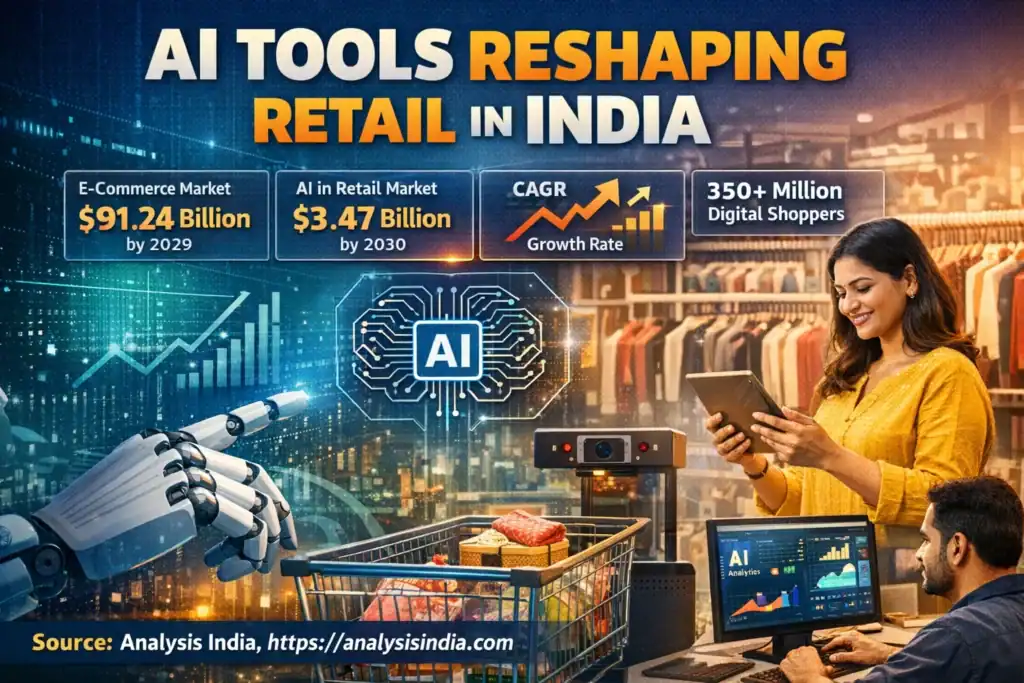
According to IBEF, India’s e-commerce market is expected to grow from USD 53.08 billion in 2024 to USD 91.24 billion by 2029. This growth is driven by better internet access and widespread use of digital payment systems. More consumers are becoming comfortable with online shopping, including in tier two and tier three cities. This expansion increases the volume of orders and the complexity of logistics. Retailers must now manage more products, more locations, and more customer interactions.
Market Growth Data
| Indicator | Value | Source |
|---|---|---|
| E-commerce market size 2024 | USD 53.08 billion | IBEF |
| Projected market size 2029 | USD 91.24 billion | IBEF |
| Digital shoppers | 350+ million | Statista |
As retail volumes increase, operational challenges also grow. Companies must track thousands of products and coordinate with multiple suppliers. They must also ensure that the right products are available in the right locations. Manual planning often leads to errors and delays. AI tools reshaping retail in India help automate these processes and improve accuracy.
Retail growth also brings stronger competition. Customers compare prices across platforms and expect better service each year. Retailers must reduce delivery delays, avoid stock shortages, and offer better experiences. AI enables faster decision making and smarter planning. This helps companies stay competitive in a crowded market environment.
Market Size of AI Tools Reshaping Retail in India
India’s strong adoption of AI in retail exemplifies industry-wide AI adoption trends, powered by digital transformation and rising consumer expectations. The rapid adoption of AI in Indian retail is supported by strong market growth. Retailers are investing in artificial intelligence to improve efficiency, reduce costs, and enhance customer experience. AI platforms are being used for forecasting, personalization, pricing, and operations. This has created a fast growing market for AI solutions in retail.
According to Grand View Research, the India AI in retail market generated USD 584.7 million in revenue in 2024. The market is projected to reach USD 3,474.6 million by 2030. This represents a compound annual growth rate of 33.7 percent. Such high growth reflects strong confidence in AI’s business value.
AI in Retail Market Forecast
| Year | Market Value | Source |
|---|---|---|
| 2024 | USD 584.7 million | Grand View Research |
| 2030 | USD 3,474.6 million | Grand View Research |
| CAGR | 33.7 percent | Grand View Research |
This expansion shows that AI tools reshaping retail in India are moving beyond early adoption. More retailers are investing in predictive analytics, automation tools, and customer intelligence platforms. Technology vendors are also developing India specific solutions for language, payments, and logistics. This supports faster adoption across different retail formats.
India’s broader AI market is also growing. Nasscom and BCG estimate that India’s AI market could reach USD 17 billion by 2027. This growth will strengthen the AI ecosystem and make advanced tools more accessible. As a result, AI tools reshaping retail in India will become more affordable and more widely used.
Data Is the Foundation of AI in Indian Retail
AI tools reshaping retail in India depend on high quality data. Every customer action generates information that can be analyzed. This includes searches, purchases, returns, and feedback. AI systems study this data to find patterns and predict future behavior. These insights help retailers make better business decisions.
Indian retail generates diverse data because customer preferences vary across regions. Festival seasons also create sharp demand spikes. Price sensitivity differs across income groups. AI models learn from these patterns and adjust forecasts accordingly. This helps retailers prepare for seasonal demand more accurately.
Retailers collect data from websites, mobile apps, stores, and loyalty programs. When this data is combined, AI tools can build a full picture of the customer journey. This allows businesses to understand what customers want and when they want it. Better insights lead to better planning and better service.
Data quality is critical for AI success. Retailers that invest in clean product catalogs and accurate customer records get stronger results. Poor data leads to weak predictions and poor recommendations. Strong data foundations make AI tools reshaping retail in India more reliable and effective.
Personalization Is Transforming Customer Experience
Personalization is one of the most visible ways AI is changing Indian retail. Customers receive product suggestions based on their interests and past behavior. This reduces the time needed to find suitable products. It also makes shopping more enjoyable and relevant.
Amazon India uses machine learning to personalize customer experiences across its platform. Abhinav Agarwal, Director of Amazon Prime India, stated that AI helps Amazon understand customer needs and deliver relevant experiences for different user groups. This allows Amazon to serve both urban and regional customers effectively. AI also supports content personalization and offer targeting.
Myntra has built strong personalization tools for fashion shoppers. Its AI assistant Maya helps users explore millions of styles based on preferences and context. Swaminathan, CTO of Myntra, explained that AI driven personalization improves shopping confidence. Customers feel more comfortable making decisions when guidance is clear and relevant.
Personalization improves both customer satisfaction and sales performance. When shoppers see relevant products, they are more likely to complete purchases. This makes personalization a core element of AI tools reshaping retail in India. Over time, personalized experiences also strengthen brand loyalty.
Catalog Intelligence Improves Product Accuracy
Accurate product information is essential for successful retail operations. Many returns in India happen because customers receive products that do not match expectations. Incorrect descriptions and size mismatches create frustration and reduce trust. AI tools help solve this problem through catalog intelligence.
Myntra uses AI to standardize sizing across brands. The system analyzes fit data and customer feedback to recommend accurate sizes. This improves customer confidence and reduces return rates. It also helps shoppers find the right product faster.
Generative AI also helps create product descriptions and styling suggestions. This improves consistency and reduces manual work for sellers. Better product information improves search accuracy and recommendation quality. Over time, this strengthens the entire shopping experience.
As catalog quality improves, AI tools reshaping retail in India become more effective. Better data leads to better recommendations and fewer errors. This improves both customer satisfaction and operational efficiency.
AI Is Optimizing Pricing and Promotions
Pricing plays a major role in customer trust and business profitability. Indian consumers are price sensitive and compare options across platforms. AI tools analyze demand trends, competitor pricing, and customer behavior to recommend optimal price levels.
Flipkart uses predictive models to estimate conversion probability for different products. Mayur Datar, former Vice President of Engineering at Flipkart, explained that AI improves demand forecasting and inventory efficiency. These insights help the company plan promotions more accurately.
AI also enables targeted promotions. Instead of offering large discounts to everyone, retailers can focus on specific customer groups. This protects profit margins while maintaining competitiveness. Smarter pricing strategies improve long term business stability.
Pricing optimization strengthens the impact of AI tools reshaping retail in India by balancing growth and profitability. Retailers can increase sales without harming margins.
Demand Forecasting Strengthens Supply Chains
Demand forecasting is critical in India due to regional diversity and seasonal trends. Festival periods can cause sharp demand spikes. AI tools analyze historical data and real time signals to predict product demand more accurately.
Flipkart uses AI to forecast demand at national and regional levels. This helps place inventory closer to customers. Faster delivery improves customer satisfaction and reduces logistics costs.
Myntra uses AI to forecast demand at neighborhood level. This allows better stock placement and quicker order fulfillment. Customers receive products faster with fewer stock issues.
Better forecasting reduces excess inventory and minimizes shortages. This improves financial performance and customer experience. Demand forecasting is a key pillar of AI tools reshaping retail in India.
AI Is Improving Store Operations
Physical stores remain important in Indian retail. Many customers still prefer in store shopping for electronics, fashion, and groceries. AI tools help improve store efficiency and service quality.
Brian Bade, CEO of Reliance Digital, stated that AI has improved backend forecasting and inventory accuracy. He emphasized that technology works best when combined with human interaction. Store staff can use AI insights to serve customers better.
AI also supports service tracking and delivery updates. Customers receive clear information about installations and repairs. This reduces confusion and builds trust. Improved communication leads to higher customer satisfaction.
Store level AI strengthens the overall impact of AI tools reshaping retail in India. It connects digital intelligence with physical service.
Computer Vision and Smart Checkout
Computer vision systems help automate billing and shelf monitoring. Indian startups and academic teams are developing smart trolley systems that recognize products automatically.
A Times of India report described a smart trolley that scans products and generates a live bill. This reduces checkout time and improves store efficiency. Faster checkout improves customer satisfaction during peak hours.
While still in early stages, computer vision will become more common in Indian retail. As hardware costs fall, adoption will increase. Smart checkout will improve store productivity and customer convenience.
AI Chatbots Are Scaling Customer Support
Customer service volumes are high in Indian retail. AI chatbots handle routine queries such as order tracking, returns, and product information.
Flipkart uses AI assistants to support both buyers and sellers. Myntra’s Maya also helps customers discover products through conversation. These systems operate around the clock.
Conversational AI reduces response time and improves service quality. Customers receive faster answers without waiting for human agents. This strengthens trust and loyalty.
Generative AI Is Boosting Retail Productivity
Generative AI is becoming an important force in improving retail productivity across India. Retail businesses manage large volumes of product information, marketing content, and customer communication every day. Creating this content manually requires time, skilled staff, and constant quality checks. Generative AI tools now help automate many of these tasks with consistent output. This allows retail teams to focus more on strategy and customer engagement.
EY India has stated that generative AI can improve productivity in retail and ecommerce by nearly 35 to 37 percent over the next five years. This improvement comes from faster content creation, better campaign planning, and automated customer messaging. Marketing teams can generate product descriptions, promotional messages, and seasonal campaign ideas more efficiently. Merchandising teams can also use AI to analyze trends and prepare assortments faster. These improvements help retailers respond quickly to changing consumer demand.
Generative AI also supports sellers on digital platforms. Small and medium sellers often struggle to create professional product listings. AI tools can generate clear descriptions and category tags that improve visibility and accuracy. This reduces listing errors and improves the customer experience. As more sellers use these tools, the overall quality of online catalogs improves.
In the long term, generative AI will become a standard productivity tool. Retailers will use it to support internal teams and improve customer communication. This will further strengthen the impact of AI tools reshaping retail in India. Productivity gains will help retailers scale faster without increasing operational costs.
Privacy, Ethics and Trust
AI tools reshaping retail in India depend heavily on customer data. This includes browsing behavior, purchase history, and personal preferences. Retailers must handle this information responsibly to protect consumer trust. Data privacy is no longer just a legal requirement. It is also a business priority.
Indian consumers are becoming more aware of how their data is used. They expect transparency and security from the brands they trust. Retailers must clearly explain how data is collected and how it is used for personalization. They must also ensure strong cybersecurity systems to prevent data breaches. Any loss of customer trust can damage brand reputation for years.
Ethical AI use is equally important. AI systems must avoid biased recommendations or unfair pricing practices. Retailers need to monitor AI decisions and keep human oversight in sensitive areas. Technology should support fair and inclusive customer experiences. When AI works with clear ethical guidelines, it builds long term credibility.
Strong privacy and ethics frameworks make AI adoption safer and more sustainable. They help retailers use advanced technology without risking customer relationships. This balance is essential for the future of AI tools reshaping retail in India.
India’s AI Ecosystem Supports Retail Growth
India’s AI ecosystem is growing rapidly with support from both government and industry. Investments in digital infrastructure, data centers, and research programs are expanding access to advanced AI tools. This creates a strong foundation for retail innovation. Retailers benefit from better technology availability and skilled talent.
According to Reuters, India has announced ₹103 billion in funding to support AI development. This includes investments in computing infrastructure and startup ecosystems. These initiatives encourage innovation across multiple sectors, including retail and ecommerce. More local AI solutions are now being developed for Indian market needs.
Indian startups are building AI tools for catalog management, customer support, and supply chain planning. These tools are designed for local languages and regional shopping behavior. This makes AI adoption easier for retailers in smaller cities. It also supports wider digital inclusion.
A strong AI ecosystem helps retailers adopt new technologies faster. It reduces dependence on imported software and improves local innovation. This environment will continue to accelerate the impact of AI tools reshaping retail in India.
Future Outlook for AI Tools Reshaping Retail in India
The future of Indian retail will be closely connected to artificial intelligence. Between 2026 and 2030, AI adoption will become deeper across every retail function. Retailers will rely more on real time data to guide decisions. Forecasting, pricing, and inventory planning will become more automated.
Personalization will become more contextual and dynamic. AI will adjust recommendations based on location, time, and customer intent. This will make shopping experiences more relevant and engaging. Customers will feel better understood by brands.
Physical stores will also become smarter. AI will support staff with real time insights and inventory updates. Smart checkout systems and digital assistance tools will improve service speed. This will create a smoother shopping experience.
Retailers that invest early in AI will gain long term advantages. They will operate more efficiently and serve customers better. AI tools reshaping retail in India will define the next phase of retail competition.
Conclusion
AI tools reshaping retail in India have moved from innovation projects to essential business systems. Retailers now use AI to improve customer experience, optimize pricing, and strengthen supply chains. These tools help businesses manage complexity in a fast growing market. They also help retailers respond quickly to changing customer expectations.
Leadership statements from companies such as Reliance Digital, Flipkart, and Myntra confirm the real business impact of AI. Forecasting accuracy has improved and inventory management has become more efficient. Customer service has become faster and more personalized. These results show that AI delivers measurable value.
Market forecasts also support this transformation. Strong growth in AI investment indicates long term confidence in the technology. Government support and private sector innovation are strengthening the AI ecosystem. This creates new opportunities for retailers of all sizes.
Indian retailers that build strong data foundations and adopt AI responsibly will remain competitive. AI tools reshaping retail in India will continue to shape how products are sold and how customers are served. The future of Indian retail will be intelligent, connected, and customer focused.