

China X-ray Market Overview
Analysis India: The China X-ray Market represents one of the fastest-evolving diagnostic imaging markets within Asia Pacific. As a major regional contributor to the Global X-ray System Market, China continues to expand its healthcare infrastructure while accelerating digital radiography adoption across public and private healthcare institutions.
X-ray imaging plays a central role in China’s hospital networks, supporting emergency diagnostics, orthopedics, respiratory care, oncology screening, and surgical procedures. Rapid urbanization, increasing healthcare investment, and modernization of hospital infrastructure are strengthening demand for advanced imaging systems. The China X-ray Market is characterized by a transition from analog systems toward fully digital radiography platforms, supported by national healthcare reform initiatives.
As China continues expanding its broader Global Medical Device Market footprint, diagnostic imaging equipment remains a priority segment within capital procurement strategies.
China X-ray Market Size and Forecast (2024–2031)
The China X-ray Market demonstrates strong expansion supported by healthcare infrastructure development and technology modernization.
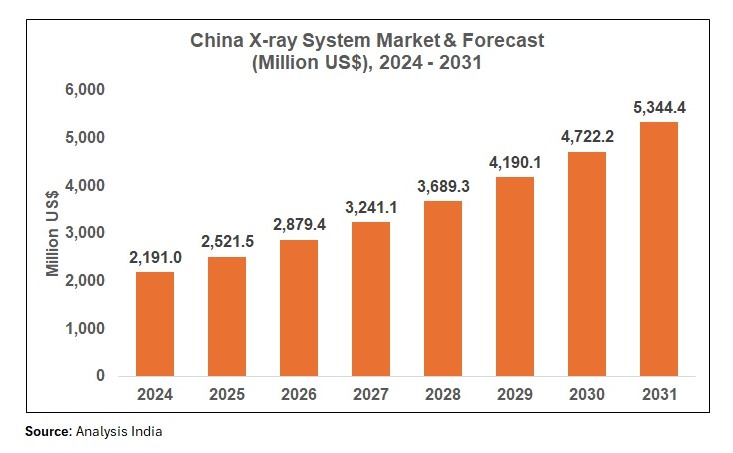
By 2031, the China X-ray Market is projected to reach US$ 5,344.4 million, from US$ 2,191 Million in 2024. Growth reflects expanding hospital construction, rural healthcare modernization, and replacement of legacy imaging equipment with digital systems. Compared with more mature markets, China demonstrates stronger growth momentum driven by infrastructure expansion and increasing diagnostic procedure volumes.
Healthcare Infrastructure Supporting the China X-ray Market
China maintains a vast and expanding healthcare system that includes tertiary hospitals, county-level facilities, community healthcare centers, and private diagnostic clinics. Government-backed healthcare reform initiatives have focused on strengthening primary care networks and upgrading medical equipment in regional hospitals.
Large urban hospitals continue investing in advanced imaging platforms, while secondary and rural facilities are transitioning from conventional radiography to digital systems. The expansion of public hospital networks and private healthcare providers is supporting consistent demand across diverse geographic regions.
Population density and rising healthcare access are increasing diagnostic imaging utilization rates, reinforcing long-term growth within the China X-ray Market.
Regulatory Framework
The China X-ray Market operates under regulatory oversight from the National Medical Products Administration. The regulatory framework ensures compliance with radiation safety standards, product registration requirements, and quality manufacturing protocols.
Approval processes include technical evaluation, safety validation, and performance testing prior to commercialization. Regulatory reforms in recent years have aimed to streamline device approvals while maintaining safety oversight.
Public hospital procurement decisions are influenced by centralized bidding systems and provincial-level funding programs. Regulatory clarity and structured procurement mechanisms support steady market expansion while maintaining compliance standards.
Technology Adoption Trends
The China X-ray Market is undergoing rapid digital transformation. Analog radiography systems are being replaced with digital radiography platforms across hospitals and diagnostic centers. Flat-panel detector technology adoption is increasing, improving image clarity and workflow efficiency.
Artificial intelligence integration is emerging within larger urban hospitals, where AI-enabled tools assist radiologists in image analysis and workflow prioritization. Integration with PACS and hospital information systems is strengthening digital ecosystem connectivity.
Mobile digital radiography systems are gaining adoption in emergency and critical care settings, particularly within expanding hospital networks. Technology modernization is a defining characteristic of the China X-ray Market, supporting improved diagnostic efficiency nationwide.
Market Segmentation
The China X-ray Market includes fixed digital radiography systems, mobile radiography units, mammography systems, fixed and mobile C-arm systems, and DRF platforms.
Fixed digital radiography systems represent the largest installed base due to their role in hospital radiology departments. Mobile systems are increasingly used in intensive care units and emergency settings. Mammography systems support growing breast cancer screening initiatives in urban centers. C-arm systems are widely used in orthopedic and surgical imaging procedures.
Hospitals account for the largest share of equipment installations, while private imaging centers and specialized clinics represent expanding end-user segments.
Procurement and Replacement Trends
Procurement activity in the China X-ray Market is influenced by centralized hospital funding programs and provincial healthcare budgets. Government modernization initiatives prioritize upgrading imaging infrastructure in secondary and county-level hospitals.
Replacement demand is driven by digital migration rather than pure lifecycle renewal alone. Many healthcare facilities are transitioning directly from analog to advanced digital systems, creating strong upgrade momentum.
Service contracts and equipment maintenance agreements are increasingly incorporated into procurement packages to ensure long-term system reliability.
Competitive Landscape
The competitive landscape of the China X-ray Market includes international imaging manufacturers alongside domestic equipment producers. Global companies such as GE HealthCare, Siemens Healthineers, Canon Medical Systems, and Philips maintain a strong presence in major metropolitan hospitals.
Domestic manufacturers also compete actively, particularly in mid-tier and regional markets where cost sensitivity influences procurement decisions.
Competition is based on pricing, detector performance, AI capabilities, and service coverage across provinces.
Regional Trends Within the China X-ray Market
Significant regional variation exists within the China X-ray Market. Tier-one cities such as Beijing, Shanghai, and Guangzhou demonstrate higher adoption of advanced digital platforms and AI integration. In contrast, rural and lower-tier cities are in earlier stages of digital transition.
Government initiatives aimed at reducing healthcare disparities are accelerating equipment upgrades in underserved regions. This regional expansion supports balanced long-term growth across urban and rural healthcare systems.
Growth Drivers
The China X-ray Market is supported by multiple structural growth drivers. Rising healthcare expenditure, expanding hospital infrastructure, and increasing chronic disease prevalence are strengthening diagnostic imaging demand.
Population aging and growing urban healthcare access are contributing to higher imaging procedure volumes. Continued government investment in public healthcare modernization further reinforces system adoption across provinces.
Challenges
Despite strong growth, the China X-ray Market faces certain challenges. Price competition can influence procurement margins, particularly in regional hospitals. Regulatory compliance requirements and product registration processes may extend market entry timelines.
Rural infrastructure limitations and workforce training gaps can also affect system utilization rates. However, ongoing healthcare reforms aim to address these disparities over time.
Future Outlook
The China X-ray Market is projected to maintain strong growth through 2031, reaching US$ 5,344.4 million. Continued digital migration, AI integration, and hospital modernization will shape market expansion.
As healthcare access improves nationwide, the China X-ray Market will remain a key growth engine within the broader Global X-ray System Market and Asia Pacific diagnostic imaging landscape.
Conclusion
The China X-ray Market represents a rapidly expanding diagnostic imaging segment driven by healthcare infrastructure development, digital transformation, and government modernization initiatives. With projected revenue reaching US$ 5,344.4 million by 2031, the market reflects strong long-term growth potential supported by structural healthcare reforms and increasing imaging demand.
Frequently Asked Questions
What is the projected size of the China X-ray Market by 2031?
The China X-ray Market is projected to reach US$ 5,344.4 million by 2031.
What drives growth in the China X-ray Market?
Growth is driven by hospital expansion, digital radiography adoption, healthcare reform initiatives, and increasing diagnostic procedure volumes.
Who regulates the China X-ray Market?
The market is regulated by the National Medical Products Administration, which oversees device approval and safety standards.
Which system type dominates the China X-ray Market?
Fixed digital radiography systems represent the largest installed base due to their central role in hospital imaging departments.