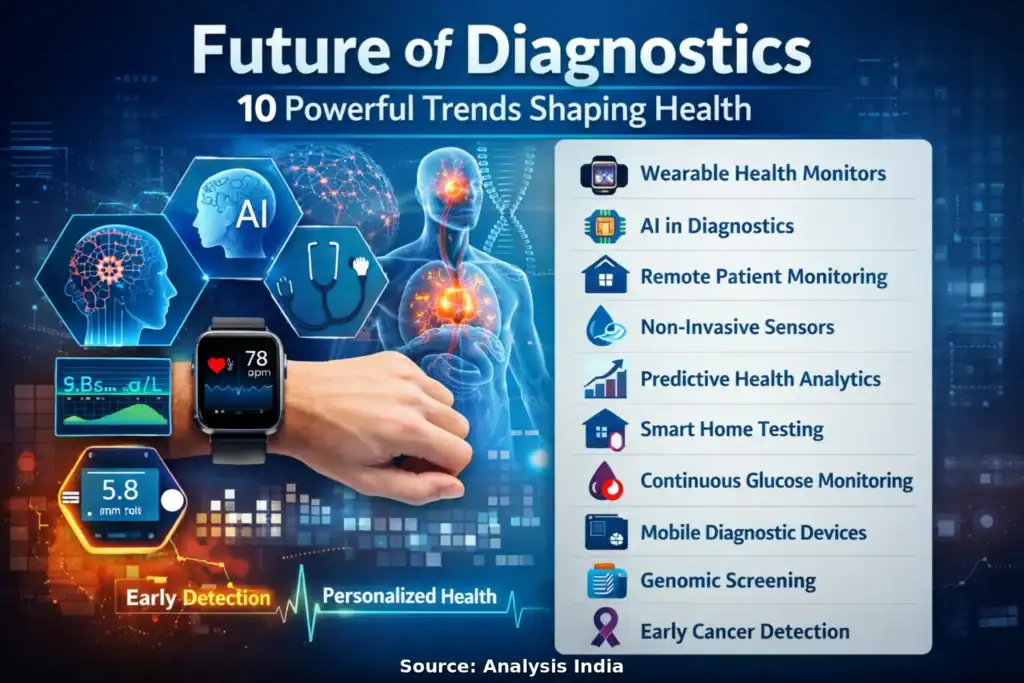
The Future of Diagnostics is rapidly evolving as smart tools and advanced wearables transform how diseases are detected, monitored and prevented. Today, companies such as Abbott, Roche Diagnostics, Apple, Google and Dexcom lead this revolution. These organizations are bringing health tracking into everyday life and enabling early detection across populations. The Future of Diagnostics is now present in-home test kits, portable ultrasound systems and wearable devices that collect continuous health information in real time.
As global demand for preventive care grows, innovation within diagnostics moves forward with greater urgency. The Future of Diagnostics is guided by the idea that testing should be continuous, simple and comfortable for users. A recent McKinsey report suggests that diagnostics will slowly shift the world from treatment after diagnosis to prediction before illness becomes serious. This shift creates opportunities for healthcare providers, technology companies and insurance firms that want to reduce risks before diseases progress.
Clinicians are now using digital systems such as Philips IntelliVue Guardian. These systems track patient data through wireless sensors and clinical software. Medical teams receive alerts when respiration patterns or heart rhythm become unusual, allowing earlier acknowledgement of risk. This direction shows how the Future of Diagnostics connects wearable technologies, software and clinical workflows to guide interventions on time.
Future of Diagnostics in smart wearable ecosystems
Smart wearables are central to the Future of Diagnostics because they collect real time physiological information throughout the day. Devices including the Apple Watch Series 9, Fitbit Sense and Samsung Galaxy Watch6 track oxygen saturation, heart rhythm, sleep quality and stress indicators. These measurements can reveal early signals of disease even before visible symptoms appear.
Apple CEO Tim Cook once said, “Apple’s greatest contribution to mankind will be in health.” This statement reflects how wearables are becoming personal diagnostic tools that continuously offer health insights for individuals.
Continuous glucose monitoring devices also demonstrate how the Future of Diagnostics shapes disease management. The Dexcom G7 supports individuals living with diabetes by offering continuous glucose tracking and alert features. These alerts help people respond quickly when glucose trends move out of range and support better day to day decision making.
Wearables are expanding their roles beyond personal tracking. Companies such as Verily and Eli Lilly use wearable based monitoring during clinical research. These devices improve trial consistency and allow remote observation, which reduces participant burden. The Future of Diagnostics in research environments improves reliability because the measured data reflects life outside controlled lab visits.
An example of practical diagnostic value in everyday life is AliveCor KardiaMobile. The device can record a medical grade ECG using a smartphone. It detects atrial fibrillation and guides patients to seek clinical support when the recording reveals problems. The Mayo Clinic works with AliveCor to analyze ECG recordings with artificial intelligence. The approach allows physicians to identify early indications of heart dysfunction even before routine symptoms appear.
Wearables are also guiding risk-based insurance programs. John Hancock provides reduced premiums to customers who engage with approved fitness trackers. This program rewards people who maintain consistent biometric tracking and encourages healthy habits based on wearable driven diagnostics.
Developers are exploring new non-invasive glucose sensing technologies.
Examples include
- Apple investigating optical glucose sensing
- Samsung and MIT exploring Raman spectroscopy-based glucose detection
- Rockley Photonics developing infrared based sensing for digital biomarkers
These examples show the direction of the Future of Diagnostics, where long term tracking supports better health decisions and offers data that guides prevention with minimal discomfort.
How smart tools shape the Future of Diagnostics in early disease detection
The Future of Diagnostics is built around early disease detection. Smart tools that are accessible and affordable support this goal. Abbott BinaxNOW home testing and Roche NAVIFY are two examples of platforms that allow rapid testing and decision support outside hospital environments. These solutions help clinicians respond sooner and allow individuals to assess their status without waiting for laboratory appointments.
Robert Ford, CEO of Abbott, stated, “Sensors and diagnostics will eventually create a world where chronic conditions are detected before symptoms appear.” His outlook is reflected in the development of biosensors that analyze cardiovascular risk while people sleep. It is also reflected in the use of Google Health AI to study retinal images for signs of diabetic complications.
Blood based cancer detection is another major focus in the Future of Diagnostics. Companies such as Guardant Health created tests that detect signals of colorectal cancer from blood samples. This approach supports earlier guidance for clinicians and creates opportunities for improved treatment timing. Another organization, Grail, developed Galleri, a single blood test that identifies molecular patterns associated with many cancers. These blood-based diagnostics simplify the experience of screening and bring testing closer to routine health checks.
Chronic heart disease management is also transforming. Biofourmis collaborates with pharmaceutical companies to create digital therapeutics that learn from patient data. Wearable devices collect continuous cardiac and activity information that allows predictions of risk. In practice this means that unusual heart behavior can be noticed sooner, supporting earlier clinical contact and fewer complications.
A strong example of diagnostic accessibility in developing regions is the Molbio Diagnostics Truenat platform. Truenat is a portable molecular testing system used for tuberculosis, HIV and HPV detection. The platform runs outside major laboratories, supporting testing in places with limited infrastructure. This direction confirms that the Future of Diagnostics is not limited to advanced hospitals. Instead, it expands availability where accurate testing is often missing.
Future of Diagnostics powered by artificial intelligence and predictive analytics
Artificial intelligence strengthens the Future of Diagnostics by processing large volumes of clinical and wearable data. Roche Diagnostics integrates artificial intelligence into cancer diagnostics to support consistent interpretations. Butterfly Network introduced a pocket sized ultrasound device connected to smartphones. This gives clinicians in rural regions better access to imaging without waiting for large equipment.
The Future of Diagnostics relies on predictive models that review thousands of biometric data points at once. When these patterns are recognized, clinicians can draw earlier conclusions about risk. Artificial intelligence helps uncover signals of neurological disorders, cardiac diseases and metabolic dysfunctions that are not easily visible in short clinical visits.
Companies such as Neurotrack develop cognitive tests that measure eye movement and attention. These assessments identify early risk for Alzheimer related changes while memory still feels normal. This approach aligns with the goal of catching problems before decline becomes visible.
Another organization, Insilico Medicine, uses deep learning models to interpret proteins, gene signatures and metabolites. The insights support both diagnostic identification and therapeutic planning. The combined method reflects the Future of Diagnostics, where detection guides personalized care choices.
Artificial intelligence also supports pathology. PathAI collaborates with major pharmaceutical companies to review digital pathology images. Their systems reduce interpretation variability among pathologists and improve consistency for treatment selection. This direction shows how the Future of Diagnostics merges human expertise with artificial intelligence based analysis.
Predictive analytics also support infectious disease monitoring. BlueDot, an analytics company, examines travel information, online discussions and regional news to recognize signals of disease spread. This method helps health organizations prepare resources early and manage the risk of outbreaks. The Future of Diagnostics extends beyond individual patients and supports the wellbeing of communities.
What lies ahead in the Future of Diagnostics
The Future of Diagnostics is aimed at prevention instead of late-stage treatment. Smart wearables, predictive systems and connected sensors will continue to move diagnostics into homes, workplaces and public spaces. People will receive early signals when health metrics change. This direction supports quicker response and lowers the risk of serious outcomes.
Expected developments in the coming decade
- Continuous glucose tracking becomes common for wellness use
- Blood pressure and cholesterol may be measured through wrist-based sensors
- Portable imaging solutions support diagnostics in underserved areas
- Predictions about individual health risk guide personal lifestyle choices
The Future of Diagnostics will likely blend everyday activity with passive monitoring inside homes. Smart bathrooms may assess urine chemistry. Mirrors may analyze skin conditions. Mattresses may track sleep patterns for respiratory and cardiac risk. The routine environment becomes a source of diagnostic information without requiring user action.
Consumer electronics will slowly integrate diagnostic hardware and software. Experts believe smartphones will be able to detect anemia, hydration and blood pressure through optical sensing. This results in billions of potential diagnostic tools already in the hands of users.
Genomics also supports preventive diagnostics. 23andMe, Helix and Color Health offer genetic insights that help individuals understand inherited conditions. Co founder Anne Wojcicki said, “The value of genetics is realized when it guides everyday decisions.” This statement reflects how genetic risk profiles and continuous diagnostics combine to support long range health decisions.
The Future of Diagnostics will also consider ethical and regulatory questions.
Important questions include
- Who controls diagnostic data
- Whether predictive results should affect insurance premiums
- How to communicate risk when treatment options are limited
Regulators such as the United States FDA, the European Medicines Agency and India Central Drugs Standard Control Organization are shaping policies that balance innovation and privacy. Their work ensures that diagnostic advances support public health and maintain trust.
Conclusion
The Future of Diagnostics is being influenced by smart tools, wearables and early detection strategies. These developments support proactive health decisions and earlier interventions. Companies such as Apple, Abbott, Google, Roche and Dexcom continue to introduce platforms that improve access and increase user engagement. As diagnostic technology becomes more continuous and predictive, healthcare systems will serve people before illness becomes severe. The Future of Diagnostics encourages healthier lives through awareness and informed action.