Introduction India imposes norms for AI cancer detection
Analysis India: India imposes norms for AI cancer detection at a critical stage when artificial intelligence is moving rapidly from experimental pilots into mainstream clinical practice. Over the past few years AI powered tools have been increasingly used across radiology pathology and population screening programs to identify early signs of cancer. These tools promise faster interpretation improved workflow efficiency and support for clinicians working under capacity constraints.
However cancer diagnosis represents one of the most sensitive areas of healthcare where inaccuracies can directly affect patient outcomes. The rapid commercialization of AI cancer detection tools without uniform regulatory oversight created concerns among policymakers clinicians and patient advocacy groups. Questions around data quality algorithm bias transparency and accountability began to surface as adoption expanded beyond controlled environments.
By introducing formal norms India has taken a decisive step toward regulating how AI is developed validated and deployed for cancer detection. This regulatory move signals that while the government supports innovation it also recognizes the need for safeguards in high risk clinical applications.
India imposes norms for AI cancer detection to address rising adoption
The decision that India imposes norms for AI cancer detection is closely linked to the growing reliance on artificial intelligence in Indian healthcare settings. India faces a high cancer burden with many cases diagnosed at advanced stages due to limited access to specialists and screening infrastructure. AI based diagnostic tools were increasingly positioned as a solution to bridge these gaps especially in underserved regions.
Hospitals diagnostic laboratories and public health programs began adopting AI systems that analyse medical images pathology slides and clinical data to flag potential malignancies. In several cases these systems were used to support decision making in breast cancer lung cancer cervical cancer and oral cancer screening initiatives.
While early results showed promise the lack of standardized evaluation raised concerns. Different tools used different datasets validation methods and performance benchmarks. Without regulatory clarity it became difficult to compare solutions or ensure consistent quality. This environment made it necessary for the government to step in and define clear norms for AI cancer detection.
India imposes norms for AI cancer detection under medical device rules
AI cancer detection classified as Software as a Medical Device
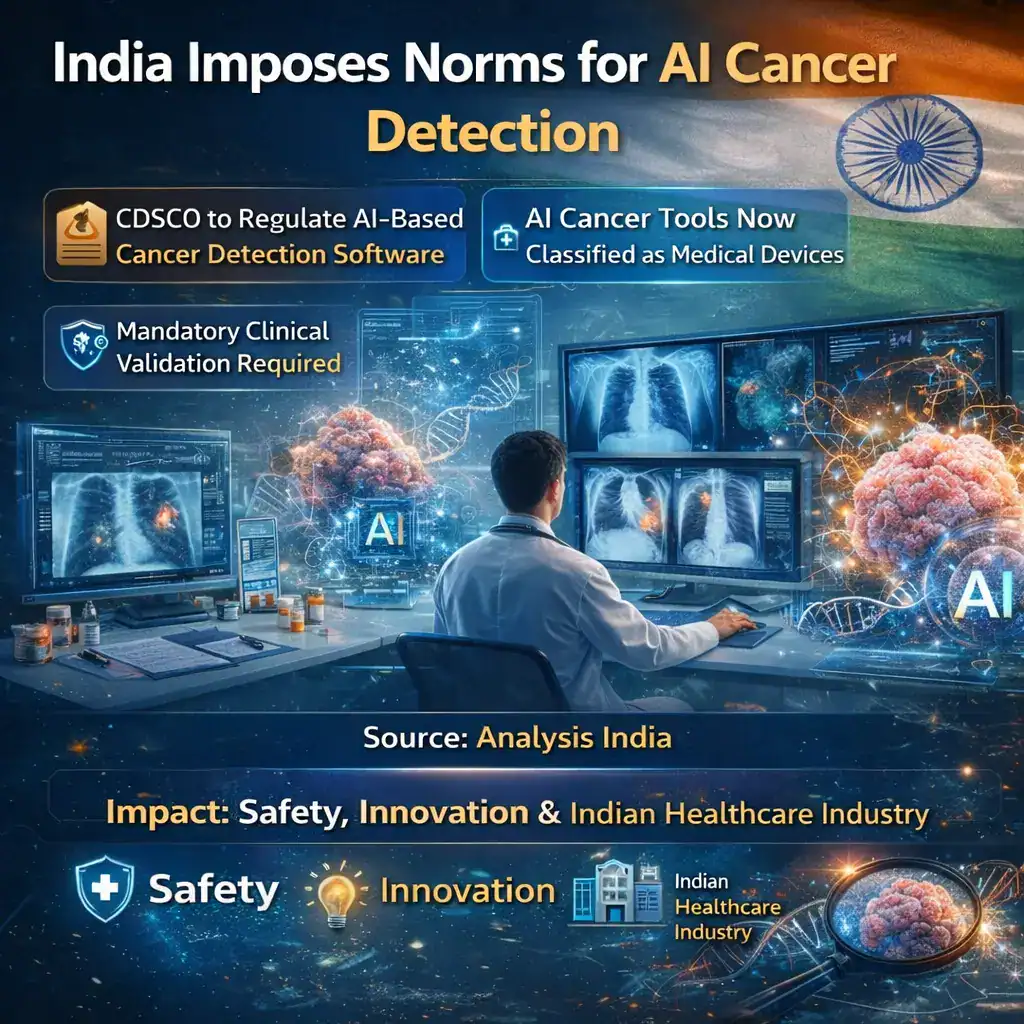
A key aspect of the policy is that AI cancer detection software is now classified as Software as a Medical Device. This brings such tools under the regulatory authority of the Central Drugs Standard Control Organisation. Once classified as a medical device AI software is subject to approval requirements similar to other diagnostic technologies.
This classification removes earlier ambiguity where AI tools were often positioned as decision support systems rather than clinical devices. In cancer detection the output of AI algorithms can influence diagnosis and treatment planning. Recognizing this impact regulators have treated these tools as medical products rather than general software.
The move aligns India with international regulatory practices and establishes a clear legal framework for AI based diagnostics.
Clinical validation becomes mandatory for AI cancer detection
Another major outcome of the decision that India imposes norms for AI cancer detection is the emphasis on clinical validation. Developers are required to demonstrate that their AI systems perform reliably in real world clinical settings. This includes validation on datasets that reflect Indian patient demographics disease patterns and healthcare infrastructure.
Cancer manifestation in India can differ significantly from Western populations where many AI models are initially trained. Differences in imaging quality stage at diagnosis and patient profiles can affect algorithm performance. Regulators have acknowledged this by stressing the importance of localized evidence.
Clinical validation also encourages collaboration between AI developers hospitals and academic institutions. This approach improves scientific rigor and builds confidence among clinicians who are cautious about adopting automated diagnostic tools.
Impact of AI cancer detection norms on Indian healthcare startups
The fact that India imposes norms for AI cancer detection has significant implications for Indian healthtech startups. Many startups entered the oncology AI space attracted by unmet clinical needs and rapid technological advancements. However regulatory requirements were often unclear during early product development.
With defined norms startups now face higher compliance requirements including documentation clinical studies and regulatory submissions. While this increases development costs it also improves market credibility. Startups that successfully navigate the regulatory pathway gain a competitive advantage when engaging with hospitals and investors.
Companies such as Niramai have consistently highlighted the importance of clinical validation and regulatory engagement. Their approach demonstrates that compliance and innovation can coexist. Clear norms may also reduce the presence of unvalidated solutions in the market leading to higher overall quality.
Impact on hospitals and diagnostic chains in India
Hospitals adopt AI cancer detection with greater accountability
Hospitals and diagnostic chains have been among the largest adopters of AI technologies. Large healthcare networks such as Apollo Hospitals have publicly discussed the role of AI in improving diagnostic accuracy and operational efficiency. With India imposing norms for AI cancer detection hospitals must now ensure that AI tools integrated into clinical workflows meet regulatory standards.
This requirement enhances accountability and reduces medico legal risks. Hospital administrators can make more informed procurement decisions knowing that approved tools meet baseline safety and performance criteria. Clinicians also benefit from clearer guidance on which AI tools are suitable for clinical use.
AI cancer detection strengthens clinical decision support
Regulated AI cancer detection systems are more likely to be trusted by clinicians. Doctors generally view AI as a support tool rather than a replacement for human expertise. When AI systems undergo regulatory scrutiny clinicians gain confidence in their outputs.
This fosters better integration of AI into clinical decision making where algorithms assist in pattern recognition while physicians retain final judgment. Such collaboration improves efficiency without compromising patient safety.
Patient safety and public health implications
From a patient perspective the decision that India imposes norms for AI cancer detection directly addresses concerns around safety and reliability. Cancer diagnosis carries emotional and clinical consequences. False positives can lead to anxiety and unnecessary procedures while false negatives can delay treatment.
Regulatory oversight reduces the risk of poorly validated tools being used in patient care. Patients can have greater confidence that AI assisted diagnostics are backed by evidence and oversight.
At a public health level regulation may facilitate broader adoption of AI in government led screening programs. Clear norms make it easier for public agencies to procure and deploy AI solutions at scale.
India imposes norms for AI cancer detection in line with global regulation
India’s approach mirrors global regulatory trends. The US Food and Drug Administration regulates AI based medical devices and has issued guidance on adaptive algorithms. The European Union classifies medical AI systems as high risk under its AI Act.
By introducing norms for AI cancer detection India ensures compatibility with international standards. This is particularly important for Indian companies aiming to expand globally. Regulatory alignment reduces barriers to international collaboration and market access.
Implementation challenges and future outlook
While the policy is widely welcomed implementation will require continuous refinement. AI technologies evolve rapidly and regulators must adapt approval processes accordingly. Managing software updates and post market surveillance will be critical.
Data availability and diversity also remain challenges. Ensuring that AI models perform well across India’s diverse population requires sustained collaboration between industry and healthcare institutions.
Despite these challenges the long term outlook is positive. Regulation provides a stable foundation for responsible innovation.
Conclusion: India imposes norms for AI cancer detection as a healthcare milestone
India imposes norms for AI cancer detection at a pivotal moment in the country’s healthcare transformation. The policy reflects a balanced approach that supports innovation while prioritizing patient safety and clinical integrity.
By formally regulating AI based cancer diagnostics India is strengthening trust in digital health technologies. The move encourages higher quality solutions deeper clinical integration and alignment with global best practices.
As artificial intelligence continues to shape the future of oncology these norms will play a defining role in ensuring that technology serves patients clinicians and the healthcare system responsibly.
FAQs on India Imposes Norms for AI Cancer Detection
What does it mean when India imposes norms for AI cancer detection
India imposes norms for AI cancer detection by classifying artificial intelligence based cancer diagnostic software as a regulated medical device. These norms require clinical validation safety assessment and regulatory approval before such AI tools can be used in hospitals diagnostic labs or screening programs.
Why did India regulate AI cancer detection tools
India regulated AI cancer detection tools because they directly influence cancer diagnosis and treatment decisions. Unregulated AI systems raised concerns about accuracy data bias and patient safety. Regulation ensures responsible innovation while protecting patients from potential diagnostic errors.
Which authority regulates AI cancer detection in India
AI cancer detection in India is regulated by the Central Drugs Standard Control Organisation. CDSCO oversees approval monitoring and compliance of AI based cancer detection software under India’s Medical Device Rules to ensure safety and clinical reliability.
Are all AI healthcare applications covered under AI cancer detection norms
Not all AI healthcare applications are covered. The norms mainly apply to high risk AI systems used for cancer detection diagnosis or clinical decision making. AI tools used for administrative functions or workflow management are regulated differently or may not require approval.
How do AI cancer detection norms affect Indian startups
AI cancer detection norms require startups to conduct clinical validation and obtain regulatory approval. While this increases development effort it improves product credibility hospital adoption and long term scalability. Regulated startups are more trusted by healthcare providers and investors.
Will AI cancer detection regulation slow innovation in India
AI cancer detection regulation is designed to guide innovation rather than slow it. Clear rules provide a structured pathway for commercialization and encourage development of safe clinically relevant and scalable AI solutions for oncology care.
How do AI cancer detection norms impact hospitals and doctors
Hospitals and doctors benefit from greater clarity and reduced clinical risk. Regulated AI cancer detection tools meet defined safety and performance standards which increases clinician trust and supports responsible integration of AI into clinical workflows.
What are the patient benefits of AI cancer detection regulation
Patients benefit from improved safety reliability and trust. Regulation reduces the use of inaccurate or biased AI tools in cancer diagnosis and ensures that AI assisted detection systems are clinically validated and regulator approved.
How does India’s AI cancer detection regulation compare globally
India’s AI cancer detection regulation aligns with global practices where AI based medical devices are treated as high risk. This alignment helps Indian healthcare AI companies meet international standards and expand into global markets.
What is the long term impact of India imposing norms for AI cancer detection
The long term impact is a more trusted and sustainable healthcare AI ecosystem. Regulation encourages higher quality innovation stronger clinical collaboration and safer adoption of AI in cancer detection across the Indian healthcare system.