
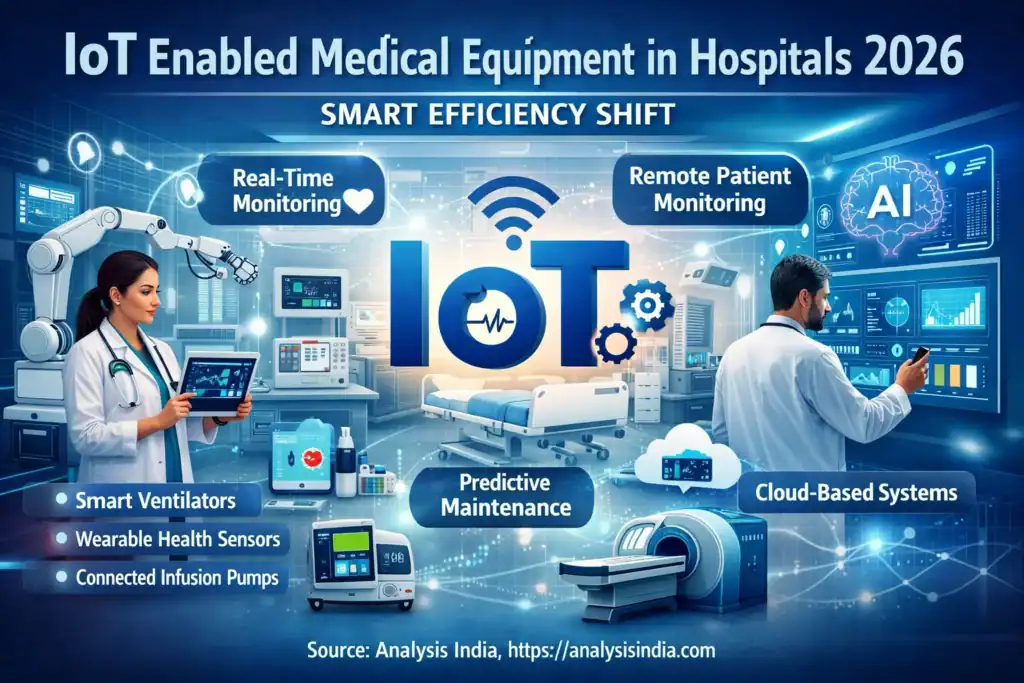
Analysis India: IoT Enabled Medical Equipment in Hospitals are becoming a critical part of healthcare infrastructure in 2026 as hospitals focus on improving efficiency, safety, and real time decision making. These connected systems include smart beds, connected ventilators, and real time equipment tracking platforms that continuously share data across hospital networks. By using Internet of Things technology, medical devices can now communicate with central dashboards and hospital information systems. This allows staff to monitor device performance, patient conditions, and equipment availability without manual checks. Hospitals rely on IoT Enabled Medical Equipment in Hospitals to reduce delays, optimise workflows, and improve patient care coordination. As digital healthcare systems mature, connected medical devices are reshaping how hospitals manage daily operations.
Modern hospitals manage thousands of medical devices every day, and traditional tracking methods often rely on manual records or staff memory. This can lead to delays, misplaced equipment, and inefficient resource use. IoT Enabled Medical Equipment in Hospitals provide real time visibility into where devices are located and how they are being used. Staff can instantly locate ventilators, infusion pumps, and wheelchairs through digital dashboards. Maintenance teams receive alerts when equipment needs servicing, which reduces unexpected downtime. By connecting devices across departments, hospitals gain a unified view of their operational resources. This level of visibility helps hospitals respond faster during emergencies and improves overall efficiency.
Rising Demand for IoT Enabled Medical Equipment in Hospitals
Hospitals face growing pressure to deliver high quality care while managing rising patient volumes and operational costs. Staff shortages, longer hospital stays, and complex treatments make efficient equipment management more important than ever. IoT Enabled Medical Equipment in Hospitals help automate the tracking of critical devices such as ventilators, monitors, and smart beds. Real time location data allows staff to find equipment quickly during emergencies. This reduces response time and improves patient safety. Administrators also gain better insight into asset utilisation across departments. As a result, hospitals can improve efficiency without expanding staff numbers.
Clinical teams benefit from faster access to life saving devices, especially in intensive care and emergency units. Administrators can analyse equipment usage patterns to avoid shortages. Maintenance teams receive automatic alerts when devices require calibration or repair. Secure hospital networks ensure continuous data flow between devices and central systems. These improvements reduce waste, prevent equipment loss, and improve care coordination. Because of these advantages, IoT Enabled Medical Equipment in Hospitals are becoming standard infrastructure in modern healthcare facilities.
Market data confirms this rising demand. According to Fortune Business Insights, the global IoT in healthcare market reached USD 160.4 billion in 2024 and continues to grow as hospitals invest in connected medical devices. This growth reflects strong confidence in IoT systems and their ability to support hospital efficiency. The expanding market also shows that healthcare organisations view IoT Enabled Medical Equipment in Hospitals as long term digital infrastructure investments.
IoT in Healthcare Market Snapshot
| Segment | Year | Market Value | Source |
|---|---|---|---|
| IoT in Healthcare | 2024 | USD 160.4 Billion | Fortune Business Insights |
Global Investment and Market Expansion
Investment in IoT Enabled Medical Equipment in Hospitals is increasing as healthcare systems move toward smart hospital models. Medical technology companies are expanding research into connected devices, wireless sensors, and hospital asset tracking platforms. Governments are also supporting smart healthcare initiatives to improve hospital preparedness and digital resilience. These investments help hospitals modernise infrastructure and improve care delivery. Digital transformation programs encourage the adoption of IoT based systems across healthcare facilities. Together, these efforts are driving widespread implementation of connected medical equipment.
North America leads IoT adoption due to advanced hospital IT systems and strong digital health policies. Europe follows with large scale hospital digitisation programs focused on connected care environments. Asia Pacific is expanding rapidly as new smart hospitals are built and existing facilities are upgraded. IoT Enabled Medical Equipment in Hospitals are now used in tertiary care centres, trauma hospitals, and large medical campuses. This global expansion highlights the growing importance of connected healthcare infrastructure.
According to MarketsandMarkets, the global smart hospital market is expected to grow strongly due to increasing adoption of IoT based medical devices and real time monitoring systems. The research firm links this growth to rising demand for operational efficiency and patient safety improvements. Hospitals are investing in connected solutions to manage complex workflows more effectively. This confirms the expanding role of IoT Enabled Medical Equipment in Hospitals across global healthcare systems.
Smart Hospital Market Forecast
| Segment | Year | Market Trend | Source |
|---|---|---|---|
| Smart Hospital Solutions | 2028 | Strong growth | MarketsandMarkets |
What Defines IoT Enabled Medical Equipment in Hospitals
IoT Enabled Medical Equipment in Hospitals include medical devices that connect to hospital networks and share data automatically. Smart beds track patient movement, posture, and vital signs through built in sensors. Connected ventilators transmit respiratory performance data to ICU dashboards in real time. Asset tracking systems use RFID or Bluetooth tags to monitor the location of mobile equipment. These technologies provide continuous visibility into both patient care and equipment usage.
Doctors can monitor patient conditions remotely through central dashboards. Administrators can track equipment availability and utilisation rates. Maintenance teams receive alerts when devices require servicing or calibration. IoT platforms integrate device data with hospital information systems for seamless coordination. This improves communication between departments and reduces operational inefficiencies. Manufacturers also focus on cybersecurity, data accuracy, and regulatory compliance to protect patient information.
Smart Beds Enhancing Patient Monitoring
Smart beds are a key part of IoT Enabled Medical Equipment in Hospitals. These beds monitor patient movement, posture, and vital signs using embedded sensors. They detect changes in pressure, breathing patterns, and heart rate. Data is transmitted to nurse stations in real time for continuous monitoring. This helps staff respond quickly to patient needs.
Smart beds also help prevent patient falls by sending alerts when patients attempt to leave the bed. This improves safety in high risk wards such as ICUs and geriatric units. Pressure injury prevention is supported by tracking patient repositioning schedules. Nurses receive reminders to adjust patient positions when needed. These features improve comfort and reduce complications. Companies such as Hillrom and Stryker offer connected hospital beds used in modern care units.
Connected Ventilators Supporting Respiratory Care
Connected ventilators use IoT technology to share real time respiratory data with ICU systems. These devices monitor airflow, oxygen levels, and lung performance continuously. AI algorithms analyse breathing patterns to detect abnormalities early. Alerts are sent when patient conditions worsen. This allows faster medical intervention.
Doctors can adjust ventilator settings remotely through digital dashboards. This improves response time in critical care situations. Data integration with ICU monitoring systems supports better treatment decisions. Remote monitoring also helps specialists review patient data from different hospital locations. Philips Healthcare, GE Healthcare, and Medtronic provide IoT enabled ventilators used in hospitals worldwide.
Real Time Equipment Tracking Improving Efficiency
Equipment tracking is one of the most valuable IoT applications in hospitals. RFID and Bluetooth tags are attached to mobile devices such as infusion pumps, monitors, and wheelchairs. Location data is updated continuously and displayed on digital maps. Staff can locate equipment instantly.
This reduces delays in patient care and prevents equipment shortages. Hospitals can optimise asset utilisation by analysing usage patterns. Lost equipment incidents decrease significantly. Maintenance schedules become more efficient. IoT Enabled Medical Equipment in Hospitals improve both clinical response time and cost control.
Workflow Automation in Hospital Operations
IoT automation reduces manual tracking and paperwork in hospital operations. Equipment usage data is recorded automatically in hospital systems. Inventory levels update in real time. This improves supply chain management.
Hospitals can analyse device utilisation to make better purchasing decisions. Staff spend less time searching for equipment. Nurses and technicians can focus more on patient care. According to Healthcare IT News, hospitals using IoT systems report improved workflow efficiency and reduced operational waste.
Real World Use Cases
Philips Healthcare uses IoT platforms to connect ventilators and monitors across hospital networks. Hospitals report better device visibility and faster clinical response. GE Healthcare provides asset tracking solutions for large hospitals, helping reduce equipment downtime. Hillrom offers smart beds that improve patient safety and nurse efficiency. These examples show how IoT Enabled Medical Equipment in Hospitals improve daily operations.
Benefits for Healthcare Systems
IoT Enabled Medical Equipment in Hospitals improve patient safety and operational efficiency. Real time monitoring reduces response delays during emergencies. Equipment tracking prevents shortages and misuse. Hospitals improve resource utilisation across departments.
Staff productivity increases because manual tasks are reduced. Patients receive faster and safer care. The World Health Organization supports digital health tools that strengthen healthcare systems. IoT technologies align with this goal.
Market Growth Driven by Smart Hospital Adoption
The growth of IoT Enabled Medical Equipment in Hospitals is driven by smart hospital initiatives worldwide. Hospitals are investing in connected infrastructure to improve visibility and coordination. Cloud platforms support device data integration and remote access.
MarketsandMarkets reports rising demand for smart hospital technologies due to operational efficiency needs. Fortune Business Insights highlights increasing IoT investment in healthcare. These trends confirm strong market momentum.
Market Forecast
| Segment | Year | Market Value | Source |
|---|---|---|---|
| IoT in Healthcare | 2024 | USD 160.4B | Fortune Business Insights |
| Smart Hospital Solutions | 2028 | Growth phase | MarketsandMarkets |
Adoption Is Rising but Challenges Remain
IoT adoption faces challenges such as cybersecurity risks, system integration complexity, and staff training needs. Hospitals must protect patient data from digital threats. Infrastructure upgrades require significant investment.
However, planning activity is increasing. Many hospitals are launching smart facility programs. IoT Enabled Medical Equipment in Hospitals are viewed as long term strategic investments rather than short term upgrades.
Future Outlook for IoT Based Hospital Equipment
IoT Enabled Medical Equipment in Hospitals will continue evolving. AI will enhance device analytics and predictive maintenance. Remote monitoring will expand beyond ICUs. Integration with electronic health records will improve clinical workflows.
Costs will decrease over time. Adoption will grow in emerging regions. Smart hospitals will become standard in global healthcare systems.
Conclusion
IoT Enabled Medical Equipment in Hospitals are transforming hospital efficiency in 2026. Smart beds, connected ventilators, and real time equipment tracking improve workflows and patient care. Market data shows strong investment growth. Hospitals benefit from better resource management. As technology advances, IoT Enabled Medical Equipment in Hospitals will become essential for modern healthcare.
Frequently Asked Questions (FAQ)
What is IoT enabled medical equipment in hospitals?
IoT enabled medical equipment refers to hospital devices connected through smart networks that collect and transmit real-time data. These systems allow hospitals to monitor patient health, equipment performance, and clinical workflows more efficiently using connected sensors and digital platforms.
How does IoT improve hospital efficiency in 2026?
In 2026, IoT medical equipment helps hospitals reduce manual processes, improve device utilization, and enhance real-time monitoring. Smart systems automate alerts, track equipment usage, and support faster clinical decisions, leading to smoother hospital operations.
Which hospital devices use IoT technology?
Common IoT enabled hospital equipment includes smart ventilators, infusion pumps, patient monitoring systems, imaging devices, wearable sensors, and connected beds. These devices share health data with hospital systems for better care coordination.
Is IoT medical equipment safe for patient data?
Hospitals use encrypted networks, secure cloud platforms, and compliance frameworks to protect patient information. While data security remains a priority, modern IoT healthcare systems are designed with advanced cybersecurity protocols.
How does IoT help with equipment maintenance?
IoT sensors continuously monitor device performance and send alerts for servicing. This predictive maintenance reduces equipment failure, avoids downtime, and keeps critical hospital machines ready for use.
What role does IoT play in remote patient monitoring?
Remote patient monitoring uses IoT devices to track vital signs outside the hospital. Doctors receive real-time data, allowing early intervention, better chronic care management, and reduced hospital readmissions.
Are IoT medical systems expensive to implement?
Initial investment is required for infrastructure and integration. However, long-term benefits such as improved efficiency, reduced downtime, and optimized workflows make IoT hospital equipment cost-effective over time.
How does IoT improve patient experience?
IoT improves patient experience through faster diagnosis, continuous monitoring, personalized treatment, and reduced waiting times. Connected devices support better communication between patients and healthcare teams.
What trends will shape IoT medical equipment by 2026?
Future trends include AI-powered IoT systems, cloud-based hospital platforms, advanced analytics, and fully connected smart wards. These innovations will enhance efficiency and clinical accuracy.