Analysis India: Predictive customer experience tools reflect broader AI market adoption trends in 2026, as enterprises across sectors integrate intelligent systems into service design and delivery. Customer expectations continue to rise across industries. Users expect brands to understand their needs before problems occur. Reactive customer service is no longer enough. Organizations now compete on how well they anticipate customer behavior and act proactively.
Predictive analytics enables businesses to move from responding to issues to preventing them. By analyzing historical data, real time signals, and behavioral patterns, predictive customer experience AI helps organizations deliver timely, relevant, and personalized interactions.
In 2026, predictive analytics is deeply integrated into customer experience platforms. It supports churn prevention, service optimization, and proactive engagement. According to McKinsey and Company, companies using predictive customer analytics outperform peers in customer retention and satisfaction.
This article explores predictive analytics and proactive customer experience in detail. It explains how predictive customer experience AI anticipates customer needs, reduces churn, and optimizes service delivery using data driven insights.
What Is Predictive Customer Experience AI
Predictive customer experience AI refers to the use of artificial intelligence and advanced analytics to forecast customer behavior and outcomes. It helps organizations understand what customers are likely to do next.
In 2026, predictive customer experience AI analyzes structured and unstructured data. This includes transaction history, browsing behavior, service interactions, and sentiment signals. AI models identify patterns that humans cannot detect at scale.
These insights allow businesses to intervene early. Instead of waiting for complaints or churn, brands act proactively to improve customer experience.
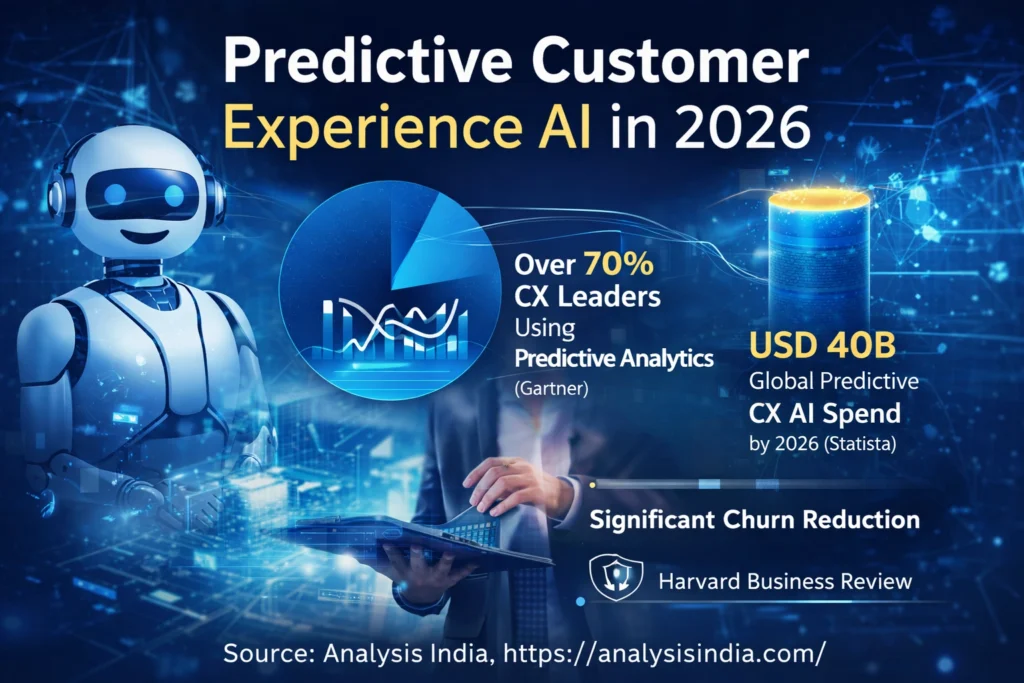
According to Gartner, more than 70 percent of customer experience leaders use predictive analytics to guide engagement strategies in 2026.
Global Market Overview for Predictive Customer Experience AI
The global market for predictive customer experience AI is growing steadily in 2026. Organizations across banking, retail, healthcare, travel, and telecom invest heavily in predictive analytics platforms.
According to Statista, global spending on customer analytics and predictive AI solutions is expected to exceed USD 40 billion by 2026. Customer experience optimization represents a major share of this investment.
Growth drivers include digital transformation, omnichannel engagement, and increasing competition. Predictive customer experience AI helps businesses differentiate through smarter engagement rather than price competition.
Enterprises also focus on explainable AI to ensure trust and compliance.
Regional Adoption Trends
North America
North America leads in predictive customer experience AI adoption. Enterprises use predictive analytics for churn prevention and service optimization.
According to Forrester, predictive analytics is widely embedded in customer experience platforms used by large organizations.
Salesforce integrates predictive AI into its customer platforms. Company leadership states that predictive insights help brands engage customers at the right moment.
Advanced data infrastructure supports adoption in this region.
Europe
Europe focuses on responsible predictive customer experience AI. Data protection regulations shape deployment strategies.
According to European Commission digital studies, predictive analytics adoption is growing across financial services and retail.
Vodafone uses predictive analytics to identify churn risk early. Executives highlight that proactive engagement improves customer loyalty while respecting privacy.
Transparency and consent remain key priorities.
Asia Pacific
Asia Pacific shows rapid growth in predictive customer experience AI adoption. Mobile first consumers generate rich behavioral data.
According to PwC, companies in China, India, Japan, and Southeast Asia invest heavily in predictive customer analytics.
Alibaba Group uses predictive AI to anticipate customer needs across commerce platforms. Leadership notes that predictive models improve relevance and engagement.
High data volumes accelerate model learning.
Anticipating Customer Needs with Predictive Analytics
Anticipating customer needs is a core benefit of predictive customer experience AI. Customers expect brands to understand intent without repeated explanations.
In 2026, predictive models analyze behavior signals such as browsing patterns, purchase frequency, and service usage. These insights help brands predict needs before customers ask.
For example, predictive AI can identify when a customer is likely to need support or a product upgrade. Proactive recommendations improve satisfaction.
According to Boston Consulting Group, anticipation driven experiences significantly increase customer engagement.
Amazon uses predictive analytics to anticipate customer needs and personalize recommendations. Company leadership has emphasized that relevance drives long term loyalty.
Anticipation transforms experience from reactive to intuitive.
Churn Prevention Using Predictive Customer Experience AI
Churn prevention is a major use case for predictive customer experience AI. Losing customers is costly and often preventable.
In 2026, predictive analytics identifies early warning signals of churn. These include reduced engagement, negative sentiment, and usage changes. AI models assign churn risk scores.
Businesses use these insights to trigger proactive interventions such as personalized offers or outreach.
According to Harvard Business Review, predictive churn models improve retention outcomes when combined with proactive engagement.
Telefónica uses predictive analytics to reduce customer churn. Executives state that early detection allows timely and personalized retention strategies.
Preventing churn strengthens long term relationships.
Service Optimization Through Predictive Analytics
Service optimization is another key benefit of predictive customer experience AI. Efficient service improves both customer satisfaction and operational performance.
In 2026, predictive analytics forecasts service demand, peak interaction times, and issue types. This enables better staffing and resource allocation.
Predictive models also identify recurring issues before they escalate into widespread problems.
According to Accenture, predictive service optimization reduces resolution time and improves service consistency.
American Express uses predictive analytics to optimize customer service operations. Leadership highlights that proactive service improves trust and loyalty.
Optimized service feels seamless to customers.
Data and Survey Insights on Predictive Customer Experience AI
The following table summarizes key survey and market insights related to predictive customer experience AI adoption and impact.
Predictive Customer Experience AI Data Table
| Insight Area | Key Finding | Source |
|---|---|---|
| CX leaders using predictive analytics | Over 70 percent adoption | Gartner |
| Global spend on predictive CX AI by 2026 | Exceeds USD 40 billion | Statista |
| Impact on churn reduction | Significant improvement with proactive models | Harvard Business Review |
| Service optimization benefits | Improved efficiency and satisfaction | Accenture |
| Customer engagement improvement | Higher engagement with anticipatory CX | BCG |
These insights highlight why predictive customer experience AI is becoming a strategic priority.
Technologies Powering Predictive Customer Experience AI
Several technologies support predictive customer experience AI in 2026.
Machine learning models analyze large datasets to identify patterns. Real time analytics processes streaming customer data. Natural language processing extracts insights from conversations and feedback.
Cloud platforms enable scalability and integration across systems.
According to IBM, combining AI technologies improves prediction accuracy and speed.
Technology convergence drives more accurate and actionable insights.
Trust and Ethical Considerations in Predictive Analytics
Trust is essential for predictive customer experience AI. Customers want personalization without intrusion.
In 2026, organizations adopt ethical AI frameworks. These frameworks ensure data transparency, consent, and explainability.
According to OECD, ethical AI practices strengthen customer trust in predictive systems.
Microsoft emphasizes responsible AI in predictive analytics solutions. Leadership states that trust is foundational for long term adoption.
Clear communication builds confidence.
Challenges in Implementing Predictive Customer Experience AI
Despite benefits, challenges remain. Data quality issues affect prediction accuracy. Siloed systems limit visibility.
Organizations also face skill gaps and governance requirements.
According to KPMG, companies that align data strategy and AI governance achieve better outcomes.
Addressing these challenges is essential for sustainable success.
Future Outlook for Predictive Customer Experience AI Beyond 2026
Looking ahead, the future of AI adoption across industries will deepen predictive intelligence in customer experience. Beyond 2026, predictive customer experience AI will become more contextual and real time.
AI will incorporate emotional signals and external factors. Predictive models will evolve into prescriptive guidance.
Customer experience will feel increasingly intuitive and personalized.
Frequently Asked Questions
What is predictive customer experience AI
Predictive customer experience AI uses artificial intelligence and analytics to forecast customer behavior and needs. In 2026, it analyzes data such as usage patterns and interactions to predict outcomes. This allows businesses to act proactively instead of waiting for customer issues to arise.
How does predictive analytics anticipate customer needs
Predictive analytics anticipates customer needs by identifying patterns in historical and real time data. In 2026, AI models detect signals that indicate upcoming needs or issues. Businesses use these insights to deliver timely recommendations and proactive support.
How does predictive customer experience AI help prevent churn
Predictive customer experience AI helps prevent churn by identifying early warning signs such as reduced engagement or negative sentiment. In 2026, AI assigns churn risk scores and triggers proactive actions. This helps businesses retain customers before they decide to leave.
What role does predictive analytics play in service optimization
Predictive analytics improves service optimization by forecasting demand and identifying potential service issues. In 2026, organizations use predictive models to allocate resources efficiently. This reduces response time and ensures consistent service quality across customer touchpoints.
Which industries benefit most from predictive customer experience AI
Industries such as banking, retail, healthcare, travel, and telecom benefit most from predictive customer experience AI. In 2026, these sectors use predictive analytics to personalize engagement, reduce churn, and improve overall customer satisfaction at scale.
Is predictive customer experience AI safe for customer data
Predictive customer experience AI is safe when implemented with strong data governance and ethical practices. In 2026, organizations focus on transparency, consent, and explainable AI. These measures help protect customer data and build trust in predictive systems.
What challenges exist in implementing predictive customer experience AI
Challenges include data quality issues, system integration, and skill gaps. In 2026, organizations address these challenges by investing in data infrastructure and governance. Proper alignment ensures predictive analytics delivers accurate and actionable insights.
What is the future of predictive customer experience AI after 2026
After 2026, predictive customer experience AI will become more real time and context aware. AI systems will move toward prescriptive guidance. This will help businesses deliver even more intuitive and proactive customer experiences.
Conclusion
Predictive customer experience AI is redefining how organizations engage customers in 2026. By anticipating needs, preventing churn, and optimizing service, predictive analytics enables proactive customer experience strategies.
Global adoption continues to grow. Organizations that invest responsibly in predictive customer experience AI gain loyalty, efficiency, and competitive advantage.
Predictive analytics is no longer optional. It is central to modern customer experience.