Agentic AI systems are becoming a major part of business transformation in 2026. Companies now need systems that can think plan and act without constant human input. Traditional automation only follows fixed rules and often fails in complex situations. Agentic AI systems can understand goals and complete tasks across different tools. This makes Agentic AI systems more efficient and flexible.
Many global enterprises are adopting agentic AI to improve workflow speed and accuracy. These systems can manage multi step processes like customer support handling and supply chain planning. Agentic AI systems benefit from faster decisions and better coordination. Businesses also reduce manual work and improve service quality. This is why Agentic AI systems are growing rapidly across key sectors. Agentic AI systems represent a new phase of enterprise automation, reflecting broader AI market adoption trends in 2026 as organizations deploy autonomous intelligence across decision making, operations, and customer engagement.
According to multiple market research estimates, the global agentic AI market is projected to grow substantially from its mid-single-digit billion base in 2025 to tens or even hundreds of billions by the early 2030s. Analysts estimate that this growth is being driven by expanded enterprise use cases, increased investment in autonomous workflows, and accelerating integration with business applications across key sectors.
Global Agentic AI Market Size and Forecast
Understanding the scale of investment and growth in agentic AI helps explain why so many industries are adopting this technology. Enterprises are moving beyond basic automation and investing in systems that can plan and act independently. Market research shows strong expansion across multiple regions. These forecasts are based on reports from well known research firms.
The table below presents a consolidated view of the global agentic AI market outlook using reliable industry sources.
| Year | Global Market Size (Approx.) | Market Stage | Source |
|---|---|---|---|
| 2024 | 5.99 to 6.23 billion USD | Base year market value | Fortune Business Insights |
| 2025 | 7.29 to 7.84 billion USD | Early expansion phase | Markets and Markets |
| 2030 | 50 to 100 plus billion USD | Broader adoption | Persistent Systems |
| 2032 | 88 to 107 plus billion USD | Continued growth | Fortune Business Insights |
| 2034 | 171 to 227 billion USD | Deep enterprise integration | Dimension Market Research |
These estimates show steady and long term growth in agentic AI adoption. Companies are shifting from small pilot projects to full scale deployments. Security governance and operational maturity remain important priorities. Enterprises are focusing on building reliable and responsible AI systems. This trend confirms that agentic AI will remain a key driver of industry transformation through the next decade. The expansion of agentic AI across healthcare, finance, retail, manufacturing, and logistics mirrors wider AI adoption across industries in 2026, driven by the need for scalable intelligence and real-time autonomy.
Adoption Trends and Enterprise Readiness
The pace of agentic AI systems adoption is supported by enterprise surveys reflecting real organizational behavior. According to the 2025 McKinsey Global Survey on the State of AI, about 23% of organizations have begun scaling agentic AI systems within at least one business function, and another 39% are actively experimenting with these capabilities. Moreover, different industry leaders report that autonomous agents are rapidly transitioning from proof-of-concept to practical workflow deployment, particularly where repeated decision steps or cross-system orchestration is required.
Another enterprise survey reports that more than 70 percent of companies have deployed or tested AI agents. A large majority also plan to increase investment in agentic AI systems within the next 12 months. This momentum highlights how businesses see real value in autonomous workflows. Agentic AI systems are moving toward maturity rather than early adoption.
| Adoption Metric | Survey Result | Source |
|---|---|---|
| Enterprises scaling AI agents | 23 percent | McKinsey Global AI Survey |
| Enterprises experimenting | 39 percent | McKinsey Global AI Survey |
| Active AI agent usage | 70 percent | Zapier AI Survey |
| Planned investment growth | 80 percent | Zapier AI Survey |
| Enterprise apps with agents by 2026 | 40 percent | Gartner |
Healthcare Industry Transformation
Healthcare is one of the most important agentic AI systems in 2026. Hospitals manage complex workflows every day including patient records scheduling diagnostics and care coordination. Agentic AI systems help organize these tasks efficiently. They reduce paperwork and improve staff productivity.
Medical teams use agentic AI to summarize patient data and support care planning. These systems improve communication between departments. Healthcare workers spend less time on documentation. They focus more on patient care and decision making. This improves both operational efficiency and care quality.
Agentic AI also supports predictive health monitoring. It analyzes clinical data patterns and highlights potential risks early. Healthcare leaders see agentic AI as a support system rather than a replacement. This balanced approach is driving continued adoption across healthcare organizations.
Finance Industry Transformation
Finance is a major contributor to agentic AI systems because it relies on structured processes and regulatory compliance. Financial institutions manage large volumes of data and documentation daily. Traditional automation struggles with complex financial workflows. Agentic AI systems guide these processes intelligently.
These systems support customer onboarding compliance checks and internal reporting. They reduce errors and improve processing speed. Finance teams benefit from structured summaries and automated task coordination. Human experts remain responsible for final decisions.
Agentic AI also improves monitoring and alerts. It helps identify unusual transaction patterns. This strengthens risk awareness and operational control. Finance organizations view agentic AI as a tool for accuracy and reliability.
Logistics Industry Transformation
Logistics operations depend on real time coordination. This makes logistics one of the fastest growing agentic AI systems. Supply chains involve inventory movement scheduling and partner coordination. Agentic AI systems manage these processes dynamically.
These systems track shipments monitor warehouse activity and suggest corrective actions. Logistics teams gain better visibility into operations. This reduces delays and improves service reliability. Agentic AI also supports coordination between planning and execution systems.
Demand forecasting is another key benefit. Agentic AI analyzes data from multiple sources to guide planning decisions. Logistics companies gain stronger control over complex networks. This improves overall supply chain performance.
Marketing Industry Transformation
Marketing is one of the most visible agentic AI systems in 2026. Marketing teams manage campaigns across platforms and customer segments. Traditional tools automate tasks but lack adaptive intelligence. Agentic AI systems coordinate workflows based on real performance signals.
These systems help plan campaigns generate content drafts and manage audience targeting. Marketing teams save time on execution tasks. They focus more on strategy and creativity. Agentic AI improves campaign consistency and responsiveness.
Personalization is a major advantage. Agentic AI adapts messages based on user behavior. This improves engagement and conversion potential. Marketing departments report higher efficiency and stronger results.
Customer Support Industry Transformation
Customer support is a high impact area within agentic AI systems. Support teams handle repetitive questions and complex service requests. Agentic AI systems classify issues and manage routine responses. They escalate difficult cases with full context.
These systems improve response speed and accuracy. Customers receive faster assistance. Support agents focus on high value interactions. This improves service quality and satisfaction.
Agentic AI also maintains consistent customer interaction records. Managers gain better insights into service trends. Support operations become more proactive and efficient.
Challenges and Responsible Adoption
Despite strong growth agentic AI industries still face important challenges. Data quality is critical for reliable performance. Inaccurate data can lead to poor decisions. Organizations must invest in clean structured data systems.
System integration also requires planning. Many companies use legacy platforms that are more than 10 years old. Connecting agentic AI with existing systems takes time and technical effort.
Security and governance remain essential. Enterprises must define clear rules for autonomous actions. Human oversight ensures responsible use. These measures protect both customers and organizations.
However most businesses see these challenges as manageable. Investments in training infrastructure and governance continue to grow. Agentic AI adoption remains a strategic priority.
Future Outlook
The rise of agentic AI signals the future of AI adoption across industries, where autonomous decision-making systems become foundational to enterprise strategy beyond 2026. More business functions will adopt autonomous systems. These systems will manage planning coordination and execution tasks across 2 or more departments.
Human teams will focus on innovation and strategy. AI will handle routine workflows. This balance improves productivity and operational resilience. Businesses become more competitive in global markets.
Agentic AI industries will define the next phase of enterprise operations. Intelligent systems will become standard tools. Early adopters will gain long term advantages.
Conclusion
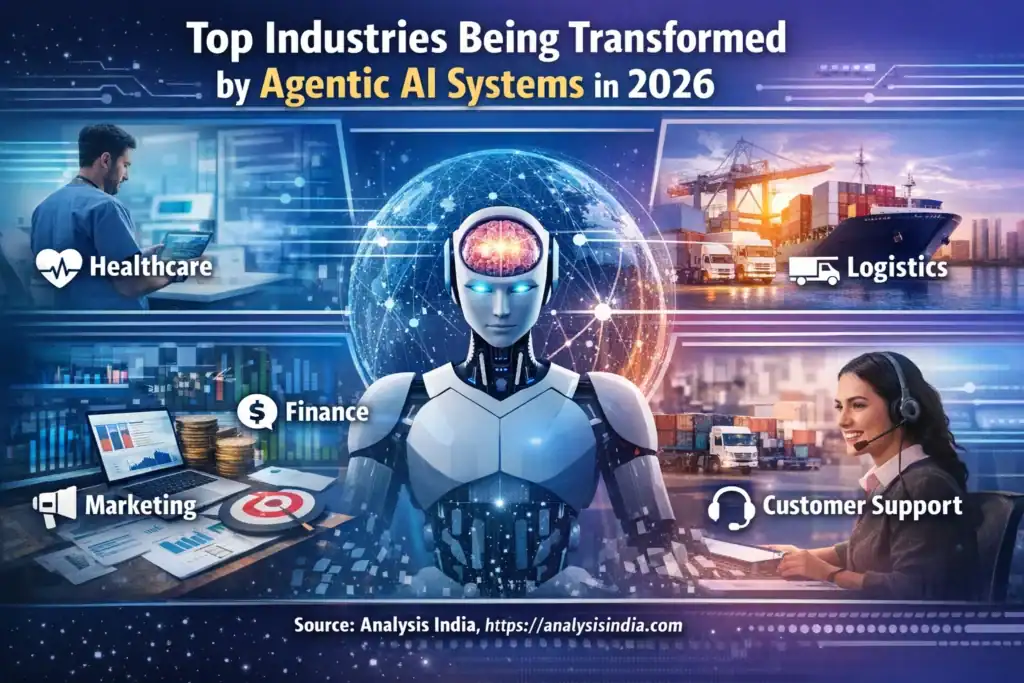
Agentic AI industries are transforming healthcare finance logistics marketing and customer support in 2026. These systems improve efficiency accuracy and scalability. They reduce manual work and support better decisions.
Market forecasts and enterprise surveys confirm sustained growth. Businesses continue investing in agentic AI systems. The future of enterprise automation is intelligent adaptive and autonomous.ue investing in agentic AI systems. The future of enterprise automation is intelligent adaptive and autonomous.
Frequently Asked Questions
What are agentic AI industries
Agentic AI industries are business sectors that use autonomous AI systems to plan and execute tasks. These systems work beyond simple automation. They can adapt to changing conditions and manage complex workflows. Many industries now use agentic AI to improve efficiency. This trend is growing in 2026.
Why are agentic AI industries growing in 2026
Agentic AI industries are growing because businesses need smarter systems. Traditional automation is limited to fixed rules. Agentic AI can make decisions and complete tasks independently. This helps companies save time and reduce manual work. It also improves operational accuracy.
Which industries benefit the most from agentic AI
Healthcare finance logistics marketing and customer support benefit the most. These industries manage complex workflows daily. Agentic AI helps organize tasks and improve coordination. It also reduces errors and delays. This makes operations more efficient.
How does agentic AI help healthcare organizations
Agentic AI helps manage patient records scheduling and care coordination. It reduces paperwork for medical staff. Doctors and nurses can focus more on patient care. AI systems also support predictive health monitoring. This improves service quality.
How does agentic AI improve finance operations
In finance agentic AI supports compliance reporting and customer onboarding. It helps analyze documents and reduce errors. Financial teams process tasks faster. Risk monitoring also improves. Human experts still control final decisions.
How does agentic AI support logistics companies
Agentic AI tracks shipments and warehouse activity. It suggests route changes when delays occur. Logistics teams gain better visibility. Supply chain coordination improves. This reduces disruptions and improves delivery performance.
How does agentic AI help marketing teams
Marketing teams use agentic AI to plan campaigns and analyze engagement data. AI helps manage audience targeting. It saves time on repetitive tasks. Teams focus more on creative strategy. Campaign results improve.
How does agentic AI improve customer support
Agentic AI handles common customer questions automatically. Complex issues go to human agents with full context. Response times improve. Service quality becomes more consistent. Customer satisfaction increases.
Are agentic AI systems safe for businesses
Yes when used with proper security and governance. Companies set rules for how AI systems operate. Human oversight remains important. Data protection is a priority. This ensures responsible AI use.
What is the future of agentic AI industries
Agentic AI industries will continue to expand after 2026. More business functions will use autonomous systems. AI will manage routine workflows. Humans will focus on strategy and innovation. Businesses will become more competitive.