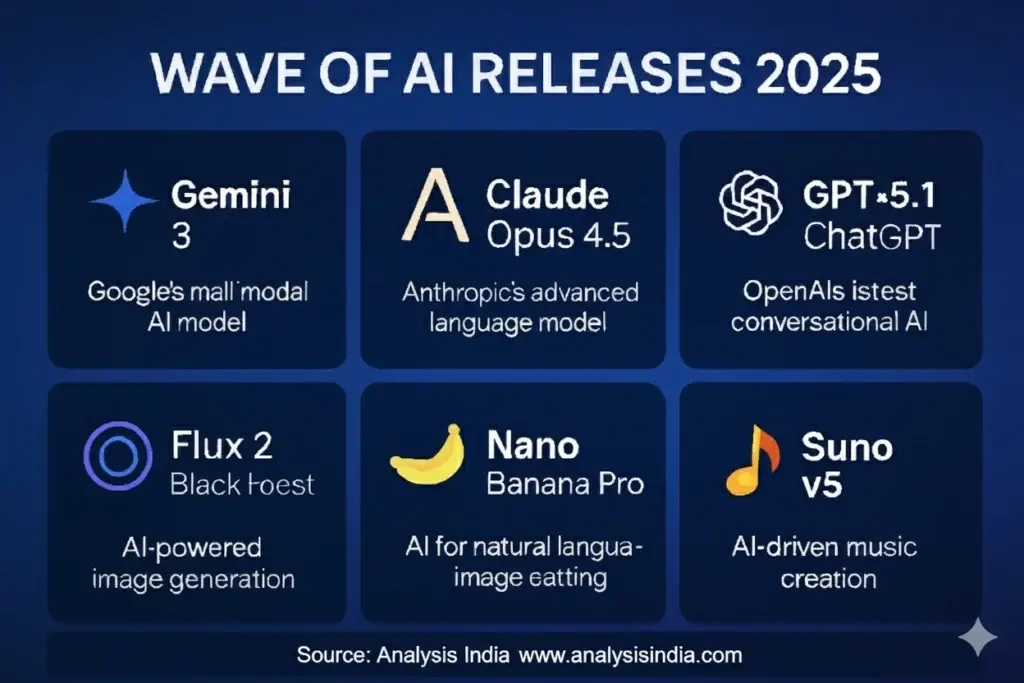
Analysis India: Artificial intelligence has become the most talked about subject in technology today. Every few months new models and platforms are introduced, each promising to push the boundaries of what machines can do. The last quarter alone has seen a wave of AI releases from leading companies such as Google, Anthropic, OpenAI, Suno, and Black Forest Labs. Each release has been accompanied by bold statements from CEOs and research leaders, signaling not only technical progress but also strategic intent. The wave of AI releases in technology seen in 2025 is an early indicator of AI market adoption trends in 2026, showing how breakthrough innovations accelerate enterprise and developer uptake across industries.
These launches are not only shaping the future of technology but also influencing business, education, healthcare, and entertainment. The pace of innovation is so fast that it feels like we are living through a revolution where every announcement changes the conversation about what is possible.
Wave of AI Releases – Acceleration of AI Development
The speed at which AI models are being released is unprecedented. In earlier years it took several years for a breakthrough to reach the public. Now companies are unveiling new models within months of each other. This acceleration is driven by competition among tech giants and the growing demand for AI solutions across industries. Businesses want tools that can automate tasks, improve decision making, and create new experiences for customers. Researchers want platforms that can analyze data faster and more accurately. Consumers are curious about how AI can make their lives easier. All these forces combine to create a cycle where innovation feeds on itself and the next release comes sooner than expected.
Wave of AI Releases – Major Players in the AI Race
Google Gemini 3 Launch and the Wave of AI Releases 2025
Google has been at the forefront of AI research for years. Its Gemini series of models represents a new generation of large language models designed to handle complex reasoning and multimodal tasks. Google unveiled Gemini 3 on November 18, 2025, positioning it as the backbone of its AI-first strategy. Sundar Pichai, CEO of Google and Alphabet, remarked, “What I loved about the launch of Gemini 3 was seeing so many products integrate it so quickly. It shows the scale of our AI-first strategy over the past decade.” Demis Hassabis, CEO of Google DeepMind, added, “Gemini 3 is another big step toward AGI, excelling in multimodal understanding and agentic capabilities.”
Gemini 3 is seen as a step forward in combining text, images, and other forms of input into a single system. The company is positioning Gemini as a platform that can power search, productivity tools, and creative applications. For Google the release of Gemini is not just about technology but also about maintaining leadership in a market where rivals are gaining ground.
Claude Opus 4.5 Anthropic: A Key AI Release in 2025
Anthropic released Claude Opus 4.5 on November 24, 2025, calling it its most advanced and aligned model. CEO Dario Amodei explained, “Opus 4.5 is our most robustly aligned model so far, excelling at coding, agents, and enterprise workflows. It sets a new benchmark for production code and agentic tasks.” Anthropic also cut prices to make frontier AI more accessible, a strategic move to challenge Google and OpenAI.
The latest Claude Opus 4.5, has attracted attention for outperforming human engineers in certain internal tests. This claim highlights the growing capability of AI systems to handle tasks that were once considered beyond their reach. Anthropic emphasizes safety and alignment in its design, aiming to create models that are powerful yet controllable. The release of Claude Opus 4.5 shows how smaller companies can challenge giants by focusing on specific strengths and values.
OpenAI and ChatGPT
OpenAI remains one of the most recognized names in AI. Its ChatGPT models have become widely used for writing, coding, and conversation. Each new release brings improvements in accuracy, creativity, and reliability. OpenAI rolled out GPT‑5.1 for ChatGPT on November 12, 2025, upgrading its flagship product with improved reasoning and conversational style. CEO Sam Altman declared a “code red” internally, urging teams to focus entirely on strengthening ChatGPT against rising competition. He stated, “We want ChatGPT to be faster, more reliable, and more personal. This release is about making it enjoyable to talk to while smarter at the same time.”
The company has also expanded its offerings with tools for image generation and code assistance. OpenAI’s releases are closely watched because they set benchmarks for what AI can achieve in everyday use. The wave of AI releases would not be complete without acknowledging the role of ChatGPT in popularizing the technology.
Flux 2 and Black Forest Labs
Black Forest Labs has quickly established itself as a rising force in the AI creative space. Its Flux series of models focuses on high-quality image generation and editing, designed to meet the needs of professionals in design and branding. The company unveiled Flux 2 on November 25, 2025, presenting it as a model built for real-world creative workflows rather than simple demonstrations.
The leadership team at Black Forest Labs explained, “Flux 2 is designed for real-world creative workflows, not just demos. It maintains character and style consistency across multiple references and adheres to brand guidelines.”
Flux 2 is seen as a step forward in creative AI, offering resolutions up to 4 megapixels and advanced editing capabilities. The company is positioning Flux 2 as a tool for designers, marketers, and enterprises that need reliable visual generation. For Black Forest Labs, the release of Flux 2 is not just about technology but about carving out a niche in the competitive generative AI market.
Google and Nano Banana Pro
Google expanded its AI portfolio further with the launch of Nano Banana Pro on November 20, 2025, just two days after unveiling Gemini 3. Built on the Gemini architecture, Nano Banana Pro delivers native 2K and optional 4K image generation, making it a powerful tool for creative professionals and everyday users alike.
Michael Gerstenhaber, Vice President of Product Management at Google Cloud, remarked, “Nano Banana Pro makes it dramatically easier to edit images with natural language and create visuals with consistent characters. It is available today in Vertex AI and Google Workspace.”
Nano Banana Pro is seen as a step forward in generative visuals, combining ease of use with high-quality output. The company is positioning it as a platform that integrates seamlessly into Google’s productivity ecosystem. For Google, the release of Nano Banana Pro is not just about expanding its AI offerings but also about reinforcing its dominance in both enterprise and consumer applications.
Suno v5 and AI Music
Suno has emerged as a leader in AI-driven music creation, offering tools that allow anyone to compose and produce audio with ease. The company released Suno v5 on September 23, 2025, followed by a major partnership announcement with Warner Music Group in late November.
CEO Mikey Shulman highlighted the significance of this release, stating, “We’re seeing the future of music take shape in real time. Millions of people are making their ideas a reality through Suno, from first-time creators to top producers.”
Suno v5 is seen as a step forward in creative AI for music, enabling users to generate songs, compositions, and soundscapes with unprecedented quality. The company is positioning Suno as a platform that bridges professional artistry with everyday creativity. For Suno, the release of v5 is not just about technology but about reshaping the music industry and ensuring artists are compensated fairly through partnerships like the one with Warner Music Group.
Wave of AI Releases – Why AI Is Evolving So Fast?
Advances in Hardware
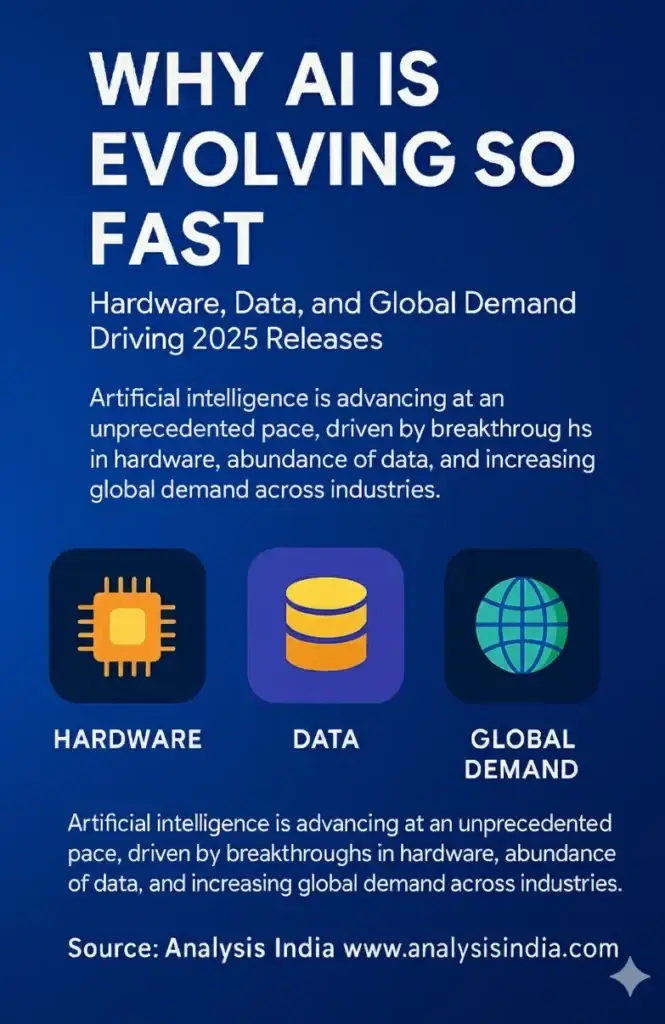
One reason for the rapid wave of releases is the improvement in hardware. Graphics processing units and specialized chips make it possible to train larger models faster. Cloud infrastructure allows companies to scale their experiments without building massive data centers. As hardware becomes more powerful and accessible the barrier to entry lowers and more organizations can attempt ambitious projects.
Availability of Data
Another factor is the availability of data. The internet provides a vast resource of text, images, audio, and video that can be used to train models. Companies are also creating synthetic data to supplement real-world sources. This abundance of data enables models to learn patterns and relationships at a scale that was not possible before. The more data available the more accurate and versatile the models become.
Demand from Industry
Industries across the world are demanding AI solutions. Healthcare wants diagnostic tools. Finance wants predictive analytics. Education wants personalized learning. Entertainment wants creative assistants. This demand creates pressure on companies to release new models quickly. The wave of AI releases is partly a response to the market’s appetite for innovation.
Wave of AI Releases – Impact on Business and Society
Transformation of Work
The wave of AI releases is transforming the way people work. Tasks that required hours of effort can now be completed in minutes with the help of AI. Writing reports, analyzing data, designing graphics, and even coding are being assisted by intelligent systems. This transformation raises questions about the future of jobs. While AI can increase productivity it also challenges traditional roles. Businesses must adapt by reskilling employees and finding new ways to integrate human creativity with machine efficiency.
Influence on Education
Education is another area affected by the wave of AI releases. Students and teachers are using AI tools to access information, generate content, and personalize learning experiences. Models like Gemini and ChatGPT can explain complex concepts in simple language. They can also create practice questions and simulate conversations. The challenge is to ensure that AI supports learning rather than replacing critical thinking. Schools and universities must develop guidelines for responsible use.
Healthcare Applications
Healthcare is benefiting from AI releases in diagnostics, drug discovery, and patient care. Models trained on medical data can identify patterns that help doctors make decisions. AI can analyze scans, predict disease progression, and suggest treatments. The wave of releases means that healthcare providers have more options to choose from. However safety and accuracy are critical. Mistakes in healthcare can have serious consequences so models must be tested thoroughly before deployment.
Creative Industries
Creative industries are experiencing a surge of interest in AI. Writers, musicians, and artists are experimenting with models that generate text, music, and images. Tools like Suno focus on audio generation while others specialize in visual design. The wave of AI releases provides creators with new instruments to explore. Some fear that AI will replace human creativity but many see it as a collaborator that expands possibilities. The challenge is to balance originality with assistance.
Wave of AI Releases – Challenges and Concerns
Ethical Questions
The rapid wave of AI releases raises ethical questions. Who controls these models. How are they trained. What biases do they carry. These questions are important because AI systems influence decisions in business, healthcare, and society. Companies must be transparent about their methods and accountable for the outcomes. Ethical frameworks are needed to guide the development and use of AI.
Regulation and Policy
Governments are struggling to keep up with the pace of releases. Regulations must balance innovation with safety. Too much restriction could slow progress while too little oversight could lead to misuse. Policies on data privacy, intellectual property, and accountability are being debated worldwide. The wave of AI releases makes these debates urgent because the technology is already in use.
Reliability and Trust
Trust is another challenge. Users need to know that AI systems are reliable. Mistakes or misleading outputs can damage confidence. Companies must invest in testing and validation. They must also communicate clearly about the limitations of their models. Building trust is essential for widespread adoption.
Wave of AI Releases – The Future of AI Releases
Continuous Innovation
The wave of AI releases shows no sign of slowing down. Companies are already working on the next generation of models. Advances in reasoning, multimodal integration, and personalization are expected. Continuous innovation means that the landscape will keep changing. Users must be prepared to adapt to new tools and possibilities.
Collaboration Between Humans and AI
The future will likely involve deeper collaboration between humans and AI. Machines will handle repetitive tasks while humans focus on creativity and judgment. The wave of releases is moving us toward this vision. The challenge is to design systems that complement human strengths rather than compete with them.
Global Competition
AI development is a global competition. Countries are investing in research and infrastructure to gain an edge. The wave of releases reflects this competition. Nations want to lead in technology because it influences economic power and security. International cooperation is also needed to address shared challenges such as ethics and regulation.
Wave of AI Releases – Conclusion
The wave of AI releases is reshaping technology and society. From Google’s Gemini to Anthropic’s Claude and OpenAI’s ChatGPT the pace of innovation is remarkable. Startups and smaller players add diversity with models like Flux 2 and Suno. Advances in hardware and data availability make these releases possible. The impact is felt in business, education, healthcare, and creative industries. Challenges remain in ethics, regulation, and trust. Yet the future promises continuous innovation and deeper collaboration between humans and machines. The wave of AI releases is not just a trend but a defining feature of our time. It represents the unfolding story of how intelligence both human and artificial will shape the world.