📅 Published: June 19, 2026
🔄 Last Updated: June 19, 2026
Quick Summary
The India Healthcare Analytics Market Forecast 2033 indicates strong growth as hospitals, pharmaceutical companies, diagnostic centers, insurers, and healthcare providers increasingly adopt data-driven technologies. Artificial intelligence, predictive analytics, electronic health records, and digital health initiatives are expected to transform healthcare delivery while improving operational efficiency and patient outcomes across India.
Introduction
The India Healthcare Analytics Market Forecast 2033 reflects one of the fastest-growing segments within the country’s healthcare technology ecosystem. Over the past decade, India’s healthcare sector has undergone significant transformation driven by digitization, artificial intelligence, cloud computing, and the increasing availability of healthcare data. As hospitals and healthcare organizations generate enormous volumes of clinical and operational information, the need for advanced analytics solutions continues to grow.
Healthcare analytics enables organizations to collect, process, and analyze data from multiple sources, including electronic health records, medical imaging systems, laboratory reports, insurance claims, wearable devices, and hospital management systems. These insights help healthcare providers improve patient outcomes, optimize resource utilization, reduce costs, and make more informed clinical decisions.
According to industry estimates, the India healthcare analytics market is expected to witness strong double-digit growth through 2033, supported by increasing investments in healthcare IT infrastructure, AI-powered decision-making tools, and government initiatives promoting digital healthcare transformation. Industry forecasts suggest the market could exceed USD 11 billion by 2033 while maintaining robust growth rates throughout the forecast period.
The growing role of analytics is transforming nearly every aspect of healthcare delivery. From disease prediction and treatment optimization to hospital operations and pharmaceutical research, healthcare analytics is becoming a critical component of modern healthcare systems.
What is Healthcare Analytics?
Healthcare analytics refers to the systematic use of healthcare data, statistical methods, machine learning, and artificial intelligence to generate actionable insights. These insights help healthcare organizations improve patient care, operational efficiency, financial performance, and regulatory compliance.
Traditionally, healthcare decisions were often based on limited historical information and manual analysis. Today, healthcare organizations can analyze millions of patient records and clinical data points in real time. This shift has significantly improved decision-making capabilities across the healthcare ecosystem.
The India Healthcare Analytics Market Forecast 2033 suggests that analytics adoption will continue accelerating as healthcare providers seek solutions that improve outcomes while managing rising healthcare costs.
Healthcare analytics can generally be categorized into descriptive analytics, predictive analytics, prescriptive analytics, and diagnostic analytics. Among these segments, predictive analytics is expected to experience particularly strong growth because of its ability to identify disease risks, forecast patient outcomes, and support preventive healthcare strategies.
Why India is Emerging as a Major Healthcare Analytics Market
Several factors are contributing to the rapid expansion of the India Healthcare Analytics Market Forecast 2033.
India’s healthcare industry is experiencing unprecedented growth driven by increasing healthcare expenditure, expanding hospital networks, rising insurance coverage, and greater adoption of digital technologies. At the same time, healthcare providers are generating more data than ever before.
Electronic health records, telemedicine platforms, wearable health devices, diagnostic systems, and hospital information systems are creating massive volumes of structured and unstructured healthcare data. Organizations are increasingly recognizing that this data has significant value when analyzed effectively.
Government initiatives promoting healthcare digitization are also supporting market growth. Programs focused on digital health records, healthcare interoperability, and improved access to medical services are creating a favorable environment for analytics adoption.
The rise of artificial intelligence in healthcare further strengthens growth prospects. AI-powered analytics solutions are helping healthcare providers improve diagnostic accuracy, automate workflows, and enhance patient care delivery. Industry estimates indicate that India’s AI healthcare market is expected to grow rapidly throughout the coming decade.
Key Growth Drivers of India Healthcare Analytics Market Forecast 2033
One of the primary drivers behind the India Healthcare Analytics Market Forecast 2033 is the increasing demand for data-driven decision-making. Hospitals and healthcare systems are under constant pressure to improve efficiency while maintaining high-quality patient care. Analytics platforms provide actionable insights that help organizations optimize operations and reduce costs.
Another major growth driver is the growing prevalence of chronic diseases. Conditions such as diabetes, cardiovascular disease, cancer, and respiratory disorders require long-term management and continuous monitoring. Healthcare analytics enables providers to identify high-risk patients, predict disease progression, and improve treatment planning.
The rapid growth of telemedicine and remote healthcare services is also contributing to increased analytics adoption. Healthcare organizations are leveraging analytics tools to monitor patient engagement, evaluate treatment effectiveness, and improve virtual care delivery.
Pharmaceutical companies are another important source of demand. Data analytics plays a critical role in drug development, clinical trials, market access strategies, and supply chain optimization. India’s growing pharmaceutical sector is creating additional opportunities for healthcare analytics providers.
Readers interested in India’s expanding pharmaceutical ecosystem can also explore our analysis of the India Pharma Export Boom and Global Supply Chains:
The increasing globalization of India’s pharmaceutical industry further reinforces the need for advanced analytics solutions.
Artificial Intelligence Is Reshaping Healthcare Analytics
Artificial intelligence is becoming one of the most influential technologies driving the India Healthcare Analytics Market Forecast 2033. Healthcare organizations are increasingly adopting AI-powered platforms to analyze large datasets, identify patterns, and generate actionable insights that would be difficult to uncover through traditional methods.
Machine learning algorithms can process millions of healthcare records within seconds, helping providers identify disease risks, predict patient outcomes, and recommend treatment pathways. These capabilities are improving both clinical and operational decision-making.
AI is particularly valuable in areas such as radiology, pathology, oncology, and population health management. Healthcare organizations can use predictive analytics models to identify high-risk patients before complications occur, enabling earlier intervention and potentially improving health outcomes.
The growing integration of AI and analytics is expected to remain one of the strongest growth drivers throughout the India Healthcare Analytics Market Forecast 2033 period.
Healthcare Analytics in Hospitals and Health Systems
Hospitals represent one of the largest end-user segments within the healthcare analytics market. Modern hospitals generate enormous volumes of data from patient admissions, laboratory systems, electronic health records, imaging departments, pharmacy operations, and financial management systems.
Analytics platforms help hospitals transform this information into actionable intelligence. Hospital administrators can use dashboards and predictive models to optimize staffing levels, improve bed utilization, reduce patient wait times, and enhance resource allocation.
Clinical teams also benefit from healthcare analytics. Physicians can access data-driven insights that support diagnosis, treatment planning, and patient monitoring. These tools help improve care quality while reducing operational inefficiencies.
As hospitals continue expanding their digital infrastructure, demand for analytics solutions is expected to increase significantly during the India Healthcare Analytics Market Forecast 2033 period.
Medical Imaging Analytics Creating New Opportunities
Medical imaging is emerging as one of the most important application areas for healthcare analytics. Radiology departments generate vast quantities of imaging data through X-ray systems, CT scanners, MRI equipment, mammography systems, and ultrasound devices.
Advanced analytics solutions can help radiologists manage imaging workflows, improve reporting efficiency, and identify patterns that support clinical decision-making. Artificial intelligence algorithms are increasingly being integrated into imaging systems to assist with disease detection and image interpretation.
India’s growing diagnostic imaging market is creating substantial opportunities for healthcare analytics providers. The increasing deployment of digital imaging systems means more data is available for analysis and clinical optimization.
Readers interested in this rapidly growing segment can also explore our detailed analysis of the India X-Ray Market, which examines trends shaping diagnostic imaging adoption across the country:
The expansion of medical imaging infrastructure is expected to remain a significant contributor to the overall India Healthcare Analytics Market Forecast 2033.
Predictive Analytics and Population Health Management
Predictive analytics is expected to become one of the fastest-growing segments within the healthcare analytics industry.
Healthcare providers are increasingly moving from reactive care models toward preventive and proactive healthcare strategies. Predictive analytics enables organizations to identify patients who may be at higher risk of developing chronic diseases, complications, or hospital readmissions.
By analyzing patient histories, lifestyle factors, treatment patterns, and clinical indicators, predictive models can support early intervention programs. This approach helps improve patient outcomes while reducing long-term healthcare costs.
Population health management programs are also benefiting from predictive analytics. Healthcare organizations can identify trends across large patient populations, monitor disease prevalence, and allocate resources more effectively.
As healthcare systems focus more on preventive care, predictive analytics will play a central role in the India Healthcare Analytics Market Forecast 2033.
Pharmaceutical Analytics Driving Industry Transformation
Pharmaceutical companies have become major adopters of healthcare analytics technologies.
The pharmaceutical industry generates significant volumes of data across research and development, clinical trials, manufacturing, distribution, and post-market surveillance. Analytics solutions help organizations improve efficiency and accelerate decision-making throughout the product lifecycle.
Clinical trial analytics allows researchers to identify suitable patient populations, optimize recruitment strategies, and monitor trial performance. Commercial analytics helps companies understand market dynamics, physician behavior, and patient adoption patterns.
India’s pharmaceutical sector is undergoing rapid transformation, supported by growing exports and increasing global competitiveness. Data analytics is becoming essential for companies seeking to improve operational performance and navigate increasingly complex healthcare markets.
The growth of high-demand therapies further illustrates the importance of healthcare analytics. For example, the recent expansion of obesity and diabetes treatment options has generated significant market interest.
Readers can learn more about this trend in our analysis of Semaglutide Launched in India 2026: Price Drop and Market Impact:
As pharmaceutical innovation accelerates, analytics will become even more critical in supporting drug development and commercialization activities.
Digital Health Records and Data Integration
One of the biggest challenges facing healthcare organizations has historically been fragmented data.
Patient information often exists across multiple systems, including hospital records, laboratory databases, pharmacy systems, insurance platforms, and diagnostic imaging solutions. This fragmentation limits visibility and reduces the effectiveness of clinical decision-making.
Healthcare analytics platforms help address this challenge by integrating data from multiple sources into unified environments. These integrated systems enable healthcare providers to access comprehensive patient information while improving coordination across departments.
Government initiatives promoting digital health records are expected to further support market growth. Improved interoperability and standardized healthcare data frameworks will create additional opportunities for analytics adoption.
The increasing availability of integrated healthcare data will remain a major factor supporting the India Healthcare Analytics Market Forecast 2033.
Healthcare Analytics and Medicine Traceability
Counterfeit medicines remain a significant concern across many healthcare markets. Healthcare analytics can play an important role in improving pharmaceutical traceability and supply chain transparency.
By analyzing product movement, distribution patterns, and authentication data, analytics platforms can help identify irregularities and improve drug safety monitoring. QR code-based verification systems are becoming increasingly important in combating counterfeit medicines and enhancing consumer confidence.
Readers interested in this topic can explore our detailed guide on How to Check Fake Medicine Using QR Code in India, which highlights the growing role of digital technologies in pharmaceutical verification:
As healthcare supply chains become more digitized, analytics solutions will play a larger role in ensuring product authenticity and regulatory compliance.
Market Segmentation
The India Healthcare Analytics Market Forecast 2033 can be segmented based on component, deployment model, application, and end user.
By component, the market includes software, services, and analytics platforms. Software solutions currently account for a significant share of the market due to increasing adoption of AI-powered healthcare applications.
By deployment model, cloud-based solutions are gaining popularity because of their scalability, flexibility, and cost advantages. Many healthcare organizations are shifting toward cloud infrastructure to support analytics initiatives.
By application, major segments include clinical analytics, financial analytics, operational analytics, population health management, and predictive analytics. Among these categories, predictive analytics is expected to experience particularly strong growth throughout the forecast period.
By end user, hospitals, pharmaceutical companies, diagnostic centers, healthcare payers, and government organizations represent the primary customer segments driving market demand.
Competitive Landscape
The India Healthcare Analytics Market Forecast 2033 is becoming increasingly competitive as technology companies, healthcare IT providers, cloud vendors, and AI startups expand their presence in the healthcare sector.
Global technology companies such as IBM, Microsoft, Google Cloud, Oracle Health, SAS Institute, Philips Healthcare, GE HealthCare, and Siemens Healthineers continue investing heavily in healthcare analytics solutions. These companies provide advanced platforms that help hospitals, pharmaceutical companies, diagnostic centers, and government healthcare agencies transform large volumes of healthcare data into actionable insights.
At the same time, Indian health-tech startups are developing innovative analytics platforms focused on population health management, predictive diagnostics, telemedicine analytics, and healthcare workflow optimization. The rapid adoption of artificial intelligence and cloud-based healthcare platforms is expected to create additional opportunities for both established vendors and emerging players.
Strategic partnerships between hospitals, healthcare providers, pharmaceutical companies, and analytics vendors are expected to accelerate market expansion throughout the forecast period.
India Healthcare Analytics Market Size Forecast 2033
The healthcare analytics sector is one of the fastest-growing healthcare technology segments in India. Multiple market research organizations project strong double-digit growth over the next decade as healthcare providers increasingly adopt data-driven decision-making systems.
India Healthcare Analytics Market Size Forecast
| Year | Market Size (USD Billion) | Growth Outlook |
|---|---|---|
| 2025 | 3.06 | Base Year |
| 2026 | 3.58 | Strong Growth |
| 2027 | 4.19 | AI Adoption Accelerates |
| 2028 | 4.90 | Hospital Analytics Expansion |
| 2029 | 5.73 | Cloud Analytics Growth |
| 2030 | 6.71 | Digital Health Integration |
| 2031 | 7.85 | Predictive Analytics Expansion |
| 2032 | 9.18 | Advanced AI Deployment |
| 2033 | 11.83 | Mature Analytics Ecosystem |
Source: Grand View Research India Healthcare Analytics Market Outlook.
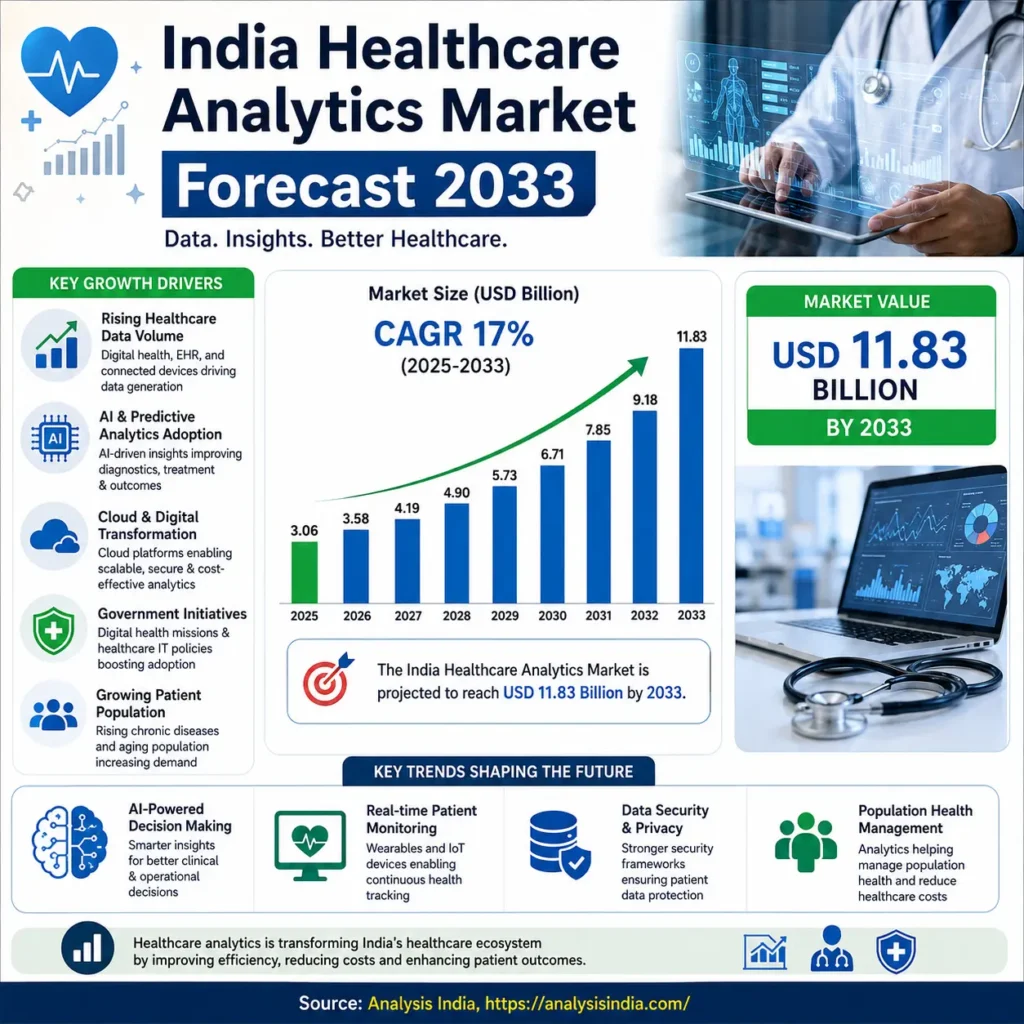
The India healthcare analytics market generated approximately USD 3.06 billion in 2025 and is projected to reach approximately USD 11.83 billion by 2033, growing at a CAGR of around 17%.
The forecast highlights the increasing importance of analytics across healthcare delivery, diagnostics, pharmaceuticals, insurance, and population health management.
Fastest Growing Segments Through 2033
Several segments are expected to outperform the overall market during the forecast period.
Predictive Analytics
Predictive analytics is expected to be the fastest-growing segment due to its ability to identify disease risks, forecast patient outcomes, and support preventive healthcare initiatives. Market studies indicate that predictive analytics will continue attracting strong investment from hospitals and healthcare systems.
Medical Imaging Analytics
The rapid adoption of digital radiology, AI-assisted diagnostics, and imaging informatics is driving demand for advanced imaging analytics solutions. Radiology departments increasingly rely on analytics tools to improve workflow efficiency and diagnostic accuracy.
Cloud-Based Analytics
Cloud deployment models are expected to experience substantial growth due to lower infrastructure costs, scalability, and easier integration with healthcare applications. Many hospital groups are moving away from traditional on-premise systems toward cloud-enabled healthcare analytics platforms.
Pharmaceutical Analytics
India’s pharmaceutical industry is becoming increasingly data-driven. Analytics is now used across clinical trials, drug development, supply chain management, commercial strategy, and pharmacovigilance.
As discussed in our article on India Pharma Export Boom and Global Supply Chains, Indian pharmaceutical companies are expanding globally and increasingly adopting digital technologies to improve competitiveness.
Emerging Trends Shaping India Healthcare Analytics Market Forecast 2033
Several transformative trends are expected to influence the future direction of the healthcare analytics industry.
One major trend is the growing adoption of generative AI within healthcare systems. Healthcare providers are beginning to explore AI-powered clinical documentation, intelligent patient engagement systems, and automated decision-support tools.
Another important trend is precision medicine. Healthcare analytics allows physicians to personalize treatments based on patient-specific clinical and genetic information. This approach improves treatment effectiveness while reducing unnecessary interventions.
Healthcare cybersecurity is also becoming increasingly important. As organizations collect larger volumes of patient data, analytics platforms are being used to identify security vulnerabilities, monitor threats, and improve compliance with data protection requirements.
The expansion of digital diagnostics will create additional opportunities. Analytics platforms are increasingly being integrated with diagnostic systems, including imaging devices and laboratory instruments.
Readers interested in India’s diagnostic imaging ecosystem can also explore our detailed analysis of the India X-Ray Market:
Challenges Facing the Market
Despite strong growth prospects, several challenges remain.
Data fragmentation continues to limit interoperability across healthcare systems. Many organizations still operate multiple disconnected information systems, making comprehensive analytics more difficult.
Another challenge involves data quality. Healthcare analytics platforms depend on accurate, standardized, and complete data. Inconsistent data collection practices can reduce the effectiveness of analytics initiatives.
Workforce shortages also represent a concern. Healthcare organizations require professionals with expertise in healthcare operations, data science, artificial intelligence, and analytics implementation. Finding skilled talent remains a challenge for many institutions.
Cybersecurity risks continue to increase as healthcare data becomes more digitized. Organizations must invest in robust security measures to protect sensitive patient information.
Future Outlook
The long-term outlook for the India Healthcare Analytics Market Forecast 2033 remains highly positive.
Government-led healthcare digitization initiatives, increasing healthcare expenditures, expanding insurance coverage, and rising AI adoption are expected to support sustained market growth. Healthcare providers increasingly recognize that data-driven decision-making is essential for improving patient outcomes and operational performance.
The market is also benefiting from broader healthcare technology trends. India’s healthcare IT sector is projected to experience significant growth through 2034 as hospitals continue investing in electronic health records, cloud infrastructure, artificial intelligence, and analytics solutions.
As healthcare organizations become more data-centric, analytics platforms will play a critical role in shaping the future of healthcare delivery.
Conclusion
The India Healthcare Analytics Market Forecast 2033 highlights a rapidly expanding industry driven by digital transformation, artificial intelligence, predictive analytics, and increasing healthcare data availability.
From hospitals and diagnostic centers to pharmaceutical companies and healthcare payers, organizations are investing in analytics solutions to improve efficiency, reduce costs, and enhance patient care. The market is projected to grow from approximately USD 3.06 billion in 2025 to nearly USD 11.83 billion by 2033, reflecting strong demand across the healthcare ecosystem.
Technologies such as predictive analytics, AI-powered diagnostics, cloud computing, and medical imaging analytics will continue driving innovation throughout the forecast period.
As India advances toward a more digital and data-driven healthcare system, healthcare analytics will become one of the most important technologies supporting clinical excellence, operational efficiency, and improved patient outcomes.
Frequently Asked Questions
What is the India Healthcare Analytics Market Forecast 2033?
The India healthcare analytics market is projected to grow from approximately USD 3.06 billion in 2025 to nearly USD 11.83 billion by 2033, driven by AI adoption, healthcare digitization, and increasing use of predictive analytics.
What is driving the growth of healthcare analytics in India?
Major growth drivers include artificial intelligence adoption, digital health initiatives, electronic health records, hospital digitization, predictive analytics, and increasing healthcare data volumes.
Which segment is growing the fastest?
Predictive analytics is expected to be the fastest-growing segment because of its ability to forecast patient outcomes and support preventive healthcare strategies.
How is AI impacting healthcare analytics?
AI enables healthcare organizations to analyze large datasets, improve diagnostics, automate workflows, enhance patient care, and support data-driven clinical decision-making.
How does healthcare analytics benefit hospitals?
Healthcare analytics helps hospitals improve operational efficiency, optimize resource allocation, reduce costs, improve patient outcomes, and support evidence-based decision-making.
What role does healthcare analytics play in pharmaceuticals?
Healthcare analytics supports clinical trials, drug development, market access strategies, pharmacovigilance, supply chain optimization, and commercial decision-making.
Why is healthcare analytics important for India’s future healthcare system?
Healthcare analytics enables providers to deliver more efficient, personalized, and data-driven healthcare services while supporting long-term healthcare transformation across India.