📅 Published: June 22, 2026
🔄 Last Updated: October 7, 2026
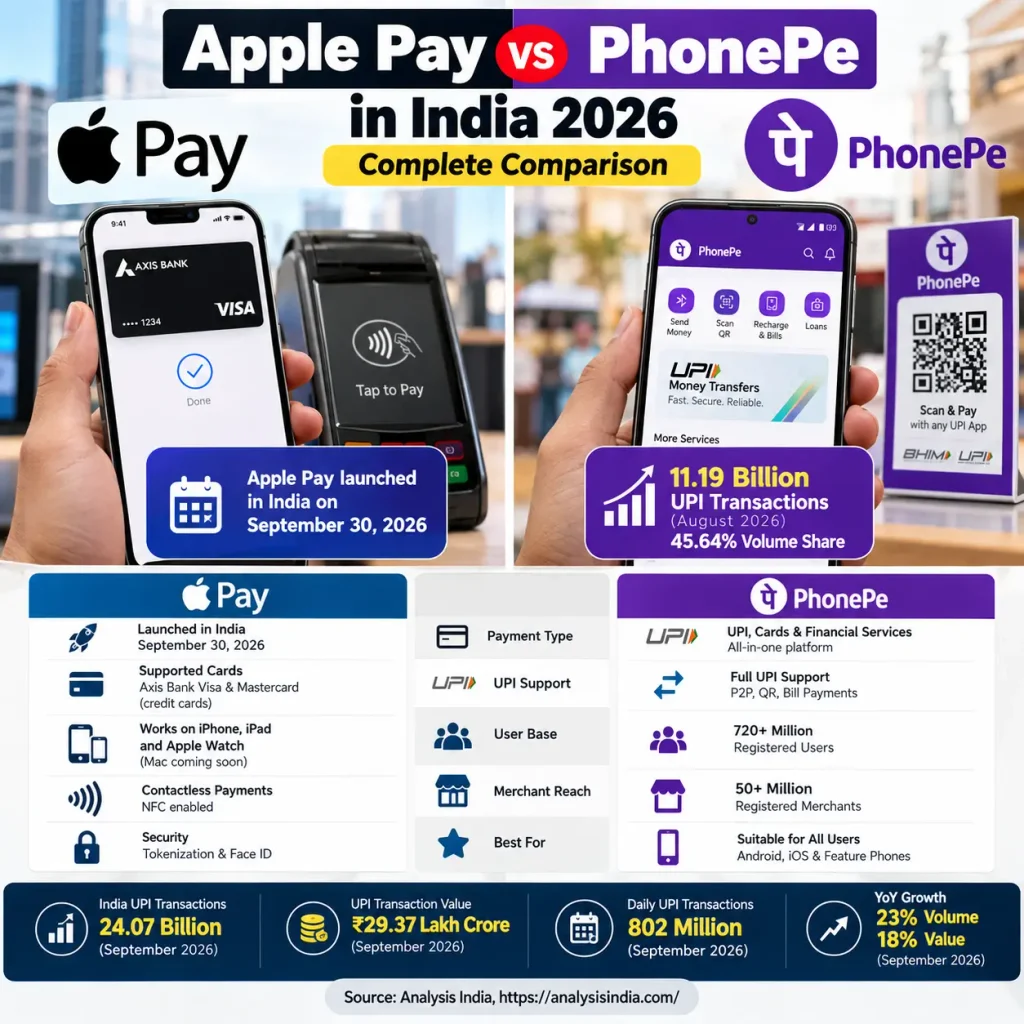
The Apple Pay vs PhonePe India 2026 comparison has changed significantly since Apple Pay officially entered the Indian market. Apple Pay launched in India on September 30, 2026, initially allowing eligible Axis Bank Visa and Mastercard credit card customers to use Apple’s digital wallet across iPhone, iPad and Apple Watch. Mac support is coming soon.
PhonePe enters this competition from a completely different position. It is already one of India’s largest digital payment platforms and has built its business around UPI, merchant payments, financial services and a large nationwide acceptance network. In August 2026, PhonePe processed 11.19 billion UPI transactions, representing 45.64% of India’s total UPI transaction volume, according to NPCI data reported by industry sources.
The scale of India’s underlying payment infrastructure makes the comparison even more important. UPI processed 24.07 billion transactions worth ₹29.37 lakh crore in September 2026. Average daily UPI transaction volume reached approximately 802 million, crossing the 800-million level for the first time. mint
The Apple Pay vs PhonePe India 2026 debate is therefore not simply about two payment applications. Apple Pay has entered India through a card-based, tokenized and contactless payment model, while PhonePe has built its leadership around UPI and is now expanding into cards, NFC, tokenization, merchant hardware and international payments.
The result is a much more interesting competitive landscape than the original comparison suggested.
Apple’s India launch is part of a much larger shift in digital payments, which we examine in our analysis of Apple Pay India digital payments in 2026, including cards, UPI, merchants and payment infrastructure.
Apple Pay vs PhonePe India 2026: What Has Changed?
The most important change is that Apple Pay is no longer a potential India launch.
Apple officially announced on September 30, 2026 that Apple Pay was available in India. Customers with eligible Axis Bank-issued Visa and Mastercard credit cards can add their cards to Apple Pay and use them at thousands of in-store and online merchants across India, including locations that accept NFC transactions. Apple Pay works on iPhone, iPad and Apple Watch, while Mac support is coming soon.
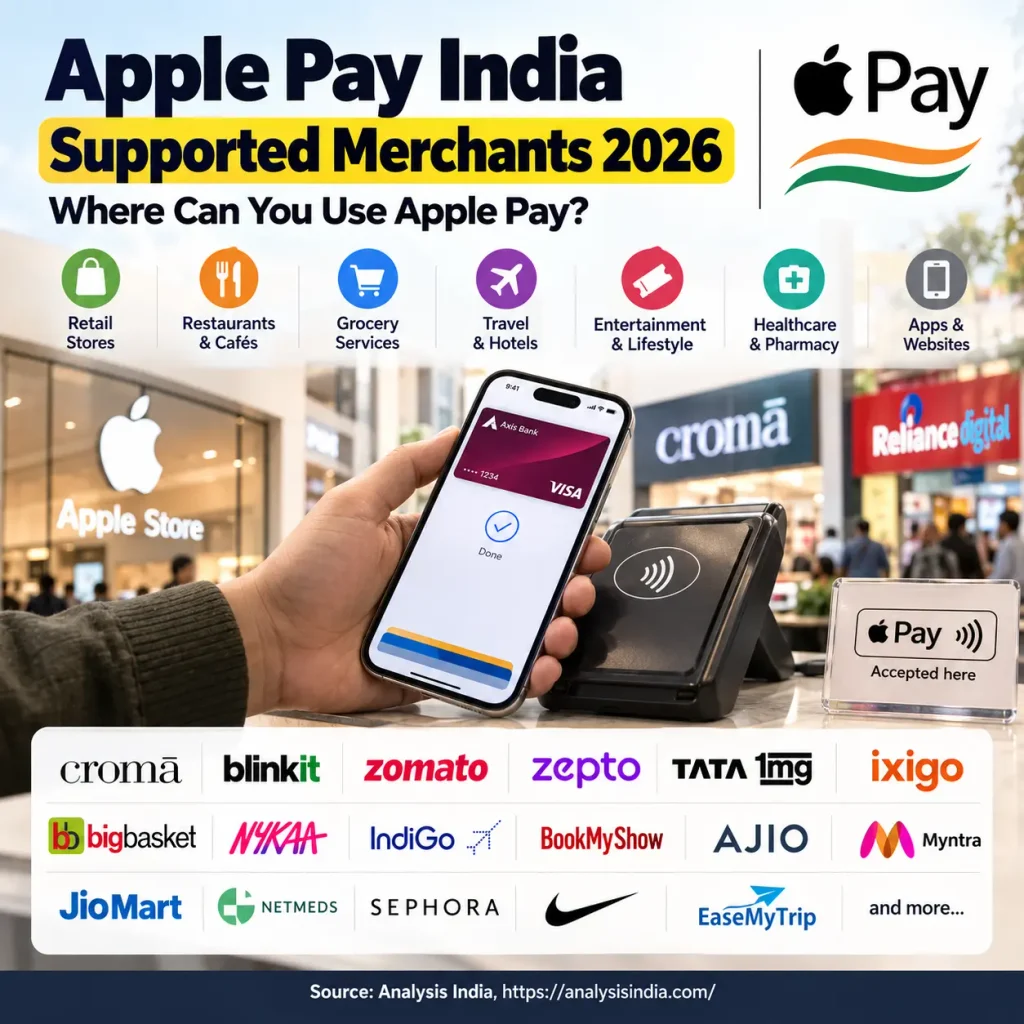
Apple’s India launch also includes major merchant and payment-service-provider partnerships. Apple says Apple Pay is accepted by millions of merchants in India, including Apple Store locations, Blinkit, Chaayos, Croma, Ixigo, Reliance brands, Tata 1mg and Zomato. It has also worked with payment service providers including BillDesk, Cashfree, Juspay, Mswipe, Paytm, PayU, Pine Labs and Razorpay.
PhonePe, however, does not have to build a market from scratch.
Its own August 2026 company information shows more than 720 million lifetime registered users and more than 50 million lifetime registered merchants. PhonePe also reported 11 billion customer transactions in July 2026.
This creates a fundamental difference in starting position.
Apple Pay is entering India’s digital payment market with a premium device ecosystem and card-based proposition. PhonePe is already embedded in India’s UPI infrastructure and has a much larger established payment network.
Apple Pay vs PhonePe India 2026: Latest Market Data
The most useful way to understand the competitive difference is through current transaction and ecosystem data rather than generic claims about popularity.
| Metric | Latest Data | Source |
|---|---|---|
| India’s UPI transactions, September 2026 | 24.07 billion | NPCI |
| India’s UPI transaction value, September 2026 | ₹29.37 lakh crore | NPCI |
| Average daily UPI transactions, September 2026 | 802 million | NPCI |
| UPI year-on-year volume growth, September 2026 | 23% | NPCI |
| UPI year-on-year value growth, September 2026 | 18% | NPCI |
| PhonePe UPI transactions, August 2026 | 11.19 billion | NPCI data |
| PhonePe UPI volume share, August 2026 | 45.64% | NPCI data |
| PhonePe UPI value share, August 2026 | 47.82% | NPCI data |
| PhonePe registered users, August 2026 | 720+ million | PhonePe |
| PhonePe registered merchants, August 2026 | 50+ million | PhonePe |
| Apple Pay India launch | September 30, 2026 | Apple |
| Initial Apple Pay bank support | Axis Bank | Apple |
| Initial Apple Pay card networks | Visa and Mastercard | Apple |
The September UPI figures show the scale of the ecosystem in which PhonePe operates. NPCI recorded 24.07 billion transactions worth ₹29.37 lakh crore in September, compared with 24.51 billion transactions worth ₹29.82 lakh crore in August. The month-on-month decline largely reflects September having 30 days compared with 31 days in August, while average daily activity actually increased.
For the Apple Pay vs PhonePe India 2026 comparison, this distinction is important. Apple Pay does not need to replace the entire UPI system to become relevant, but PhonePe’s existing scale creates a substantial barrier to direct competition.
PhonePe Has a Major UPI Advantage
PhonePe’s biggest competitive advantage is its position inside UPI.
In August 2026, PhonePe processed 11.19 billion UPI transactions and accounted for 45.64% of total UPI transaction volume. Its transaction value reached approximately ₹14.26 lakh crore, representing 47.82% of UPI value.
Google Pay ranked second during the same month with 7.91 billion transactions and a 32.26% volume share, showing how concentrated India’s UPI market has become.
This means PhonePe has an enormous transaction base before Apple Pay has even established a significant Indian user base.
The strategic challenge for Apple is therefore clear. A consumer already using PhonePe does not need another application simply to make a UPI payment.
Apple Pay must offer something different.
Its strongest initial differentiation is the combination of Apple hardware, credit cards, tokenization, biometrics and contactless payments.
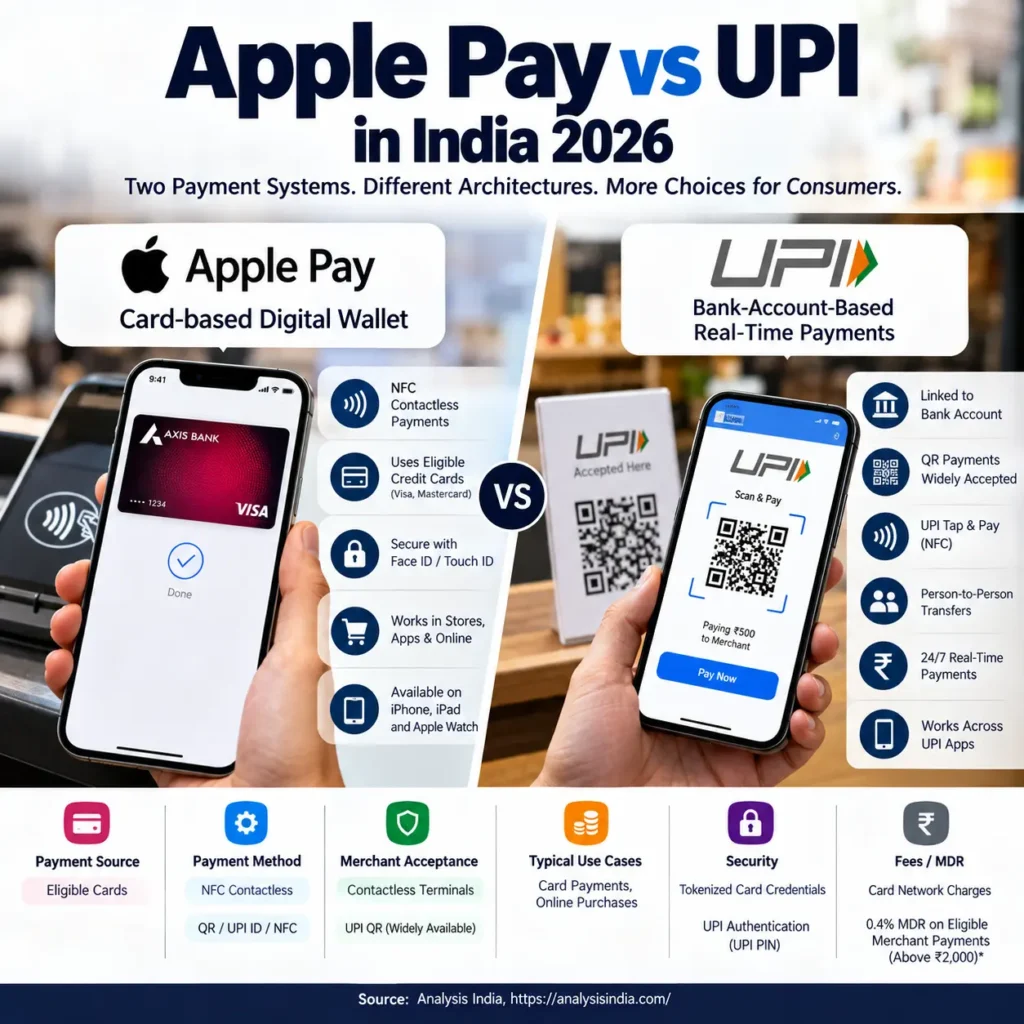
The distinction between Apple’s card-based payment model and India’s bank-account payment infrastructure is explored in greater detail in our analysis of Apple Pay vs UPI in India 2026.
Apple Pay vs PhonePe India 2026: Apple Pay’s India Strategy Is Card First
Apple has taken a card-first approach to India.
At launch, eligible Axis Bank Visa and Mastercard credit cards can be added to Apple Pay. Apple’s current supported-card page lists Axis Bank as the Indian issuer and states that the list will be updated as additional banks are added. Apple
This is one of the biggest differences between the two platforms.
PhonePe is fundamentally connected to bank-account payments through UPI.
Apple Pay’s initial Indian proposition is built around supported payment cards.
Therefore, a consumer can use PhonePe to send money to another person, pay a merchant through UPI or scan a UPI QR code, while Apple Pay can be used to make eligible card payments through supported Apple devices.
This makes the Apple Pay vs PhonePe India 2026 comparison more accurately a competition between different payment layers.
Apple Pay is currently a digital wallet and card interface.
PhonePe is a broad digital payment and financial-services platform.
Apple Pay vs PhonePe India 2026: UPI Integration
UPI is the single biggest structural advantage held by PhonePe.
PhonePe allows users to link bank accounts and make UPI payments to individuals and merchants. It also supports QR-based payments and other services built around the UPI ecosystem.
Apple Pay’s initial Indian launch does not include UPI bank-account payments.
This means an iPhone user cannot currently replace PhonePe’s UPI functionality simply by installing or activating Apple Pay.
For many users, the two services can therefore coexist.
Apple Pay can handle eligible card transactions, while PhonePe can continue to handle UPI payments.
Whether Apple eventually adds UPI functionality is an important future question, but Apple has not announced UPI support as part of the initial India launch. It should therefore not be presented as a confirmed feature.
Apple Pay vs PhonePe India 2026: PhonePe Is Expanding Beyond Traditional UPI
PhonePe’s strategy in 2026 is becoming broader than conventional UPI payments.
In September 2026, PhonePe and Visa announced Tap to Pay, Cross Border Scan to Pay, online Device Tokenization and Smart Accept. PhonePe said the initiative makes it the first app in India to offer this combination of Visa capabilities. PhonePe
The Tap to Pay capability allows Android users to tokenize eligible Visa cards and make contactless payments at supported point-of-sale terminals.
PhonePe’s online device tokenization also allows users to save a Visa card and use tokenized credentials across participating online merchants.
Smart Accept takes the strategy further by allowing small merchants to accept card payments through compatible smartphones without buying a separate card POS machine.
This development is particularly important because Apple Pay’s initial India proposition is also heavily focused on contactless card payments.
PhonePe is therefore moving toward one of the areas where Apple Pay has traditionally differentiated itself.
Apple Pay vs PhonePe India 2026: NFC and Contactless Payments
NFC is becoming an important battleground.
Apple Pay was built around contactless payments. Users can authenticate a payment with Face ID, Touch ID or a device passcode and hold the iPhone or Apple Watch near a compatible contactless reader.
PhonePe’s September 2026 partnership with Visa introduced Tap to Pay, Device Tokenization, Cross Border Scan to Pay and Smart Accept, expanding the company’s capabilities beyond conventional UPI payments.
The difference is that Apple’s payment experience is tightly integrated into Apple hardware, while PhonePe’s contactless strategy is being built across Android devices and card infrastructure.
This creates an interesting competitive situation.
Apple Pay has the stronger device-level integration.
PhonePe has the broader UPI ecosystem and a larger potential device base.
The Apple Pay vs PhonePe India 2026 competition could therefore become increasingly important in organized retail, restaurants, travel and other environments where contactless card payments are common.
Apple Pay vs PhonePe India 2026: PhonePe Has a Stronger Merchant Ecosystem
Merchant acceptance remains one of PhonePe’s most significant advantages.
PhonePe says it had more than 50 million lifetime registered merchants as of August 2026. Its merchant infrastructure extends across cities, towns and rural markets.
The company is also expanding physical payment infrastructure aggressively.
In September 2026, PhonePe announced plans to deploy more than 50 lakh payment devices over the following 12 months, including Smart Speakers and POS devices. Approximately 50% of the planned deployment is targeted at rural India. PhonePe also plans to hire more than 20,000 frontline sales employees.
This is a major advantage in the Apple Pay vs PhonePe India 2026 comparison.
Apple Pay can use existing card and NFC acceptance infrastructure, and Apple says its launch already covers millions of merchants.
PhonePe, however, has built a much deeper merchant relationship around India’s UPI QR ecosystem.
Readers who want to compare Apple’s payment ecosystem with Google’s UPI and Android strategy can also read our detailed Apple Pay vs Google Pay in India 2026 comparison.
Apple Pay vs PhonePe India 2026: Apple Pay Has a Premium Consumer Opportunity
Apple Pay’s opportunity is not necessarily to compete with PhonePe on raw transaction volume.
Apple has a different customer base.
Its strongest opportunity is among consumers already using iPhones, Apple Watch and other Apple products, particularly those who use credit cards and value frictionless contactless payments.
Apple Pay allows eligible cardholders to make payments without repeatedly entering card information or using a separate payment app at checkout.
Apple also emphasizes privacy and tokenization. It says actual card numbers are not stored on Apple servers or shared with merchants. Instead, a unique Device Account Number is encrypted and securely stored in the Secure Element.
This creates a premium proposition that could appeal to Apple’s existing ecosystem users.
Apple Pay vs PhonePe India 2026: Security
Security is another area where the two platforms take different approaches.
Apple Pay uses device-level security, tokenization and biometric authentication. Apple says the actual card number is not stored on the device or Apple servers and is not shared with merchants. Mastercard also says Apple Pay transactions use unique cryptographically secured tokens.
PhonePe operates through India’s regulated UPI infrastructure and has also expanded its card-tokenization capabilities.
The Visa partnership announced in September 2026 gives PhonePe access to online Device Tokenization and Tap to Pay capabilities. PhonePe
It would therefore be inaccurate to simply state that Apple Pay is safer than PhonePe.
A more useful comparison is that Apple Pay has an advantage in tightly integrated device security, while PhonePe combines UPI authentication with an increasingly sophisticated card and tokenization infrastructure.
PhonePe’s Feature-Phone Strategy Is a Major Differentiator
One of PhonePe’s most important recent developments is not aimed at premium smartphones at all.
In August 2026, PhonePe launched UPI 123Pay for feature-phone users. The service enables instant UPI payments without requiring an internet connection and targets India’s 200 million-plus feature-phone users.
PhonePe says the service supports peer-to-peer transfers and merchant payments and uses an SMS-based architecture designed to work in areas with limited 2G connectivity.
This is a significant strategic difference.
Apple Pay is deeply connected to modern Apple hardware.
PhonePe is attempting to extend digital payments across India’s entire device spectrum, including users who do not own smartphones.
This strengthens PhonePe’s position in rural and semi-urban India and makes the Apple Pay vs PhonePe India 2026 competition much more than a premium smartphone comparison.
PhonePe’s Rural Expansion Could Deepen Its Lead
PhonePe’s rural expansion is another important development.
The PhonePe plans to deploy more than 50 lakh payment devices over 12 months, with approximately half targeted at rural India. It also plans to expand its on-roll sales workforce by more than 20,000 employees.
This strategy addresses a segment Apple Pay is unlikely to dominate in the near term.
Apple Pay’s current service depends on compatible Apple devices and eligible cards.
PhonePe can operate across Android smartphones, iPhones and now selected feature phones through UPI 123Pay.
That broader accessibility gives PhonePe a structural advantage in India’s mass-market payment ecosystem.
Apple Pay vs PhonePe India 2026: Card Payments
Card payments represent one area where Apple’s entry could be particularly significant.
Apple Pay’s initial Indian launch supports eligible Axis Bank Visa and Mastercard credit cards.
PhonePe is also moving deeper into cards through its Visa partnership.
This means the competitive landscape is becoming more complicated.
PhonePe is no longer only a UPI application, while Apple Pay is no longer simply a global card wallet entering India.
Both platforms are gradually moving toward a broader mix of payment technologies.
Apple starts from the card and device side.
PhonePe starts from UPI and merchant infrastructure.
The two models are increasingly converging.
Apple Pay vs PhonePe India 2026: Privacy and Data
Privacy could become an important differentiator among premium consumers.
Apple’s global positioning emphasizes privacy, and Apple Pay uses tokenized payment credentials rather than sharing actual card numbers with merchants.
PhonePe operates a much broader financial-services platform that includes payments, financial products and merchant services.
The comparison should not assume that one platform automatically provides better privacy in every context. Instead, consumers should examine how payment credentials, transaction data, authentication and account information are handled for the specific service they use.
For Apple users who already prioritize the Apple ecosystem, Apple’s privacy positioning may strengthen Apple Pay adoption.
For PhonePe users, convenience and the breadth of financial services may remain more important than ecosystem privacy positioning.
Apple Pay vs PhonePe India 2026: PhonePe Is Building an International Payment Proposition
PhonePe is also expanding beyond India.
In September 2026, the company announced its first international footprint in the UAE after receiving in-principle approval from the Central Bank of the UAE for Retail Payment Services, Card Schemes and Stored Value Facilities licences.
This is strategically important because PhonePe is beginning to position itself as a broader payments technology company rather than an India-only UPI application.
For the Apple Pay vs PhonePe India 2026 comparison, this creates another dimension.
Apple brings a global payment network into India.
PhonePe is beginning to take an Indian payment platform beyond India.
The two companies therefore have increasingly international ambitions, although their expansion strategies remain very different.
Apple Pay vs PhonePe India 2026: Ecosystem Comparison
| Factor | Apple Pay | PhonePe |
|---|---|---|
| Core model | Digital wallet and card payments | UPI and financial-services platform |
| India launch/status | Launched September 2026 | Established |
| Initial Indian card support | Axis Bank Visa and Mastercard credit cards | Multiple card and UPI options |
| UPI | Not supported at initial Apple Pay launch | Core payment rail |
| QR payments | Not core to initial launch | Core capability |
| Contactless | Native Apple Pay experience | Visa Tap to Pay |
| Tokenization | Device Account Number and Secure Element | Visa Device Tokenization |
| P2P payments | Not through UPI | Yes through UPI |
| Feature-phone payments | No | UPI 123Pay |
| Merchant network | Millions of merchants according to Apple | 50+ million registered merchants reported by PhonePe |
| Device reach | Apple ecosystem | Android, iOS and selected feature phones |
| Rural strategy | Limited initial relevance | Major expansion focus |
| Main opportunity | Premium card and Apple ecosystem users | Mass-market digital payments |
Sources: Apple, PhonePe, NPCI, September 2026.
Apple Pay vs PhonePe India 2026: Which Is Better for iPhone Users?
For iPhone users, the answer depends on the type of payment.
An eligible Axis Bank credit card user can now use Apple Pay for supported in-store, online and in-app payments.
However, the same iPhone user may still need PhonePe for UPI payments, QR payments and bank-account transfers.
This makes the two services complementary rather than mutually exclusive.
A consumer who prefers credit cards and contactless payments may find Apple Pay more convenient.
A consumer who relies heavily on UPI may continue using PhonePe.
Therefore, the Apple Pay vs PhonePe India 2026 decision for iPhone users is likely to depend more on payment habits than device ownership alone.
Apple Pay vs PhonePe India 2026: Which Is Better for Android Users?
PhonePe has a clear advantage for Android users.
Apple Pay cannot be used as the primary Apple wallet on Android devices.
PhonePe supports Android and iOS and is also expanding its NFC capabilities through Visa Tap to Pay.
Its UPI functionality provides another major advantage because Android users can use PhonePe for bank-account transfers, merchant QR payments and peer-to-peer transactions.
This makes PhonePe the more versatile option for Android users.
Which Is Better for Merchants?
Merchants also have little reason to treat the platforms as mutually exclusive.
PhonePe gives merchants access to India’s enormous UPI ecosystem and a broad customer base.
Apple Pay provides another payment option for eligible Apple users paying through cards and contactless terminals.
PhonePe’s Smart Accept initiative could further reduce the cost of card acceptance by allowing small merchants to accept card payments directly through compatible smartphones. PhonePe
This could make PhonePe particularly competitive because it combines UPI, QR, card and contactless acceptance within one broader merchant ecosystem.
Apple Pay vs PhonePe India 2026: What Could Change Next?
The biggest variable for Apple will be bank expansion.
Apple’s current Indian supported-card list identifies Axis Bank Visa and Mastercard credit cards. Apple says additional banks will be added over time.
Adding major banks could dramatically expand Apple’s potential user base.
The second variable is payment-network expansion.
Apple’s initial launch is based on Visa and Mastercard credit cards. Broader card and bank support would make Apple Pay more useful to Indian consumers.
The third variable is UPI.
Apple has not announced UPI support as part of its initial India launch. If UPI were eventually supported, Apple Pay could become a much more direct competitor to PhonePe.
Until then, PhonePe has a substantial advantage in India’s everyday payment market.
For practical information about Apple’s current Indian rollout, including supported cards and devices, see our guide to Apple Pay India supported banks, cards and devices.
Apple Pay vs PhonePe India 2026: Market Impact
The impact of Apple’s entry may initially be larger in India’s credit-card and contactless market than in UPI.
Apple Pay could encourage eligible iPhone users to use their cards more frequently because contactless payments are simple and integrated into the device.
That could benefit banks, Visa, Mastercard, payment processors, acquiring banks and merchants.
PhonePe’s response is already visible.
The company is adding Tap to Pay, device tokenization and Smart Accept while continuing to expand UPI and merchant infrastructure.
This means Apple Pay could indirectly accelerate innovation across India’s broader payment ecosystem even if PhonePe retains its UPI leadership.
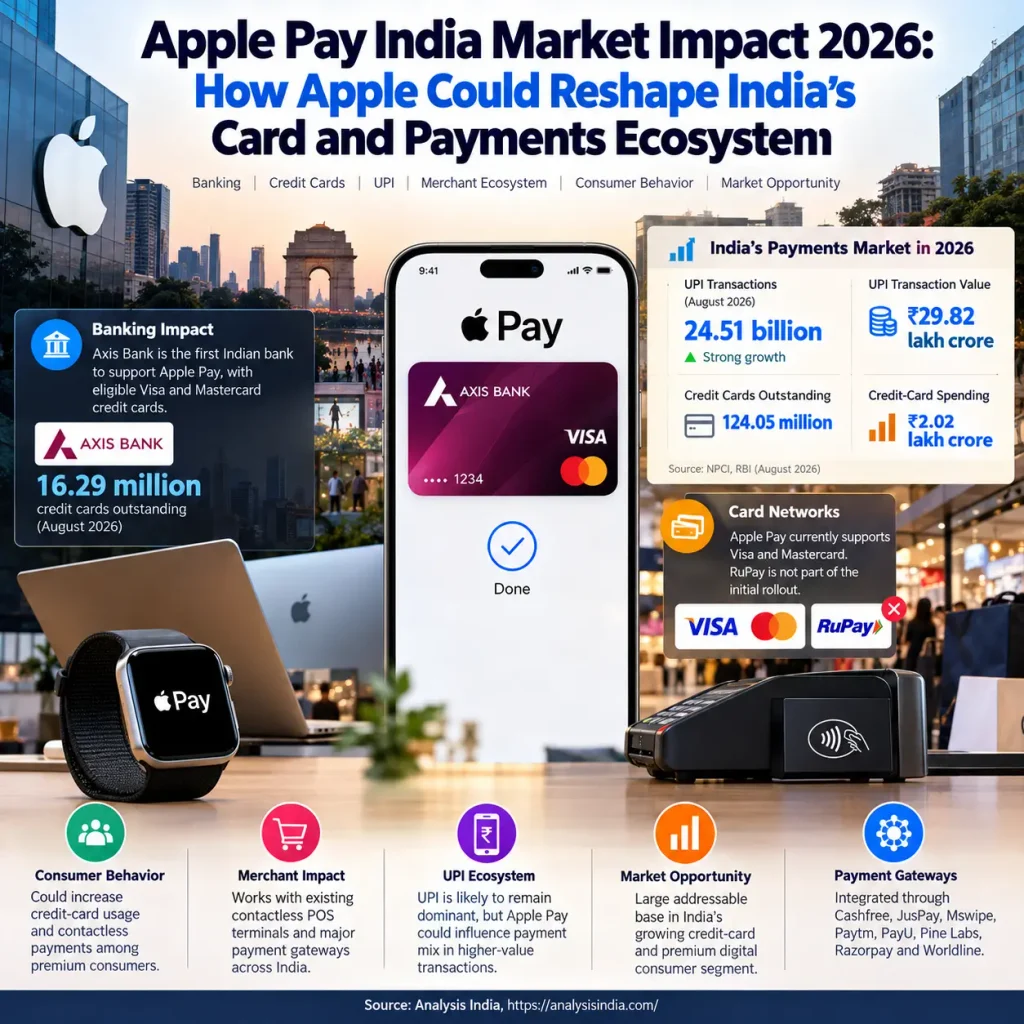
The effect of Apple’s entry on banks, credit cards, payment networks and merchants is examined in our detailed analysis of Apple Pay India market impact 2026.
Apple Pay vs PhonePe India 2026: Final Verdict
The Apple Pay vs PhonePe India 2026 comparison does not produce one universal winner.
PhonePe currently has the stronger position in India’s everyday digital payment ecosystem. Its UPI scale, merchant network, financial-services portfolio, rural expansion and feature-phone strategy give it a much broader market reach.
Apple Pay has entered India through a narrower but potentially valuable proposition.
Its initial strengths are Apple device integration, eligible credit-card support, tokenization, biometric authentication, online checkout and contactless payments.
For UPI transfers, QR payments, bank-account payments and broad financial services, PhonePe is currently the stronger platform.
For eligible Apple users who want a seamless card-based wallet and contactless payment experience, Apple Pay provides a strong new option.
The most important point is that Apple Pay does not currently need to replace PhonePe.
An iPhone user can use Apple Pay for supported card payments and PhonePe for UPI transactions.
PhonePe, meanwhile, is becoming more competitive in areas traditionally associated with digital wallets by adding card tokenization, Tap to Pay and broader merchant capabilities.
The future of the Apple Pay vs PhonePe India 2026 competition will depend heavily on Apple’s bank expansion and whether the company eventually adds UPI functionality.
For now, the market can be described more accurately as follows: PhonePe leads India’s mass-market UPI ecosystem, while Apple Pay is establishing a premium card and contactless payment position within Apple’s device ecosystem.
Apple Pay vs PhonePe India 2026: Frequently Asked Questions
Is Apple Pay available in India in 2026?
Yes. Apple Pay officially launched in India on September 30, 2026. Eligible Axis Bank Visa and Mastercard credit card customers can use Apple Pay on supported iPhone, iPad and Apple Watch devices. Mac support is coming soon.
Does Apple Pay support UPI in India?
Apple Pay’s initial India launch does not include UPI bank-account payments. Its current Indian service is focused on eligible payment cards and supported online, in-app and contactless transactions.
Is PhonePe bigger than Apple Pay in India?
PhonePe currently has a much larger established payment ecosystem. In August 2026, PhonePe processed 11.19 billion UPI transactions, representing 45.64% of UPI transaction volume.
Which is better, Apple Pay or PhonePe in India?
PhonePe is currently better for UPI, QR payments, bank transfers and broader financial services. Apple Pay is better suited to eligible Apple users who prefer integrated credit-card and contactless payments.
Can Apple Pay replace PhonePe in India?
Not currently. Apple Pay’s initial Indian service is card-focused, while PhonePe is deeply integrated with UPI. Many iPhone users may use both services for different payment requirements.
Which banks support Apple Pay in India?
Apple currently lists eligible Axis Bank Visa and Mastercard credit cards. Apple says its supported-bank list will be updated as additional banks are added. Apple
Does Apple Pay support RuPay cards?
RuPay is not part of Apple’s initial India card rollout. PhonePe supports eligible RuPay credit cards through UPI for merchant transactions. NPCI’s official RuPay-on-UPI information lists PhonePe among enabled UPI applications.
Does PhonePe support contactless payments?
Yes. PhonePe and Visa launched Tap to Pay capabilities in September 2026, allowing eligible Android users to tokenize Visa cards and make contactless payments at supported POS terminals.
Can PhonePe work on feature phones?
Yes. PhonePe launched UPI 123Pay in August 2026 for feature-phone users. The service is designed to support UPI payments without an internet connection.
Is Apple Pay safer than PhonePe?
Both use security mechanisms appropriate to their payment systems. Apple Pay uses tokenization, Secure Element technology and biometric authentication. PhonePe operates within UPI’s security framework and has expanded into card tokenization and contactless payments.
Will Apple Pay support UPI in the future?
Apple has not announced UPI support as part of the initial India launch. Future UPI support should therefore be treated as a possibility rather than a confirmed feature.
Who will win the Apple Pay vs PhonePe competition?
PhonePe currently has the stronger mass-market position because of UPI scale and merchant reach. Apple Pay has an opportunity to establish a strong position among Apple users and in India’s premium card and contactless payment segments.