📅 Published: October 1, 2026
🔄 Last Updated: October 1, 2026
Apple Pay has officially launched in India, bringing Apple’s card-based digital wallet to a market where UPI already dominates everyday digital payments. This makes Apple Pay vs UPI an important comparison for consumers, merchants and businesses trying to understand how the two payment systems actually work.
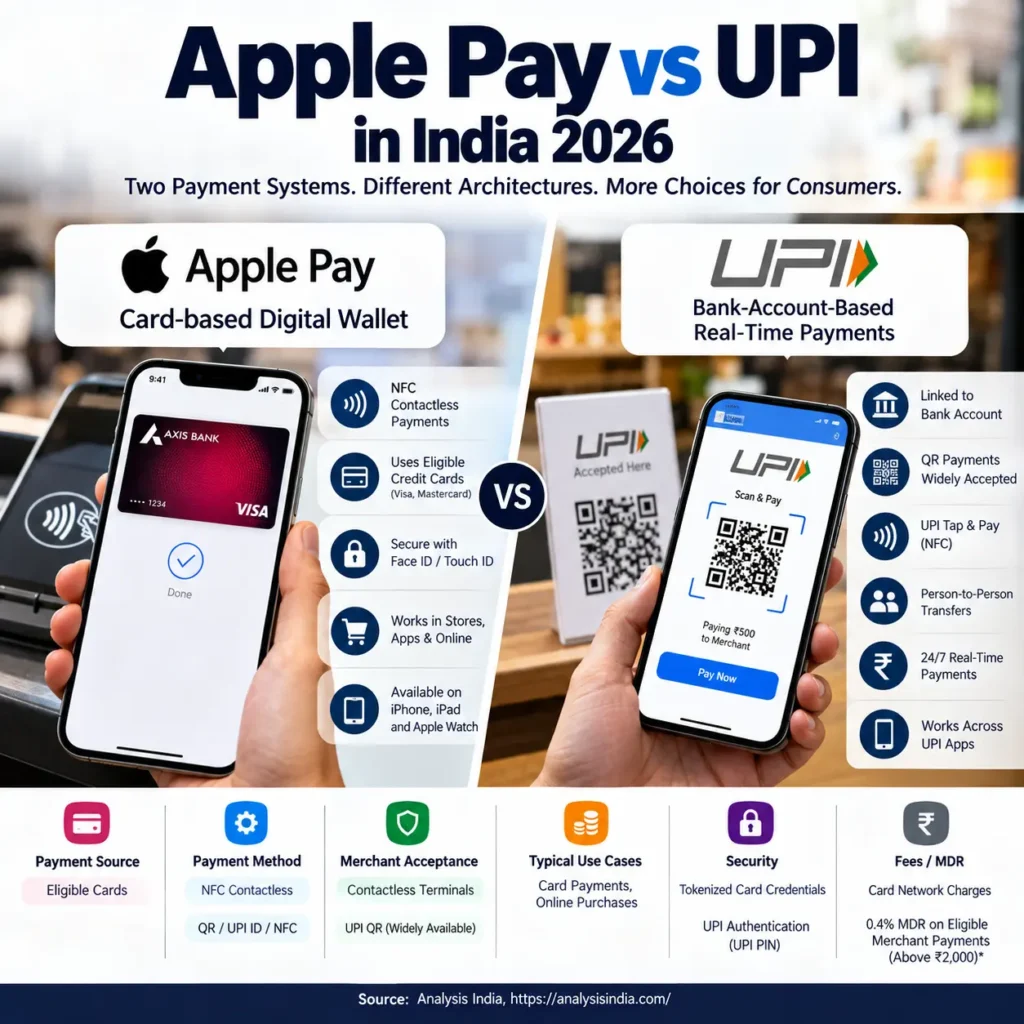
At first glance, both services can appear similar. A consumer can use a smartphone, authenticate a transaction and complete a digital payment without using cash. However, the underlying payment architecture is very different. Apple Pay is primarily a digital wallet that uses eligible payment cards, while UPI is a real-time payment system built around bank accounts and UPI identifiers.
The difference becomes even more important when looking at NFC, QR codes, credit cards, bank accounts, merchant acceptance and transaction costs. Apple Pay is strongly associated with contactless card payments through Apple devices, while UPI has become deeply embedded in India’s QR-based and account-to-account payment ecosystem.
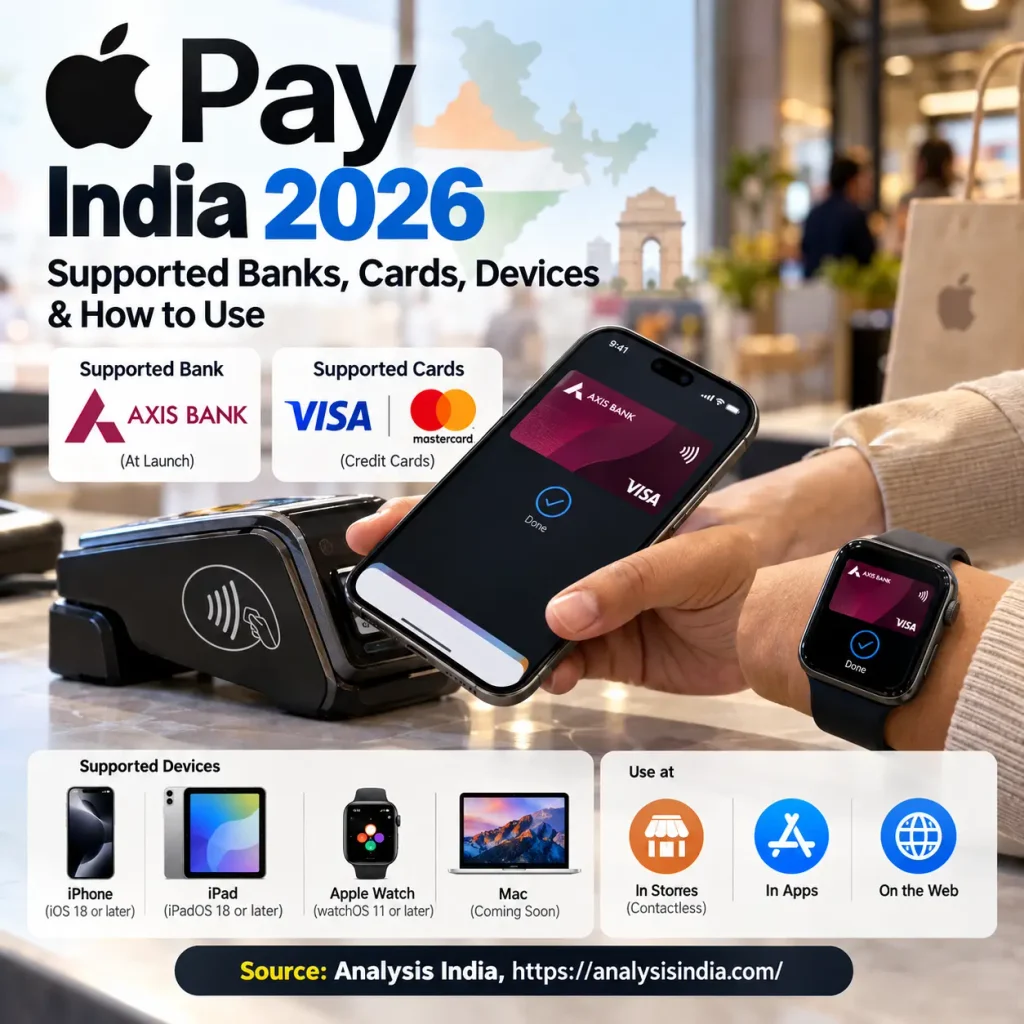
Apple officially launched Apple Pay in India on September 30, 2026, initially supporting eligible Axis Bank Visa and Mastercard credit cards. Apple says the service is available on iPhone, iPad and Apple Watch, with Mac support coming soon.
At the same time, UPI remains the dominant digital-payment infrastructure in India. Reuters reported on September 30, 2026 that UPI accounts for about 84% of India’s digital-payment volume. NPCI data shows that UPI processed 24,508.96 million transactions in August 2026, equivalent to about 24.51 billion transactions, with 752 banks live on the platform.
Therefore, the important question is not whether Apple Pay will replace UPI. The more useful question is how Apple Pay vs UPI differs and which payment mechanism fits a particular consumer or merchant situation.
Apple Pay vs UPI: The Basic Difference
The simplest way to understand the Apple Pay vs UPI difference is to identify the source of funds and the payment rail used to complete the transaction.
Apple Pay is primarily a digital wallet for eligible cards. In India’s initial launch, eligible Axis Bank Visa and Mastercard credit cards can be added to Apple Wallet and used through supported Apple devices. The underlying payment remains a card transaction. Apple Pay provides the wallet interface, device authentication and tokenized payment credentials that allow the card to be used without presenting the physical card.If you want to understand supported banks, cards, devices and the setup process, read our complete Apple Pay India 2026 guide.
UPI follows a different architecture. It connects participating banks and payment applications to enable real-time account-based transactions. A consumer can use a UPI application to pay a merchant through a QR code, UPI ID, online checkout or supported contactless mechanism. The money is ultimately transferred through the UPI ecosystem rather than through a conventional card transaction.
This creates the central distinction between Apple Pay vs UPI payments. Apple Pay digitizes access to an eligible payment card, while UPI digitizes the movement of money through a bank-account-based payment infrastructure.
| Feature | Apple Pay | UPI |
|---|---|---|
| Basic architecture | Card-based digital wallet | Bank-account-based payment system |
| Main funding source | Eligible payment card | Linked bank account or supported UPI instrument |
| Common physical payment | NFC contactless | QR and supported NFC methods |
| Common online payment | Apple Pay checkout | UPI checkout |
| Credit-card orientation | Strong in current Apple Pay India rollout | Supported through specific UPI arrangements |
| P2P payments | Not the primary India use case | Core UPI functionality |
| Merchant acceptance | Contactless card infrastructure | UPI QR and other UPI integrations |
| Device ecosystem | Apple-focused | Broad smartphone and app ecosystem |
| UPI integration | Not supported in initial Apple Pay India rollout | Native |
The table makes clear why UPI vs Apple Pay is not simply a competition between two applications. The two systems operate through different payment structures.
Apple Pay vs UPI India: Card vs Bank Account
The funding source is one of the most important differences between the two systems.
When a consumer uses Apple Pay with an eligible Axis Bank credit card, the transaction is associated with that credit card. The consumer is effectively using the card through a digital wallet rather than presenting the physical card.
Axis Bank confirms that eligible Visa and Mastercard credit cards can be used through Apple Pay for purchases in stores, online and in apps.
UPI generally works differently because the payment is linked to a bank account. A customer can select a UPI application, choose a linked account and authorize the transaction through the UPI payment flow.
This difference affects the way consumers use the two systems. A credit-card user may choose Apple Pay when a merchant accepts contactless card payments and the consumer wants to use an eligible card. Another customer may choose UPI when paying directly from a bank account, especially when the merchant provides a UPI QR code.
The Apple Pay or UPI decision can therefore depend on the source of funds rather than simply the brand or application being used.
Apple Pay Is Primarily Card-Based
Apple Pay’s Indian launch makes the card relationship particularly clear. The initial rollout is based on eligible Axis Bank Visa and Mastercard credit cards. RuPay cards are not supported in the initial launch. Reuters confirmed that Axis Bank is Apple’s first Indian banking partner and that the initial card support is limited to Visa and Mastercard credit cards.
This means Apple Pay does not currently function as an alternative interface for a user’s UPI bank account. A consumer cannot simply add a UPI ID to Apple Wallet and make a UPI payment through Apple Pay.
UPI Is Primarily Account-Based
UPI was designed around instant bank-account payments. Its broad functionality includes person-to-person transfers, merchant payments, online transactions and QR-based payments.
The scale of this ecosystem is substantial. NPCI’s August 2026 statistics show 24.51 billion UPI transactions worth about ₹29.82 lakh crore during the month.
This existing scale is central to the Apple Pay UPI India comparison. Apple Pay is entering an ecosystem where digital payments are already deeply established rather than introducing digital payments to a market that lacks them.
Apple Pay vs UPI: NFC vs QR
The physical payment experience provides another clear difference.
Apple Pay is strongly associated with NFC contactless payments. A compatible iPhone or Apple Watch communicates with a supported contactless payment terminal after the user authenticates the transaction.
UPI became widely recognized in India through QR payments. The customer scans a QR code, confirms the merchant and amount, and authorizes the payment through the UPI application.
The result is a different physical experience.
With Apple Pay, the customer typically brings the Apple device close to a contactless terminal.
With conventional UPI QR payment, the customer brings the camera or UPI application to the merchant’s QR code.
This is one of the most visible aspects of the Apple Pay vs UPI difference, but it does not tell the entire story because UPI itself now supports contactless payment functionality.
What Is UPI Tap & Pay?
UPI is no longer limited to QR codes.
NPCI has introduced UPI Tap & Pay, which allows supported NFC-enabled devices to interact with UPI Smart QR codes or NFC-based merchant tags. The feature is intended to provide an alternative to conventional Scan & Pay transactions.
This makes the Apple Pay contactless payment and UPI contactless payment comparison more interesting.
Both systems can involve a consumer tapping a phone, but the payment mechanism underneath the tap is different.
In Apple Pay, the device presents a protected digital representation of the payment card to a compatible contactless payment terminal.
In UPI Tap & Pay, the NFC interaction can identify the merchant’s UPI payment destination and initiate a UPI transaction.
Therefore, the physical action may look similar while the underlying payment architecture remains different.
Apple Pay Contactless Payment vs UPI Tap & Pay
A tap does not automatically mean that two payment systems work in the same way.
Apple Pay contactless payment is fundamentally a card transaction. The consumer authenticates the payment and the device communicates with a compatible contactless payment terminal.
UPI Tap & Pay uses NFC differently. The consumer can tap an NFC-enabled device or tag associated with the merchant and then complete the UPI payment process through a supported UPI application.
The distinction can be represented simply:
Apple Pay:
Apple device → tokenized card credential → card network → merchant
UPI Tap & Pay:
NFC-enabled device → merchant UPI identifier → UPI infrastructure → bank account → merchant
This is why UPI vs Apple Pay should be evaluated according to the payment rail rather than only the physical act of tapping.
Apple Pay UPI Support: Does Apple Pay Use UPI?
The current answer is no.
The initial Apple Pay India implementation does not provide UPI payments. Apple Pay launched with eligible Axis Bank Visa and Mastercard credit cards, while India’s domestic RuPay network was excluded from the initial rollout.
Consequently, an iPhone user cannot use Apple Pay as a UPI application.
A consumer who wants to make a UPI transaction still needs a supported UPI application or another supported UPI interface.
However, this does not mean Apple Pay and UPI cannot exist on the same device. An iPhone user can have Apple Pay for eligible card payments and use UPI applications separately for bank-account payments.
This distinction is important for understanding Apple Pay India UPI functionality. Apple Pay does not need to become a UPI interface to provide value to its users because its initial purpose is different.
Apple Pay vs UPI Merchant Acceptance
Merchant acceptance is one of the biggest differences between the two ecosystems.
UPI has developed a massive merchant network across India’s retail economy. QR codes can be found at small shops, restaurants, local businesses, service providers, large retailers and online merchants.
Apple Pay enters through existing card-payment infrastructure. For physical transactions, a merchant generally needs compatible contactless payment acceptance.
Apple’s launch announcement says Apple Pay can be used at retailers of different sizes, while Axis Bank instructs customers to look for the Apple Pay or contactless payment symbol at checkout.
This means that Apple Pay does not necessarily require merchants to install a completely separate Apple-specific payment system. Where compatible contactless card acceptance already exists, Apple Pay can operate through that infrastructure.
UPI has a different advantage because QR-based acceptance can be used by merchants that may not have a traditional contactless card terminal.
This is particularly relevant when comparing Apple Pay or UPI for small businesses.
Apple Pay vs UPI for Small Merchants
Consider a small retailer that accepts payments through a UPI QR code but does not have a contactless card terminal.
That merchant already has a UPI payment mechanism available to customers. An Apple Pay user cannot necessarily use Apple Pay at that location simply because the consumer has an iPhone.
Now consider a retailer that already operates a modern contactless POS terminal. The same merchant may be able to accept Apple Pay through its existing card-payment infrastructure.
The merchant therefore does not necessarily have to choose one payment system exclusively.
A modern retail location can potentially accept conventional cards, Apple Pay contactless payments and UPI QR payments at the same checkout.
The practical difference is the infrastructure behind each method.
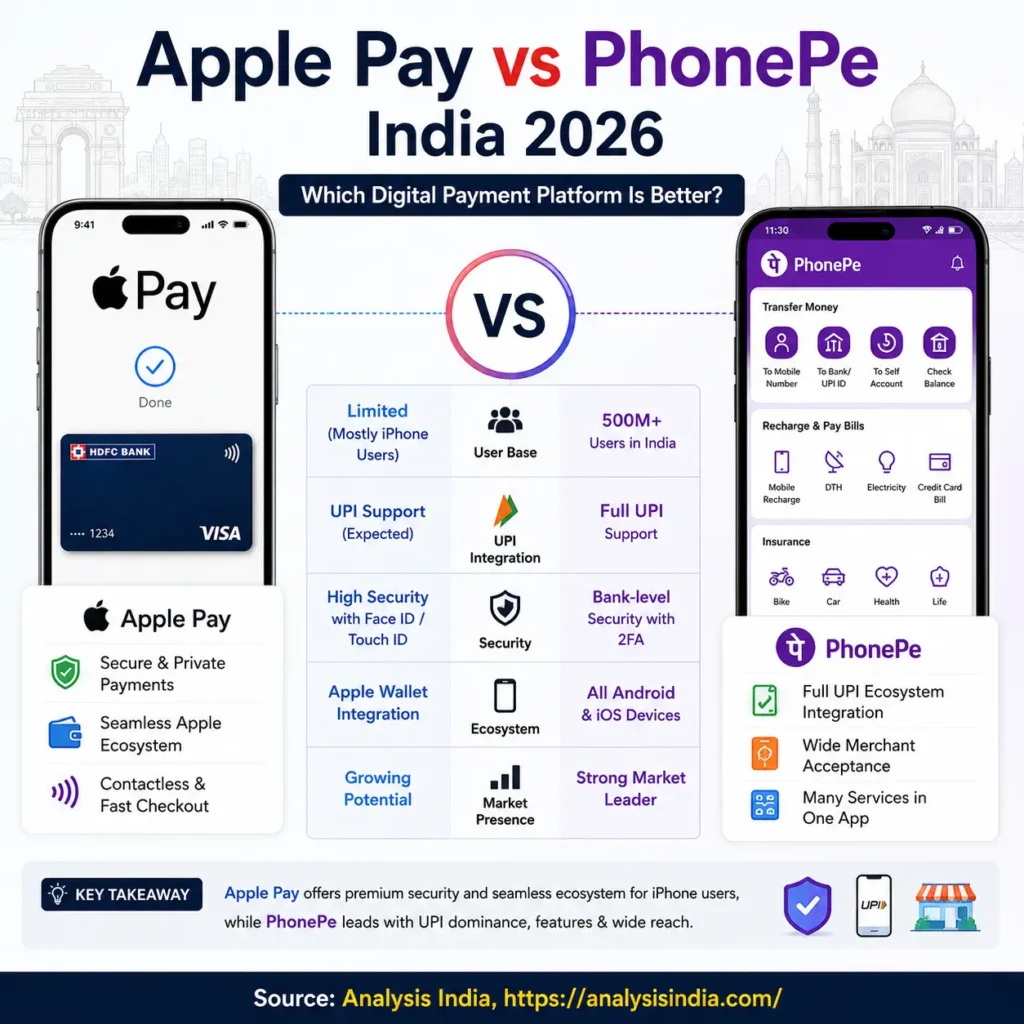
The consumer experience can also be compared with India’s major UPI-based platforms through our Apple Pay vs PhonePe India 2026 comparison.
Apple Pay vs UPI for Online Payments
The Apple Pay vs UPI payments comparison changes somewhat when the transaction moves online.
Apple Pay can appear as a payment option on participating websites and applications. A customer can select Apple Pay and authenticate the payment using the Apple device.
UPI is also widely integrated into online checkout. A consumer can select UPI and complete the payment through a supported UPI application or payment flow.
For online merchants, the decision is therefore less about NFC versus QR. It is more about the payment options integrated into the checkout experience.
A merchant may offer cards, Apple Pay, UPI and other payment methods simultaneously.
This creates a multi-payment environment in which consumers can choose the method that matches their preferred funding source and available payment infrastructure.
Apple Pay vs UPI: Security Comparison
Security is another important part of the comparison, but the two systems should not be reduced to a simple claim that one is automatically more secure than the other.
Apple Pay uses device authentication and tokenized payment credentials. Apple says that the actual card number is not stored on Apple servers or shared with merchants during Apple Pay transactions. Apple Pay instead uses a Device Account Number and transaction-specific security mechanisms.
This makes device security a central component of the Apple Pay model.
UPI follows a different security architecture. The payment is linked to the user’s participating bank account and authenticated through the UPI payment process. UPI applications, PSPs and banks also operate within the wider UPI security framework.
The user experience is therefore different.
Apple Pay emphasizes device authentication, tokenized card credentials and Apple’s hardware security architecture.
UPI emphasizes bank-account authentication, UPI credentials and the security infrastructure operated by participating banks and UPI ecosystem participants.
The practical security of either payment method also depends on user behavior, device protection, authentication practices, merchant systems and bank controls.
Apple Pay vs UPI: Credit Card and Bank Account Use Cases
The difference between a credit card and a bank account creates several practical use cases.
Suppose a consumer has an eligible Axis Bank credit card and wants to pay at a contactless terminal. Apple Pay can provide a way to use that card through an iPhone or Apple Watch.
Another consumer may want to pay ₹500 to a neighborhood merchant directly from a bank account. If the merchant has a UPI QR code, UPI can provide that payment route.
The two systems therefore address different funding relationships.
| Use case | Apple Pay | UPI |
|---|---|---|
| Eligible credit-card payment | Yes | Possible through supported UPI credit-card arrangements |
| Direct bank-account payment | Not the primary model | Yes |
| Contactless card payment | Yes | Different NFC-based UPI mechanism |
| QR payment | Not the primary model | Yes |
| Person-to-person transfer | Not the primary India use case | Yes |
| Online merchant payment | Yes, where supported | Yes |
| Local QR merchant | Not the primary mechanism | Yes |
| Apple device integration | Strong | Through UPI applications |
One important nuance is that UPI can also support certain credit-card arrangements. NPCI allows eligible RuPay credit cards to be linked to UPI and used for merchant payments through supported UPI applications.
This means the distinction should not be described as simply “Apple Pay uses credit cards while UPI never does.” The more accurate distinction is that Apple Pay’s initial Indian launch is card-wallet based, while UPI remains an account-based payment infrastructure that also supports certain additional funding sources.
Apple Pay or UPI: Which Fits Which Situation?
For consumers, the choice between the two systems depends on the transaction.
Apple Pay can fit a situation where the consumer has an eligible supported card, uses a compatible Apple device and wants to make a contactless payment at a participating merchant.
It can also fit supported online purchases where Apple Pay is available at checkout.
UPI can fit situations where the consumer wants to pay directly from a linked bank account, use a merchant QR code, transfer money to another person or use a UPI-enabled online checkout.
The distinction becomes particularly clear for small-value everyday transactions. A consumer buying an item from a small merchant may find a UPI QR code readily available, while Apple Pay may depend on whether the merchant has compatible contactless card acceptance.
At a modern retail store with a contactless POS terminal, Apple Pay may provide a convenient card-based payment experience.
Therefore, Apple Pay or UPI is often a transaction-specific decision rather than a permanent consumer preference.
Apple Pay vs UPI for Merchants
Merchants have a different set of considerations.
UPI provides access to a large consumer ecosystem and supports QR-based acceptance. Its widespread adoption means that many Indian businesses already have UPI acceptance as a standard payment option.
Apple Pay adds another route for eligible customers who want to use cards through Apple devices.
For a merchant that already accepts contactless card payments, Apple Pay can potentially fit into the existing infrastructure. For a merchant that operates primarily through a UPI QR code, UPI may remain the more relevant digital-payment mechanism for that environment.
The two can therefore coexist.
A merchant can display a UPI QR code while also accepting contactless card payments through its POS terminal.
This is an important reason why Apple Pay vs UPI should not be framed as a binary merchant decision.
Apple Pay vs UPI: Fees and MDR
Payment economics require a current and carefully qualified comparison.
For consumers using Apple Pay, Axis Bank currently states that Apple Pay itself does not add a separate fee for eligible customers. Normal terms and charges associated with the underlying credit card continue to apply.
UPI’s merchant economics are changing in October 2026. Reuters reported that a 0.4% Merchant Discount Rate is scheduled to apply from October 15, 2026 to eligible UPI person-to-merchant transactions above ₹2,000, with specified exemptions and a cap. Person-to-person payments remain outside this merchant-fee framework.
This is important because older explanations that describe all UPI merchant transactions as having zero MDR will soon be outdated.
At the same time, the new MDR should not be interpreted as a blanket consumer charge. Reuters reported that the framework is designed as a merchant-side fee and that providers and banks have been directed not to pass the fee directly to consumers.
Apple Pay’s merchant economics are different because its transactions operate through card-payment infrastructure. Costs can involve the card network, issuing bank, acquiring bank and payment service providers.
Therefore, Apple Pay vs UPI on fees should be evaluated from the perspective of the specific participant. A consumer, merchant, card issuer and payment provider can experience different economics.
Why UPI’s Existing Scale Matters
The most important context for Apple Pay vs UPI India is UPI’s enormous existing scale.
Reuters reported that UPI represents about 84% of India’s digital-payment volume. The same report described UPI as the world’s largest retail fast-payment system by transaction volume.
NPCI’s official August 2026 statistics provide another view of that scale. UPI recorded 24,508.96 million transactions during August, worth ₹29,82,355.95 crore, with 752 banks live on the network.
This means Apple Pay is not entering an immature digital-payment market.
India already has a highly developed payment ecosystem involving UPI applications, QR payments, bank accounts, credit cards, debit cards, contactless cards, payment gateways and digital wallets.
Apple Pay is therefore adding a new card-based wallet experience within an existing ecosystem.
That distinction should remain central to any discussion of Apple Pay India UPI.
Apple Pay and UPI Can Coexist
The fact that Apple Pay and UPI use different architectures means that they can operate alongside each other.
An iPhone user could use UPI to pay a local merchant through a QR code and use Apple Pay to tap an eligible credit card at a contactless terminal.
The same person could also use UPI for a bank-account transfer, Apple Pay for an online purchase where it is supported and a physical card where neither digital method is available.
This is similar to having multiple payment instruments in a physical wallet.
The digital environment simply gives consumers more ways to access those instruments.
The relationship between UPI vs Apple Pay is therefore better understood as coexistence between payment rails rather than a straightforward replacement relationship.
The broader role of Apple Pay within India’s digital-payment ecosystem is discussed in our Apple Pay India digital payments analysis.
Apple Pay vs UPI and the Indian Merchant Ecosystem
Merchant infrastructure could determine how these systems evolve alongside each other.
UPI’s QR model allows merchants to participate in digital payments without necessarily relying on the same card-terminal infrastructure required for contactless card transactions.
Apple Pay benefits from existing contactless card acceptance. Apple’s launch announcement says Apple Pay can be used at retailers of different sizes, while Axis Bank confirms acceptance at participating contactless terminals.
This creates two different adoption paths.
UPI can expand through QR acceptance and digital merchant integrations.
Apple Pay can expand through contactless card acceptance, online checkout integrations and the addition of more participating banks and card products.
For consumers, the result could be a payment environment where multiple options are available at the same merchant.
Apple Pay UPI India: What Could Change?
The current Apple Pay UPI India comparison reflects the September 30, 2026 launch position.
Apple’s Indian card ecosystem could expand over time. Additional banks could potentially join the service, and the range of supported cards and payment networks could increase.
UPI is also continuing to evolve. The introduction of UPI Tap & Pay demonstrates that the UPI ecosystem is not permanently tied to QR codes. NPCI’s broader UPI product development includes multiple payment methods and transaction capabilities.
This means future comparisons may become even more complex.
The physical experience could increasingly converge around simple actions such as tapping a phone. But the underlying payment architecture could remain different.
That is why consumers and merchants should focus on the payment rail rather than the physical interaction alone.
The comparison becomes broader when Apple’s payment ecosystem is examined alongside another major digital-payment platform in our Apple Pay vs Google Pay in India 2026 analysis.
Analysis India View: Apple Pay’s Position Alongside UPI
The launch of Apple Pay represents an important addition to India’s digital-payment landscape, but its initial position is clearly different from that of UPI.
Apple Pay enters through eligible cards, Apple devices and contactless payment infrastructure. UPI already operates as a broad bank-linked payment ecosystem with enormous transaction volumes and widespread merchant acceptance.
The initial Apple Pay launch also has a relatively narrow card base. Axis Bank is the first Indian banking partner, and the initial rollout supports eligible Visa and Mastercard credit cards. Reuters reported that Apple had also discussed the service with HDFC Bank and ICICI Bank, but agreements had not been finalized at launch.
The future reach of Apple Pay will therefore depend partly on bank participation, supported card products, payment-network availability and merchant acceptance.
UPI’s future will involve its own developments, including new contactless capabilities and changes to the economics of merchant payments.
For consumers, the practical outcome may be greater choice rather than the disappearance of one payment method.
A consumer can use UPI when an account-based payment is appropriate and Apple Pay when an eligible card-based contactless or online payment is more suitable.
That is the most useful way to understand Apple Pay vs UPI in India in 2026.
Apple Pay vs UPI: Key Differences at a Glance
| Factor | Apple Pay | UPI |
|---|---|---|
| Core architecture | Digital wallet for eligible cards | Real-time bank-account payment system |
| India launch status | Launched September 30, 2026 | Established nationwide ecosystem |
| Initial Apple Pay bank | Axis Bank | 752 banks live on UPI in August 2026 |
| Current Apple Pay cards | Eligible Axis Bank Visa and Mastercard credit cards | Multiple bank-linked payment sources |
| Primary physical method | NFC contactless | QR plus supported NFC methods |
| Online payments | Supported websites and apps | Very widely supported |
| P2P payments | Not the primary Apple Pay India use case | Core UPI use case |
| Funding relationship | Card-based | Primarily bank-account based |
| Credit cards | Central to current Apple Pay launch | Supported through specific UPI-linked arrangements |
| Security model | Device authentication and tokenized card credentials | UPI authentication and bank/payment infrastructure |
| Merchant infrastructure | Contactless card acceptance | QR and other UPI acceptance methods |
| UPI support | Not supported in initial Apple Pay India launch | Native |
| Current scale | New India launch | 24.51 billion transactions in August 2026 |
| Main consumer context | Card-based digital wallet | Account-based real-time payments |
Conclusion
The Apple Pay vs UPI comparison becomes much clearer when the two systems are examined according to their underlying payment architecture rather than their user interface.
Apple Pay is primarily a card-based digital wallet. India’s initial Apple Pay launch supports eligible Axis Bank Visa and Mastercard credit cards and allows users to make supported contactless, app and online payments through compatible Apple devices.
UPI is a real-time payment infrastructure built around participating banks, UPI applications and account-based transactions. Its QR-based merchant ecosystem is already deeply embedded in India’s economy, while features such as UPI Tap & Pay are extending the system into NFC-based payment experiences.
The biggest Apple Pay vs UPI difference is therefore not simply whether one requires a tap and the other requires a QR scan. It is the underlying financial mechanism.
Apple Pay primarily provides a digital way to use an eligible card.
UPI primarily provides a digital way to move money through the UPI ecosystem from a linked account or another supported payment source.
For a consumer using an eligible credit card at a contactless terminal, Apple Pay can be a natural fit. For a consumer paying a local merchant through a QR code or transferring money directly through UPI, UPI provides the relevant payment mechanism.
The two systems can coexist on the same smartphone and within the same consumer payment strategy.
With UPI handling about 84% of India’s digital-payment volume, Apple Pay is entering an already mature digital-payment ecosystem rather than attempting to create one from scratch.
The future of India’s payments market may therefore involve more payment options operating together rather than one mechanism eliminating another.
Frequently Asked Questions
Is Apple Pay the same as UPI?
No. Apple Pay is primarily a digital wallet for eligible payment cards, while UPI is a real-time payment infrastructure that primarily enables bank-account-based transactions.
What is the main Apple Pay vs UPI difference?
The main difference is the payment architecture. Apple Pay uses eligible cards through Apple’s digital wallet and supported devices, while UPI connects users, banks and merchants through India’s real-time payment infrastructure.
Does Apple Pay support UPI in India?
No. The initial Apple Pay India launch does not provide UPI payments. It supports eligible Axis Bank Visa and Mastercard credit cards.
Can Apple Pay and UPI be used on the same iPhone?
Yes. A consumer can use Apple Pay for eligible card transactions and a supported UPI application for UPI transactions on the same iPhone.
Is Apple Pay better than UPI?
Apple Pay and UPI serve different payment architectures. Apple Pay can fit eligible card-based contactless payments, while UPI is widely used for bank-account payments, QR transactions, transfers and online payments.
Does Apple Pay use NFC?
Yes. Apple Pay uses NFC for supported contactless in-store payments.
Does UPI support contactless payment?
Yes. NPCI’s UPI Tap & Pay enables supported UPI applications to use NFC-based interactions with compatible merchant devices or tags.
Is UPI Tap & Pay the same as Apple Pay contactless payment?
No. Both can involve tapping a device, but the underlying payment mechanism is different. Apple Pay processes a card-based payment, while UPI Tap & Pay initiates a UPI transaction.
Can Apple Pay use a credit card in India?
Yes. At the September 30, 2026 launch, eligible Axis Bank Visa and Mastercard credit cards are supported.
Can UPI use credit cards?
Yes, certain credit-card arrangements are supported through UPI. NPCI supports eligible RuPay credit cards linked to UPI for merchant payments.
Does Apple Pay replace UPI in India?
No. Apple Pay and UPI are based on different payment architectures. They can coexist and serve different consumer and merchant use cases.
Which is better for QR payments, Apple Pay or UPI?
UPI is the relevant mechanism for conventional UPI QR payments. Apple Pay’s primary physical payment experience is contactless card payment rather than UPI QR payment.
Can merchants accept Apple Pay and UPI together?
Yes. A merchant can potentially accept Apple Pay through compatible contactless card infrastructure while also accepting UPI through QR or other supported UPI payment methods.
Does Apple Pay require a UPI ID?
No. The initial Apple Pay India implementation uses eligible payment cards and does not require a UPI ID.
Why is UPI important in the Apple Pay India comparison?
UPI already has enormous scale in India. It accounted for about 84% of India’s digital-payment volume according to Reuters, while NPCI recorded about 24.51 billion UPI transactions in August 2026.