📅 Published: September 29, 2026
🔄 Last Updated: September 29, 2026
India Location Analytics Market Overview
The India Location Analytics Market is becoming an important part of the country’s broader analytics and digital transformation ecosystem. Location analytics combines geographic information with business, demographic, mobility, infrastructure and operational data to identify patterns that may not be visible through conventional analytics.
Businesses can use location analytics to understand where customers live, where demand is concentrated, how people move between locations and where new facilities should be established. Government organizations can use spatial information for infrastructure planning, urban development, land management, transportation and public services. This makes location analytics relevant across both private and public sector applications.
The growing importance of geospatial information is supported by India’s policy environment. The Government of India introduced the National Geospatial Policy 2022 to strengthen the country’s geospatial ecosystem and promote wider use of geospatial data, products, solutions and services. The policy recognizes geospatial data as an important resource for areas ranging from agriculture and infrastructure to banking, finance, disaster management and social planning.
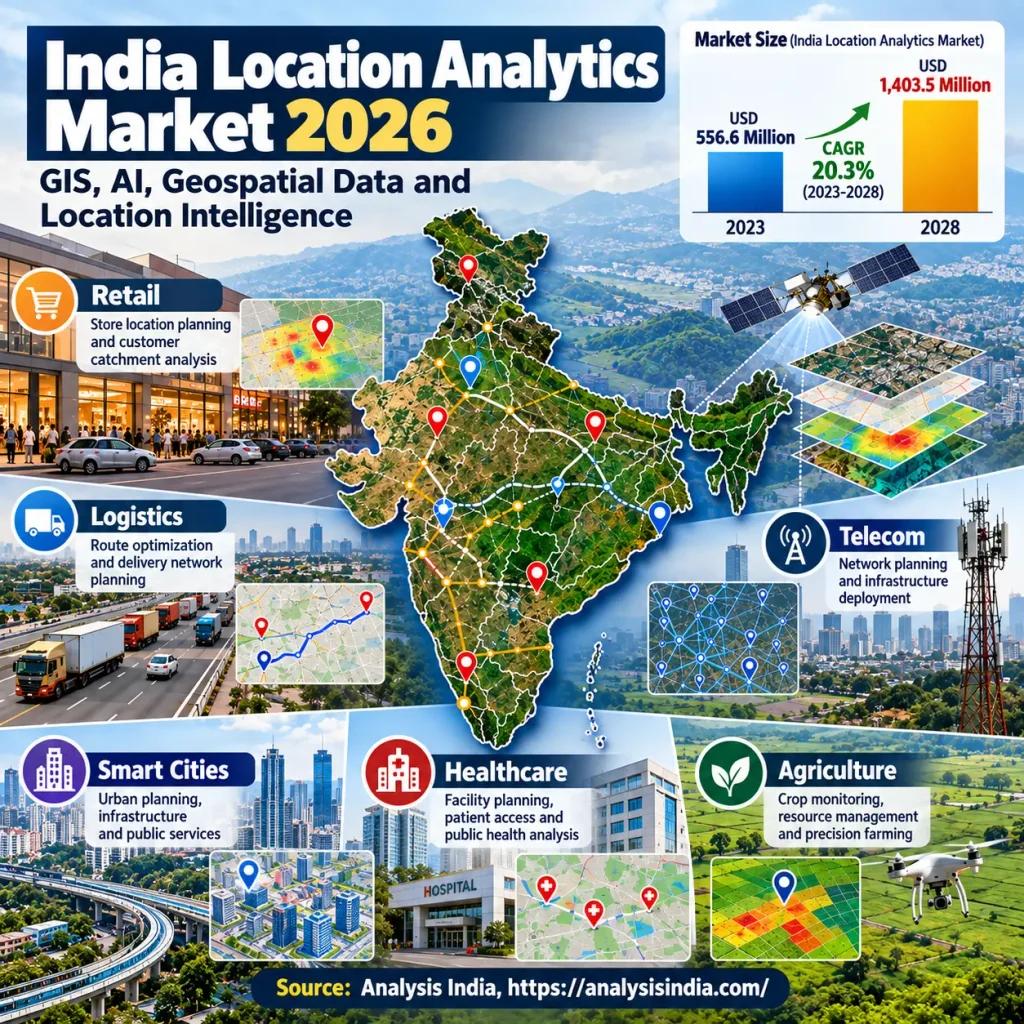
The commercial opportunity is also expanding. MarketsandMarkets estimates that the India location analytics market was valued at USD 556.6 million in 2023 and is projected to reach USD 1,403.5 million by 2028, representing a CAGR of 20.3 percent during the forecast period.
However, market estimates should be interpreted carefully. Other research organizations use different definitions and market boundaries. For example, 6Wresearch estimates the India location analytics market at USD 1.2 billion in 2025 and projects it to reach USD 1.726 billion by 2032. These figures are not directly comparable because research methodologies, included technologies and market definitions can differ.
For this reason, the India Location Analytics Market should be analyzed using individual research estimates rather than combining different forecasts into one market size.
India Location Analytics Market Size and Forecast
The market size provides an important indication of the commercial opportunity emerging around location based decision making in India. MarketsandMarkets estimates the India location analytics market at USD 556.6 million in 2023 and forecasts USD 1,403.5 million by 2028.
The reported CAGR of 20.3 percent indicates rapid expansion during the forecast period. This growth is being supported by increasing adoption of geospatial technologies across retail, logistics, transportation, telecommunications, infrastructure, agriculture, real estate and government applications.
The following table summarizes the major published estimates.
| Market Indicator | Value | Period | Source |
|---|---|---|---|
| India Location Analytics Market | USD 556.6 million | 2023 | MarketsandMarkets |
| India Location Analytics Market | USD 1,403.5 million | 2028 | MarketsandMarkets |
| Reported CAGR | 20.3 percent | 2023 to 2028 | MarketsandMarkets |
| India Location Analytics Market | USD 1.2 billion | 2025 | 6Wresearch |
| India Location Analytics Market | USD 1.726 billion | 2032 | 6Wresearch |
| Reported CAGR | 6.7 percent | 2026 to 2032 | 6Wresearch |
The differences between these estimates demonstrate why market definition is important. Location analytics can include software platforms, spatial analysis tools, location intelligence services, geospatial applications and related technologies. Some research studies may include a wider range of geospatial intelligence and spatial technology services.
The broader India geospatial analytics market is considerably larger under some research definitions. Mordor Intelligence estimates the India geospatial analytics market at USD 1.58 billion in 2025 and forecasts USD 3.55 billion by 2031. Grand View Research provides an even broader estimate of USD 4.63 billion in 2025 and projects the market to reach USD 14.02 billion by 2033.
These broader figures should not be treated as direct estimates of the India Location Analytics Market. They provide context for the wider geospatial technology ecosystem in which location analytics operates.
Market Scope and Definition
Location analytics refers to the use of geographic or spatial information together with other datasets to generate insights for decision making. The technology can combine location coordinates with customer information, transaction data, demographic information, road networks, weather information, infrastructure data and other variables.
Geographic Information Systems are an important technology within this ecosystem. However, location analytics extends beyond simply displaying information on a map. The analytical component is what allows organizations to compare locations, identify spatial relationships, estimate demand and support operational decisions.
For example, a retailer can analyze customer locations, competitor locations, income levels, traffic patterns and existing store performance before selecting a new store site. A logistics company can combine road networks, vehicle locations, delivery addresses and traffic information to improve route planning.
The India Location Analytics Market therefore includes technology and services that help organizations convert location data into actionable business or operational intelligence.
India Location Analytics Market and India’s Geospatial Policy
Government policy is one of the important structural factors supporting the development of location based technologies in India.
The National Geospatial Policy 2022 provides a framework for strengthening India’s geospatial ecosystem. The policy identifies applications across agriculture, industries, urban and rural infrastructure, land administration, banking and finance, mining, water resources, disaster management and social planning.
The Department of Science and Technology has also highlighted the importance of easier access to geospatial data and services. India’s geospatial guidelines have progressively liberalized the acquisition and use of geospatial data while establishing appropriate requirements for sensitive information.
This policy environment creates opportunities for private technology companies because organizations can develop applications around geospatial datasets without operating within the older approval framework that applied to many categories of mapping activity.
The policy environment is therefore an important long term driver for the India Location Analytics Market.
PM GatiShakti and Location Analytics
PM GatiShakti National Master Plan is one of the most important government examples of large scale geospatial decision making in India.
The platform integrates infrastructure related information using geospatial technology so that government departments can examine transportation networks, economic zones, logistics infrastructure and other geographic relationships.
According to the Government of India, the PM GatiShakti platform has been developed to support integrated infrastructure planning using geospatial data, satellite imagery and digital systems. In 2025, the government reported that the platform had more than 550 data layers for infrastructure planning applications.
The government also launched PM GatiShakti Public through the Unified Geospatial Interface in October 2025 to expand access to infrastructure and geospatial information.
These developments are significant for the India Location Analytics Market because they demonstrate how spatial data can move from a specialized mapping function to a broader decision support system.
The use of geospatial information for infrastructure planning can also create demand for software, analytics services, data integration, visualization, consulting and implementation.
Role of SVAMITVA in Location Analytics
The SVAMITVA scheme provides another major example of location based technology deployment in India.
The scheme uses drone based surveying and mapping to identify rural residential properties and support the creation of property cards. It combines drone surveys, mapping, geospatial data and land related information.
According to the Ministry of Panchayati Raj’s current dashboard, drone surveys had been completed in more than 327,000 villages, while the scheme dashboard reported more than 28.3 million property cards prepared.
The scale of this initiative demonstrates how location data can support land administration and rural governance.
The data generated through such programs can also support planning activities. Local governments can potentially use mapped information for property management, infrastructure planning, taxation and development decisions.
Therefore, programs such as SVAMITVA can contribute indirectly to the development of India’s location analytics ecosystem.
Role of ISRO and Bhuvan
India’s space and remote sensing infrastructure provides another important foundation for location based analytics.
ISRO’s Bhuvan platform provides access to a range of thematic, sectoral, disaster management and government related geospatial applications. The platform allows users to visualize, overlay and analyze geographic information for different applications.
Satellite imagery can provide information about land use, agriculture, environmental conditions, infrastructure and physical changes over time. When this information is combined with business or administrative datasets, organizations can develop more advanced spatial analytics applications.
This creates an important connection between satellite technology and the India Location Analytics Market.
The expansion of earth observation data, drones, satellite positioning and cloud computing can increase the amount of spatial information available for analytical applications.
Major Applications of India Location Analytics Market
The India Location Analytics Market is expanding because organizations across different industries are increasingly using geographic information to understand customers, infrastructure, assets and operational activity. Unlike conventional analytics, which often focuses on numerical or transactional data, location analytics adds a geographic dimension to business decisions. This allows organizations to understand not only what is happening, but also where it is happening and how location influences the outcome.
Retail, logistics, telecommunications, banking, healthcare, agriculture, real estate and government are among the major areas where location based analytics can create value. The growing availability of digital maps, satellite imagery, mobility information, demographic datasets and connected devices is further increasing the amount of location data available to organizations. As these datasets become easier to integrate with conventional business intelligence systems, the potential applications are becoming broader.
Location Analytics in Retail
Retail is one of the most important commercial applications of location analytics because the performance of a physical store is closely connected with its surrounding market. Retailers need to understand population density, customer characteristics, purchasing behavior, competitor presence, transportation access and the availability of complementary businesses before investing in a new location.
Location analytics can combine these variables to create a more detailed picture of a potential store catchment area. A retailer can compare existing store performance with demographic and geographic characteristics to identify locations that have similar demand potential. This can also help businesses identify areas where customer demand is increasing but existing store coverage remains limited.
The role of location analytics has become even more relevant with the growth of quick commerce and hyperlocal delivery. Businesses operating smaller fulfillment facilities need to understand demand at a much more localized level. Customer concentration, delivery distance and road connectivity can directly affect delivery economics. This creates an important opportunity for the India Location Analytics Market as retailers increasingly combine physical and digital channels.
Location Analytics in E Commerce and Logistics
The growth of ecommerce has increased the importance of geographic intelligence because every online order eventually has to be delivered to a physical location. Companies need to understand where customers are concentrated, how far fulfillment centers are from demand centers and how transportation networks affect delivery time.
Location analytics can help logistics companies examine delivery routes, distribution centers, vehicle movement and customer locations. When combined with traffic and road network information, spatial analysis can support more efficient routing and network planning. For companies handling large delivery volumes, even relatively small improvements in route planning can create significant operational benefits.
The expansion of India’s logistics infrastructure is therefore closely connected with the India Location Analytics Market. Warehouses, fulfillment centers, transportation hubs and delivery networks all have a geographic relationship that can be analyzed. As logistics companies move toward increasingly data driven operations, location intelligence can become an important part of network optimization.
Location Analytics in Telecommunications
Telecommunications is another industry where geography plays a central role. Mobile networks depend on physical infrastructure, including towers, fiber networks and other communication assets. Operators need to understand population distribution, network coverage, customer concentration and usage patterns when deciding where to invest in additional infrastructure.
Location analytics can help telecommunications companies identify areas where network capacity may need to be expanded. Geographic analysis can also help companies compare coverage with population density and commercial activity. This can support decisions related to network investment and infrastructure deployment.
The continued expansion of high speed mobile connectivity and digital services can therefore support demand for spatial intelligence. As telecom operators manage increasingly complex networks, geographic information can be combined with operational and customer data to provide a more comprehensive view of network performance.
Location Analytics in Banking and Financial Services
Banking and financial services also provide important applications for location analytics. Although digital banking has reduced dependence on physical branches, geographic information remains relevant for branch planning, ATM placement, customer accessibility and market expansion.
A bank can analyze population distribution, income levels, commercial activity, existing customer concentration and competitor presence to understand the characteristics of a particular market. Geographic analysis can also help financial institutions identify areas where access to banking services may be limited.
Insurance companies can use spatial information for a different set of applications. Geographic characteristics can help insurers assess exposure to natural hazards, property related risks and concentrations of insured assets. However, organizations need to ensure that location based information is used responsibly, particularly when it is combined with personally identifiable information.
The development of India’s digital data governance framework will therefore remain relevant as financial institutions expand their use of location intelligence.
Location Analytics in Healthcare
Healthcare represents an emerging opportunity within the India Location Analytics Market because access to healthcare is strongly influenced by geography. The location of hospitals, diagnostic centers, clinics, pharmacies and emergency services can affect how easily people can obtain medical care.
Healthcare organizations can use geographic analysis to identify areas with limited healthcare infrastructure. They can examine population distribution, travel distance, existing facilities and demographic characteristics when considering the expansion of hospitals or diagnostic services.
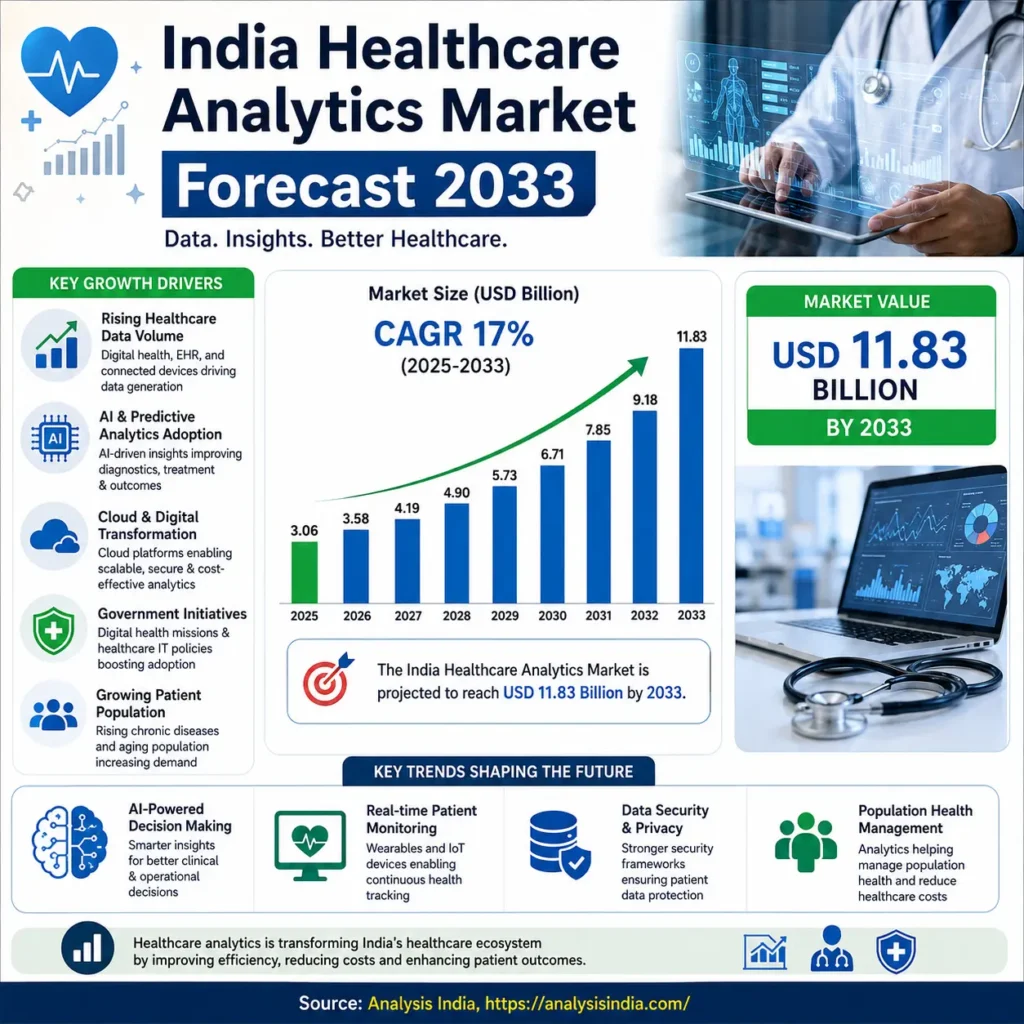
Location based healthcare insights are also becoming part of the wider healthcare analytics ecosystem, where hospitals and healthcare organizations increasingly use data for operational planning, resource allocation and patient focused decision making. The broader India Healthcare Analytics Market Forecast 2033 provides additional context on the expanding role of analytics across India’s healthcare sector.
Location analytics can also support public health planning. Geographic patterns can help authorities understand how healthcare resources are distributed across regions and whether certain populations have limited access to essential services.
The connection between location analytics and healthcare is particularly important as healthcare organizations increasingly adopt broader data driven systems. For a deeper examination of predictive technologies in this sector, readers can explore the India Healthcare Predictive Analytics Market, where healthcare data is analyzed to support clinical and operational decision making.
Location Analytics in Agriculture
Agriculture is another important application because almost every agricultural activity is geographically connected. Crop production, soil characteristics, rainfall, irrigation, land use and weather conditions can vary considerably between locations.
Satellite imagery, drones, remote sensing systems and geographic information can provide farmers and agricultural organizations with more detailed information about individual fields and wider agricultural regions. These technologies can help identify changes in crop conditions and support more targeted resource management.
Government agencies can also use spatial information for agricultural planning, crop monitoring and disaster assessment. As remote sensing data becomes more accessible, the combination of geospatial information and analytics can support the wider adoption of precision agriculture.
This creates a significant long term opportunity for the India Location Analytics Market because agriculture represents one of India’s largest geographic data environments.
Location Analytics in Real Estate
Real estate is naturally dependent on location, making it another important application area. Property demand can vary significantly according to transportation connectivity, population growth, commercial development, public infrastructure and access to essential services.
Real estate companies can use location analytics to compare potential development areas and understand how demographic and infrastructure changes may influence future demand. Developers can examine proximity to roads, public transport, schools, hospitals and commercial centers when evaluating potential sites.
Location based analysis can also help property companies understand competitive supply. By mapping existing residential or commercial developments against population growth and infrastructure expansion, companies can identify areas where market conditions may be changing.
The increasing availability of geographic and demographic information can therefore make spatial intelligence more useful in real estate investment and development decisions.
Location Analytics in Smart Cities
Urban development is creating another major opportunity for location analytics. Indian cities are becoming increasingly complex, with governments required to manage transportation, water systems, waste management, drainage, land use and public infrastructure across rapidly growing populations.
GIS based systems can bring different infrastructure datasets together and allow planners to examine their geographic relationships. Instead of analyzing roads, buildings, drainage systems and population information independently, urban planners can examine how these elements interact within the same geographic environment.
The use of GIS based master planning in India demonstrates the growing role of spatial information in urban development. Government initiatives have encouraged the preparation of GIS based master plans and integration of geospatial information with broader infrastructure planning systems.
For the India Location Analytics Market, this creates opportunities in urban planning software, spatial databases, visualization platforms, data integration and analytical services.
Artificial Intelligence and Location Analytics
Artificial intelligence is beginning to change the capabilities of location analytics. Traditional geographic systems were primarily designed to store, display and analyze spatial information. Modern platforms can increasingly combine these capabilities with machine learning and automated pattern recognition.
AI can analyze large volumes of satellite imagery, identify changes in land use, classify geographic features and detect patterns that may be difficult to identify manually. Machine learning can also be applied to applications such as traffic forecasting, demand estimation, delivery optimization and infrastructure monitoring.
The combination is particularly valuable because modern organizations can generate very large geographic datasets from satellites, connected devices, vehicles, mobile applications and IoT systems. AI can help transform these large datasets into more usable insights.
However, the use of AI does not eliminate the need for reliable data. Poor quality geographic information can produce inaccurate results even when sophisticated models are used. Organizations therefore need appropriate validation, data governance and domain expertise when implementing AI based spatial analytics.
Cloud Computing and Location Analytics
Cloud computing is also influencing the development of the India Location Analytics Market. Organizations increasingly need to process large geographic datasets that may be difficult to manage using traditional infrastructure.
Cloud platforms can provide scalable storage and computing resources for spatial databases, satellite imagery, mapping applications and analytical workloads. They can also make location based information accessible to teams working across different offices and geographic regions.
This can be particularly valuable for organizations operating nationwide networks. A retailer, logistics company or telecommunications operator can maintain centralized geographic datasets while allowing different business units to access information relevant to their operations.
At the same time, cloud adoption introduces requirements around security, access management, data governance and regulatory compliance. Location information can become sensitive when it is connected to identifiable individuals, making appropriate controls essential.
Key Drivers of India Location Analytics Market
Several structural factors are supporting the expansion of the India Location Analytics Market. The first is the increasing digitization of business operations. Companies are generating more information from transactions, connected devices, mobile applications, vehicles and digital services, creating additional opportunities to analyze business activity geographically.
Government investment in geospatial infrastructure is another important driver. The National Geospatial Policy 2022 has created a policy framework for wider use of geospatial technology across sectors. Initiatives such as PM GatiShakti and SVAMITVA demonstrate the practical use of spatial information for infrastructure planning and land administration.
The rapid growth of ecommerce and logistics is also increasing the need for geographic intelligence. Businesses need to understand customer distribution, delivery networks, transportation infrastructure and fulfillment locations.
Urbanization provides another structural opportunity. As cities expand, governments and businesses require better information about population distribution, infrastructure, land use and transportation.
The increasing availability of satellite imagery and drone based mapping is further expanding the supply of geographic information. When these datasets are combined with artificial intelligence and cloud computing, organizations can develop more sophisticated analytical applications.
Together, these factors are creating a broader foundation for the India Location Analytics Market.
Key Trends Shaping India Location Analytics Market
One of the most important trends is the movement from traditional mapping toward location intelligence. Organizations increasingly want geographic information to support specific business decisions rather than simply displaying information on a map.
The integration of artificial intelligence with GIS is another important development. AI can automate parts of spatial analysis and allow organizations to work with large volumes of imagery and geographic information.
Cloud based spatial analytics is also gaining importance because organizations need scalable infrastructure for increasingly large datasets. Cloud systems can support centralized geographic databases and make spatial information available across multiple departments.
Another important trend is the integration of different data sources. Satellite imagery, demographic information, customer data, transportation information and IoT data can increasingly be analyzed together. This creates a more detailed understanding of how geographic factors influence business and operational outcomes.
Real time location intelligence is also becoming more relevant. Logistics companies, transportation operators and other businesses increasingly require information that reflects current conditions rather than relying only on historical geographic patterns.
These developments are gradually moving location analytics from specialist GIS departments into mainstream enterprise analytics.
India Location Analytics Market by Technology
The technology ecosystem supporting location analytics includes several interconnected components. GIS software remains a fundamental layer because organizations need systems capable of storing, visualizing and analyzing geographic information.
Spatial databases provide the underlying infrastructure for managing geographic datasets. Remote sensing technologies provide information from satellites and other observation systems, while drones can provide high resolution geographic information for specific areas.
Location intelligence platforms add business analysis capabilities to geographic information. Artificial intelligence and machine learning can provide predictive and automated analytical capabilities, while cloud infrastructure allows organizations to store and process large datasets at scale.
The convergence of these technologies is creating a more integrated location intelligence ecosystem. The distinction between GIS, business intelligence, data science and location analytics is therefore becoming less rigid as organizations combine these capabilities within broader analytical platforms.
India Location Analytics Market by End User
Government organizations represent an important end user because infrastructure development, transportation, land administration and urban planning all depend heavily on geographic information.
Retail and ecommerce companies are another important user group. Their operations are closely connected with customer locations, store networks, fulfillment centers and delivery zones.
Logistics companies can use geographic analysis to improve routes and network planning, while telecommunications operators can use spatial information for network deployment and infrastructure management.
Real estate companies can use geographic data to analyze development opportunities, while agricultural organizations can apply satellite and drone information to crop monitoring and precision farming.
Financial services companies can use spatial analysis for branch planning, service accessibility and selected risk applications.
This broad end user base provides multiple growth opportunities for the India Location Analytics Market rather than making the industry dependent on a single application area.
Regional Opportunity in India Location Analytics Market
The adoption of location analytics is likely to remain strong in major technology and commercial centers such as Bengaluru, Hyderabad, Mumbai, Delhi NCR, Pune and Chennai. These cities have large concentrations of technology companies, financial institutions, retailers, logistics providers and other organizations that can adopt advanced analytics.
However, the long term opportunity extends well beyond major metropolitan areas. Rural mapping, agricultural applications, infrastructure development and government programs are increasing the use of geospatial technology across smaller cities and rural regions.
State governments and local administrations are also becoming increasingly important users of GIS based planning systems. As more public infrastructure and urban planning activities become digitized, demand for spatial databases, visualization tools and analytical services can expand geographically.
The development of the India Location Analytics Market is therefore likely to involve both enterprise adoption in major economic centers and government driven applications across a much wider geographic area.
Challenges Facing India Location Analytics Market
Despite the growth opportunity, the India Location Analytics Market faces several challenges. Data quality remains one of the most important issues because geographic datasets can come from multiple sources with different levels of accuracy, resolution and update frequency.
Data integration can also be difficult. Large organizations may have customer, operational, financial and geographic information stored in separate systems. Connecting these datasets requires suitable technology as well as consistent data standards.
The availability of skilled professionals is another challenge. Effective spatial analytics requires a combination of GIS knowledge, statistics, data engineering, visualization and business understanding. Organizations may therefore need to invest in both technology and specialized talent.
Privacy is also becoming increasingly important. Geographic information does not automatically constitute personal data, but location information can become sensitive when it is associated with an identifiable individual.
The cost of specialized datasets can represent another barrier. High resolution imagery, commercial mobility information and other specialized geographic datasets may involve licensing or subscription costs.
Finally, organizations need to demonstrate measurable business value. Location analytics projects are more likely to receive continued investment when they can demonstrate outcomes such as improved sales, reduced logistics costs, better infrastructure planning or improved resource utilization.
Data Privacy and Responsible Location Analytics
Data privacy will become increasingly important as the India Location Analytics Market expands into customer and mobility related applications. Location information can sometimes reveal patterns about an identifiable individual when it is combined with other datasets.
Organizations therefore need to understand whether the geographic information they process falls within applicable data protection requirements. The Digital Personal Data Protection Act 2023 provides an important framework for the processing of digital personal data in India.
Responsible location analytics requires more than regulatory compliance. Organizations should also consider data minimization, appropriate access controls, security measures and transparent governance.
Businesses that use location information responsibly can reduce regulatory and reputational risks while building greater confidence among customers and other stakeholders.
Competitive Landscape in India Location Analytics Market
The competitive landscape includes global GIS providers, cloud technology companies, mapping platforms, location intelligence providers, analytics companies and Indian geospatial technology firms.
Large technology companies can offer integrated combinations of cloud infrastructure, artificial intelligence, analytics and spatial capabilities. Specialized geospatial companies can compete through mapping expertise, spatial databases and industry specific applications.
Indian companies have opportunities to differentiate themselves through local market knowledge, sector expertise and customized solutions. Government projects and infrastructure programs can also create opportunities for companies with experience in large scale geospatial implementation.
Competition is likely to become increasingly application focused. A logistics company may require route optimization, while a retailer may need customer catchment analysis and a telecommunications operator may need network planning.
This creates room for both broad technology platforms and specialized solution providers.
Analysis India Perspective on India Location Analytics Market
The most significant development in the India Location Analytics Market is the movement from mapping toward decision intelligence. Traditional mapping primarily helped organizations visualize geographic information. Modern location analytics attempts to explain how geographic factors influence business and operational outcomes.
A retailer, for example, does not simply need to know where its stores are located. It needs to understand whether those stores are positioned close to potential customers and whether other geographic factors support future demand.
A logistics company similarly needs more than a digital road map. It needs to understand how customer distribution, transportation networks, traffic and fulfillment locations affect delivery performance.
Government organizations face a similar requirement. Infrastructure maps become more valuable when they can be combined with information about population, land use, economic activity and transportation networks.
This shift creates the fundamental opportunity behind location intelligence.
India’s expanding geospatial ecosystem provides an important foundation for this transition. The National Geospatial Policy 2022, PM GatiShakti, SVAMITVA and ISRO’s Bhuvan platform demonstrate that geographic information is increasingly being used for applications beyond conventional mapping.
The private sector can build on this infrastructure by developing industry specific applications that connect location information with business data.
The India Location Analytics Market should therefore be viewed as part of the wider analytics ecosystem. Location represents another analytical dimension that can complement customer, financial, operational and demographic information.
India Location Analytics Market Data and Analysis
Published market research indicates substantial growth potential, but the available estimates vary because research organizations use different definitions and methodologies. This distinction is important when evaluating the size of the India Location Analytics Market.
MarketsandMarkets estimates the India location analytics market at USD 556.6 million in 2023 and forecasts it to reach USD 1,403.5 million by 2028. The company reports a CAGR of 20.3 percent during the forecast period.
6Wresearch provides a different estimate, valuing the market at approximately USD 1.2 billion in 2025 and forecasting USD 1.726 billion by 2032. Because the two studies use different methodologies and market boundaries, their figures should not be combined.
| Research Organization | Market Definition | Base Value | Forecast Value | Forecast Year | Reported CAGR |
|---|---|---|---|---|---|
| MarketsandMarkets | India Location Analytics | USD 556.6 million in 2023 | USD 1,403.5 million | 2028 | 20.3 percent |
| 6Wresearch | India Location Analytics | USD 1.2 billion in 2025 | USD 1.726 billion | 2032 | 6.7 percent |
| Mordor Intelligence | India Geospatial Analytics | USD 1.58 billion in 2025 | USD 3.55 billion | 2031 | 14.43 percent |
| Grand View Research | India Geospatial Analytics | USD 4.63 billion in 2025 | USD 14.02 billion | 2033 | 14.4 percent |
The final two estimates cover the broader geospatial analytics market and should therefore be used as ecosystem benchmarks rather than direct estimates of the India Location Analytics Market.
The differences also demonstrate why market analysts should identify the precise definition used by each research organization before comparing forecasts. Location analytics, location intelligence and geospatial analytics can overlap, but they do not necessarily represent identical market categories.
For a focused analysis, the MarketsandMarkets estimate provides one useful benchmark because it specifically identifies location analytics as the market being measured.
Future Outlook for India Location Analytics Market
The future of the India Location Analytics Market will be closely connected with India’s wider digital transformation. Businesses are generating increasingly large volumes of information through transactions, connected devices, vehicles, mobile applications and digital services.
Geographic context can make this information more useful. A business may know that demand has increased, for example, but location analytics can help identify where that increase is occurring and whether it is connected with demographic, infrastructure or competitive changes.
Retail companies can use this information to evaluate new store opportunities. Logistics companies can analyze delivery networks. Telecommunications companies can examine infrastructure requirements. Government organizations can use geographic information for infrastructure and public service planning.
Artificial intelligence could further accelerate adoption by simplifying spatial analysis. Instead of requiring every business user to understand complex GIS tools, future platforms may allow users to ask geographic questions using natural language.
A manager could potentially ask which areas have high population growth but limited store coverage, while a logistics manager could examine which delivery zones are associated with longer travel times.
Such applications could make spatial intelligence accessible to a much wider group of business users.
India Location Analytics Market and India Analytics Market
The development of location analytics is closely connected with the broader India Analytics Market because organizations require many of the same technologies and capabilities. Data engineering, cloud infrastructure, artificial intelligence, visualization and statistical analysis can all contribute to location intelligence applications.
As Indian businesses become more comfortable with data driven decision making, geographic information can increasingly be incorporated into existing analytical workflows.
Healthcare provides one example of this relationship. Hospitals can combine geographic information with patient, demographic and facility data to understand healthcare accessibility and service requirements.
Predictive analytics provides another layer of opportunity. The India Healthcare Predictive Analytics Market demonstrates how specialized analytical applications can emerge from the wider healthcare data ecosystem.
A similar development can occur in location analytics as companies move from simple geographic visualization toward predictive and prescriptive decision support.
The growth of location intelligence is closely connected with the broader India Analytics Market, as organizations increasingly combine geographic information with customer, operational, financial and demographic data.
Key Market Data Sources
The analysis of the India Location Analytics Market should combine commercial market research with government and institutional sources. Commercial research organizations provide market size and forecast estimates, while government sources provide information about policy, infrastructure and public sector implementation.
| Source | Main Information Used |
|---|---|
| MarketsandMarkets | India location analytics market size and forecast |
| 6Wresearch | Alternative location analytics market estimate |
| Mordor Intelligence | India geospatial analytics market benchmark |
| Grand View Research | India geospatial analytics market forecast |
| Department of Science and Technology | National Geospatial Policy and geospatial framework |
| Press Information Bureau | PM GatiShakti and government geospatial initiatives |
| Ministry of Panchayati Raj | SVAMITVA implementation information |
| ISRO | Bhuvan and earth observation applications |
| Ministry of Electronics and Information Technology | Digital Personal Data Protection Act 2023 |
Government sources are particularly useful for evaluating India’s geospatial ecosystem because they provide information about actual programs and policy initiatives. Commercial forecasts should be treated as estimates because their market definitions, methodologies and forecast assumptions can differ.
Key Takeaways in India Location Analytics Market
The India Location Analytics Market is developing as businesses and government organizations increasingly connect geographic information with conventional datasets.
The market has applications across retail, ecommerce, logistics, telecommunications, financial services, healthcare, agriculture, real estate and urban planning. The expansion of digital infrastructure is increasing the amount of location related data available for analysis.
Government initiatives are also creating a strong foundation. The National Geospatial Policy 2022 provides a policy framework for wider use of geospatial technology, while PM GatiShakti demonstrates how spatial information can support infrastructure planning. SVAMITVA provides another example through its use of drone based mapping for rural property related information.
Artificial intelligence, cloud computing, satellite imagery and drones are expected to expand the capabilities of location intelligence. These technologies can help organizations move from static geographic visualization toward predictive and operational decision support.
At the same time, data quality, interoperability, privacy, cybersecurity, skilled professionals and implementation costs remain important challenges.
The future opportunity will therefore depend on how effectively organizations convert geographic data into measurable business and public sector outcomes.
Conclusion: India Location Analytics Market
The India Location Analytics Market is gradually moving beyond traditional mapping toward a broader model of location based decision intelligence. India’s expanding digital economy is generating large volumes of information that can be analyzed geographically, while government initiatives are strengthening the underlying geospatial ecosystem.
The National Geospatial Policy 2022 provides an important policy foundation. PM GatiShakti demonstrates the role of geospatial information in integrated infrastructure planning, while SVAMITVA demonstrates the use of drone based mapping for rural land administration. ISRO’s Bhuvan platform further illustrates the applications of satellite and earth observation information.
For businesses, the opportunity extends across retail, ecommerce, logistics, telecommunications, agriculture, real estate, financial services and healthcare. Each sector can use geographic information differently, but the underlying objective is similar: improving decisions by understanding the relationship between data and location.
The next stage of development is likely to involve stronger integration between GIS, artificial intelligence, cloud computing, satellite imagery, drones, IoT and conventional business analytics.
The most important opportunity is therefore not simply producing more digital maps. It is transforming geographic information into actionable intelligence.
As Indian organizations increasingly adopt data driven decision making, location can become an important analytical dimension alongside customer, financial, operational and demographic information. This broader shift provides a strong foundation for continued development of the India Location Analytics Market.
Frequently Asked Questions: India Location Analytics Market
What is the India Location Analytics Market?
The India Location Analytics Market includes technologies and services that use geographic information together with business, demographic, operational or other datasets to generate insights. Common applications include retail site selection, logistics planning, infrastructure development, telecommunications network planning, agriculture and urban planning.
What is the size of the India Location Analytics Market?
MarketsandMarkets estimates that the India location analytics market was valued at USD 556.6 million in 2023 and could reach USD 1,403.5 million by 2028, representing a reported CAGR of 20.3 percent. Other research organizations provide different estimates because their market definitions and methodologies vary.
Why is location analytics market growing in India?
The growth is supported by digital transformation, ecommerce, logistics expansion, urbanization, government geospatial programs, satellite imagery, drone mapping, cloud computing and artificial intelligence. Initiatives such as PM GatiShakti and SVAMITVA are also increasing the practical use of geographic information.
Which industries use location analytics in India?
Retail, ecommerce, logistics, telecommunications, banking, insurance, real estate, agriculture, healthcare, transportation, manufacturing, energy and government are among the major application areas. The specific use cases differ according to the operational requirements of each industry.
How is artificial intelligence changing location analytics?
Artificial intelligence can help analyze large geographic datasets, classify satellite imagery, detect changes, identify spatial patterns, forecast demand and optimize routes. AI can therefore expand location analytics beyond traditional mapping and visualization.
What is the role of PM GatiShakti in location analytics?
PM GatiShakti uses geospatial information to support integrated infrastructure planning. The platform brings together multiple infrastructure and economic data layers, allowing government organizations to examine geographic relationships during planning and coordination.
How does SVAMITVA support location based analytics?
SVAMITVA uses drone based surveying and mapping to support rural property identification and the preparation of property cards. The resulting geographic information can support land administration, local planning and infrastructure related decision making.
What are the major challenges facing the India Location Analytics Market?
Major challenges include inconsistent data quality, fragmented systems, interoperability issues, shortages of specialized professionals, privacy requirements, cybersecurity risks and the cost of high quality commercial geographic datasets.
Is location analytics the same as geospatial analytics?
The terms are related but can represent different market categories. Geospatial analytics is often used as a broader term covering GIS, spatial analysis, remote sensing and other geospatial technologies. Location analytics generally focuses more specifically on using geographic information to support business and operational decisions.
What is the future of the India Location Analytics Market?
The market is likely to benefit from increasing adoption of artificial intelligence, cloud computing, satellite imagery, drones, IoT and real time geographic information. As organizations integrate location data with conventional business analytics, location intelligence can become a more important part of enterprise and government decision making.