📅 Published: September 24, 2026
🔄 Last Updated: September 24, 2026
India Healthcare Predictive Analytics Market Overview
The India Healthcare Predictive Analytics Market is developing at an important point in India’s healthcare transformation. Over the last several years, hospitals, diagnostic laboratories, pharmaceutical companies, health insurers and digital health platforms have increasingly adopted digital systems. As a result, healthcare organizations are generating much larger volumes of clinical, operational and financial data than they did in the past. However, the growing availability of data is also creating a new challenge. Healthcare organizations need to move beyond simply storing information and begin using it to understand risks, anticipate demand and support better decisions.
This changing requirement is creating a larger role for predictive analytics. The India Healthcare Predictive Analytics Market focuses on technologies and services that use historical and current information to estimate future outcomes. In healthcare, these applications can range from predicting patient risk and hospital readmissions to forecasting bed requirements, insurance claims and pharmaceutical demand. Therefore, predictive analytics is becoming relevant not only to doctors and hospitals but also to administrators, insurers, researchers and healthcare technology companies.
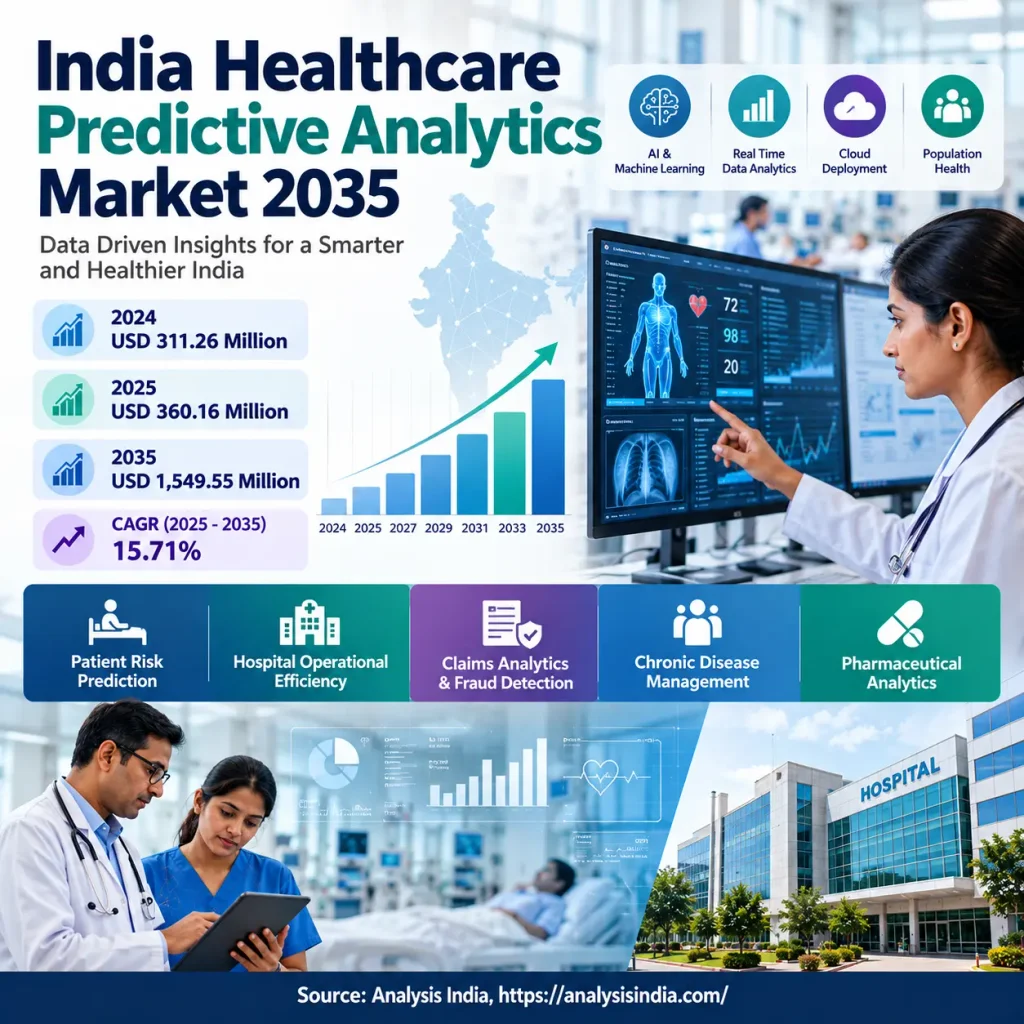
The commercial opportunity is becoming increasingly visible. Market Research Future estimates that the India Healthcare Predictive Analytics Market was valued at USD 311.26 million in 2024 and is expected to reach USD 360.16 million in 2025. The same research estimates that the market could reach USD 1,549.55 million by 2035, representing a CAGR of 15.71 percent during 2025 to 2035.
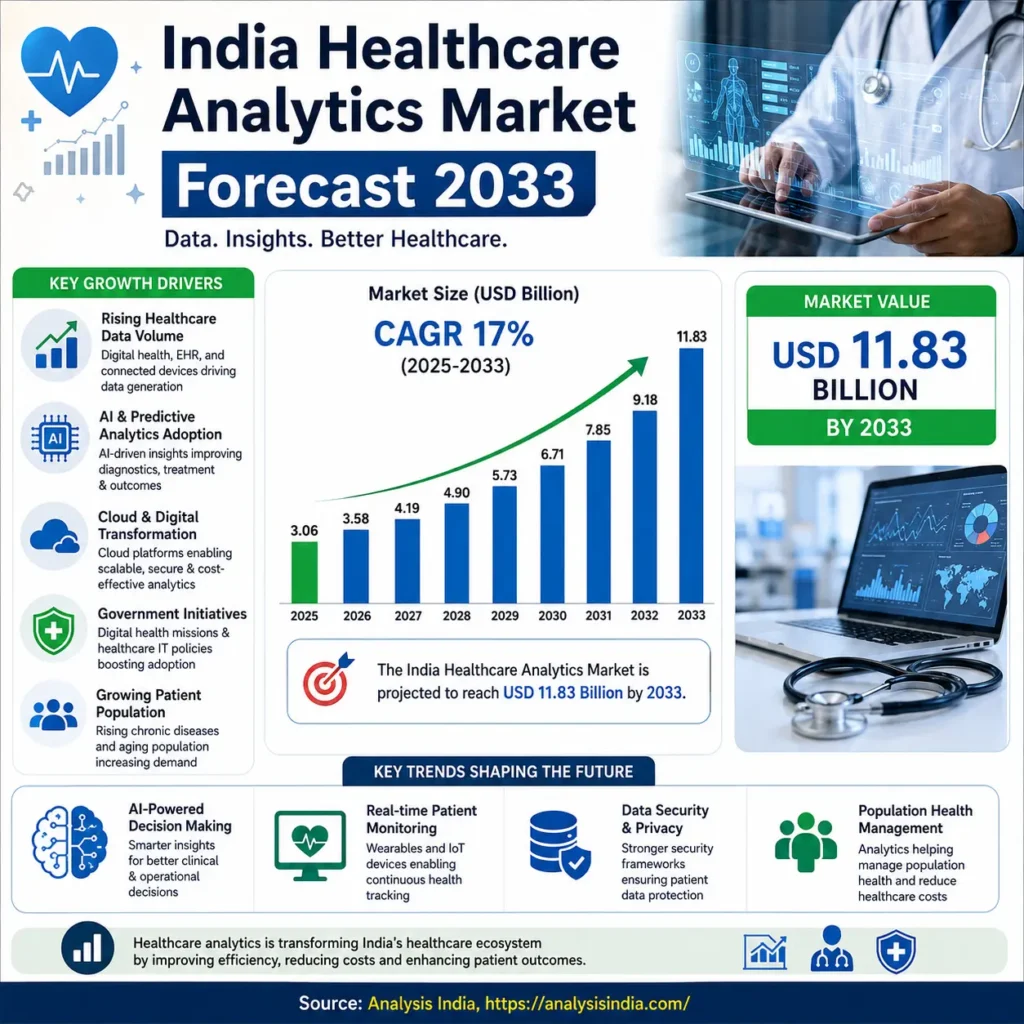
At the same time, the India Healthcare Predictive Analytics Market should not be confused with the much broader healthcare analytics market. Healthcare analytics includes descriptive analytics, predictive analytics, prescriptive analytics and other analytical applications. Consequently, broader healthcare analytics estimates are higher than the specific predictive analytics estimate.
TechSci Research, for example, estimates India’s broader healthcare analytics market at USD 640.28 million in 2024 and expects it to grow at a CAGR of 25.01 percent during its forecast period. The difference between these estimates is largely related to market scope and methodology. Therefore, the figures should be considered separately rather than added together.
The underlying digital healthcare environment is also expanding rapidly. According to the Government of India, by August 12, 2026, India had created 96.43 crore ABHA health identity numbers, while more than 110 crore health records had been linked with ABHA. More than 5.47 lakh health facilities and over 10.50 lakh healthcare professionals had also been registered on the digital health platform.
These figures do not represent direct adoption of predictive analytics. Nevertheless, they demonstrate the expanding digital data foundation on which the India Healthcare Predictive Analytics Market can develop. As more healthcare information becomes digital, standardized and interoperable, the potential applications for advanced analytics are also likely to increase.
India Healthcare Predictive Analytics Market Size and Forecast
The market size of the India Healthcare Predictive Analytics Market provides an important starting point for understanding the industry’s commercial opportunity. Market Research Future places the 2024 market value at USD 311.26 million and estimates that it will increase to USD 360.16 million in 2025. By 2035, the market is projected to reach USD 1.55 billion.
The forecast implies substantial expansion over the next decade. However, the growth should be interpreted in the context of India’s wider healthcare technology transformation. Predictive analytics does not operate as an isolated software category. Instead, it depends on electronic healthcare information, digital infrastructure, cloud computing, artificial intelligence and organizations willing to incorporate analytical insights into their daily workflows.
| Market Indicator | Value | Period | Source |
|---|---|---|---|
| India Healthcare Predictive Analytics Market | USD 311.26 million | 2024 | Market Research Future |
| India Healthcare Predictive Analytics Market | USD 360.16 million | 2025 | Market Research Future |
| India Healthcare Predictive Analytics Market | USD 1.55 billion | 2035 | Market Research Future |
| CAGR | 15.71 percent | 2025 to 2035 | Market Research Future |
| Broader India Healthcare Analytics Market | USD 640.28 million | 2024 | TechSci Research |
| Broader Healthcare Analytics Forecast | USD 2.42 billion | 2030 | TechSci Research |
Sources: Market Research Future and TechSci Research.
Note: The two sources measure different market scopes and forecast periods.
The India Healthcare Predictive Analytics Market therefore needs to be analyzed as a specialized segment rather than simply using the broader healthcare analytics forecast. This distinction is particularly important for market researchers, investors and healthcare technology companies because a broader market figure can otherwise make the predictive analytics opportunity appear larger than the specific segment actually measured.
Another important point is that commercial market research estimates are not official government statistics. They are independently developed forecasts based on methodologies that can differ between research organizations. Therefore, the most useful approach is to use these figures as indicators of market direction and commercial potential rather than treating any single forecast as an exact measurement of future revenue.
India Healthcare Predictive Analytics Market and the Digital Health Transformation
The development of the India Healthcare Predictive Analytics Market is closely connected with India’s wider digital health transformation. Historically, healthcare information was often distributed across paper records, hospital information systems, diagnostic reports, insurance databases and different provider platforms. This fragmentation made it difficult to create a continuous picture of a patient’s healthcare journey.
Digital health infrastructure is gradually changing this situation. The Ayushman Bharat Digital Mission has created a framework involving ABHA health identities, healthcare facility registration, healthcare professional registration and digital health records. By August 2026, the scale of this infrastructure had become substantial. The Government of India reported 96.43 crore ABHA health identity numbers and more than 110 crore linked health records.
For the India Healthcare Predictive Analytics Market, the importance of this development is not simply the number of digital identities. Rather, it is the increasing availability of structured healthcare information. Predictive models require historical information to identify patterns, and the availability of longitudinal healthcare information can potentially make those models more useful.
| Digital Health Indicator | Latest Reported Data | Date | Source |
|---|---|---|---|
| ABHA health identity numbers | 96.43 crore | August 12, 2026 | Government of India |
| Health records linked with ABHA | More than 110 crore | August 12, 2026 | Government of India |
| Registered health facilities | More than 5.47 lakh | August 12, 2026 | Government of India |
| Registered healthcare professionals | More than 10.50 lakh | August 12, 2026 | Government of India |
| Ayushman Bharat Arogya Mandirs | More than 1.86 lakh | August 12, 2026 | Government of India |
| Ayushman Cards issued | More than 45.5 crore | August 12, 2026 | Government of India |
Source: Government of India, Press Information Bureau.
However, the expansion of digital health data does not automatically guarantee successful predictive analytics. Data needs to be accurate, standardized and appropriately accessible. Moreover, healthcare information is sensitive, so organizations must maintain appropriate privacy, security and consent mechanisms.
Consequently, the future of the India Healthcare Predictive Analytics Market will depend as much on data governance and interoperability as it does on artificial intelligence.
What Is Predictive Analytics in Healthcare?
The India Healthcare Predictive Analytics Market is based on a relatively simple concept. Predictive analytics uses historical and current information to estimate the probability of future events. In healthcare, the information can include patient history, laboratory results, medication records, diagnostic information, hospital utilization and other relevant data.
For example, a hospital may analyze previous patient records to identify factors associated with readmission. A healthcare insurer may study claims history to estimate future utilization. Similarly, a pharmaceutical company can use historical demand information to improve inventory planning.
The important distinction is that predictive analytics does not provide certainty. Instead, it produces an estimate based on patterns found in available information. Therefore, the technology should generally support human decision making rather than replace professional judgment.
This distinction becomes particularly important in healthcare because decisions can directly affect patients. A predictive model that works well in one environment may not perform equally well in another. Patient populations, treatment practices, data quality and clinical workflows can vary considerably.
As a result, the India Healthcare Predictive Analytics Market will require not only advanced algorithms but also appropriate validation, monitoring and clinical expertise.
Why Is India Healthcare Predictive Analytics Market Growing?
The growth of the India Healthcare Predictive Analytics Market is being supported by several interconnected changes in Indian healthcare. The first is the continuing digitization of hospitals and healthcare providers. As more clinical and administrative processes become digital, healthcare organizations accumulate larger datasets that can potentially be analyzed.
The second factor is the increasing emphasis on preventive healthcare. Traditional healthcare systems often respond after a patient develops a problem. Predictive analytics can potentially help identify higher risk patients earlier, allowing healthcare providers to consider additional monitoring or intervention.
The third driver is the growing adoption of artificial intelligence and machine learning. These technologies have made it possible to analyze large datasets and identify relationships that may be difficult to discover through conventional reporting.
At the same time, hospitals are under pressure to improve efficiency. Bed occupancy, emergency department demand, operating room schedules, staffing and diagnostic capacity all fluctuate. Predictive models can potentially help administrators anticipate these changes.
Therefore, the India Healthcare Predictive Analytics Market is being driven by both clinical and operational requirements. This combination gives the market a broader base than a technology segment focused only on clinical decision support.
Healthcare Data Is Becoming a Strategic Asset
The growth of healthcare data is changing how healthcare organizations think about information. In the past, patient records were primarily maintained to document care. Increasingly, however, the same information can also be used to identify patterns across larger populations.
This creates an important opportunity for the India Healthcare Predictive Analytics Market. When data from multiple encounters can be analyzed together, healthcare organizations can potentially identify trends that would remain hidden when each patient record is examined independently.
For instance, repeated laboratory results can reveal changes over time. Hospital utilization records can reveal patterns in admissions and discharge. Insurance claims can indicate changes in treatment utilization. Diagnostic information can reveal population-level trends.
However, data only becomes valuable when it can be used appropriately. Poorly structured information, missing records and incompatible systems can reduce the usefulness of predictive models. Therefore, investments in data management are likely to remain an important part of healthcare analytics adoption.
Major Applications of India Healthcare Predictive Analytics Market
The application landscape of the India Healthcare Predictive Analytics Market is becoming broader as healthcare organizations move from basic reporting toward forward-looking decision support. Market Research Future identifies applications including patient risk prediction, operational efficiency, population health management, clinical decision support and fraud detection.
Patient risk prediction is particularly important because hospitals want to identify individuals who may require additional attention. At the same time, operational analytics can help administrators anticipate resource requirements.
The following table summarizes major application areas.
| Application | Potential Use |
|---|---|
| Patient Risk Prediction | Identifying patients with potentially elevated risk |
| Readmission Prediction | Estimating the probability of hospital readmission |
| Chronic Disease Management | Supporting long term patient monitoring |
| Clinical Decision Support | Providing predictive information to clinicians |
| Hospital Demand Forecasting | Estimating future admissions |
| Bed Management | Supporting occupancy and discharge planning |
| Workforce Planning | Forecasting staffing requirements |
| Claims Analytics | Estimating utilization and expenditure |
| Fraud Detection | Identifying unusual claims patterns |
| Population Health | Identifying risk across patient populations |
| Supply Chain Forecasting | Estimating demand for medicines and supplies |
| Pharmaceutical Analytics | Supporting research and commercial planning |
Because these applications address different problems, adoption is unlikely to happen uniformly. Large hospital networks may initially focus on operational and clinical analytics, while insurers may prioritize claims and utilization.
Consequently, the India Healthcare Predictive Analytics Market is likely to develop through multiple parallel use cases rather than a single dominant application.
Patient Risk Prediction
Patient risk prediction is becoming one of the most important areas of the India Healthcare Predictive Analytics Market because it connects large healthcare datasets with proactive care.
Hospitals routinely collect information about diagnoses, laboratory results, medications, procedures and previous admissions. When these variables are analyzed together, predictive models can identify patterns associated with higher risk.
The practical value comes from timing. If a patient is identified as having a higher probability of readmission or deterioration, healthcare professionals may be able to provide additional monitoring or follow up.
Nevertheless, predictive risk scores should not be interpreted as definitive clinical conclusions. They are estimates based on available information. Therefore, clinical teams need to consider the model’s output alongside professional judgment and the patient’s individual circumstances.
This requirement for human oversight is likely to remain a defining characteristic of the India Healthcare Predictive Analytics Market.
Predictive Analytics for Chronic Disease Management
Chronic disease management offers another important opportunity because conditions such as diabetes, cardiovascular disease and chronic kidney disease require long term monitoring.
A conventional healthcare model often relies on periodic consultations. Between visits, changes in a patient’s condition may not always be visible to the healthcare provider. Predictive analytics can potentially help identify changing risk when sufficient longitudinal data is available.
The opportunity becomes even greater when predictive models are combined with remote monitoring and connected devices. Wearables and home monitoring systems can generate additional information that may complement conventional clinical records.
However, this approach also introduces new challenges. More data does not necessarily mean better data, and healthcare organizations need appropriate systems to distinguish clinically useful signals from irrelevant information.
Therefore, the India Healthcare Predictive Analytics Market will increasingly depend on the ability to combine different data sources without creating unnecessary complexity for healthcare professionals.
Hospital Operations and Resource Planning
Hospital operations represent an important commercial application because hospitals need to manage scarce resources efficiently.
Emergency departments experience fluctuations in patient arrivals, while bed occupancy changes according to admissions and discharges. Operating rooms also have different procedure durations, cancellation rates and scheduling requirements.
Predictive analytics can analyze historical patterns and estimate future demand. As a result, hospital administrators can potentially improve staffing plans, bed allocation and operating schedules.
This application may prove particularly attractive because operational benefits can be measured using practical indicators. Improvements in capacity utilization, waiting times or scheduling efficiency can help organizations evaluate whether analytics investments are producing measurable value.
Consequently, operational applications could become an important growth area within the India Healthcare Predictive Analytics Market, particularly among large hospital networks.
Predictive Analytics in Diagnostic Services
Diagnostic services are another important source of healthcare data. Laboratories generate structured information through blood tests and other investigations, while diagnostic imaging systems generate large volumes of digital images and reports.
As diagnostic systems become more digital, predictive analytics can potentially be applied to both clinical and operational questions.
A diagnostic center could use historical testing patterns to forecast workload and equipment requirements. At the clinical level, combinations of diagnostic information and patient history could potentially be used to identify risk patterns.
This creates a connection between the India Healthcare Predictive Analytics Market and the wider diagnostics technology industry. As digital diagnostics expand, the amount of structured healthcare information available for analysis is also likely to increase.
Pharmaceutical Industry and Predictive Analytics
The pharmaceutical industry represents another major opportunity because pharmaceutical companies generate data throughout the product lifecycle.
During clinical development, researchers can analyze patient information and trial data. During manufacturing, predictive models can support production planning. In supply chain operations, forecasting can help estimate demand and inventory requirements.
Commercial teams can also use analytics to understand market demand and changes in treatment patterns.
India’s large pharmaceutical industry therefore provides an important addressable market for healthcare predictive analytics companies. However, pharmaceutical analytics often requires specialized domain knowledge, meaning that technology providers need to understand the specific requirements of clinical research, manufacturing and commercial operations.
This specialization could create opportunities for both large technology companies and focused analytics providers.
Artificial Intelligence and Machine Learning
Artificial intelligence is closely linked to the future development of the India Healthcare Predictive Analytics Market. Machine learning systems can process large datasets and identify complex relationships that may be difficult to detect using traditional analytical approaches.
However, healthcare AI requires a more cautious approach than many commercial applications. A model can perform well on a development dataset but perform differently when deployed among a different patient population.
For this reason, model validation is essential. Healthcare organizations also need to monitor performance after deployment because patient populations and clinical practices can change over time.
The Indian Council of Medical Research has published ethical guidelines for AI in biomedical research and healthcare. The guidelines provide a framework for ethical decision making, governance and informed consent across the development and deployment of healthcare AI.
Therefore, the India Healthcare Predictive Analytics Market will need to develop alongside responsible AI practices rather than treating governance as a separate issue.
Cloud Computing and Healthcare Predictive Analytics
Cloud computing is another factor supporting the development of the India Healthcare Predictive Analytics Market. Healthcare organizations increasingly need scalable computing resources as their datasets become larger.
Traditional infrastructure can require significant capital expenditure and internal IT resources. Cloud based platforms can provide more flexible computing and storage capacity, which may be particularly useful for healthcare organizations experimenting with advanced analytics.
At the same time, healthcare organizations need to assess privacy, security, access controls and vendor risk before using cloud infrastructure for sensitive information.
Therefore, cloud adoption is likely to develop alongside stronger data governance. The technology provides scalability, but healthcare organizations still need clear policies regarding how information is stored, accessed and processed.
India Healthcare Predictive Analytics Market by Deployment
The India Healthcare Predictive Analytics Market can be divided into on premise, cloud based and hybrid deployment models. Market Research Future includes these deployment modes in its market segmentation.
| Deployment Model | Characteristics | Likely Users |
|---|---|---|
| Cloud Based | Scalable infrastructure and flexible computing | Hospitals, startups and technology providers |
| On Premise | Greater organizational control over infrastructure | Large hospitals and institutions |
| Hybrid | Combination of cloud and internal infrastructure | Large healthcare networks |
Cloud based solutions are likely to remain important because they can reduce some infrastructure requirements. Nevertheless, large healthcare organizations may continue using hybrid models because they often operate complex legacy systems alongside newer cloud applications.
Consequently, deployment strategies will depend on organizational size, existing IT infrastructure, security requirements and the sensitivity of the data being analyzed.
India Healthcare Predictive Analytics Market by End User
Healthcare providers are likely to remain a major end user segment because hospitals generate large volumes of clinical and operational information. They can use predictive models to support patient management, demand forecasting and resource planning.
Healthcare payers represent another important segment. Insurance companies generate substantial claims data that can be analyzed to identify utilization patterns, estimate future expenditure and detect unusual activity.
Pharmaceutical companies can use predictive analytics for clinical research, demand forecasting and supply chain management, while research organizations can apply models to population health and biomedical datasets.
| End User | Major Applications |
|---|---|
| Healthcare Providers | Patient risk, clinical support and operations |
| Healthcare Payers | Claims, utilization and risk analysis |
| Pharmaceutical Companies | Clinical, commercial and supply chain analytics |
| Diagnostic Centers | Workload and diagnostic analytics |
| Research Organizations | Clinical and population health research |
| Government Healthcare Organizations | Population health and healthcare planning |
This broad end user base gives the India Healthcare Predictive Analytics Market multiple potential sources of demand.
Regional Opportunity in India
Healthcare technology adoption is not uniform across India. Major metropolitan centers such as Bengaluru, Hyderabad, Mumbai, Delhi NCR, Chennai and Pune have strong healthcare and technology ecosystems and are therefore likely to remain important markets for advanced analytics.
These cities have large hospitals, technology companies, pharmaceutical organizations, research institutions and skilled professionals. Consequently, they provide an environment in which healthcare analytics solutions can be developed, tested and scaled.
However, the longer term opportunity for the India Healthcare Predictive Analytics Market extends beyond major metropolitan areas. Cloud computing, telemedicine and digital health infrastructure can make advanced healthcare technology more accessible to smaller cities and regional providers.
This geographical expansion is important because India’s healthcare system is highly diverse. Predictive analytics solutions designed only for large corporate hospitals may not necessarily address the needs of smaller hospitals and regional healthcare providers.
Therefore, technology companies may increasingly need flexible solutions that can operate across different levels of healthcare infrastructure.
Key Trends Shaping India Healthcare Predictive Analytics Market
One of the most important trends in the India Healthcare Predictive Analytics Market is the increasing integration of artificial intelligence with conventional analytics. Healthcare organizations are moving beyond basic dashboards toward systems that can generate forecasts and identify potential risks.
Another trend is the growing availability of real time information. Remote monitoring systems, connected medical devices and wearable technologies can generate data outside traditional hospital environments. As these systems become more common, predictive models may increasingly analyze information continuously rather than only during hospital visits.
Personalized healthcare is another important trend. Predictive models can potentially identify differences in patient risk and treatment response, which could support more individualized healthcare planning.
Population health management is also becoming more important because healthcare organizations increasingly need to understand risks across groups rather than only individual patients.
Finally, responsible AI is becoming a central issue. As predictive technologies influence healthcare decisions, organizations will need stronger systems for validation, monitoring, privacy and governance.
India Healthcare Predictive Analytics Market Drivers
The growth of the India Healthcare Predictive Analytics Market is being supported by the interaction of several structural drivers.
Healthcare digitization is increasing the amount of data available for analysis. At the same time, artificial intelligence is improving the ability of organizations to process that information.
The expansion of digital health infrastructure is also improving connectivity across the healthcare ecosystem. Meanwhile, chronic disease management is creating demand for continuous risk assessment.
Hospitals are also facing pressure to improve resource utilization. Predictive models can potentially help organizations forecast demand and manage capacity more effectively.
The healthcare insurance industry provides another source of demand because claims and utilization data can support predictive analysis.
Pharmaceutical companies add another opportunity through research, supply chain and commercial analytics.
As a result, the India Healthcare Predictive Analytics Market is being driven by multiple healthcare requirements rather than by a single technology trend.
Challenges Facing India Healthcare Predictive Analytics Market
Despite the growth opportunity, the India Healthcare Predictive Analytics Market faces several challenges.
Data quality is one of the most important. Predictive models depend on historical information, and incomplete or inconsistent records can reduce model performance.
Interoperability is another challenge because healthcare providers may use different information systems and data formats. Even when information is digital, it may not always be easily exchanged or analyzed across systems.
Privacy and cybersecurity are particularly important because healthcare data can contain highly sensitive information.
Clinical validation also presents a challenge. A predictive model developed using data from one hospital may not necessarily produce the same results in another healthcare environment.
Finally, there is a need for professionals who understand both healthcare and analytics. Data scientists need to understand clinical requirements, while healthcare professionals increasingly need the ability to interpret analytical outputs.
These challenges mean that the India Healthcare Predictive Analytics Market will require investment not only in software but also in data infrastructure, skills, governance and implementation.
Data Privacy and Responsible AI
Trust will become increasingly important as the India Healthcare Predictive Analytics Market expands.
Patients need confidence that their health information is being used responsibly. Healthcare professionals need confidence that predictive systems provide useful information. Technology providers need clear frameworks for developing and validating their solutions.
ICMR’s official AI healthcare guidelines address ethical principles, governance, stakeholder responsibilities, ethics review and informed consent.
This framework is relevant because predictive models can influence healthcare decisions. Therefore, organizations need to consider not only technical accuracy but also whether the model is appropriate for the population and clinical context in which it is being used.
Model monitoring will also become increasingly important. A model can perform well when first deployed but become less accurate as patient populations, treatment practices or data patterns change.
Consequently, responsible AI should be treated as an ongoing process rather than a one time compliance exercise.
Competitive Landscape
The competitive environment of the India Healthcare Predictive Analytics Market includes global technology companies, healthcare software providers, analytics companies and specialized healthcare technology firms.
Market Research Future identifies companies including IBM, Optum, Cerner, McKesson, Philips, Allscripts, Epic Systems, Siemens Healthineers and Health Catalyst among the companies covered in its market assessment.
However, the competitive landscape is likely to become more specialized as healthcare organizations seek solutions for specific problems.
A hospital may require a platform focused on readmission risk or bed demand. An insurer may need claims analytics. A pharmaceutical company may require demand forecasting or clinical research analytics.
Therefore, domain expertise could become an important competitive advantage.
Indian healthcare technology companies may also have opportunities because they understand local healthcare workflows, data structures and operational requirements.
Analysis India Perspective on India Healthcare Predictive Analytics Market
From an Analysis India perspective, the most important development in the India Healthcare Predictive Analytics Market is not simply the projected increase in software revenue. The larger story is the gradual conversion of healthcare data into a strategic resource.
India’s healthcare ecosystem is generating data across hospitals, diagnostics, insurance, pharmaceutical companies, telemedicine platforms and digital health systems. At the same time, national digital infrastructure is creating an increasingly connected environment.
The Government of India reported 96.43 crore ABHA health identity numbers and more than 110 crore linked health records as of August 12, 2026. This scale demonstrates the development of India’s digital health foundation, although it should not be interpreted as direct predictive analytics adoption.
For the India Healthcare Predictive Analytics Market, the more important question is how effectively this information can be transformed into reliable and actionable insights.
A hospital with millions of patient records does not automatically have a predictive analytics capability. The information needs to be structured, standardized and securely accessible. The organization also needs analytical expertise and healthcare professionals who understand how to interpret the results.
Therefore, the next stage of the India Healthcare Predictive Analytics Market will probably be shaped by implementation rather than data accumulation alone.
Hospitals may use predictive models to anticipate admissions, identify higher risk patients and plan resources. Insurers may use them to understand utilization and claims. Pharmaceutical companies may use them to forecast demand and support clinical research. Government health programs may eventually use them for population health planning.
This creates a broader value chain around predictive analytics. Software is only one component. Data integration, cloud infrastructure, implementation, validation, consulting and ongoing model monitoring can also become important parts of the market.
For this reason, the India Healthcare Predictive Analytics Market should be read alongside the broader India Healthcare Analytics Market. Predictive analytics is a specialized segment, but its development depends heavily on the maturity of the wider healthcare analytics ecosystem.
The broader India Analytics Market also provides useful context because the development of analytics skills, cloud infrastructure and artificial intelligence capabilities across Indian industries can indirectly strengthen healthcare analytics adoption.
From this perspective, the India Healthcare Predictive Analytics Market is not simply a healthcare software story. It is part of India’s larger transition toward data driven decision making.
India Healthcare Predictive Analytics Market Data and Analysis
The available market data shows significant growth potential, but the estimates need to be interpreted according to their definitions.
| Research Organization | Market Covered | 2024 Value | Forecast Value | Forecast Year | CAGR |
|---|---|---|---|---|---|
| Market Research Future | Healthcare Predictive Analytics | USD 311.26 million | USD 1.55 billion | 2035 | 15.71 percent |
| Market Research Future | Healthcare Analytics | USD 589.2 million | USD 2.11 billion | 2035 | 12.31 percent |
| TechSci Research | Healthcare Analytics | USD 640.28 million | USD 2.42 billion | 2030 | 25.01 percent |
Sources: Market Research Future and TechSci Research.
The figures demonstrate why market definition matters. The first estimate measures the specific predictive analytics segment, while the other estimates cover broader healthcare analytics markets.
Therefore, the India Healthcare Predictive Analytics Market should not be described as a USD 589 million or USD 640 million market simply because those figures relate to healthcare analytics overall.
For a specialist market analysis, the more appropriate reference point is the USD 311.26 million estimate for 2024 and the USD 1.55 billion forecast for 2035.
Future Outlook for India Healthcare Predictive Analytics Market
The future of the India Healthcare Predictive Analytics Market will depend on the interaction between healthcare digitization, artificial intelligence, data availability and healthcare demand.
In the short term, hospitals and insurers are likely to remain important users because they have large datasets and clear operational requirements. Over time, however, adoption could spread to diagnostic centers, pharmaceutical companies, research institutions and regional healthcare providers.
Remote monitoring could also change the market. As connected devices generate more information outside hospitals, predictive analytics may increasingly become a continuous process rather than a periodic analytical exercise.
At the same time, personalized healthcare could create demand for models that analyze individual patient characteristics rather than relying solely on population averages.
Population health represents another long term opportunity. As healthcare organizations gain access to larger datasets, they may increasingly analyze risk across defined patient populations.
However, the pace of adoption will depend on trust. Healthcare professionals need confidence in predictive models, patients need confidence in data governance, and healthcare organizations need confidence that investments will generate measurable benefits.
Therefore, the India Healthcare Predictive Analytics Market is likely to evolve gradually from experimental projects toward integrated analytical systems.
India Healthcare Predictive Analytics Market and India Healthcare Analytics Market
The relationship between the India Healthcare Predictive Analytics Market and the broader healthcare analytics industry is important for understanding future growth.
Descriptive analytics helps organizations understand historical performance. Predictive analytics estimates future events or risks. Prescriptive analytics goes further by helping organizations evaluate possible actions.
Therefore, predictive analytics represents the forward looking layer of the wider healthcare analytics ecosystem.
Readers interested in the broader market can explore our detailed India Healthcare Analytics Market analysis, which provides additional information on the size, growth drivers and applications of healthcare analytics in India.
For a wider view of analytics adoption across Indian industries, readers can also explore the India Analytics Market analysis.
The broader Healthcare Market Analysis section provides additional coverage of healthcare, diagnostics, medical devices and related technologies.
Key Market Data Sources
The India Healthcare Predictive Analytics Market analysis uses both commercial market research and government sources. Commercial reports provide market size and forecast estimates, while government sources provide information about digital healthcare infrastructure.
| Source | Data Used |
|---|---|
| Market Research Future | Predictive analytics market size and forecast |
| Market Research Future | Broader healthcare analytics market data |
| TechSci Research | India healthcare analytics market data |
| Government of India | Digital health infrastructure |
| Press Information Bureau | ABHA and healthcare infrastructure indicators |
| Indian Council of Medical Research | AI healthcare ethics and governance |
| National Health Authority | Digital health ecosystem |
Commercial market estimates should be interpreted according to each research organization’s methodology. Government infrastructure statistics should not be treated as direct revenue measurements of the India Healthcare Predictive Analytics Market.
Key Takeaways
The India Healthcare Predictive Analytics Market is developing alongside India’s broader transition toward digital and data driven healthcare.
The specific market is estimated by Market Research Future at USD 311.26 million in 2024 and is forecast to reach USD 1.55 billion by 2035 at a CAGR of 15.71 percent.
The broader healthcare analytics market is considerably larger, although research organizations provide different estimates because their market definitions and methodologies vary.
India’s digital healthcare infrastructure is also expanding rapidly. More than 96 crore ABHA health identity numbers and more than 110 crore linked health records were reported by August 2026.
The major applications of the India Healthcare Predictive Analytics Market include patient risk prediction, hospital resource planning, chronic disease management, clinical decision support, claims analytics, population health and pharmaceutical analytics.
Artificial intelligence and machine learning are likely to remain important technologies, but their success will depend on data quality, validation and responsible implementation.
The market also faces challenges related to interoperability, privacy, cybersecurity and skilled workforce availability.
From the Analysis India perspective, the most important opportunity lies in connecting India’s growing healthcare data infrastructure with analytical systems that can provide useful and responsible insights.
Conclusion
The India Healthcare Predictive Analytics Market is becoming an increasingly important part of India’s wider healthcare technology transformation. The market is developing because healthcare organizations are generating more digital information while simultaneously facing pressure to improve patient management, resource utilization and operational efficiency.
The available market forecast provides a clear indication of the opportunity. Market Research Future estimates the specific predictive analytics market at USD 311.26 million in 2024 and projects it to reach USD 1.55 billion by 2035. While other research organizations provide different estimates for the broader healthcare analytics industry, these figures should be interpreted according to their respective market definitions.
At the same time, India’s digital health infrastructure is expanding at considerable scale. The Government of India reported 96.43 crore ABHA health identity numbers, more than 110 crore linked health records, more than 5.47 lakh registered health facilities and more than 10.50 lakh registered healthcare professionals by August 12, 2026.
This expanding digital foundation creates an important opportunity for predictive analytics, but data volume alone will not determine market success. Healthcare organizations need reliable information, interoperability, appropriate privacy controls, secure infrastructure and professionals who can translate analytical results into meaningful healthcare decisions.
Therefore, the India Healthcare Predictive Analytics Market is likely to develop through a combination of technology adoption and healthcare transformation. Hospitals may increasingly use predictive models for patient risk and operational planning, insurers can apply analytics to claims and utilization, pharmaceutical companies can use forecasting across research and supply chains, and government organizations can potentially apply analytics to population health.
From the Analysis India perspective, the most significant opportunity is the conversion of India’s expanding healthcare data into useful and responsible intelligence. Predictive analytics can become an important bridge between raw healthcare information and forward looking decision support.
The market’s future will consequently depend not only on how quickly AI and machine learning are adopted, but also on how effectively healthcare organizations can integrate those technologies into real clinical and operational environments.
For a broader understanding of the industry, readers should also explore our India Healthcare Analytics Market analysis and the wider India Analytics Market. Together, these markets illustrate the broader movement toward data driven decision making across India’s healthcare and business ecosystem.
The India Healthcare Predictive Analytics Market is therefore moving into a more important phase. The next stage will be less about simply generating more healthcare data and more about making that data accurate, connected, secure and useful. That shift will determine how predictive analytics contributes to the future of India’s healthcare system.
Frequently Asked Questions
What is the India Healthcare Predictive Analytics Market?
The India Healthcare Predictive Analytics Market includes software, services and technologies that analyze healthcare information to estimate future clinical, operational or financial outcomes. These solutions can use statistical methods, machine learning and artificial intelligence to identify patterns in historical and current data.
What is the current size of India Healthcare Predictive Analytics Market?
According to Market Research Future, the India Healthcare Predictive Analytics Market was valued at USD 311.26 million in 2024 and is estimated at USD 360.16 million in 2025. The market is projected to reach USD 1.55 billion by 2035 at a CAGR of 15.71 percent.
What is driving the India Healthcare Predictive Analytics Market?
The India Healthcare Predictive Analytics Market is being supported by healthcare digitization, increasing healthcare data, artificial intelligence adoption, machine learning, digital health infrastructure, chronic disease management and demand for better hospital efficiency.
What are the major applications of predictive analytics in healthcare India?
The major applications include patient risk prediction, readmission prediction, chronic disease management, hospital demand forecasting, clinical decision support, insurance claims analysis, fraud detection and population health management.
How is AI supporting the India Healthcare Predictive Analytics Market?
Artificial intelligence and machine learning allow healthcare organizations to analyze large datasets and identify patterns associated with future outcomes. Consequently, AI can support risk prediction, operational forecasting and population health applications.
How does ABDM support predictive analytics?
ABDM is creating digital health infrastructure through ABHA health identities, healthcare facility registration, healthcare professional registration and linked health records. As a result, it provides an expanding digital foundation for healthcare analytics. The Government reported 96.43 crore ABHA health identity numbers and more than 110 crore linked health records by August 2026.
How many ABHA health identity numbers have been created in India?
The Government of India reported 96.43 crore ABHA health identity numbers as of August 12, 2026. More than 110 crore health records had also been linked with ABHA.
What are the major challenges for the India Healthcare Predictive Analytics Market?
The major challenges include data quality, interoperability, privacy, cybersecurity, clinical validation and the availability of professionals who understand both healthcare and advanced analytics.
Is predictive analytics the same as healthcare analytics?
No. Healthcare analytics is a broader category that can include descriptive, predictive and prescriptive analytics. Predictive analytics focuses specifically on estimating future events, risks or outcomes.
Which healthcare organizations can use predictive analytics?
Hospitals, diagnostic centers, health insurers, pharmaceutical companies, research institutions, government healthcare organizations and healthcare technology companies can all use predictive analytics for different purposes.
Can predictive analytics replace doctors?
Predictive analytics is generally designed as a decision support technology rather than a replacement for doctors. Because predictions are estimates, healthcare professionals need to consider the results alongside clinical judgment and patient circumstances.
Why is responsible AI important for India Healthcare Predictive Analytics Market?
Responsible AI is important because predictive systems can influence healthcare decisions. ICMR’s guidelines address ethical principles, governance and informed consent for AI applications in biomedical research and healthcare.
What is the future of India Healthcare Predictive Analytics Market?
The India Healthcare Predictive Analytics Market is expected to develop alongside digital health infrastructure, artificial intelligence, machine learning, cloud computing, connected healthcare devices and population health management. Market Research Future currently projects the specific market to reach USD 1.55 billion by 2035.