📅 Published: August 24, 2026
🔄 Last Updated: October 4, 2026
Introduction
The India analytics market is entering a new phase of growth as businesses move from basic reporting toward predictive decision-making, artificial intelligence and real-time intelligence. Companies across banking, healthcare, retail, manufacturing, telecom, logistics and technology are generating more data than ever before. The business challenge is no longer simply collecting information. It is turning that information into decisions that improve revenue, reduce costs, manage risk and strengthen customer relationships.
India has several structural advantages in this transition. The country has a large digital consumer base, a rapidly expanding technology sector, strong IT services capabilities and a growing pool of data and AI professionals. Digital public infrastructure has also created large-scale digital transaction and identity ecosystems. NITI Aayog describes Aadhaar, UPI and the Account Aggregator framework as important components of India’s digital public infrastructure.
The India analytics market is also becoming closely connected with artificial intelligence. Modern analytics platforms increasingly combine data engineering, machine learning, business intelligence and AI-based decision support. This changes the value proposition of analytics. Earlier systems mainly explained what happened. Newer systems increasingly explain why something happened, what is likely to happen next and what action a business should consider.
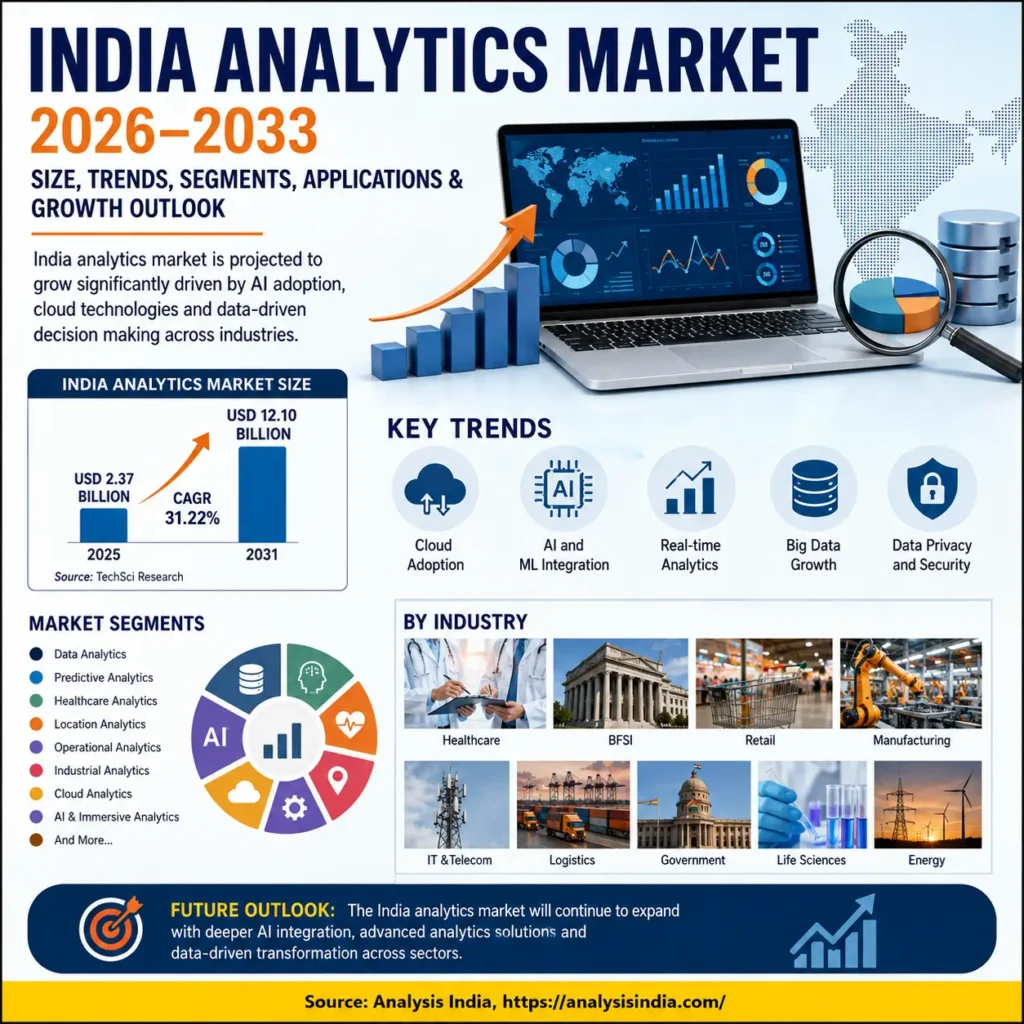
Market estimates illustrate the scale of this opportunity, although the numbers vary considerably according to market definitions. TechSci Research estimates the broader India analytics market at USD 2.37 billion in 2025 and projects it to reach USD 12.10 billion by 2031 at a 31.22% CAGR. Grand View Research estimates the narrower India data analytics market at USD 4.23 billion in 2025 and forecasts revenue of USD 47.51 billion by 2033 at a 36.1% CAGR.
These differences are important for investors and business decision makers. They show why market size should always be interpreted alongside the definition, technology scope and revenue model used by the research provider.
The central outlook is nevertheless clear. India is moving toward a more data-driven economy, and analytics is becoming part of the core technology stack rather than a specialist function used only by large enterprises. The India analytics market should therefore expand across business intelligence, predictive analytics, customer analytics, healthcare analytics, location intelligence, industrial analytics and other specialized applications through 2033.
India Analytics Market Overview
The India analytics market covers technologies and services that help organizations collect, process, analyze, visualize and act on data. The ecosystem includes business intelligence software, data platforms, analytics services, predictive models, machine learning systems, visualization tools and industry-specific analytical applications.
At the basic level, analytics helps companies understand past performance. Descriptive analytics answers questions such as what happened and how much was sold. Diagnostic analytics goes one step further by examining why an event occurred. Predictive analytics uses historical and current information to estimate what may happen next. Prescriptive analytics recommends possible actions based on predicted outcomes.
This progression is changing the economics of the India analytics market. Businesses are becoming less interested in dashboards that simply display information and more interested in systems that influence actual decisions.
For example, a retailer can use descriptive analytics to see that sales declined in a particular region. Predictive analytics can estimate whether the decline is temporary or likely to continue. Prescriptive systems can then help determine which products, prices or promotions could improve performance.
The same logic applies to healthcare. Hospitals can use analytics to monitor patient activity and operational performance. Predictive models can help identify potential demand patterns, readmission risks or resource requirements. Pharmaceutical and life science companies can use analytics to support clinical research, commercial planning and supply chain management.
This broad application base makes the India analytics market different from a single software category. It is an ecosystem that cuts across industries, technologies and business functions.
India is also developing a strong analytics services ecosystem. Companies such as Mu Sigma, Fractal, Tiger Analytics, Tredence and LatentView have built capabilities around data science, AI and analytics, while large IT service providers such as TCS, Infosys, Wipro and HCLTech provide analytics as part of wider digital transformation services.
The competitive structure is therefore mixed. Large technology companies offer scale and integrated platforms. Specialist analytics companies focus on industry knowledge and advanced analytical models. Cloud providers provide infrastructure and AI services. Software companies increasingly embed analytics directly into enterprise applications.
This convergence will be one of the defining characteristics of the India analytics market through 2033.
India Analytics Market Size and Growth Forecast 2026–2033
There is no single universally accepted market-size figure for the India analytics market because research firms use different definitions. Some studies include analytics services, consulting, business intelligence and AI. Others focus specifically on data analytics software and related revenue.
TechSci Research estimates the India analytics market at USD 2.37 billion in 2025 and forecasts USD 12.10 billion by 2031, representing a CAGR of 31.22%. Its definition includes business intelligence, predictive analytics, machine learning, big data solutions and artificial intelligence.
Grand View Research provides a much larger estimate for the narrower data analytics category. It estimates India’s data analytics revenue at USD 4.23 billion in 2025, with a forecast of USD 47.51 billion by 2033 and a CAGR of 36.1% from 2026 to 2033. It identifies predictive analytics as the largest type segment in 2025.
IMARC provides another estimate for the India data analytics market. It puts the 2025 market at approximately USD 3.3 billion and forecasts USD 28.9 billion by 2034, with a 26.37% CAGR from 2026 to 2034.
These estimates should not be averaged into one artificial number. AnalysisIndia’s view is that the most useful way to understand the India analytics market is through a range of market definitions. The broader ecosystem is already large, while specialized analytics categories are growing at different rates.
| Market definition | Base year | Estimated market size | Forecast | CAGR |
|---|---|---|---|---|
| India analytics market | 2025 | USD 2.37 billion | USD 12.10 billion by 2031 | 31.22% |
| India data analytics market | 2025 | USD 4.23 billion | USD 47.51 billion by 2033 | 36.1% |
| India data analytics market | 2025 | USD 3.3 billion | USD 28.9 billion by 2034 | 26.37% |
Sources: TechSci Research, Grand View Research and IMARC.
The important conclusion is not that one forecast is correct and the others are wrong. The important conclusion is that India’s analytics economy is expected to grow rapidly across multiple layers.
The growth opportunity will increasingly shift from basic reporting toward predictive, prescriptive and AI-enabled analytics. This is also reflected in the India data analytics market, where Grand View Research identifies predictive analytics as the largest type segment and prescriptive analytics as the fastest-growing segment.
The India analytics market should therefore be viewed as a long-term technology investment opportunity rather than a short-term software trend.
Key Factors Driving the India Analytics Market
Rapid digitalization
India’s economy has undergone a major shift toward digital transactions, digital services and connected platforms. Consumers increasingly interact with banks, retailers, healthcare providers, government services and businesses through digital channels.
Every digital interaction creates data. That data becomes valuable when organizations can connect it with other information and use it to improve decisions.
The expansion of digital public infrastructure is particularly important. NITI Aayog highlights Aadhaar, UPI and Account Aggregator as major components of India’s digital transformation.
This creates a strong foundation for the India analytics market.
Growth of cloud computing
Cloud infrastructure has reduced the need for companies to build large on-premise technology environments before deploying analytics.
Smaller businesses can now access data warehouses, business intelligence tools and machine learning platforms through cloud services. This reduces upfront investment and makes advanced analytics more accessible.
Cloud adoption also allows companies to process larger datasets without continuously expanding physical infrastructure.
Rising AI adoption
Analytics and AI are increasingly converging. The rapid expansion of analytics is closely connected with broader AI market adoption trends, as businesses increasingly use intelligent systems to support operational and strategic decisions.
Modern AI models require high-quality data. At the same time, analytics systems increasingly use machine learning and generative AI to automate analysis and generate recommendations. India’s analytics ecosystem is also receiving support from the IndiaAI Mission and government-backed AI infrastructure, which can improve access to computing resources and accelerate domestic AI development.
A 2025 EY study of more than 125 Indian enterprise leaders found that nearly all surveyed enterprises had exposure to GenAI through existing software, although only 15% had directly implemented GenAI in production at the time of the study.
This gap between exposure and production deployment represents an important future opportunity for the India analytics market.
Growing business pressure for measurable returns
Technology spending is increasingly evaluated through business outcomes.
Companies want analytics projects to improve customer retention, pricing, forecasting, fraud detection, inventory management or operational efficiency. This pressure is pushing vendors to move from selling tools toward delivering measurable business results.
Expansion of data-intensive industries
Banking, insurance, retail, healthcare, telecom, manufacturing and logistics all generate large volumes of structured and unstructured data.
As data volumes increase, manual analysis becomes less practical. This creates sustained demand for analytics platforms and specialized services.
Development of India’s analytics workforce
India has developed a large technology and data science talent ecosystem. The country has also become an important global delivery location for analytics and AI services.
NASSCOM has highlighted India’s long-standing position as an emerging global analytics hub, while newer analytics companies continue to expand capabilities in AI, data engineering and industry-specific solutions. The next stage of analytics will increasingly involve agentic AI and intelligent workflow automation, allowing systems to interpret information, make decisions and execute multi-step tasks with less human intervention.
India Analytics Market Trends
The India analytics market is moving through several important changes.
The first is the transition from historical reporting to predictive decision-making. Companies increasingly want systems that identify risks and opportunities before they become visible through traditional reports.
The second trend is embedded analytics. Instead of asking employees to open separate dashboards, analytics capabilities are increasingly integrated into enterprise applications. A sales employee may receive a customer recommendation inside a CRM system. A supply chain manager may receive an inventory alert inside an operations platform.
The third trend is real-time analytics. Traditional analytics often relied on daily, weekly or monthly data cycles. Digital businesses increasingly need information within minutes or seconds.
The fourth trend is the growing use of natural language interfaces. Generative AI allows users to ask questions about business data in plain language. This could make analytics accessible to managers who do not have advanced technical skills.
The fifth trend is industry-specific analytics. Generic dashboards are becoming less differentiated. Vendors are increasingly building solutions around specific business problems such as fraud detection, healthcare capacity planning, retail demand forecasting and industrial maintenance.
The sixth trend is stronger data governance. The Digital Personal Data Protection Rules, 2025 were notified by MeitY in November 2025, creating a clearer framework around personal data protection and organizational responsibilities.
This matters because analytics depends on data access. Businesses need to balance data utilization with privacy, security and lawful processing.
The seventh trend is the convergence of analytics and AI. The future India analytics market will not be defined by analytics dashboards alone. It will increasingly involve machine learning, AI agents, automated decision support and intelligent workflows.
India Analytics Market Segmentation
The India analytics market is highly fragmented because different technologies solve different business problems. The following segments represent important areas of demand and also provide a framework for understanding the GSC search opportunities emerging around India’s analytics ecosystem.
India Data Analytics Market
The India data analytics market covers the processes and technologies used to examine large datasets and generate useful business insights.
Grand View Research estimates India’s data analytics market generated USD 4.23 billion in revenue in 2025 and forecasts it to reach USD 47.51 billion by 2033. Predictive analytics accounted for the largest type share in 2025.
The market includes descriptive, diagnostic, predictive and prescriptive analytics. Customer analytics is another important area because businesses increasingly want to understand customer behavior across digital and physical channels.
The strongest growth opportunity will likely come from organizations moving beyond reporting toward decision automation.
For AnalysisIndia, this segment is strategically important because the India data analytics market can act as a broad cluster page beneath this pillar.
India Predictive Analytics Market
Predictive analytics uses historical and current information to estimate future outcomes.
It is already one of the most important segments within the India analytics market. Grand View Research identifies predictive analytics as the largest type segment in its India data analytics market assessment.
6Wresearch estimates the India predictive analytics market at USD 1.074 billion in 2025 and forecasts it to reach USD 1.537 billion by 2032. Another research provider, Market Research Future, uses a different definition and forecasts a much faster trajectory through 2035.
The difference reinforces the importance of market definitions.
Predictive analytics has applications in fraud detection, demand forecasting, healthcare risk assessment, customer churn, credit scoring and industrial maintenance.
India Healthcare Analytics Market
Healthcare is one of the most attractive verticals within the India analytics market because healthcare organizations generate data across clinical, financial, operational and patient-facing systems.
Hospitals can use analytics to understand patient flows, resource utilization and operational performance. Pharmaceutical companies can apply analytics to clinical development, commercial planning and supply chains.
The opportunity is also expanding as healthcare becomes more digital. Electronic health records, diagnostic data, telemedicine platforms and connected devices create additional sources of information.
Healthcare analytics is therefore an important bridge between the India analytics market and the healthcare technology ecosystem.
For a deeper analysis of this growing opportunity, see our detailed India Healthcare Analytics Market Forecast 2033, which examines market size, growth drivers, key trends and future opportunities.
India Healthcare Predictive Analytics Market
Healthcare predictive analytics uses statistical models and machine learning to estimate future clinical or operational outcomes.
Potential applications include patient risk stratification, hospital demand forecasting, readmission prediction, staffing optimization and disease management.
The commercial opportunity is significant, but healthcare requires stronger validation than many consumer applications. Accuracy alone is not enough. Models must also be explainable, secure and appropriate for clinical use.
The India analytics market will benefit from healthcare predictive analytics as hospitals and health technology companies become more comfortable with data-driven decision support.
Healthcare predictive analytics is emerging as an important specialized segment within the broader India Analytics Market, particularly as hospitals and health technology companies adopt data-driven decision support.
India Location Analytics Market
Location analytics combines geographic information with business data to understand where customers, assets, risks or activities are concentrated.
Retailers can use it to evaluate store locations. Logistics companies can analyze routes and delivery patterns. Banks can assess branch performance. Governments can study infrastructure and population patterns.
The broader growth of geospatial technologies and digital mapping is creating new opportunities for location analytics in India.
The segment is especially relevant to retail, logistics, telecommunications, infrastructure and urban planning.
India Operational Analytics Market
Operational analytics focuses on improving day-to-day business performance.
It can help companies monitor production, inventory, staffing, service levels and supply chains.
The main difference from traditional business intelligence is the stronger focus on action. Operational analytics attempts to identify problems quickly enough for managers to respond.
Manufacturing and logistics should remain important users because even small efficiency improvements can have a measurable impact on margins.
India Life Science Analytics Market
Life science companies are generating increasingly complex datasets across research, clinical development, manufacturing and commercial operations.
Analytics can help pharmaceutical and biotechnology companies analyze clinical trial data, identify patient populations, improve supply planning and understand market demand.
The segment also overlaps with diagnostics and medical research.
For India, this is particularly relevant because the country has a large pharmaceutical industry and an expanding biotechnology ecosystem.
India Industrial Analytics Market
Industrial analytics applies data analysis to factories, equipment, production lines and industrial supply chains.
Sensors and industrial Internet of Things systems generate large volumes of operational information. Analytics can convert this information into maintenance alerts, production forecasts and quality insights.
Predictive maintenance is one of the strongest applications. Instead of waiting for equipment to fail, manufacturers can identify patterns associated with potential failures.
The India analytics market should see growing demand from automotive, electronics, chemicals, pharmaceuticals, energy and other industrial sectors.
India Network Analytics Market
Network analytics examines data from telecommunications and digital networks.
Telecom companies can use it to monitor performance, identify congestion and understand customer behavior.
As 5G networks expand and digital services become more dependent on connectivity, network analytics becomes increasingly important.
The segment also has relevance to cybersecurity and enterprise IT operations.
India Graph Analytics Market
Graph analytics examines relationships between connected entities rather than treating each data point separately.
This approach can be useful for fraud detection, cybersecurity, social network analysis and supply chain mapping.
For example, a bank can use graph analytics to identify unusual relationships among accounts, devices and transactions.
Although graph analytics is a smaller segment than mainstream business intelligence, its value can be high in problems where relationships matter more than individual records.
India Embedded Analytics Market
Embedded analytics places analytical capabilities directly inside business applications.
This removes the need for users to switch between applications and separate analytics dashboards.
Embedded analytics is particularly useful in CRM, enterprise resource planning, supply chain and customer service systems.
The growth of software-as-a-service platforms should support this segment because vendors increasingly compete on the intelligence built into their applications.
India Cloud Analytics Market
Cloud analytics uses cloud infrastructure to store, process and analyze data.
It has become important because organizations can scale computing capacity without investing heavily in physical infrastructure.
Cloud platforms also make it easier to connect data from multiple applications.
Security and governance remain important considerations, especially for healthcare, financial services and government organizations.
The India analytics market is likely to become increasingly cloud-centric as businesses modernize legacy data systems.
India App and Web Analytics Market
App and web analytics measure how users interact with digital platforms.
Companies use these tools to understand traffic, conversion, engagement, retention and customer journeys.
For e-commerce and digital businesses, analytics can directly influence marketing spending and product development.
The growing use of mobile applications in India gives this segment a large potential user base.
India Software Analytics Market
Software analytics focuses on data generated by software applications and development environments.
It can help companies understand application performance, user behavior, system errors and development productivity.
As enterprises operate increasingly complex software environments, the need for visibility into application performance is growing.
Software analytics also overlaps with observability, DevOps and cybersecurity.
India Text Analytics Market
Text analytics converts unstructured written information into usable insights.
Businesses can analyze customer reviews, emails, call transcripts, surveys, documents and social media content.
Natural language processing has expanded the capabilities of text analytics. Generative AI is now making it possible to summarize and interpret large collections of text more efficiently.
This creates new opportunities in customer service, healthcare, financial services, legal services and government.
India Immersive Analytics Market
Immersive analytics uses interactive visual environments to explore complex datasets.
It can involve advanced visualization, three-dimensional environments, augmented reality or virtual reality interfaces.
The market remains relatively specialized, but it could become more relevant in engineering, industrial design, healthcare research and training.
Its long-term growth will depend on hardware costs, software maturity and the ability to demonstrate measurable business value.
India Analytics Market by Industry
Healthcare
Healthcare is becoming one of the most important verticals for analytics.
Hospitals need better visibility into patient flows, staffing, capacity and financial performance. Pharmaceutical companies need analytics for clinical research, market access, supply chains and commercial planning.
The combination of healthcare analytics, AI and diagnostics could create one of the strongest specialized opportunities within the India analytics market.
BFSI
Banking, financial services and insurance have historically been major users of analytics.
Fraud detection, credit scoring, customer segmentation, risk management and personalized financial products all depend heavily on data.
The real-time nature of digital payments is also increasing the importance of rapid analytics.
Retail
Retailers use analytics to understand customers, forecast demand, optimize inventory and evaluate promotions.
India’s growth in e-commerce and omnichannel retail is increasing the volume and variety of customer data.
Location analytics and customer analytics are especially relevant to this sector.
Manufacturing
Manufacturers use analytics to monitor production, improve quality, forecast maintenance and optimize supply chains.
Industrial IoT is increasing the amount of machine-generated data available for analysis.
The next stage will involve integrating industrial analytics with AI-based automation.
IT and Telecom
IT and telecom companies generate large volumes of operational and customer data.
Analytics helps monitor network performance, customer behavior, application performance and cybersecurity risks.
The expansion of cloud services and 5G should sustain demand.
Logistics
Logistics companies use analytics to optimize routes, delivery schedules, warehouse operations and fleet utilization.
Location analytics and predictive analytics are especially valuable in this industry.
Government
Government agencies can use analytics to improve public service delivery, identify patterns and allocate resources.
India’s digital public infrastructure provides a large foundation for data-enabled public services. NITI Aayog has highlighted the role of DPI in improving service delivery, financial inclusion and economic participation.
Life Sciences
Pharmaceutical, biotechnology and research organizations increasingly rely on analytics for clinical, commercial and operational decisions.
The integration of analytics with AI could improve research productivity while also increasing the need for strong data governance.
Energy
Energy companies can use analytics for demand forecasting, asset monitoring, maintenance and operational optimization.
The expansion of renewable energy adds further complexity because supply can vary according to weather and other conditions.
Analytics can help integrate these changing supply patterns with demand and grid requirements.
AI and Machine Learning in India’s Analytics Market
Artificial intelligence is changing the role of analytics from information delivery to decision support.
Traditional analytics typically required users to define the question, select a dataset and interpret the results. AI-enabled analytics can automate parts of this process.
Machine learning can identify patterns that may be difficult to detect manually. Generative AI can summarize reports and answer questions in natural language. AI agents may eventually execute multi-step analytical workflows and trigger actions based on predefined business rules.
This creates a major opportunity for the India analytics market.
However, AI does not eliminate the need for high-quality data. In many cases, it increases the importance of data governance because unreliable data can produce unreliable AI outputs.
EY’s 2025 research on Indian enterprises found that organizations are moving toward AI-first transformation but still face challenges around data governance, workforce readiness, risk and implementation.
India’s AI investment environment is also strengthening. A 2026 Autodesk report cited by Express Computer found that 91% of surveyed Indian organizations had increased AI spending over the previous year. The report also identified data quality, integration, skills and regulatory uncertainty among the major challenges.
The implication for the India analytics market is clear. Analytics vendors that can combine reliable data foundations with AI capabilities are likely to gain an advantage over providers that offer visualization alone.
India Analytics Technology Landscape
The technology stack behind the India analytics market can be divided into several layers.
The first layer is data collection. This includes transaction systems, enterprise applications, websites, mobile applications, sensors and connected devices.
The second layer is data storage and processing. Cloud data warehouses, data lakes and distributed processing systems allow organizations to manage large datasets.
The third layer is data engineering. This layer cleans, transforms and connects information from different sources.
The fourth layer is analytics. Business intelligence, statistical analysis and machine learning tools convert data into insights.
The fifth layer is AI and decision intelligence. This layer uses models and intelligent systems to generate predictions, recommendations and automated actions.
The sixth layer is visualization and user interaction. Dashboards, natural language interfaces and embedded analytics allow business users to consume insights.
The market is increasingly moving toward integrated platforms that combine several of these layers.
This creates an important competitive shift. Businesses do not necessarily want to purchase many disconnected analytics tools. They increasingly want an architecture that connects data, analytics and AI.
India’s growing data-centre capacity can support this transition. India’s live data-centre IT capacity has reportedly reached about 1.7 GW, with significant additional capacity under development, although rising power and cooling requirements are becoming important constraints.
Major Analytics Companies in India
The India analytics market includes global technology companies, Indian IT services companies and specialist analytics providers.
Large technology and consulting companies such as IBM, Microsoft, Oracle, SAP, Salesforce and Accenture compete through analytics platforms, cloud services, consulting and AI capabilities.
Indian IT service providers including TCS, Infosys, Wipro and HCLTech offer analytics as part of broader digital transformation programs.
Specialist analytics firms have also developed strong positions.
Mu Sigma focuses on data-driven decision sciences and enterprise intelligence.
Fractal describes itself as an enterprise AI company with more than two decades of analytics and AI experience.
Tiger Analytics combines AI, data and analytics capabilities across data engineering, data science, business intelligence and machine learning.
Tredence focuses on data science and AI solutions with industry-specific capabilities across areas such as retail, healthcare, financial services, industrials and telecom.
LatentView is another established analytics-focused company with a history of serving data and analytics requirements. Industry analysis has previously grouped LatentView with specialist players such as Mu Sigma, Fractal and Tiger Analytics.
The competitive landscape will increasingly depend on three capabilities: industry expertise, data engineering strength and the ability to convert analytical models into measurable business outcomes.
India Analytics Market Opportunities
The largest opportunity is likely to come from the shift from analytics as a reporting function to analytics as an operating capability.
Healthcare is one opportunity. India has a large healthcare ecosystem that can benefit from better operational and clinical data use.
Financial services remain attractive because fraud, risk and customer personalization require continuous analysis.
Retail and e-commerce offer strong potential for customer analytics, pricing and demand forecasting.
Manufacturing creates opportunities for industrial analytics, predictive maintenance and supply chain intelligence.
SMEs represent another long-term opportunity. Historically, advanced analytics was often associated with large enterprises because of cost and complexity. Cloud-based software is reducing that barrier.
The growth of AI also creates opportunities for analytics companies that can help organizations prepare data for AI deployment.
This is an important AnalysisIndia insight. The next phase of India’s analytics opportunity may not come primarily from selling dashboards. It may come from helping businesses create the data foundations needed to make AI useful.
Challenges and Barriers
The India analytics market also faces several structural challenges.
Data quality remains one of the most important. A sophisticated model cannot compensate for incomplete, inconsistent or poorly structured data.
Legacy systems are another barrier. Many organizations operate multiple applications that were not designed to share information easily.
Skills are also important. Organizations need people who understand both technology and business problems.
Data privacy and cybersecurity are becoming increasingly important. The Digital Personal Data Protection Rules, 2025 establish a framework for protecting personal data and introduce an implementation timeline for organizations.
The cost of advanced infrastructure can also become a challenge. AI and large-scale analytics workloads require computing resources, storage and increasingly sophisticated data-centre infrastructure.
Another challenge is proving return on investment.
Organizations can easily purchase analytics software. The harder task is changing business processes so that employees actually use the insights.
This means successful analytics projects require more than technology. They require leadership support, clear objectives, data governance and organizational change.
Future Outlook 2026–2033
The India analytics market should remain one of the country’s important technology growth areas through 2033.
The first phase of growth was driven by business intelligence and reporting. The next phase is being driven by predictive analytics, cloud platforms and AI.
The market is likely to become more specialized as companies demand industry-specific solutions.
Healthcare analytics should benefit from digital health expansion. Financial services should continue using analytics for risk and fraud. Retail should expand customer and demand analytics. Manufacturing should increase industrial analytics and predictive maintenance.
AI will influence almost every segment.
The biggest strategic change will be the movement from analytics that tells people what happened toward systems that recommend or execute what should happen next.
This will create new opportunities for companies that can connect data engineering, analytics and AI.
At the same time, the market will become more demanding. Buyers will increasingly ask whether an analytics system improves revenue, reduces costs, improves productivity or reduces risk.
AnalysisIndia expects the strongest long-term winners to be companies that can demonstrate measurable business value rather than simply offering more sophisticated technology.
The growth of cloud infrastructure, AI investment and digital public infrastructure provides a strong foundation for this outlook. India’s expanding data-centre ecosystem will also support more compute-intensive analytics and AI workloads, although energy availability, cooling and infrastructure concentration will remain important issues.
The overall outlook is therefore positive, but the market will mature from a technology-led opportunity into a business-outcome-led market.
Frequently Asked Questions
What is the India analytics market?
The India analytics market includes technologies and services used to collect, process, analyze and interpret data for business and organizational decisions. It includes data analytics, business intelligence, predictive analytics, AI-enabled analytics and several specialized applications.
How big is the India analytics market in 2026?
Market size depends on the definition used. TechSci Research estimated the broader India analytics market at USD 2.37 billion in 2025, while Grand View Research estimated India’s data analytics market at USD 4.23 billion in 2025. These figures cover different market scopes.
What is the expected growth rate of the India analytics market?
Published forecasts vary because research firms use different definitions. TechSci Research forecasts a 31.22% CAGR for the broader India analytics market through 2031, while Grand View Research forecasts a 36.1% CAGR for India’s data analytics market from 2026 to 2033.
Which segment is leading the India analytics market?
Data analytics and predictive analytics are among the strongest segments. Grand View Research identifies predictive analytics as the largest type segment within India’s data analytics market in 2025.
Why is predictive analytics growing in India?
Predictive analytics helps organizations estimate future outcomes using historical and current data. It has applications in fraud detection, demand forecasting, customer churn, healthcare, manufacturing and supply chain management.
Which industries use analytics the most in India?
BFSI, healthcare, retail, manufacturing, IT and telecom, logistics and life sciences are major users of analytics. Their large volumes of customer, operational and transaction data create strong demand for analytical solutions.
How is AI changing the India analytics market?
AI is making analytics more automated and accessible. Machine learning can identify patterns and generate predictions, while generative AI can help users interact with data using natural language. The next stage is likely to involve AI agents that connect analysis with automated business workflows.
What are the biggest challenges for the India analytics market?
Data quality, legacy systems, cybersecurity, privacy, skills shortages and difficulty proving return on investment remain important challenges. Regulatory requirements around personal data also increase the need for strong governance.
Is cloud computing important for the India analytics market?
Yes. Cloud platforms allow businesses to scale storage and computing resources without building all infrastructure themselves. Cloud analytics is particularly important for organizations that need to connect data from multiple applications.
What is the future of the India analytics market?
The future is moving toward predictive and prescriptive analytics, AI-enabled decision support, embedded analytics, real-time intelligence and industry-specific solutions. Businesses will increasingly evaluate analytics based on measurable outcomes rather than the number of dashboards or reports produced.
Conclusion
The India analytics market is moving beyond traditional business intelligence into a broader ecosystem built around data, cloud computing, predictive models and artificial intelligence.
The market opportunity is substantial, but the most important change is qualitative rather than simply quantitative. Analytics is becoming part of how businesses operate, not just how they report performance.
Healthcare, BFSI, retail, manufacturing, logistics, technology and life sciences are likely to remain important demand centres. Specialized segments such as predictive analytics, healthcare analytics, location analytics, industrial analytics and embedded analytics should create additional opportunities.
The combination of India’s digital infrastructure, expanding technology ecosystem, growing AI investment and large enterprise base provides a strong foundation for continued growth through 2033.
For investors and business leaders, the key question is no longer whether India will become more data-driven. The more important question is which companies and industries will convert that data into better decisions faster than their competitors.
That shift will define the next stage of the India analytics market.
AnalysisIndia Outlook: The strongest opportunity through 2033 will be created where analytics, AI and industry-specific data meet. Companies that build reliable data foundations and connect insights directly to business decisions are likely to capture more value than those that treat analytics as a standalone reporting function.
Sources and market data references
Market-size estimates in this article are based on published research from TechSci Research, Grand View Research, IMARC and 6Wresearch. Government and policy references include NITI Aayog and the Ministry of Electronics and Information Technology. Company capability references are based on information published by the respective analytics companies.