📅 Published: November 3, 2026
🔄 Last Updated: November 3, 2026
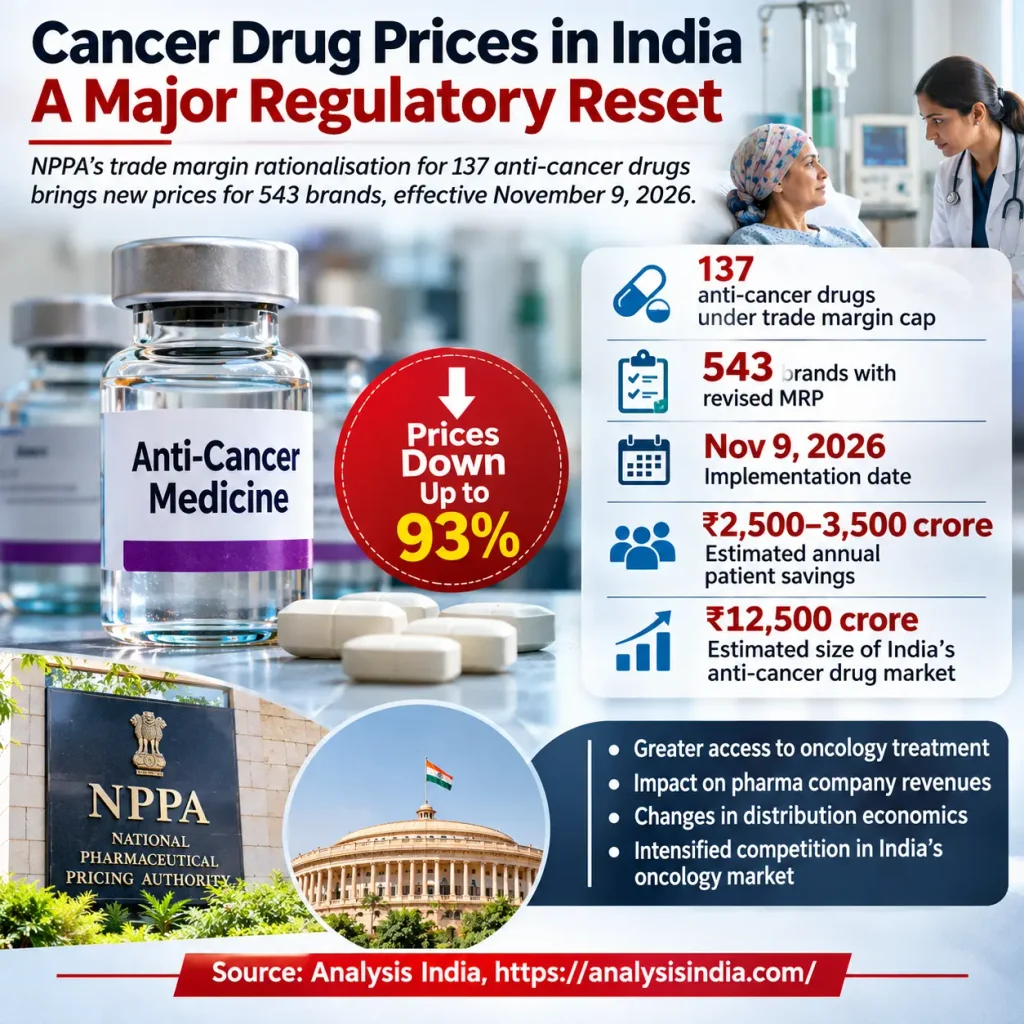
Analysis India: India’s pharmaceutical industry is approaching an important regulatory transition following the government’s decision to introduce trade margin rationalisation for 137 selected non-scheduled anti-cancer drugs. The National Pharmaceutical Pricing Authority (NPPA) has published revised maximum retail prices for 543 brands, with implementation scheduled for November 9, 2026. This development is expected to influence Cancer Drug Prices in India, potentially improving oncology medicine affordability while reshaping pharmaceutical company revenues, distribution economics and competition among domestic and multinational drug manufacturers. Beyond the immediate price reductions, the policy raises important questions about the future structure, commercial sustainability and growth opportunities of India’s oncology pharmaceutical market.
India’s Oncology Pharmaceutical Market Enters a New Regulatory Phase
Cancer has become one of India’s most significant public health and healthcare expenditure challenges. Increasing incidence, changing disease patterns, improved diagnostic capabilities and wider adoption of advanced therapies are expanding demand for oncology medicines. However, access to several modern cancer treatments remains restricted by their high acquisition costs and the financial limitations of patients.
The government’s latest intervention represents a significant development in the regulation of this market. Instead of relying exclusively on conventional ceiling-price mechanisms, the government has used trade margin rationalisation to address the difference between manufacturer selling prices and the final prices charged to patients.
This distinction is important for pharmaceutical companies and healthcare investors. The intervention directly changes the permitted distribution economics of selected medicines. It does not impose an identical price reduction on every oncology formulation, nor does it automatically reduce the manufacturer’s revenue by the same percentage as the retail price.
The policy is therefore more than a patient affordability initiative. It represents a change in the commercial framework governing selected cancer medicines in India.
According to the Department of Pharmaceuticals, the intervention covers 137 identified non-scheduled anti-cancer drugs. On October 28, 2026, NPPA published revised maximum retail prices for 543 brands based on information submitted by manufacturers up to October 27. The list is subject to further updates as companies submit revised prices.
The revised prices are scheduled to take effect on November 9, 2026. This article evaluates the policy and market information available as of November 3, 2026.
1. India’s Cancer Burden Creates a Growing Pharmaceutical Demand Opportunity
The economic importance of the policy becomes clearer when examined alongside India’s cancer burden.
A 2025 research study published in JAMA Network Open, based on India’s population-based cancer registry network, estimated 1,562,099 new cancer cases in India during 2024. The same study estimated 874,404 cancer deaths. These figures demonstrate the substantial healthcare requirement associated with cancer diagnosis, treatment and long-term disease management.
The study also identified significant regional differences in cancer incidence. Breast cancer remained a major contributor among women, while oral, lung and prostate cancers represented important disease categories among men.
Estimated cancer burden in India
| Indicator | Estimated cases |
|---|---|
| Total new cancer cases, 2024 | 15,62,099 |
| Estimated cancer deaths, 2024 | 8,74,404 |
| New cases among males | 7,80,822 |
| New cases among females | 7,81,277 |
| Breast cancer cases | 2,43,905 |
| Oral cavity and pharynx cancers | 2,80,998 |
| Lung and bronchus cancers | 1,05,209 |
| Cervical cancer cases | 78,499 |
| Prostate cancer cases | 49,998 |
Source: National Cancer Registry Programme Investigator Group, JAMA Network Open, August 2025. These are model-based national estimates, not a count of all individually registered cases.
The figures have important implications for the pharmaceutical market. The demand for cancer medicines is not restricted to one therapeutic category. It includes conventional chemotherapy, hormonal therapies, targeted treatments, immunotherapy, biological medicines and supportive oncology products.
As cancer diagnosis expands and treatment pathways become more specialised, demand for these products is likely to remain an important component of India’s healthcare market.
However, higher demand does not automatically translate into higher treatment access. The affordability of medicines, reimbursement availability, hospital infrastructure and uninterrupted product supply all influence the number of patients who can receive treatment.
This is where the government’s pricing intervention becomes commercially significant.
The expansion of oncology treatment capacity also creates a connection with India’s diagnostic industry. Our existing Cancer Screening Market growth and technology analysis examines the diagnostic side of this broader healthcare ecosystem. The present article focuses specifically on pharmaceutical pricing and market economics.
2. Understanding the NPPA Notification and the 30% Trade Margin Cap
On October 17, 2026, NPPA announced Trade Margin Rationalisation for 137 selected non-scheduled anti-cancer drugs under Paragraph 19 of the Drugs (Prices Control) Order, 2013.
The government has capped the aggregate trade margin at 30% of the maximum retail price, excluding applicable GST.
This is different from conventional price control, where the government determines a ceiling price for a scheduled medicine based on the applicable pricing methodology.
Under trade margin rationalisation, the regulator focuses on the distribution chain between the manufacturer’s selling price and the final retail price.
The distinction between a margin and a markup is particularly important. A 30% margin on the final price is equivalent to approximately 42.86% markup over the stockist or distributor price, assuming the same tax basis. It would be incorrect to interpret the regulation as a simple 30% reduction in every manufacturer’s selling price.
The government has selected formulations across several oncology categories. These include immunotherapy medicines used in more than 20 cancer types, Denosumab, Pegfilgrastim and Bevacizumab.
Important molecules covered by the exercise include Pembrolizumab, Durvalumab, Osimertinib, Nivolumab and Olaparib, among others.
The policy builds on an earlier intervention introduced in 2019, when trade margins on 42 selected non-scheduled anti-cancer drugs were capped at 30%. According to the government, that exercise resulted in MRP reductions of up to 90% across 526 brands.
The latest exercise expands the regulatory coverage and introduces a broader set of products recommended by an expert committee under the Directorate General of Health Services.
Policy implementation timeline
| Development | Date |
|---|---|
| Earlier cancer medicine margin intervention | 2019 |
| Government announces expanded pricing decision | October 8, 2026 |
| NPPA issues notification covering 137 drugs | October 17, 2026 |
| Revised MRP information published | October 28, 2026 |
| Scheduled implementation date | November 9, 2026 |
The manufacturers are required to submit revised price information, publish applicable price lists and circulate the revised information to retailers and hospitals. State drug controllers will monitor compliance.
Sources: Department of Pharmaceuticals and NPPA official notifications.
3. Actual Cancer Medicine Price Reductions: What the Latest NPPA Data Shows
The most important development for pharmaceutical market participants is the publication of revised MRPs for 543 brands.
The official list provides an opportunity to examine the actual impact on individual brands rather than relying only on the government’s estimated maximum reduction.
The following table compares selected brands using the previous and revised prices published by the Department of Pharmaceuticals on October 28, 2026.
Selected anti-cancer medicine price comparison in India
| Company | Brand | Medicine | Previous MRP | Revised MRP |
|---|---|---|---|---|
| RPG Life Sciences | Anarzole | Anastrozole | ₹695.76 | ₹73.00 |
| Dr. Reddy’s Laboratories | Azacytin | Azacitidine | ₹6,337.00 | ₹1,495.04 |
| Abbott Healthcare | Bevacizab | Bevacizumab | ₹21,767.70 | ₹5,930.13 |
| Natco Pharma | Dasanat 20 | Dasatinib | ₹2,812.50 | ₹1,085.93 |
| RPG Life Sciences | Debrumab 60 mg | Denosumab | ₹22,031.25 | ₹5,941.00 |
| RPG Life Sciences | Enuta | Enzalutamide | ₹6,578.20 | ₹2,232.00 |
| Neon Laboratories | Erlib | Erlotinib | ₹4,637.45 | ₹2,008.00 |
| Hetero Healthcare | Fludanox | Fludarabine | ₹14,235.00 | ₹2,432.00 |
| RPG Life Sciences | Fulbreca | Fulvestrant | ₹26,072.16 | ₹5,491.00 |
Source: Press Information Bureau, Department of Pharmaceuticals, October 28, 2026. Prices relate to the specific strengths, dosage forms and pack sizes reported in the notification.
Cancer Drug Prices in India: Which brands have experienced the largest reductions?
Calculating the difference between the previous and revised MRPs reveals the scale of the adjustment for the selected examples.
| Brand | Previous MRP | Revised MRP | Calculated reduction |
|---|---|---|---|
| Anarzole | ₹695.76 | ₹73.00 | 89.5% |
| Azacytin | ₹6,337.00 | ₹1,495.04 | 76.4% |
| Bevacizab | ₹21,767.70 | ₹5,930.13 | 72.8% |
| Dasanat 20 | ₹2,812.50 | ₹1,085.93 | 61.4% |
| Debrumab 60 mg | ₹22,031.25 | ₹5,941.00 | 73.0% |
| Enuta | ₹6,578.20 | ₹2,232.00 | 66.1% |
| Erlib | ₹4,637.45 | ₹2,008.00 | 56.7% |
| Fludanox | ₹14,235.00 | ₹2,432.00 | 82.9% |
| Fulbreca | ₹26,072.16 | ₹5,491.00 | 78.9% |
Calculated as (previous MRP minus revised MRP) divided by previous MRP. These calculations are based on the selected examples in the official release and should not be interpreted as the average reduction across all 543 brands.
The data demonstrates that the impact is not uniform. Some selected brands show substantial price adjustments, while other products may experience smaller changes or no change.
This distinction is commercially important. A manufacturer with several affected brands may experience a different financial impact from a company with only one or two notified formulations.
For patients, the exact prescribed brand, strength, dosage form and pack size determine the relevant price. Comparing medicines only by their active ingredient can produce misleading conclusions.
The complete revised list should be checked through the official NPPA revised anti-cancer medicine price database.
4. Cancer Drug Prices in India: Estimated ₹2,500 Crore Patient Savings – Understanding the Market Economics
One of the most significant financial estimates associated with the policy is the expected annual savings for cancer patients.
The government has indicated potential annual savings of approximately ₹2,500 crore from the expanded intervention. Media reports citing officials and government documents have also discussed a possible range of ₹2,500 crore to ₹3,500 crore.
The estimated anti-cancer medicine market in India has been reported at approximately ₹12,500 crore, covering around 225 drugs and 500 formulations.
These figures suggest that the policy has the potential to influence a commercially meaningful segment of the domestic oncology market.
However, estimated patient savings should not be confused with a guaranteed reduction in total cancer treatment expenditure.
The calculation depends on several variables, including the actual number of prescriptions, sales volumes of affected brands, revised procurement prices, patient assistance arrangements and the extent to which the new MRPs are implemented throughout the distribution chain.
A patient receiving an affected medicine through a retail pharmacy may experience a different financial outcome from a patient enrolled in a manufacturer-funded patient assistance programme.
Similarly, the savings from an injectable medicine may be influenced by the hospital’s procurement and billing arrangements.
Therefore, the ₹2,500 crore estimate should be treated as a government policy projection rather than an independently verified realised saving.
5. Cancer Drug Prices in India: Impact on Indian Pharmaceutical Companies – Who Faces the Biggest Commercial Changes?
The pricing intervention creates different opportunities and challenges for domestic manufacturers, multinational pharmaceutical companies and specialty medicine suppliers.
The most useful way to examine the impact is at the individual brand and product portfolio level rather than assuming that every company in the pharmaceutical industry will experience the same outcome.
Dr. Reddy’s Laboratories
Dr. Reddy’s Laboratories is directly represented in the published revised-price examples through Azacytin, an azacitidine formulation.
The official list reduces the reported MRP of this brand from ₹6,337 to ₹1,495.04.
This is a substantial adjustment for the specific product and pack identified in the notification.
The broader impact on Dr. Reddy’s will depend on the contribution of affected oncology brands to its India business, the company’s selling prices, sales volumes and the economics of its remaining pharmaceutical portfolio.
The company also has wider exposure to specialty pharmaceuticals and complex generics. Therefore, the policy should not be interpreted as a measure of its overall financial performance.
Natco Pharma
Natco Pharma has an established presence in oncology and complex generic medicines. Dasanat 20, a dasatinib formulation, is included in the published price comparison.
Its reported MRP falls from ₹2,812.50 to ₹1,085.93 for the specified pack.
The adjustment highlights the potential impact on domestic companies competing in specialty oncology formulations.
For Natco, the longer-term commercial question is whether greater affordability can increase treatment volumes sufficiently to offset any reduction in the economics of affected brands.
The answer will depend on market demand, competition, manufacturing costs and the company’s product portfolio.
RPG Life Sciences
RPG Life Sciences appears multiple times in the government’s selected price examples, including Anarzole, Debrumab, Enuta and Fulbreca.
This concentration makes its disclosed brands particularly relevant for evaluating the impact of the policy.
The price changes cover different therapeutic categories and dosage forms. The implications may therefore differ according to manufacturing costs, product demand, treatment duration and the commercial structure of each formulation.
For investors and industry researchers, RPG Life Sciences provides an interesting case for monitoring how a domestic manufacturer adjusts its oncology product strategy following regulatory price changes.
Abbott Healthcare
Abbott Healthcare’s Bevacizab is another important example.
The reported MRP of the 100 mg/4 ml injection falls from ₹21,767.70 to ₹5,930.13.
Bevacizumab is an important biological therapy used in selected cancer indications. Its market economics involve additional considerations such as manufacturing complexity, storage, distribution and hospital administration.
The revised price may influence the economics of this particular brand, but the wider financial implications cannot be determined without product-level sales and margin disclosures.
Hetero Healthcare and Neon Laboratories
Hetero Healthcare’s Fludanox and Neon Laboratories’ Erlib also appear in the official list.
These examples demonstrate that the intervention is not restricted to a few large pharmaceutical groups.
Several domestic companies with specialised oncology portfolios may need to adjust their pricing, distribution and inventory strategies.
The key industry insight is that regulatory exposure should be assessed using the notified formulation, brand, pack size and company sales contribution. A simple list of affected companies does not establish the financial loss or gain for each business.
6. Cancer Drug Prices in India: What Pharmaceutical Industry Leaders Are Saying About the Pricing Reform
The industry response reflects a common objective but different views on implementation.
Pharmaceutical associations have generally welcomed the government’s attempt to improve patient affordability. At the same time, industry representatives have emphasised that sustainable pricing requires a workable distribution structure and a predictable regulatory environment.
Anil Matai, Director General, Organisation of Pharmaceutical Producers of India
In an October 26, 2026 interview with The Week, Anil Matai discussed the relationship between medicine prices, patient affordability and the wider pharmaceutical innovation ecosystem.
He stated:
“OPPI has supported the rationalisation of trade margins since the issue first came up in 2019. We believe that excessive trade margins need to be addressed.”
He also highlighted a wider affordability challenge, arguing that lower medicine prices alone cannot resolve the financial burden faced by patients.
His comments are relevant because multinational pharmaceutical companies and innovative medicine suppliers operate within an ecosystem that requires investment in research, regulatory compliance and product development.
Rajiv Singhal, General Secretary, All India Organisation of Chemists and Druggists
Rajiv Singhal highlighted the importance of distinguishing legitimate manufacturer costs from excessive MRP structures.
He stated to The Times of India:
“A moderately high MRP is not necessarily unreasonable, as manufacturers have legitimate costs to consider.”
He further warned that artificially inflated MRPs designed to accommodate deep discounting can mislead consumers and distort competition.
This is an important perspective for the distribution industry because it places responsibility on the entire pricing chain rather than automatically attributing every pricing problem to retail pharmacies.
Tanvi Singh, Medical Oncologist, MOC Cancer Care
The patient impact of the policy may vary depending on how medicines are procured.
Commenting on patient assistance programmes, Tanvi Singh told Business Standard:
“The trade-margin cap is unlikely to reduce costs for patients enrolled in PAPs, because their medicines are already being provided free or at heavily discounted rates.”
Her observation identifies an important limitation of using MRP reductions as the only measure of patient affordability.
Patients who purchase medicines outside such programmes may benefit more directly, whereas those already receiving discounted medicines may experience a smaller additional financial benefit.
Malini Aisola, Co-convener, All India Drug Action Network
Malini Aisola raised concerns about how patient assistance programmes are treated in the pricing calculation.
She described these programmes as:
“PAPs are market-expansion strategies which operate by providing discounts or buy and get some free deals.”
Her comments point towards the need for transparent reporting of commercial sales, free supplies and discounted patient assistance volumes.
Mandeep Singh Malhotra, Director of Surgical Oncology, CK Birla Hospital
Mandeep Singh Malhotra highlighted the importance of transparent implementation and verification.
He stated:
“An independent verification of sales data, transparent disclosures and periodic audits would help ensure the exemption did not obscure commercial sales or dilute intended price reductions.”
These statements indicate that the industry’s debate is moving beyond the headline percentage reduction. The quality of implementation, transparency of commercial arrangements and sustainability of the supply chain will determine the longer-term outcome.
7. Cancer Drug Prices in India: Patient Assistance Programmes Could Change the Actual Savings
Patient assistance programmes are an important component of India’s oncology treatment ecosystem.
Pharmaceutical companies may provide free medicines, discounts or additional treatment-cycle support to eligible patients.
These arrangements can be particularly relevant for expensive targeted therapies and immunotherapies.
The new pricing framework creates a distinction between the revised MRP and the actual amount paid by a patient enrolled in an assistance programme.
For a patient already receiving a medicine free of charge, a lower MRP may not generate an additional direct saving.
For a patient purchasing the same medicine through a private pharmacy without assistance, the revised MRP may create a more immediate financial benefit.
According to reporting by Business Standard, some patient assistance programmes can reduce expenditure by approximately 30% to 60% for selected expensive therapies.
The government has established record-keeping and reporting requirements for qualifying programmes. These include patient identity, diagnosis, dosage and medicine distribution information.
From a market research perspective, this creates a need to distinguish between listed MRP, net realised price, institutional procurement price and the effective cost paid by patients.
Without these distinctions, market-size and affordability estimates may overstate the real financial benefit of a pricing intervention.
8. Hospitals, Distributors and Oncology Pharmacies Face a New Operating Environment
Hospitals are important buyers and distributors of oncology medicines in India.
A substantial proportion of specialised cancer medicines is supplied directly to hospitals and medical institutions.
This means the new pricing framework will require operational adjustments beyond conventional retail pharmacy implementation.
Hospitals will need to update procurement databases, pharmacy billing systems, inventory records and patient communication processes.
They must also ensure that the revised prices are reflected in applicable medicine charges from November 9.
For distributors and stockists, the adjustment could change the economics of products that previously generated higher trade margins.
Companies may need to review credit arrangements, inventory turnover, working capital requirements and distribution agreements.
However, the actual effect will depend on the price-to-stockist structure and the permitted margin under the notification.
Specialised oncology products may also involve cold-chain management, storage monitoring, product traceability and trained handling.
The industry therefore needs to distinguish between excessive commercial markups and legitimate logistics costs required to maintain medicine quality.
The challenge for policymakers is to ensure that margin rationalisation does not create unintended pressure on availability.
9. Cancer Drug Prices in India: Competitive Outlook -Domestic Generics, Biosimilars and Innovative Medicines
The new pricing framework could strengthen competition in selected oncology categories.
Indian pharmaceutical manufacturers have developed capabilities in generic medicines, complex formulations, injectables and biosimilars.
These capabilities could become increasingly important as healthcare providers look for affordable alternatives to expensive oncology products.
However, trade margin rationalisation does not automatically remove patent protection or create immediate opportunities for generic entry.
Companies must still comply with intellectual property requirements, manufacturing standards, clinical and regulatory requirements and applicable approvals.
For biosimilars, product quality, comparability, manufacturing consistency and clinical confidence remain important commercial considerations.
The opportunity for domestic companies will therefore depend on their ability to combine affordable pricing with reliable supply and quality assurance.
The policy could also increase interest in oncology research and development, particularly in areas where India has established manufacturing and scientific capabilities.
Our separate analysis of RNA-based cancer therapies and opportunities for Indian pharmaceutical companies examines this innovation pathway. It is a complementary research area rather than a direct consequence of the new trade margin notification.
10. What Does the Reform Mean for Pharmaceutical Investors and Market Researchers?
The announcement creates several variables that deserve attention in future company and industry analysis.
First, investors should monitor the share of affected oncology brands in individual companies’ domestic sales. A company with a large exposure to notified formulations may experience a different commercial outcome from a company with a diversified portfolio.
Second, changes in retail prices should be evaluated alongside manufacturer realisations. A lower MRP does not automatically translate into an equivalent reduction in manufacturer revenue.
Third, sales volume trends will become important. Improved affordability may increase patient access and prescription volumes in selected categories, but this possibility must be demonstrated through actual sales data.
Fourth, the market should monitor whether manufacturers maintain production and supply levels after implementation.
Fifth, future regulatory interventions could extend the discussion to other high-cost medicines, medical consumables and distribution practices.
The wider debate over pharmaceutical pricing also involves the relationship between affordable medicines and innovation investment.
A predictable pricing framework, efficient regulatory approvals and appropriate reimbursement mechanisms can influence the willingness of companies to invest in advanced pharmaceutical research.
The comments made by OPPI Director General Anil Matai underline this broader relationship.
For the Indian pharmaceutical industry, the challenge is not simply to lower prices. It is to create a sustainable market in which patients can access quality medicines while manufacturers retain the ability to invest in production, research and innovation.
11. Seven Market Indicators to Monitor After November 9, 2026
The next phase of this policy should be evaluated using measurable industry indicators rather than headline price announcements alone.
| Market indicator | Why it matters | Data to monitor |
|---|---|---|
| Revised MRP compliance | Measures policy implementation | NPPA and company price lists |
| Oncology brand sales | Measures commercial impact | Pharmarack and company disclosures |
| Manufacturer realisations | Tracks revenue impact | Product-level selling prices |
| Prescription volumes | Measures demand response | Retail and hospital sales data |
| Hospital procurement prices | Measures institutional impact | Procurement and billing disclosures |
| Patient assistance volumes | Measures effective affordability | Company programme disclosures |
| Medicine availability | Identifies supply risks | NPPA, state drug controllers and market checks |
The first few months after implementation will be particularly important.
A meaningful evaluation should compare pre-policy and post-policy sales, prices and supply trends while accounting for seasonal variation, treatment mix and changes in prescription volumes.
It would be premature to conclude that the policy has permanently changed the competitive structure of India’s oncology market before these indicators become available.
12. Cancer Drug Prices in India: Future Outlook – Will India Move Towards Broader Pharmaceutical Price Rationalisation?
The anti-cancer medicine intervention could become an important reference point for future pharmaceutical pricing policy.
The government’s use of Paragraph 19 of DPCO 2013 demonstrates that trade margin rationalisation can be used as a targeted regulatory instrument when affordability concerns become significant.
The immediate focus is on selected oncology formulations. However, wider discussions concerning excessive medicine markups and transparency in the pharmaceutical distribution chain could influence future policy decisions.
For manufacturers, the likely strategic priorities include better cost control, transparent pricing, portfolio diversification and improved supply-chain efficiency.
For distributors and pharmacies, sustainable operations will increasingly depend on inventory efficiency, service quality and compliance.
For hospitals, procurement transparency and patient billing practices will remain important.
For patients, the longer-term benefit will depend on whether lower medicine prices are supported by wider access to treatment, reimbursement and reliable healthcare infrastructure.
India’s oncology pharmaceutical market will continue to require a combination of domestic manufacturing, innovative therapies, generic competition and effective public policy.
Conclusion: A Regulatory Reset for India’s Oncology Pharmaceutical Market
The government’s 2026 trade margin rationalisation initiative represents an important change in the commercial framework for selected cancer medicines.
The notification covering 137 non-scheduled anti-cancer drugs and the publication of revised MRPs for 543 brands create a substantial regulatory development for domestic and multinational pharmaceutical companies.
The official price comparisons demonstrate that some selected brands are experiencing significant reductions. However, the commercial impact will vary according to the product, manufacturer, sales mix and distribution structure.
The estimated annual patient savings of approximately ₹2,500 crore highlight the potential public-health importance of the intervention. Yet the actual benefit will depend on implementation, patient assistance arrangements, hospital procurement practices and medicine availability.
For Indian pharmaceutical companies, the next phase will involve balancing regulatory compliance, operational efficiency, commercial sustainability and product innovation.
For investors and healthcare market researchers, the most important task is to monitor the actual changes in company-level revenues, medicine volumes and patient expenditure after November 9.
The policy should ultimately be judged not only by how much medicine prices decline, but also by whether more patients receive timely, quality-assured and financially accessible cancer treatment.
Analysis India will continue monitoring pharmaceutical pricing reforms, oncology market developments, company strategies and healthcare industry trends through evidence-based market intelligence.
Cancer Drug Prices in India: Frequently Asked Questions
Why has the Indian government introduced cancer medicine price rationalisation in 2026?
The government introduced trade margin rationalisation to address excessive distribution markups on selected non-scheduled anti-cancer medicines. The objective is to improve affordability, reduce patient expenditure and strengthen access to cancer treatment.
How many cancer medicines are covered under the NPPA notification?
The October 17, 2026 notification covers 137 identified non-scheduled anti-cancer drugs. NPPA subsequently published revised maximum retail prices for 543 brands on October 28, 2026.
When will the revised cancer medicine prices become effective?
The revised maximum retail prices are scheduled to become effective from November 9, 2026. Manufacturers, retailers and hospitals are required to implement the applicable revised prices.
What is the expected annual saving for Indian cancer patients?
The government has estimated potential annual savings of approximately ₹2,500 crore. Some media reports have discussed a range of ₹2,500 crore to ₹3,500 crore. Actual savings will depend on sales volumes, patient eligibility and implementation.
Which pharmaceutical companies have affected cancer medicine brands?
The published examples include Dr. Reddy’s Laboratories, Natco Pharma, RPG Life Sciences, Abbott Healthcare, Neon Laboratories and Hetero Healthcare. The impact on each company depends on the specific notified products and their contribution to company sales.
Will all cancer medicines become cheaper in India?
No. The intervention covers selected non-scheduled anti-cancer drugs. It does not apply an identical reduction to every oncology medicine. Patients must check the exact brand, strength, dosage form and pack size in the official NPPA list.
What is the impact of the 30% trade margin cap?
The policy limits the aggregate trade margin to 30% of the MRP, excluding GST, for the notified formulations. This changes distribution economics and can reduce the final price charged to patients.
Will the policy affect pharmaceutical company profitability?
The impact will differ across companies. Manufacturers may face lower MRP levels on affected brands, but their revenue impact depends on manufacturer realisations, sales volumes, product mix and distribution arrangements.
Will patient assistance programme beneficiaries receive additional savings?
Not necessarily. Patients already receiving free or heavily discounted medicines through qualifying assistance programmes may experience a smaller additional benefit from MRP reductions. The actual outcome depends on programme eligibility and the medicine procurement arrangement.
How can patients check revised cancer medicine prices?
Patients can consult the NPPA website and the Pharma Sahi Daam application. They should compare the exact medicine brand, strength, dosage form and pack size rather than relying only on the generic molecule name.
Could the new policy encourage generic cancer medicine competition?
It may improve the commercial environment for affordable oncology products, but generic entry still depends on patent protection, regulatory approvals, manufacturing capacity and quality requirements. Trade margin rationalisation does not itself remove intellectual property restrictions.
What should pharmaceutical investors monitor after implementation?
Investors should monitor company-level oncology sales, revised manufacturer realisations, prescription volumes, inventory movements, medicine availability and regulatory compliance. The first few months after implementation will provide important evidence of the policy’s commercial impact.
Sources and References
- Department of Pharmaceuticals, Government of India. Trade Margin Rationalisation on 137 Anti-Cancer Drugs, October 17, 2026.
- Press Information Bureau. NPPA Releases Revised MRP for 543 Brands of Anti-Cancer Medicines, October 28, 2026.
- National Pharmaceutical Pricing Authority. Revised Prices of 137 Anti-Cancer Drugs, October 28, 2026.
- National Cancer Registry Programme Investigator Group. Cancer Incidence and Mortality Across 43 Cancer Registries in India. JAMA Network Open, August 2025.
- The Week. Interview with Anil Matai, Director General, OPPI, October 26, 2026.
- The Times of India. Industry and Chemist Association Perspectives on Pharmaceutical Trade Margins, October 8, 2026.
- Business Standard. Patient Assistance Programmes and the Impact of Cancer Drug Trade Margin Rationalisation, October 26, 2026.
- Moneycontrol. Pharma Industry Welcomes Cancer Drug Price Cap, Flags Need to Balance Affordability and Sustainability, October 9, 2026.
Research note: All regulatory figures and published price examples are based on information available as of November 3, 2026. The NPPA price list is subject to updates. Calculated price reductions are based on the specific listed brands and packs and should not be generalised to all anti-cancer medicines.