
📅 Published: January 3, 2026
🔄 Last Updated: October 23, 2026
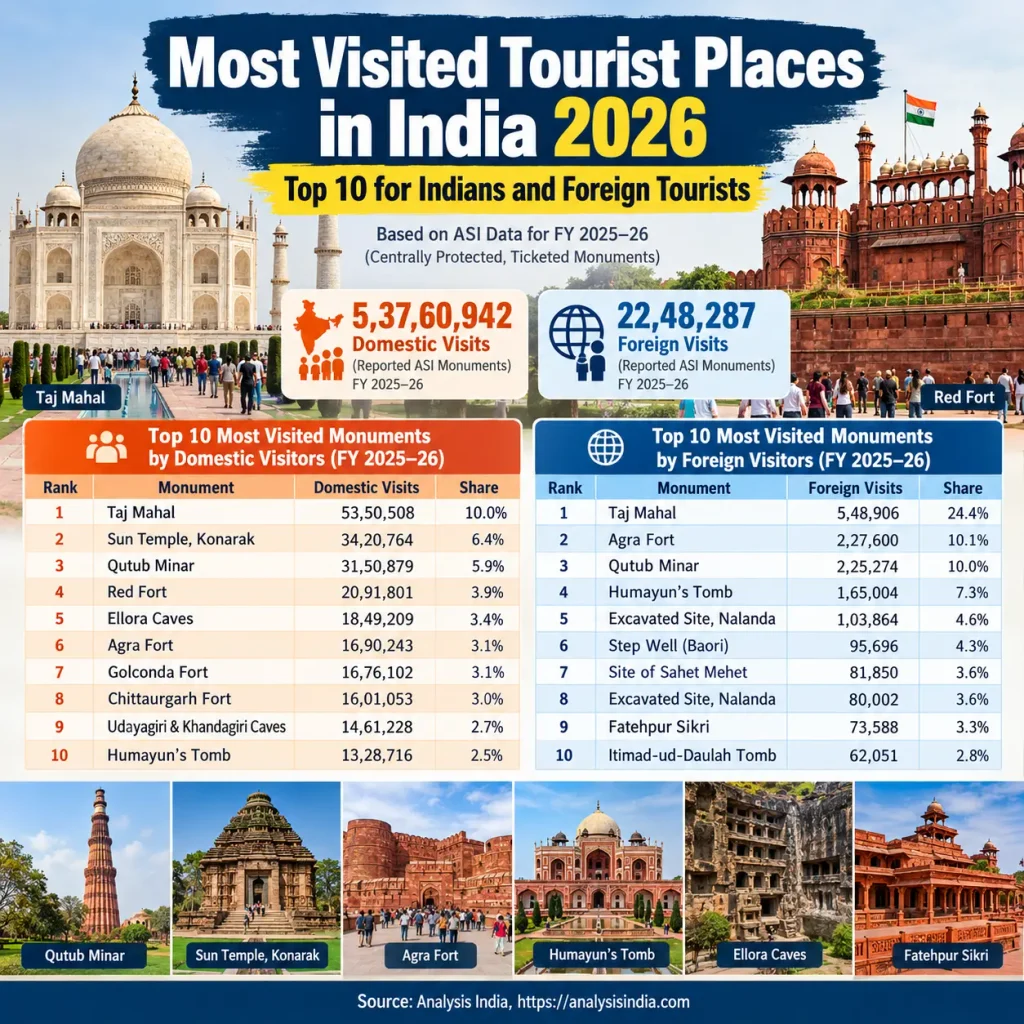
Analysis India: The Most Visited Tourist Places in India attract millions of domestic and international visitors every year. India’s historic monuments, religious landmarks, ancient archaeological sites, and architectural masterpieces remain important attractions for travellers. However, the popularity of individual monuments can vary significantly between Indian visitors and foreign tourists.
According to the Archaeological Survey of India (ASI) figures for financial year 2025–26, the Taj Mahal ranked first among centrally protected, ticketed monuments for both domestic and foreign visitors. The monument recorded 53,50,508 domestic visits and 5,48,906 foreign visits. Other popular attractions included Sun Temple at Konarak, Qutub Minar, Agra Fort, Humayun’s Tomb, and the excavated archaeological sites at Nalanda.
This updated guide to the Most Visited Tourist Places in India examines the latest available monument-level figures, compares domestic and foreign visitor preferences, and explains why these historic destinations remain important to India’s tourism industry. The rankings below are based on ASI data for FY 2025–26 rather than a ranking of every tourist destination in the country.
Most Visited Tourist Places in India: Key Statistics for 2025–26
India’s centrally protected monuments attract visitors for their historical significance, architectural heritage, cultural value, and international recognition. The latest ASI figures provide a useful way to compare the popularity of these ticketed monuments.
| Tourism indicator | FY 2025–26 figure |
|---|---|
| Total domestic visits to the reported ASI monument category | 5,37,60,942 |
| Total foreign visits to the reported ASI monument category | 22,48,287 |
| Domestic visits to the Taj Mahal | 53,50,508 |
| Foreign visits to the Taj Mahal | 5,48,906 |
| Domestic share represented by the Taj Mahal | 10.0% |
| Foreign share represented by the Taj Mahal | 24.4% |
Source: Archaeological Survey of India, as presented in the State of Tourism of India 2026 report by the US-India Strategic Partnership Forum (USISPF).
These figures represent recorded visits to centrally protected, ticketed ASI monuments. They do not represent all visitors to India, all tourist destinations, or necessarily unique individuals. A traveller visiting multiple monuments may contribute more than one visit to the totals.
The Most Visited Tourist Places in India also show an important difference in travel preferences. Domestic visitors were distributed across a wider range of monuments, while foreign visits were more concentrated at the Taj Mahal, Agra Fort, Qutub Minar, and Humayun’s Tomb.
Top 10 Most Visited Tourist Places in India by Domestic Visitors
The following table ranks the ten most visited centrally protected, ticketed ASI monuments by domestic visits during FY 2025–26.
| Rank | Monument | Domestic visits | Share |
|---|---|---|---|
| 1 | Taj Mahal | 53,50,508 | 10.0% |
| 2 | Sun Temple, Konarak | 34,20,764 | 6.4% |
| 3 | Qutub Minar | 31,50,879 | 5.9% |
| 4 | Red Fort | 20,91,801 | 3.9% |
| 5 | Ellora Caves | 18,49,209 | 3.4% |
| 6 | Agra Fort | 16,90,243 | 3.1% |
| 7 | Golconda Fort | 16,76,102 | 3.1% |
| 8 | Chittaurgarh Fort | 16,01,053 | 3.0% |
| 9 | Udayagiri and Khandagiri Caves | 14,61,228 | 2.7% |
| 10 | Humayun’s Tomb | 13,28,716 | 2.5% |
Source: ASI figures for FY 2025–26.
1. Taj Mahal, Agra
The Taj Mahal ranked first among the Most Visited Tourist Places in India for domestic visitors in the ASI monument statistics. It recorded 53,50,508 domestic visits, accounting for 10.0% of the total reported domestic visits to the covered monument category.
Built by Mughal emperor Shah Jahan in memory of Mumtaz Mahal, the Taj Mahal is widely recognised for its white marble architecture, symmetrical gardens, intricate decorative work, and monumental dome. Its international reputation and historical significance make it one of India’s most recognisable heritage attractions.
The Taj Mahal also ranked first among foreign visitors, demonstrating its strong appeal across different visitor groups. Agra’s other historic attractions, particularly Agra Fort and Fatehpur Sikri, also make the city an important destination for heritage tourism.
2. Sun Temple, Konarak
The Sun Temple at Konarak ranked second among domestic visitors, recording 34,20,764 visits and a 6.4% share of the reported total. Located in Odisha, the temple is famous for its monumental architectural design and elaborate stone carvings.
Dedicated to the Sun God, the temple was conceived in the form of a gigantic stone chariot. Its sculptural details and historical significance make it one of the most important examples of medieval Indian temple architecture.
Its high domestic ranking highlights the importance of religious heritage and regional tourism in India. The Sun Temple also demonstrates why the Most Visited Tourist Places in India should not be understood only through the popularity of internationally famous destinations.
3. Qutub Minar, Delhi
Qutub Minar recorded 31,50,879 domestic visits, giving it third place in the domestic ranking. It also ranked third for foreign visitors, with 2,25,274 visits.
Located in Delhi, Qutub Minar is a major example of Indo-Islamic architecture. The complex includes historic structures and archaeological remains that reflect the development of early Sultanate architecture in the region.
Its location in the national capital makes it accessible to domestic travellers, international tourists, and visitors exploring Delhi’s historical attractions. Its strong position in both rankings makes it one of the most consistently popular monuments in the ASI dataset.
4. Red Fort, Delhi
The Red Fort recorded 20,91,801 domestic visits, representing 3.9% of the reported domestic total. It ranked fourth among the listed monuments for domestic visitors.
Constructed during the Mughal period, the Red Fort is an important symbol of India’s political and architectural history. Its association with the independence movement and the annual Independence Day address by the Prime Minister gives it significance beyond its architectural features.
For travellers exploring Delhi, the Red Fort is often combined with other historic attractions. Its domestic ranking reflects the continuing importance of national heritage sites in India’s tourism landscape.
5. Ellora Caves, Maharashtra
Ellora Caves recorded 18,49,209 domestic visits and ranked fifth in the domestic list. The archaeological complex is known for its rock-cut architecture, religious diversity, and monumental Kailasa Temple.
The site contains Buddhist, Hindu, and Jain monuments created over several centuries. These structures demonstrate the technical skill of artisans who carved elaborate architectural spaces directly into rock.
Ellora is also an important destination for cultural and educational tourism. Its position among the Most Visited Tourist Places in India by domestic visitors shows the continuing appeal of archaeological heritage outside the country’s most widely recognised tourist cities.
6. Agra Fort, Uttar Pradesh
Agra Fort recorded 16,90,243 domestic visits and ranked sixth in the domestic table. Its importance is even more evident in the foreign visitor ranking, where it secured second place.
The fort served as a major centre of Mughal political power and contains palaces, audience halls, courtyards, and other historic structures. Its relationship with the Taj Mahal makes it a central part of Agra’s heritage tourism circuit.
Many visitors explore both monuments during the same trip. This connection helps explain why Agra remains one of the most important destinations in India’s international heritage tourism market.
7. Golconda Fort, Telangana
Golconda Fort recorded 16,76,102 domestic visits, placing it seventh in the domestic ranking. Located near Hyderabad, the fort is known for its defensive architecture, gateways, elevated structures, and association with the historic Golconda kingdom.
The fort reflects the region’s political and commercial history. Its large complex offers visitors an opportunity to explore historic fortification techniques and understand the strategic importance of the area.
Its visitor numbers also demonstrate the contribution of regional heritage destinations to the Most Visited Tourist Places in India list. The monument provides an important alternative to the better-known attractions in northern India.
8. Chittaurgarh Fort, Rajasthan
Chittaurgarh Fort recorded 16,01,053 domestic visits, accounting for 3.0% of the reported domestic total. The fort is associated with the history of Mewar, Rajput traditions, and several significant events in Rajasthan’s past.
Its extensive fortified landscape includes historic palaces, towers, temples, and other structures. The scale of the complex makes it an important destination for travellers interested in military architecture and regional history.
The monument’s ranking highlights the importance of Rajasthan’s forts in domestic heritage tourism. Its appeal extends beyond a single building because the broader site offers a view of the region’s historical and architectural development.
9. Udayagiri and Khandagiri Caves, Odisha
Udayagiri and Khandagiri Caves recorded 14,61,228 domestic visits, ranking ninth in the ASI table. Located near Bhubaneswar, these rock-cut caves are associated with ancient Jain heritage and provide insight into early Indian religious and artistic traditions.
The caves contain inscriptions, carved details, and spaces that help researchers understand the history of the region. Their archaeological importance makes them valuable for both tourism and historical study.
Their presence among the Most Visited Tourist Places in India for domestic visitors demonstrates that travellers continue to explore ancient sites beyond the country’s most prominent monuments.
10. Humayun’s Tomb, Delhi
Humayun’s Tomb recorded 13,28,716 domestic visits, ranking tenth in the domestic list. It ranked fourth among foreign visitors, with 1,65,004 visits.
Built in the sixteenth century, the tomb is an important example of Mughal garden-tomb architecture. Its layout, architectural proportions, and landscaped setting influenced the development of later Mughal monuments.
Its location in Delhi makes it a convenient addition to a broader heritage itinerary. The monument’s strong performance among foreign visitors also reflects international interest in Mughal architecture and the historical development of the Indian subcontinent.
Top 10 Most Visited Tourist Places in India by Foreign Visitors
Foreign visitors show a different distribution across the ASI monuments. The Taj Mahal accounts for nearly one-quarter of the foreign visits recorded in the supplied table.
| Rank | Monument as listed in the ASI table | Foreign visits | Share |
|---|---|---|---|
| 1 | Taj Mahal | 5,48,906 | 24.4% |
| 2 | Agra Fort | 2,27,600 | 10.1% |
| 3 | Qutub Minar | 2,25,274 | 10.0% |
| 4 | Humayun’s Tomb | 1,65,004 | 7.3% |
| 5 | Excavated Site, Nalanda | 1,03,864 | 4.6% |
| 6 | Step Well (Baori) | 95,696 | 4.3% |
| 7 | Site of Sahet Mehet | 81,850 | 3.6% |
| 8 | Excavated Site, Nalanda | 80,002 | 3.6% |
| 9 | Fatehpur Sikri | 73,588 | 3.3% |
| 10 | Itimad-ud-Daulah Tomb | 62,051 | 2.8% |
Important data note: The supplied ASI data lists “Excavated Site, Nalanda” twice, at ranks five and eight, and identifies the sixth entry only as “Step Well (Baori).” These entries have been reproduced as reported rather than silently corrected. Verify the original ASI classification before treating the two Nalanda entries as distinct locations or assigning a specific name to the stepwell.
1. Taj Mahal, Agra
The Taj Mahal was the leading attraction in the foreign visitor ranking, with 5,48,906 visits and a 24.4% share. This means that almost one-quarter of the foreign visits recorded across the covered ASI monuments were attributed to the Taj Mahal.
Its international recognition, Mughal history, distinctive architecture, and reputation as a major world heritage attraction contribute to its popularity. The monument is frequently included in international itineraries covering Delhi, Agra, and other historic destinations in northern India.
The Taj Mahal’s first-place position in both domestic and foreign rankings makes it the clearest example of a monument with broad national and international appeal.
2. Agra Fort, Uttar Pradesh
Agra Fort ranked second for foreign visitors, recording 2,27,600 visits and a 10.1% share. Its proximity to the Taj Mahal makes it an important part of the same heritage tourism circuit.
The fort provides a different perspective on Mughal history, including royal residences, defensive structures, and spaces associated with imperial administration. Visitors interested in the history behind the Taj Mahal often include the fort in their itinerary.
Its high position among the Most Visited Tourist Places in India for foreign visitors demonstrates the value of combining related attractions into a single destination experience.
3. Qutub Minar, Delhi
Qutub Minar recorded 2,25,274 foreign visits, representing 10.0% of the reported foreign total. It ranked third in the international visitor table.
The monument and its surrounding complex provide insight into the architectural history of Delhi. The site’s combination of historical structures, inscriptions, and distinctive tower architecture makes it a significant attraction for international visitors.
Its strong performance in both domestic and foreign rankings confirms the importance of Delhi as a starting point for heritage-focused travel across India.
4. Humayun’s Tomb, Delhi
Humayun’s Tomb received 1,65,004 foreign visits, accounting for 7.3% of the total. Its architecture and landscaped setting make it a major attraction for visitors interested in Mughal history.
The tomb is particularly important for understanding the evolution of Mughal funerary architecture. Its design illustrates architectural traditions that developed further in later monuments, including the Taj Mahal.
Its fourth-place ranking among foreign visitors demonstrates the international appeal of Delhi’s historical landmarks.
5. Excavated Site, Nalanda, Bihar
The first entry labelled “Excavated Site, Nalanda” recorded 1,03,864 foreign visits, representing 4.6% of the total shown in the ASI table.
Nalanda is associated with the history of ancient Indian education and Buddhist scholarship. Its archaeological remains help visitors understand the development of a major historical centre of learning and the intellectual networks that connected India with other parts of Asia.
Because the supplied table contains a second entry with the same label, the figures should be interpreted carefully until the original classification is verified. Nevertheless, the reported entry highlights the importance of archaeological heritage within international tourism.
6. Step Well (Baori)
The ASI table records 95,696 foreign visits for an attraction identified as “Step Well (Baori),” accounting for 4.3% of the foreign total.
Stepwells are important examples of traditional Indian water architecture. Their designs often combine practical water storage with elaborate steps, platforms, and architectural features that reflect the history of local communities.
However, the supplied table does not identify this attraction by a more specific name. It would therefore be inappropriate to assign the count to a particular stepwell without checking the original ASI record.
7. Site of Sahet Mehet
The site of Sahet Mehet recorded 81,850 foreign visits, representing 3.6% of the reported total. The archaeological remains are associated with ancient Shravasti, an important centre in the history of Buddhism.
The site attracts visitors interested in ancient Indian history, Buddhist heritage, archaeology, and religious travel. Its significance extends beyond architectural features because it helps connect present-day visitors with historical traditions and ancient settlements.
Its appearance in the foreign visitor ranking illustrates the importance of India’s archaeological and spiritual heritage to international tourism.
8. Second Excavated Site, Nalanda Entry
The second “Excavated Site, Nalanda” entry in the supplied table recorded 80,002 foreign visits, also accounting for 3.6% of the total.
Since the table repeats the same site label, the entry should not automatically be interpreted as a separate tourist destination. The original ASI publication should be consulted to determine whether the duplication reflects a classification issue, a separate ticketed unit, or another reporting distinction.
For editorial accuracy, this entry is retained separately in the ranking. This approach preserves the published figures while avoiding an unsupported assumption about the identity of the location.
9. Fatehpur Sikri, Uttar Pradesh
Fatehpur Sikri recorded 73,588 foreign visits, accounting for 3.3% of the reported total. The historic city was developed under Mughal emperor Akbar and is known for its palaces, courtyards, gateways, and monumental architecture.
The site offers insight into Mughal urban planning and imperial life. Its historic structures also illustrate the interaction of architectural traditions during the period.
Fatehpur Sikri is often combined with visits to Agra and the Taj Mahal, making it a valuable part of northern India’s heritage tourism circuit.
10. Itimad-ud-Daulah Tomb, Agra
Itimad-ud-Daulah Tomb recorded 62,051 foreign visits, representing 2.8% of the reported total. Often discussed in the context of Mughal architecture, the monument is known for its decorative stonework and intricate detailing.
Its architectural features offer visitors another perspective on the evolution of Mughal design in Agra. The tomb complements the city’s larger monuments and provides a more detailed view of the artistic traditions that developed during the period.
Its position among the Most Visited Tourist Places in India for foreign visitors reflects the continued appeal of Agra’s wider heritage landscape.
Domestic vs Foreign Visitors: What Do the Rankings Reveal?
The ASI figures show that visitor preferences differ depending on the audience. The Taj Mahal dominates both rankings, but the relative positions of other monuments change considerably.
| Finding | Domestic visitors | Foreign visitors |
|---|---|---|
| Leading monument | Taj Mahal | Taj Mahal |
| Taj Mahal visits | 53,50,508 | 5,48,906 |
| Taj Mahal share | 10.0% | 24.4% |
| Second-ranked monument | Sun Temple, Konarak | Agra Fort |
| Third-ranked monument | Qutub Minar | Qutub Minar |
| Other prominent attractions | Red Fort, Ellora Caves, Golconda Fort | Humayun’s Tomb, Nalanda entries, Step Well (Baori) |
The first major finding is the concentration of foreign visits around a small number of well-known monuments. The Taj Mahal alone accounts for 24.4% of the reported foreign visits, compared with 10.0% of domestic visits.
The second finding is the broader distribution of domestic visits. Domestic travellers visited a wider selection of monuments, including the Sun Temple at Konarak, Ellora Caves, Golconda Fort, and Chittaurgarh Fort. This suggests that domestic heritage tourism includes a wider range of regional destinations.
The third finding is the importance of destination clusters. Agra benefits from the presence of several major Mughal monuments, while Delhi offers multiple historical attractions within the same city. These clusters can encourage visitors to explore more than one site during a single trip.
These findings help explain why the Most Visited Tourist Places in India cannot be understood through a single national ranking alone. Domestic and international travel patterns reflect different itineraries, interests, access conditions, and levels of familiarity with individual destinations.
Why These Monuments Matter to India’s Tourism Industry
Heritage tourism supports a wide network of economic activities. Visitor spending can benefit hotels, restaurants, transport providers, local guides, handicraft sellers, and other businesses operating around popular monuments.
High visitor numbers can also increase the need for better visitor management, sanitation, conservation, signage, accessibility, and digital information. Authorities must balance the economic benefits of tourism with the long-term protection of historic structures and archaeological remains.
The Most Visited Tourist Places in India also offer opportunities to promote less familiar destinations. Travellers who visit well-known monuments may be encouraged to explore nearby historical sites, regional museums, cultural festivals, and local tourism circuits. Such diversification can spread tourism spending across a wider area.
However, visitor counts should not be treated as a complete measure of tourism performance. Revenue, average visitor spending, length of stay, local employment, conservation needs, and visitor satisfaction also matter. A destination with fewer visitors may still make a substantial contribution to cultural preservation and the local economy.
How to Plan a Heritage Trip to India’s Popular Tourist Places
Travellers planning a heritage trip should consider location, travel time, weather, opening hours, and the time required to explore each monument. Agra and Delhi can be combined in a northern India itinerary, while Ellora Caves and other Maharashtra attractions can be planned as part of a separate trip.
Visitors interested in ancient religious and archaeological heritage may consider Konarak, Udayagiri and Khandagiri, Nalanda, and Sahet Mehet. Rajasthan’s historic forts offer a different experience focused on regional kingdoms, military architecture, and royal history.
Before travelling, check current entry rules, ticket prices, opening hours, photography restrictions, and official travel advisories. Visitor counts from FY 2025–26 indicate past recorded visits; they do not guarantee current crowd levels or future rankings.
For readers exploring the Most Visited Tourist Places in India, the best itinerary will depend on whether the main interest is architecture, religion, archaeology, photography, or a broader cultural experience.
Frequently Asked Questions
Which is the most visited tourist place in India according to the latest ASI figures?
The Taj Mahal ranked first among the centrally protected, ticketed ASI monuments in FY 2025–26. It recorded 53,50,508 domestic visits and 5,48,906 foreign visits. These figures refer to monument visits, not all tourist arrivals across India.
Which Indian monument received the most foreign visitors in FY 2025–26?
The Taj Mahal ranked first, with 5,48,906 foreign visits. It accounted for 24.4% of the foreign visits recorded across the monument category.
Which monument ranked second among domestic visitors?
The Sun Temple at Konarak ranked second among domestic visitors, with 34,20,764 visits and a 6.4% share of the reported total.
Is Qutub Minar popular with both Indian and foreign tourists?
Yes. Qutub Minar ranked third in both categories. It recorded 31,50,879 domestic visits and 2,25,274 foreign visits during FY 2025–26.
Do these statistics cover every tourist destination in India?
No. The figures cover the centrally protected, ticketed ASI monuments represented in the supplied table. They do not include every religious site, beach, hill station, national park, museum, or other tourist destination in India.
Why are domestic and foreign visitor rankings different?
Travel preferences can vary because of cultural interests, religious significance, international recognition, itinerary choices, accessibility, and destination proximity. Domestic visitors also explore a wide range of regional monuments, while foreign visits in the supplied data are more concentrated at a few prominent attractions.
Conclusion
The latest ASI figures provide a useful snapshot of India’s heritage tourism landscape during FY 2025–26. The Taj Mahal led both domestic and foreign visitor rankings, while monuments such as the Sun Temple at Konarak, Qutub Minar, Agra Fort, Ellora Caves, and Humayun’s Tomb also attracted substantial numbers of visitors.
The Most Visited Tourist Places in India demonstrate the continuing importance of historical architecture, archaeological heritage, and cultural tourism. They also show why domestic and foreign visitor statistics should be examined separately. Understanding these differences can help tourism businesses, policymakers, and travellers make better-informed decisions about destination development and travel planning.
As India continues to develop its tourism infrastructure, conserving historic monuments and improving visitor experiences will remain essential to sustaining the country’s heritage tourism appeal.
Sources and Further Reading
- US-India Strategic Partnership Forum: State of Tourism of India 2026 report
- Archaeological Survey of India
- Ministry of Tourism, Government of India: Market Research and Statistics
For related analysis, explore Analysis India’s coverage of travel and tourism market analysis, including tourism trends, destination development, and the economic impact of travel.