📅 Published: January 3, 2026
🔄 Last Updated: October 28, 2026
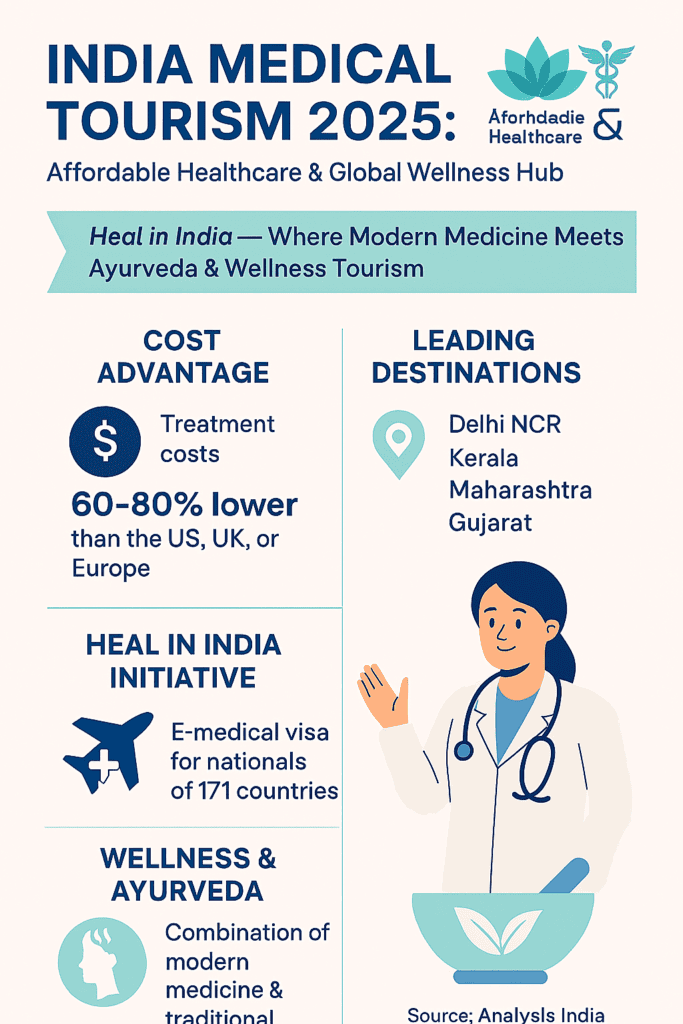
Analysis India: India medical tourism 2025 reflects an important shift in international healthcare, as patients increasingly travel across borders to access specialised treatment, experienced medical professionals and comparatively affordable hospital services. India’s healthcare sector combines advanced clinical capabilities with a large network of multispecialty hospitals, diagnostic facilities and traditional wellness centres. This combination is creating opportunities across healthcare delivery, medical travel facilitation, hospitality and international patient services.
Official government data confirms that India received 644,387 foreign tourists for medical purposes in 2024. A government publication released in May 2026 reports 507,244 medical-purpose arrivals for 2025. These figures provide an important measure of international patient movement, although they do not represent the entire domestic or international medical tourism market.
India’s opportunity extends beyond the number of patients entering the country. Hospitals must coordinate treatment planning, international consultations, medical visas, accommodation, language support, discharge arrangements and follow-up care. Government initiatives, including Heal in India and medical visa facilities, are intended to strengthen this ecosystem. The long-term opportunity will depend on whether India can combine affordability with consistent clinical quality, transparent pricing and reliable patient experiences.
India Medical Tourism 2026: Latest Market Data and Growth Outlook
India’s medical tourism industry has become an important part of the country’s international healthcare engagement. Patients travel to India for procedures that require specialist expertise, advanced medical equipment and coordinated hospital care. The market also includes supporting services such as medical travel agencies, international insurance coordination, rehabilitation and recovery accommodation.
According to the Government of India’s Press Information Bureau, India’s medical tourism market was estimated at USD 8.7 billion in 2025 and is projected to reach USD 16.2 billion by 2030. These are market-size estimates rather than audited national revenue figures. The Ministry of Tourism has clarified in a parliamentary response that it does not maintain state-wise medical tourism revenue data or conduct a comprehensive study of the sector’s current market size.
The distinction matters because foreign arrivals measure people entering India for a stated purpose, whereas market estimates measure the economic value of a broader set of services. These indicators can be used together to understand the industry’s development, but they should not be treated as equivalent measures.
India Medical Tourism Market Size and Forecast
| Market indicator | Value | Period |
|---|---|---|
| Estimated Indian medical tourism market | USD 8.7 billion | 2025 |
| Projected Indian medical tourism market | USD 16.2 billion | 2030 |
| Estimated global Medical Value Travel market | USD 115.6 billion | 2022 |
| Projected global Medical Value Travel market | USD 286.1 billion | 2030 |
| Estimated global market CAGR | 10.8% | 2022 to 2030 |
Source: Government of India, Press Information Bureau, Medical and Wellness Tourism in India, published May 2, 2026. Global and Indian market figures are estimates and projections, not official arrival statistics.
The projected expansion of India medical tourism reflects several underlying opportunities. Rising healthcare costs in some overseas markets encourage patients to compare international treatment options. India also benefits from established hospitals, a large clinical workforce and experience in complex medical procedures. However, the projected market value will depend on the country’s ability to attract patients while maintaining clinical standards and improving service delivery.
Foreign Medical Tourist Arrivals in India: Year-Wise Data
Foreign tourist arrivals for medical purposes offer a more direct indicator of international patient demand. The figures below are compiled from government-reported data, including the Ministry of Tourism’s parliamentary response and its subsequent 2026 publication.
Foreign Tourist Arrivals for Medical Purposes in India
| Year | Medical-purpose foreign tourist arrivals |
|---|---|
| 2019 | 697,453 |
| 2020 | 182,945 |
| 2021 | 323,748 |
| 2022 | 474,798 |
| 2023 | 659,356 |
| 2024 | 644,387 |
| 2025 | 507,244 |
Source: Government of India, Bureau of Immigration data reported through the Press Information Bureau. The 2025 figure is reported in the PIB publication dated May 2, 2026. See the official government medical tourism data release.
The historical trend shows the severe disruption caused by the pandemic and the subsequent recovery in international medical travel. Arrivals increased substantially between 2020 and 2023, before declining in 2024 and again in the reported 2025 figures. This pattern suggests that the industry should not be assessed through a single growth year or a long-term market forecast alone.
The 2025 figure of 507,244 is approximately 21.3% lower than the 2024 figure of 644,387. This comparison is based on the reported annual figures and should be interpreted alongside changes in travel access, source-country demand and the timing of government reporting. It does not, by itself, establish why arrivals declined.
For a balanced assessment, India medical tourism 2025 should therefore be evaluated using three indicators: actual medical-purpose arrivals, independently defined market-size estimates and the capacity of hospitals to serve international patients safely and consistently.
India’s International Tourism Performance and Medical Travel
Medical tourism operates within India’s wider international tourism economy. According to the Ministry of Tourism’s official dashboard, India recorded 9.15 million foreign tourist arrivals in 2025, alongside 20.22 million international tourist arrivals. These measures have different definitions and should not be used interchangeably.
Foreign tourist arrivals exclude non-resident Indian arrivals, whereas international tourist arrivals include foreign tourists and non-resident Indians under the dashboard’s reporting framework. Medical-purpose arrivals represent a separate purpose-of-visit category.
India’s International Tourism Indicators in 2025
| Indicator | Reported value |
|---|---|
| International tourist arrivals | 20.22 million |
| Foreign tourist arrivals | 9.15 million |
| Non-resident Indian arrivals | 11.07 million |
| Foreign tourist visits | 25.27 million |
| Foreign exchange earnings from tourism | Approximately ₹2.7 lakh crore |
Source: Ministry of Tourism, Government of India, Tourism Data Dashboard, year 2025. The figures refer to distinct indicators and are not additive in every comparison.
Medical travel can generate economic activity across multiple industries. International patients may require hospital treatment, diagnostic services, hotel accommodation, local transport, food, translation and extended recovery support. Attendants and family members can also generate additional spending during the treatment period.
However, tourism-wide foreign exchange earnings should not be described as medical tourism revenue. The government does not publish a directly comparable national medical tourism revenue series covering all states and providers. A reliable market assessment must preserve this distinction.
Which Countries Send Medical Tourists to India?
India receives international patients from neighbouring countries as well as markets in West Asia, Central Asia and Africa. Geographic proximity, flight connections, existing medical relationships and access to specialist treatment can influence these flows.
Government-reported figures for 2025 identify Bangladesh as the largest source country in the published medical-purpose arrival data. Iraq, Uzbekistan, Somalia, Turkmenistan, Oman and Kenya also feature among the leading source markets.
Leading Source Countries for Medical Tourism in India in 2025
| Source country | Medical-purpose arrivals |
|---|---|
| Bangladesh | 325,127 |
| Iraq | 30,989 |
| Uzbekistan | 13,699 |
| Somalia | 11,506 |
| Turkmenistan | 10,231 |
| Oman | 9,738 |
| Kenya | 9,357 |
Source: Government of India, Press Information Bureau, May 2, 2026. Figures represent the published country-level medical-purpose arrival counts.
Bangladesh is particularly important because of its geographic proximity and established patient movement to Indian hospitals. Patients may travel for specialist consultations, surgery, cancer care, cardiac treatment and diagnostic services. For hospitals serving this market, accessible international patient desks, assistance with documentation and clear communication can improve the treatment journey.
Markets in Central Asia, West Asia and Africa offer different opportunities. Patients may require more extensive support with travel planning, language assistance, accommodation and coordination between referring doctors and Indian specialists. Hospitals seeking to expand international services should assess each market individually rather than assume that one patient acquisition strategy will work everywhere.
The country figures also demonstrate why source-market diversification matters. Heavy dependence on a single country can expose hospitals and medical travel facilitators to changes in travel policy, diplomatic conditions, flight availability and household purchasing power.
Why International Patients Choose India for Medical Treatment
The competitiveness of India medical tourism rests on the combination of clinical expertise, treatment availability and total treatment cost. International patients often compare not just the hospital bill but the entire cost of care, including travel, accommodation, investigations, medicines and recovery.
Advanced Specialist Healthcare
Indian hospitals offer a wide range of specialist services, including cardiology, oncology, orthopaedics, neurosciences and organ transplantation. These services attract patients who need multidisciplinary consultations, advanced diagnostics or complex procedures. Large hospital networks can also coordinate treatment across departments when a patient’s condition requires several specialists.
Nevertheless, international patients should evaluate the suitability of an individual hospital and doctor rather than rely only on a country’s reputation. Treatment outcomes depend on the diagnosis, clinical team, patient condition, infection control, postoperative care and the availability of follow-up services.
Treatment Affordability
India can offer a lower total treatment cost than some higher-cost healthcare markets. The difference depends on the procedure, hospital, medical devices required, length of admission and complications. A meaningful comparison should include the complete treatment plan rather than a promotional starting price.
Hospitals can strengthen confidence by providing itemised estimates, explaining what is included and identifying costs that may arise if the treatment plan changes. Patients should also receive clear information about expected recovery time, additional consultations and arrangements for continuing care after returning home.
Medical Expertise and Hospital Infrastructure
International patients may seek access to specialist clinicians, modern diagnostic equipment and multidisciplinary treatment teams. Hospitals that combine clinical expertise with transparent communication can improve their ability to attract patients through physician referrals and established international healthcare relationships.
Accreditation can provide an additional quality reference, although it should not be interpreted as a guarantee of an individual patient’s outcome. Patients should verify the current accreditation status of the specific hospital and department, as well as the credentials of their treating clinicians.
Integrated Wellness and Recovery Services
India also offers wellness services based on Yoga, Ayurveda and other AYUSH systems. These services form part of the wider medical and wellness travel ecosystem, but they should be distinguished from evidence-based treatment for serious medical conditions.
Patients considering traditional or complementary therapies should discuss them with qualified healthcare professionals, especially when they are receiving cancer treatment, taking prescription medicines or recovering from surgery. Clear separation between clinical treatment and wellness services helps protect patient safety and build trust.
Government Initiatives Supporting Medical Value Travel
The Government of India has taken steps to improve the country’s international medical travel ecosystem. These include medical visa facilities, promotional activities, a national strategy for medical and wellness tourism and collaboration with industry stakeholders.
The Ministry of Tourism has formulated a National Strategy and Roadmap for Medical and Wellness Tourism. The Services Export Promotion Council has also developed the India Healthcare Tourism portal, which provides information about healthcare providers, accredited hospitals, wellness centres and travel-related requirements.
E-Medical Visa and E-Medical Attendant Visa
India’s e-Medical visa and e-Medical Attendant visa facilities are intended to make travel for treatment easier for eligible foreign nationals. Patients should check the current eligibility conditions, permitted duration, required documents and application process through official government channels before booking travel.
Visa access is only one part of the patient journey. International patients also need reliable information about appointment availability, treatment costs, admission requirements and the arrangements required for accompanying family members.
Heal in India
Heal in India is a broader initiative to position the country as a destination for medical and wellness travel. Its success will depend on coordination across healthcare providers, tourism authorities, visa services, transport operators and hospitality businesses.
A strong national proposition requires more than international promotion. It needs consistent service quality, dependable referral pathways, transparent pricing and mechanisms through which patients can seek help if a problem occurs during or after treatment.
Regional Medical Hubs
The Union Budget 2026-27 proposed the establishment of five regional medical hubs in partnership with state governments and the private sector. According to the government’s May 2026 publication, the proposed hubs are intended to integrate healthcare, education, research, advanced diagnostics, rehabilitation, AYUSH centres and medical value travel facilitation.
These hubs could support more coordinated services for international patients if implementation delivers the proposed infrastructure and administrative support. Their eventual contribution should be evaluated using measurable outcomes such as treatment capacity, patient experience, service quality and access to specialist care.
What India’s Healthcare Leaders Say About Medical Tourism
Industry perspectives help explain why India medical tourism is increasingly being discussed as a healthcare services and trust-building opportunity rather than a price-led business alone.
In September 2026, Mahindra Group Chairman Anand Mahindra highlighted the importance of patient confidence in international medical travel. Business Today reported his statement: “Because this business isn’t won on price alone. It’s won on trust,” said Anand Mahindra, Chairman of Mahindra Group.
His observation points to a practical challenge for the industry. A patient evaluates the entire experience, from the initial consultation and travel arrangements to hospital admission, treatment, recovery and discharge. A competitive price may attract attention, but poor communication or uncertain billing can weaken confidence.
Government statements also emphasise clinical quality and patient-centred services. At the eighth edition of Advantage Healthcare India in February 2026, Union Health Minister Jagat Prakash Nadda said that the government was working to position India as a preferred destination for medical value travel. He highlighted the role of skilled medical professionals and modern healthcare infrastructure in specialist fields including cardiology, oncology, organ transplantation, orthopaedics and neurosciences.
These perspectives support a broader industry conclusion. Medical tourism competitiveness requires the combined contribution of clinical quality, transparent processes, patient communication and reliable support services. For hospital operators, investment in international patient coordination and continuity of care can be as important as investment in medical technology.
Hospital Networks and the International Patient Experience
Large Indian hospital groups play an important role in the international patient ecosystem. Their services may include remote consultations, second opinions, treatment planning, assistance with medical documentation and coordination between overseas patients and specialist teams.
Apollo Hospitals, for example, reported the opening of an information centre in Chattogram, Bangladesh, intended to help patients access specialist consultations, treatment planning and visa facilitation. The initiative also included coordination with local physicians and medical value travel professionals.
Such facilities illustrate how hospitals can build relationships with international patients before they travel. They can also help referring physicians communicate with Indian specialists and reduce uncertainty during the initial decision-making process.
However, an information centre or international patient desk should not be confused with a guarantee of treatment outcomes. Patients still need an individual clinical assessment, informed consent, a clear cost estimate and a treatment plan appropriate to their medical condition.
Hospitals can strengthen their international services by providing multilingual communication, written discharge instructions, digital access to reports and a clear process for follow-up consultations. These services are particularly important when patients return to their home countries and need to coordinate ongoing treatment with local clinicians.
Digital Health and Patient Coordination in Medical Tourism
Digital technology is becoming increasingly important in cross-border healthcare. International patients may begin their journey with an online enquiry, upload medical reports, obtain a remote specialist opinion and discuss treatment options before travelling. Digital systems can help hospitals organise these steps and reduce unnecessary delays.
This development also connects medical tourism with wider healthcare technology trends. For a related perspective on digital transformation in tourism, see AI in Personalised Travel: The Future of Smart Tourism. Although medical travel has distinct clinical and privacy requirements, both sectors depend on relevant information, efficient coordination and reliable digital communication.
For medical tourism providers, useful digital services include secure document exchange, appointment management, estimated treatment costs, travel guidance and follow-up scheduling. Hospitals should ensure that patient information is protected and that online consultations are conducted by appropriately qualified professionals.
Artificial intelligence may help with administrative tasks such as enquiry classification, multilingual assistance and appointment coordination. It should not replace clinical judgement, specialist diagnosis or informed consent. Medical recommendations must remain under appropriate professional oversight.
Key Challenges Facing India’s Medical Tourism Industry
India medical tourism has considerable potential, but several challenges could affect its long-term development. The first is the need to maintain consistent service quality across hospitals and destinations. International patients may be unfamiliar with local procedures and may require additional support to understand billing, clinical risks and recovery arrangements.
The second challenge is transparency. Treatment estimates should clearly identify the services included, possible additional expenses and the circumstances in which costs may change. Patients should also receive information about cancellation policies, refunds and arrangements for complications or extended admission.
The third challenge is continuity of care. Some patients return home soon after discharge, making communication between the Indian hospital and the patient’s local doctor important. Written discharge summaries, medication instructions and follow-up plans can help reduce uncertainty after international travel.
A fourth challenge is dependence on particular source markets. Hospitals that serve a broad range of countries may be better placed to respond to disruptions affecting one market, although diversification requires investment in languages, patient support and referral relationships.
Finally, India must balance promotional ambitions with measurable clinical quality. International patients need accurate information and realistic expectations. Responsible medical travel promotion should explain the limitations, risks and suitability of treatment rather than present medical procedures as universally successful or risk-free.
India Medical Tourism Outlook to 2030
The outlook for India medical tourism depends on the interaction of international demand, hospital investment, government facilitation and patient confidence. The government’s market estimate of USD 16.2 billion by 2030 indicates a substantial opportunity, but it remains a projection rather than a guaranteed outcome.
Hospitals may benefit from strengthening relationships with overseas doctors, developing secure digital consultation services and providing more coordinated international patient support. Destination cities can contribute through improved transport, accessible accommodation, language services and partnerships between hospitals and hospitality providers.
Government initiatives such as regional medical hubs may support this ecosystem if the proposed infrastructure is implemented effectively. Medical visa facilitation and clear information for international patients can also reduce administrative barriers, although they cannot replace the need for safe clinical care.
The most important long-term measure will be whether India can convert its cost and clinical advantages into consistently positive patient experiences. Strong referral networks, transparent billing, reliable aftercare and appropriate quality standards are likely to be central to sustainable growth.
Conclusion
India medical tourism 2025 highlights both the opportunity and the complexity of building an international healthcare destination. Government data shows that medical-purpose foreign tourist arrivals reached 644,387 in 2024, while the latest government publication reports 507,244 arrivals for 2025. Separately, government-published market estimates place the Indian medical tourism market at USD 8.7 billion in 2025, with a projection of USD 16.2 billion by 2030.
These figures describe different aspects of the industry and should be interpreted separately. International patient arrivals indicate cross-border demand, while market estimates attempt to measure the economic value of medical travel services.
India’s future competitiveness will depend on more than affordable treatment. Specialist clinical capabilities, transparent pricing, reliable patient coordination, medical visa facilitation and continuity of care will all influence international patient confidence. The proposed regional medical hubs and existing Heal in India efforts provide a policy framework for further development.
Ultimately, sustainable growth will require healthcare providers and government institutions to make quality, safety and patient trust central to the international medical travel experience.
Frequently Asked Questions
What was India’s medical tourism market size in 2025?
The Government of India’s May 2026 publication estimated India’s medical tourism market at USD 8.7 billion in 2025. It projected the market to reach USD 16.2 billion by 2030. These are market estimates, not official medical tourist arrival counts.
How many foreign tourists visited India for medical treatment in 2025?
A government publication released on May 2, 2026, reported 507,244 foreign arrivals for medical treatment in 2025. The figure measures medical-purpose arrivals and should not be confused with the broader number of international tourists visiting India.
Which country sends the most medical tourists to India?
Bangladesh was the largest source country in the government-reported 2025 medical-purpose arrival figures, with 325,127 arrivals. Iraq, Uzbekistan, Somalia, Turkmenistan, Oman and Kenya were also among the leading source countries.
Why do international patients choose India for treatment?
International patients may choose India for specialist medical services, experienced clinicians, hospital infrastructure and comparatively affordable treatment. The suitability of a hospital and procedure depends on the patient’s condition, clinical assessment, treatment plan and expected outcomes.
What government initiatives support medical tourism in India?
Government initiatives include Heal in India, e-Medical visa and e-Medical Attendant visa facilities, the National Strategy and Roadmap for Medical and Wellness Tourism, and the proposed regional medical hubs announced in the Union Budget 2026-27.
What is the outlook for India’s medical tourism industry by 2030?
The government estimates that India’s medical tourism market could grow from USD 8.7 billion in 2025 to USD 16.2 billion by 2030. Achieving this projection will depend on patient confidence, clinical quality, transparent pricing, international access and effective aftercare.
Is medical tourism the same as wellness tourism?
No. Medical tourism generally involves clinical services such as surgery, cancer treatment, cardiac care and specialist diagnostics. Wellness tourism focuses on preventive and wellbeing-oriented services, including Yoga and selected AYUSH therapies. Both contribute to the wider medical value travel ecosystem, but they have different objectives and care requirements.
What should patients check before travelling to India for treatment?
Patients should verify the treating doctor’s credentials, the hospital’s relevant accreditation, the proposed treatment plan, itemised costs, clinical risks, visa requirements and follow-up arrangements. They should also understand what happens if treatment requires a longer hospital stay or additional procedures.