📅 Published: February 17, 2026
🔄 Last Updated: October 7, 2026
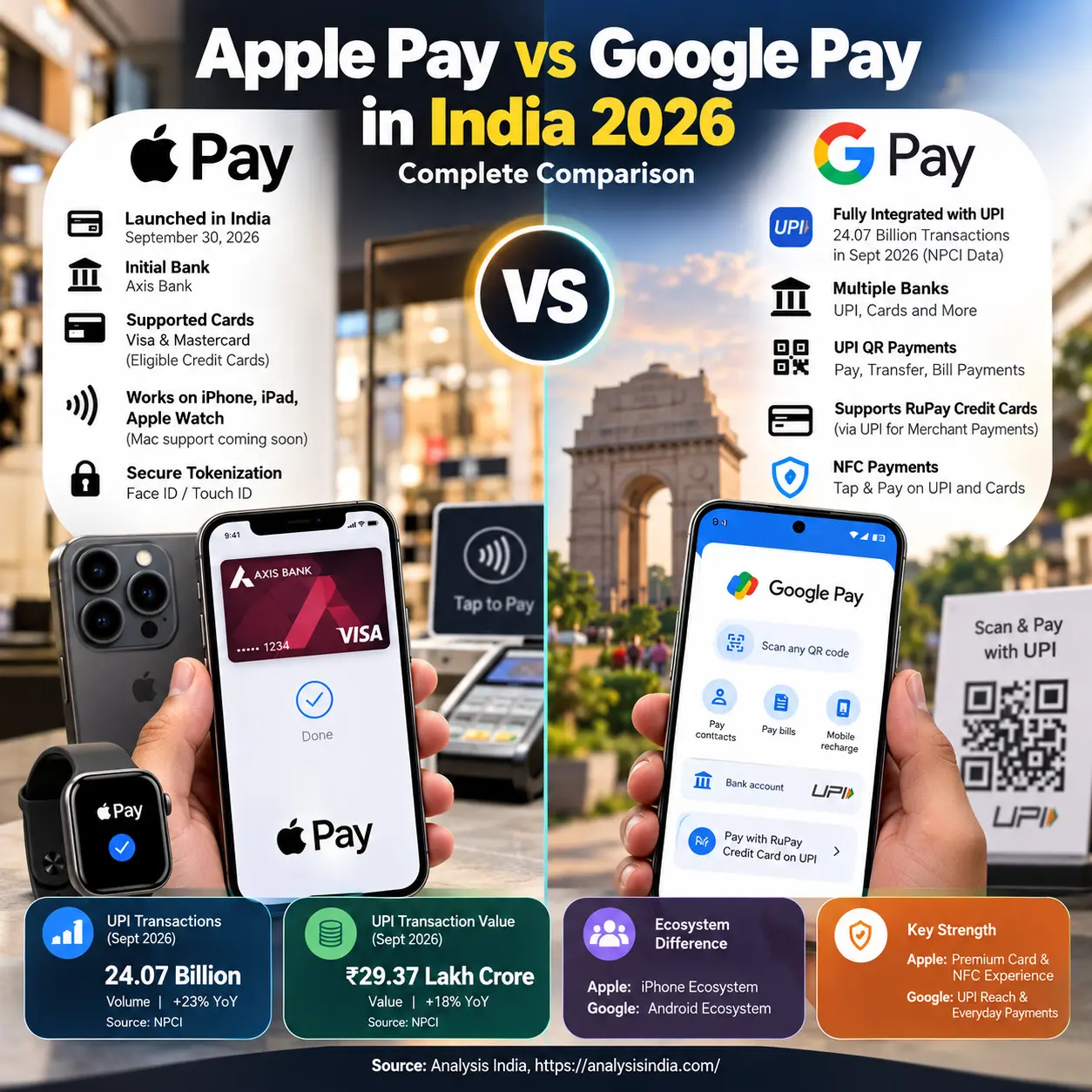
The Apple Pay vs Google Pay in India 2026 comparison has changed significantly since the beginning of the year. Apple Pay is no longer a potential future service in India. Apple officially launched Apple Pay in India on September 30, 2026, initially allowing eligible Axis Bank Visa and Mastercard credit card customers to use Apple Pay across iPhone, iPad and Apple Watch. Mac support is expected to follow. Apple has also announced acceptance across thousands of in-store and online merchants and anywhere compatible NFC transactions are accepted. Source: Apple, September 30, 2026.
Google Pay, meanwhile, remains deeply connected to India’s UPI ecosystem. The latest National Payments Corporation of India data shows that UPI processed 24.07 billion transactions worth ₹29.37 lakh crore in September 2026. Transaction volume increased by about 23% year over year, while transaction value increased by 18%. This scale makes Google Pay’s UPI position one of the most important factors in the Apple Pay vs Google Pay in India 2026 debate.
However, the comparison is not simply about which payment app has more users. Apple Pay and Google Pay currently operate through different payment models. Apple Pay’s India launch is primarily focused on card-based payments, tokenized transactions and contactless NFC payments. Google Pay combines UPI bank-account payments with card payments, QR transactions and other financial services.
That distinction is important for consumers, banks, card networks and merchants. The Apple Pay vs Google Pay in India 2026 competition is therefore developing across two overlapping but different payment ecosystems.
Readers looking at the broader payment ecosystem can also explore our analysis of Apple Pay India digital payments in 2026, which examines how Apple’s entry could influence India’s wider digital payment landscape.
Apple Pay vs Google Pay in India 2026: What Has Changed?
The biggest change is Apple’s actual entry into the Indian market.
Before September 2026, discussions about Apple Pay in India largely focused on whether Apple would launch the service and whether UPI integration would be required. That uncertainty has now ended. Apple Pay is available in India, but the initial product is narrower than the full UPI experience offered by Google Pay.
According to Apple, customers with eligible Axis Bank-issued Visa and Mastercard credit cards can add their cards to Apple Wallet. They can then use Apple Pay in stores, in apps and on websites where the payment option is supported. Apple also says the service works at NFC-enabled contactless terminals.
Axis Bank became the first Indian bank to offer Apple Pay to its credit card customers. According to Axis Bank, eligible Mastercard and Visa credit cardholders can add their cards through the Axis Bank mobile banking application or directly through Apple Wallet.
This changes the search intent behind Apple Pay vs Google Pay in India 2026. Users are no longer asking only whether Apple Pay will come to India. They increasingly want to know which service is better, which cards are supported, whether Apple Pay supports UPI, and whether Google Pay still has an advantage.
Apple Pay vs Google Pay in India 2026: Quick Comparison
| Feature | Apple Pay India 2026 | Google Pay India 2026 |
|---|---|---|
| India status | Launched September 30, 2026 | Established UPI platform |
| Main payment model | Card-based digital wallet | UPI, cards and other payment services |
| UPI bank-account payments | Not supported at initial launch | Supported |
| Initial Apple Pay bank | Axis Bank | Multiple banks through UPI and card infrastructure |
| Initial Apple Pay card networks | Visa and Mastercard | Visa, Mastercard and RuPay depending on payment mode |
| RuPay credit card through UPI | Not part of initial Apple Pay launch | Supported for eligible merchant payments |
| NFC payments | Yes | Yes |
| UPI QR payments | Not the core Apple Pay launch model | Yes |
| Peer-to-peer UPI | No | Yes |
| Primary ecosystem | Apple devices | Android ecosystem |
| Authentication | Face ID, Touch ID or passcode | UPI authentication, device security and supported biometrics |
| Card tokenization | Yes | Yes |
| Main advantage | Premium contactless card experience | UPI reach and everyday payment flexibility |
The table shows why a simple winner-takes-all conclusion would be misleading. The Apple Pay vs Google Pay in India 2026 comparison is increasingly about payment use cases rather than identical services.
UPI Gives Google Pay a Major Structural Advantage: Apple Pay vs Google Pay
UPI remains the strongest advantage for Google Pay in India.
According to NPCI data, UPI processed 24.07 billion transactions in September 2026, compared with 24.51 billion transactions in August. September’s monthly volume declined slightly because the month had fewer days, but year-over-year growth remained strong.
The September 2026 UPI value was ₹29.37 lakh crore. Average daily transaction volume was approximately 802 million transactions.
This matters because UPI is not simply another payment method in India. It has become a fundamental part of everyday payments, including person-to-person transfers, merchant QR payments, bill payments and bank-account transactions.
Google Pay is already positioned inside this infrastructure.
The Apple Pay vs Google Pay in India 2026 comparison therefore gives Google Pay a clear advantage when the user wants to transfer money from a bank account, pay another person or scan a conventional UPI QR code.
Apple Pay’s initial Indian product does not provide this same bank-account payment functionality.
The wider implications are discussed in our analysis of Apple Pay vs UPI in India 2026, where the differences between card-based payments, UPI accounts, QR payments and contactless transactions are examined in greater detail.
Google Pay’s Position in India’s UPI Market
Google Pay has built a substantial position in India’s UPI market over several years.
The latest available NPCI app-level data shows that Google Pay remains one of India’s largest UPI applications. Its established user base, merchant relationships and integration with Android devices give it a major advantage in everyday digital payments.
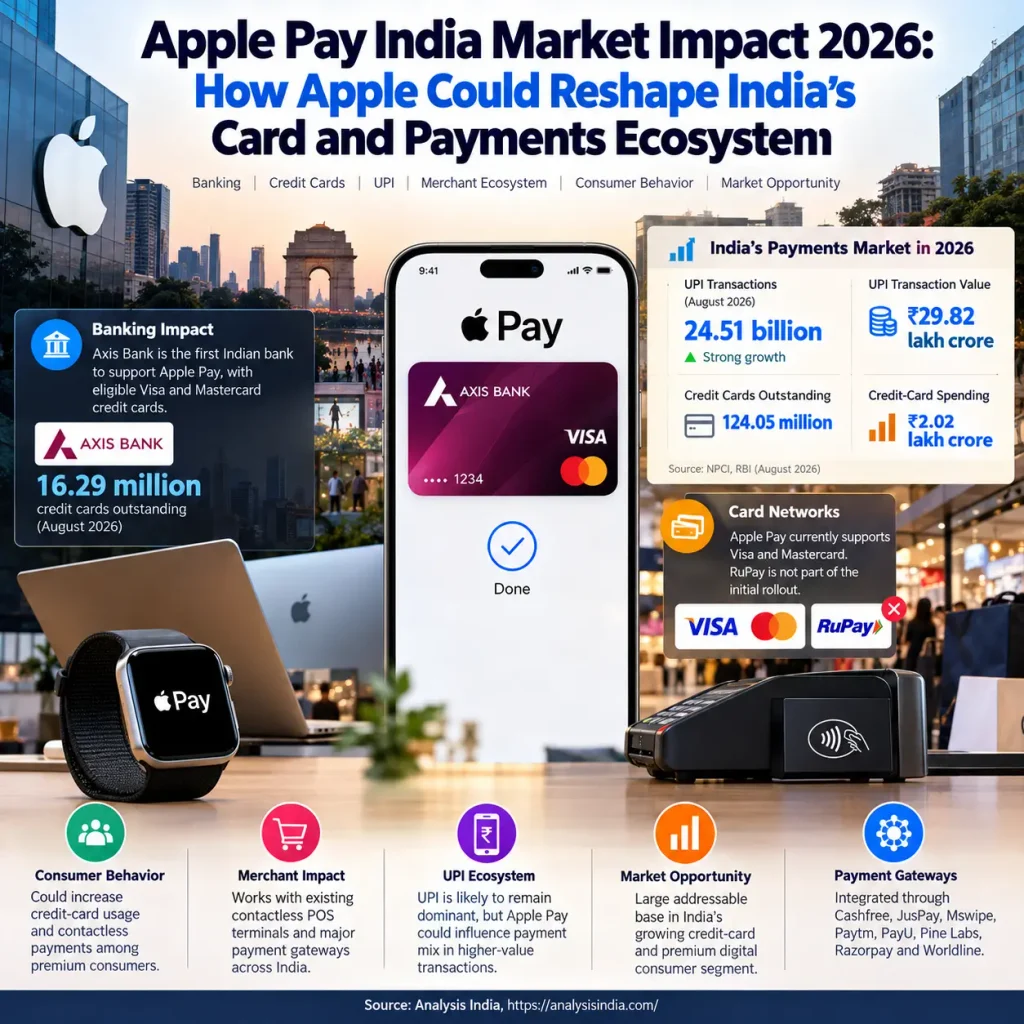
The wider UPI ecosystem is also continuing to expand. NPCI’s August 2026 data recorded 24.51 billion UPI transactions worth ₹29.82 lakh crore across 752 live banks.
The September figure remained above 24 billion transactions, demonstrating the scale at which India’s UPI infrastructure now operates. For a deeper assessment of banking, card issuers, payment networks and merchant economics, see our analysis of Apple Pay India market impact 2026.
For the Apple Pay vs Google Pay in India 2026 comparison, this means Apple is entering an ecosystem that already has extraordinary transaction depth.
Apple therefore does not need to immediately replace Google Pay to succeed. A more realistic opportunity is to capture a larger share of India’s premium card-payment and contactless-payment market.
Apple Pay’s Initial India Strategy Is Different
Apple has entered India through cards rather than through UPI.
This is strategically important.
Eligible Axis Bank Visa and Mastercard credit cards can be added to Apple Wallet. Once added, users can authenticate payments using Face ID, Touch ID or a device passcode.
Apple says actual card numbers are not stored on Apple’s servers or shared with merchants. Instead, a unique Device Account Number is used and securely stored in the device’s Secure Element.
This gives Apple Pay a payment architecture that is different from a conventional UPI application.
The strategy also allows Apple to use its global payment infrastructure while building its Indian merchant network.
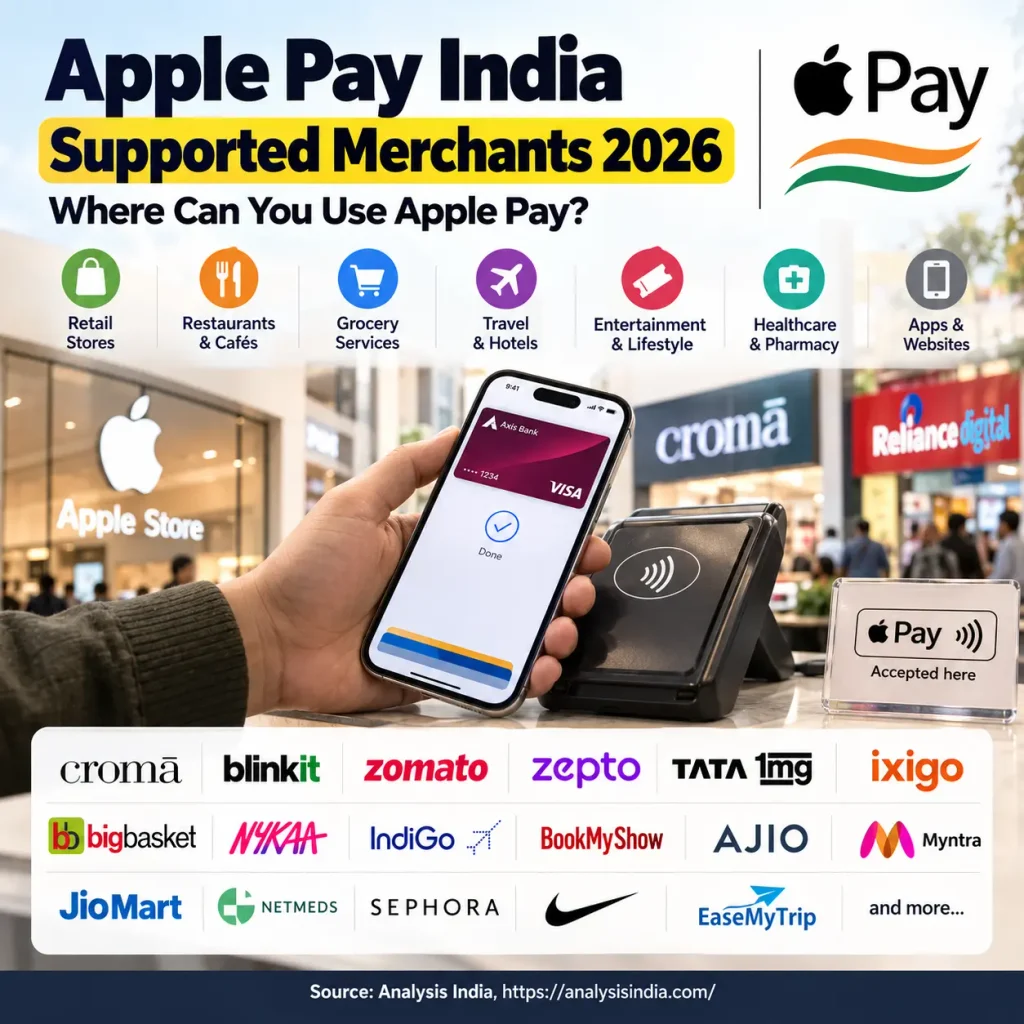
According to Apple, Apple Pay launched with acceptance across millions of merchants in India, including Apple Store locations, Blinkit, Chaayos, Croma, Ixigo, Reliance brands, Tata 1mg and Zomato. Apple also worked with payment service providers including BillDesk, Cashfree, Juspay, Mswipe, Paytm, PayU, Pine Labs and Razorpay.
This merchant infrastructure will be important to the future Apple Pay vs Google Pay in India 2026 competition.
Apple Pay vs Google Pay: UPI and QR Payments
UPI QR payments remain one of Google’s strongest advantages.
A consumer using Google Pay can link a bank account and scan a merchant’s UPI QR code. The same ecosystem can also be used for peer-to-peer payments.
Apple Pay’s initial Indian launch is different. Its core proposition is using an eligible payment card through Apple Wallet.
This means an iPhone owner may use Apple Pay for a contactless credit card purchase while continuing to use Google Pay or another UPI application for bank-account payments.
This dual-app scenario is important.
Apple Pay does not currently need to replace Google Pay for consumers to adopt it. It can become an additional payment method within an individual’s overall digital payment behavior.
That is one of the most important conclusions from the Apple Pay vs Google Pay in India 2026 analysis.
NFC Payments Narrow the Difference: Apple Pay vs Google Pay
NFC is one area where the comparison becomes more interesting.
Apple Pay is designed around contactless card payments. Users can authenticate on a compatible Apple device and hold the device near a contactless payment terminal.
Google Pay also supports NFC card payments on compatible Android devices. Google states that supported credit and debit cards can be used through Tap & Pay at compatible card terminals.
Google has also expanded NFC functionality through UPI Tap & Pay. Its current help documentation says NFC-enabled Android users can use Tap & Pay on UPI at compatible merchant NFC tags, QR codes with NFC capability and supported SoundPod devices.
This development is significant because it means Google Pay is not limited to QR-based payments.
In other words, the Apple Pay vs Google Pay in India 2026 comparison cannot simply be described as NFC versus UPI. Google Pay increasingly supports both contactless card payments and contactless UPI payments.
Google Pay Has an Important RuPay Advantage
RuPay is another major differentiator.
Google Pay supports eligible RuPay credit cards for merchant transactions through UPI. Google states that RuPay credit cards can be used for online merchant payments and QR-based merchant transactions, although they cannot be used for person-to-person transfers.
This gives Google Pay access to a payment combination that Apple Pay does not currently offer in India.
Apple’s initial India launch supports eligible Axis Bank Visa and Mastercard credit cards. Apple’s current supported-card page lists Axis Bank Visa and Mastercard credit cards and says the list will be updated as additional banks are added.
The absence of RuPay support at launch is therefore an important limitation when evaluating the Apple Pay vs Google Pay in India 2026 market opportunity.
Card Support: Apple Pay vs Google Pay
Card support is another area where the two platforms currently differ.
Apple Pay’s initial Indian availability is limited to eligible Axis Bank Visa and Mastercard credit cards.
Google Pay has a broader card ecosystem. Its current India documentation lists supported cards from several banks and supports eligible Mastercard and Visa cards for merchant payments. Google Pay also supports eligible RuPay credit cards through UPI.
This gives Google Pay greater card-network flexibility at the present stage.
Apple’s advantage is the tightly integrated Apple Wallet experience.
The future direction will depend heavily on whether Apple adds more Indian banks and card products. If major private and public sector banks are added, the addressable Apple Pay customer base could expand significantly.
For a practical breakdown of eligible banks, cards, devices and payment requirements, see our guide to Apple Pay India supported banks, cards and devices.
Apple Pay vs Google Pay: Security and Tokenization
Security is one of Apple’s strongest selling points.
Apple says that actual card numbers are not stored on the device or Apple’s servers and are not shared with merchants. Instead, Apple uses a unique Device Account Number stored securely in the Secure Element.
Mastercard has also stated that Apple Pay transactions using its network are protected by tokenization, with a unique cryptographically secured token replacing the underlying card information.
Google Pay also uses tokenization for supported card payments. Google’s documentation explains that a virtual account number, or token, can replace the actual card number when a card is added to Google Pay.
The two services therefore use sophisticated tokenization rather than simply exposing card details during every transaction.
The security comparison should consequently focus less on declaring one platform universally safer and more on how each payment rail handles authentication, tokenization, device security and fraud controls.
Biometric Authentication Is Becoming More Important
Authentication is also evolving in India’s digital payments market.
Apple Pay uses Face ID, Touch ID or the device passcode to authorize supported transactions.
Google Pay has also introduced biometric authentication for certain UPI payments. Google’s current documentation says eligible users can use fingerprint or face authentication for UPI transactions up to ₹5,000, subject to supported devices, accounts and payment methods.
This development makes the Apple Pay vs Google Pay in India 2026 security comparison more competitive than it was in earlier versions of this article.
Both ecosystems are moving toward lower-friction authentication while maintaining additional security requirements for higher-value transactions.
Device Ecosystem Is a Major Competitive Factor
The device ecosystem creates a fundamental difference between Apple Pay and Google Pay.
Apple Pay is designed for Apple hardware. At launch, Apple supports iPhone, iPad and Apple Watch, with Mac support coming soon.
Apple states that Apple Pay requires iPhone XR or later with iOS 18 or later, while compatible Apple Watch models require watchOS 11 or later.
Google Pay is primarily built around Android devices.
This gives Google Pay a much larger potential smartphone base in India, while Apple can focus on the premium segment of smartphone users.
The competitive question is therefore not simply how many smartphones each company supports. It is whether Apple can convert its premium hardware base into higher-value digital payment activity.
That is where the Apple Pay vs Google Pay in India 2026 story becomes more relevant for India’s credit card market.
Merchant Acceptance Could Determine Apple’s Growth
Merchant acceptance will be critical to Apple’s long-term position.
Apple says its India launch includes millions of merchants and online businesses. The company has worked with several payment service providers to enable Apple Pay across their merchant networks.
This is a strong initial foundation.
However, Google Pay benefits from India’s enormous UPI QR network.
A small merchant can accept UPI without necessarily having a traditional card terminal. This is one of the structural reasons Google Pay and other UPI applications have achieved mass adoption.
Apple Pay generally requires compatible card acceptance, NFC infrastructure or an enabled online checkout.
Therefore, the Apple Pay vs Google Pay in India 2026 competition will probably remain different across merchant segments.
Google Pay should remain stronger among small merchants and QR-led transactions. Apple Pay could become more important in organized retail, restaurants, travel, hotels, premium stores, e-commerce and other card-heavy categories.
Apple Pay vs Google Pay for Online Payments
Online payments present another interesting area.
Apple Pay allows supported users to select Apple Pay during compatible app and website checkouts. Apple says users can authenticate without repeatedly entering billing, shipping and card information.
Google Pay also supports online payments through supported merchants and apps.
The difference is again linked to the underlying payment method.
Apple Pay primarily provides a streamlined card checkout experience.
Google Pay can provide UPI-based payment flows alongside supported card payments.
For Indian consumers who prefer bank-account payments, Google Pay therefore retains a structural advantage. For consumers who prefer credit cards and the Apple ecosystem, Apple Pay can reduce checkout friction.
Apple Pay vs Google Pay: Fees and Payment Economics
Consumers should distinguish between platform fees and charges associated with banks, cards, merchants or specific payment services.
Apple does not charge consumers a separate Apple Pay fee simply for using Apple Pay to make purchases. Existing card terms, interest charges and other issuer conditions continue to apply.
Google Pay also generally does not charge users simply for making ordinary UPI payments. However, specific services can have their own charges or convenience fees.
The larger issue is merchant economics.
India’s payment market is evolving as regulators and payment networks examine the economics of large-value merchant transactions and payment infrastructure.
For Apple Pay, card economics are particularly important because its initial Indian proposition is card-based.
For Google Pay, UPI economics remain central to the platform’s long-term merchant strategy.
Apple Pay vs Google Pay for iPhone Users
For an iPhone user with an eligible Axis Bank credit card, Apple Pay offers a highly integrated experience.
The card can be stored in Apple Wallet and authenticated using Face ID, Touch ID or the device passcode. Users can make supported contactless payments without opening a separate payment application.
However, iPhone users still need a UPI application if they want to send money to friends, pay through standard UPI QR codes or transfer money directly from a bank account.
Therefore, an iPhone owner may ultimately use both Apple Pay and Google Pay.
This is an important reason why the Apple Pay vs Google Pay in India 2026 competition should not be viewed as an immediate replacement battle.
Apple Pay vs Google Pay for Android Users
For Android users, Google Pay remains the more relevant choice.
Apple Pay cannot replace Google Pay on Android because Apple’s wallet is part of the Apple device ecosystem.
Google Pay combines bank-account UPI payments, QR payments, card payments, NFC functionality and RuPay credit-card payments through UPI.
Google also supports UPI Tap & Pay on compatible NFC-enabled Android devices.
This creates a broader payment proposition for Android users.
Apple Pay vs Google Pay: Which Is Better for Merchants?
The answer depends on the merchant’s customer profile.
A merchant serving mass-market customers will continue to benefit significantly from UPI acceptance and Google Pay.
A premium retailer with a large iPhone customer base may benefit from Apple Pay because contactless card transactions can be completed quickly without requiring the consumer to enter card details or use a separate payment application.
The two platforms can therefore coexist.
A merchant does not necessarily need to choose Apple Pay over Google Pay. In a mature digital payment environment, supporting multiple payment methods can increase consumer choice and reduce checkout friction.
Apple Pay vs Google Pay and India’s Credit Card Market
Apple Pay could have a more important impact on India’s credit card ecosystem than on UPI.
The reason is simple. Apple Pay’s initial Indian proposition is based on credit cards.
If iPhone users begin using eligible credit cards more frequently because Apple Pay makes contactless and online payments easier, card transaction frequency could increase.
That could create opportunities for issuing banks, Visa, Mastercard, payment processors, acquiring banks and merchants.
Axis Bank has already positioned its Apple Pay partnership as an extension of its credit card and digital payments strategy.
Future bank additions will determine whether this remains a relatively narrow partnership or develops into a broader Indian card-wallet ecosystem.
Apple Pay vs Google Pay: Future Outlook
The next stage of the Apple Pay vs Google Pay in India 2026 competition will depend on expansion rather than the initial launch alone.
Apple’s current supported-card list includes Axis Bank Visa and Mastercard credit cards. Apple says the list will be updated as additional banks are added.
The addition of major Indian banks would significantly change Apple’s market reach.
UPI support would represent an even larger strategic development, but it should not be treated as confirmed unless Apple or the relevant Indian payment authorities officially announce it.
Google Pay, meanwhile, is likely to continue expanding its UPI, NFC, card and financial-service capabilities.
Its UPI Tap & Pay functionality demonstrates that Google is already moving toward more contactless payment experiences rather than relying only on QR codes.
This means the future Apple Pay vs Google Pay in India 2026 competition may increasingly involve contactless payments on both ecosystems.
Apple Pay vs Google Pay in India 2026: Strategic Verdict
The strongest conclusion from the Apple Pay vs Google Pay in India 2026 comparison is that neither platform currently dominates every payment use case.
Google Pay has the stronger mass-market proposition because it is deeply integrated with UPI. UPI processed 24.07 billion transactions in September 2026, demonstrating the enormous scale of the infrastructure in which Google Pay operates.
Apple Pay has entered India through a different route. Its initial focus is eligible Axis Bank Visa and Mastercard credit cards, contactless NFC transactions and integrated Apple-device payments.
For bank-account transfers, peer-to-peer payments, QR transactions and everyday UPI payments, Google Pay remains the stronger option.
For eligible Apple users who want contactless credit-card payments and an integrated wallet experience, Apple Pay offers a compelling alternative.
The Apple Pay vs Google Pay in India 2026 competition is therefore less about one platform eliminating the other and more about two payment ecosystems competing for different parts of the consumer wallet.
Google Pay’s biggest strength is India’s UPI infrastructure.
Apple Pay’s biggest opportunity is India’s growing premium smartphone and credit-card ecosystem.
The next major development to watch is Apple’s expansion beyond Axis Bank. Additional banks, more card networks and potential future UPI integration could materially change Apple’s competitive position.
For now, Google Pay leads in India’s UPI-led everyday payment ecosystem, while Apple Pay is establishing a new position in India’s card-based and contactless payment market.
Frequently Asked Questions
Is Apple Pay available in India in 2026?
Yes. Apple officially launched Apple Pay in India on September 30, 2026. The initial launch supports eligible Axis Bank Visa and Mastercard credit cards on iPhone, iPad and Apple Watch, with Mac support coming soon.
Does Apple Pay support UPI in India?
Apple Pay’s initial India launch does not include UPI bank-account payments. Its current Indian offering is focused on eligible payment cards and contactless or online transactions.
Which is better, Apple Pay or Google Pay in India?
Google Pay is currently better for UPI payments, QR payments, bank-account transfers and peer-to-peer transactions. Apple Pay is better suited to eligible Apple users who want integrated credit-card and contactless payments.
Can Apple Pay replace Google Pay in India?
Not currently. The two services have different payment architectures. Apple Pay’s initial Indian offering is card-focused, while Google Pay is deeply integrated with UPI.
Which banks support Apple Pay in India?
At the time of this October 7, 2026 update, Apple lists eligible Axis Bank Visa and Mastercard credit cards as supported. Apple says the supported-bank list will be updated as additional banks are added.
Does Apple Pay support RuPay cards?
RuPay is not part of Apple Pay’s initial India card rollout. Google Pay, by contrast, supports eligible RuPay credit cards for merchant payments through UPI.
Can Google Pay use credit cards in India?
Yes. Google Pay supports eligible credit and debit cards for merchant payments. It also supports eligible RuPay credit cards through UPI for merchant transactions.
Does Google Pay support NFC payments?
Yes. Google Pay supports NFC-based card payments on compatible Android devices and also offers UPI Tap & Pay on supported NFC-enabled Android devices.
Is Apple Pay safer than Google Pay?
Both platforms use tokenization, authentication and device-level security. Apple Pay uses a Device Account Number and Secure Element, while Google Pay uses tokenization for supported card transactions and the security framework of UPI for UPI payments.
Will Apple Pay support UPI in India?
Apple has not announced UPI support as part of its initial Indian launch. Future UPI support should therefore be treated as a possibility rather than a confirmed feature until Apple or Indian payment authorities make an official announcement.
Data Sources and Methodology
This comparison uses the latest information available as of October 7, 2026. Apple and Axis Bank are the primary sources for Apple Pay’s India launch, supported cards, devices, tokenization and initial merchant ecosystem.
NPCI is the primary source for India’s UPI infrastructure and monthly transaction statistics. The latest September 2026 figures show 24.07 billion UPI transactions worth ₹29.37 lakh crore.
Google’s official India support documentation is used for current information about Google Pay’s supported cards, NFC payments, UPI Tap & Pay, RuPay credit cards and biometric authentication.
Because payment services and supported banks can change quickly, readers should verify card eligibility with their bank and check the latest official Apple Pay and Google Pay documentation before making decisions.