📅 Published: February 23, 2026
🔄 Last Updated: July 27, 2026
Quick Summary
The Global Mammography X ray System Market is becoming increasingly important as healthcare systems worldwide strengthen breast cancer screening programmes and invest in advanced diagnostic imaging technologies. Mammography remains the primary imaging method for detecting breast cancer at an early stage, helping clinicians identify abnormalities before symptoms become clinically significant. Growing awareness of preventive healthcare, rising breast cancer incidence, expanding government screening initiatives, and continuous improvements in digital imaging technologies are supporting long-term market growth.
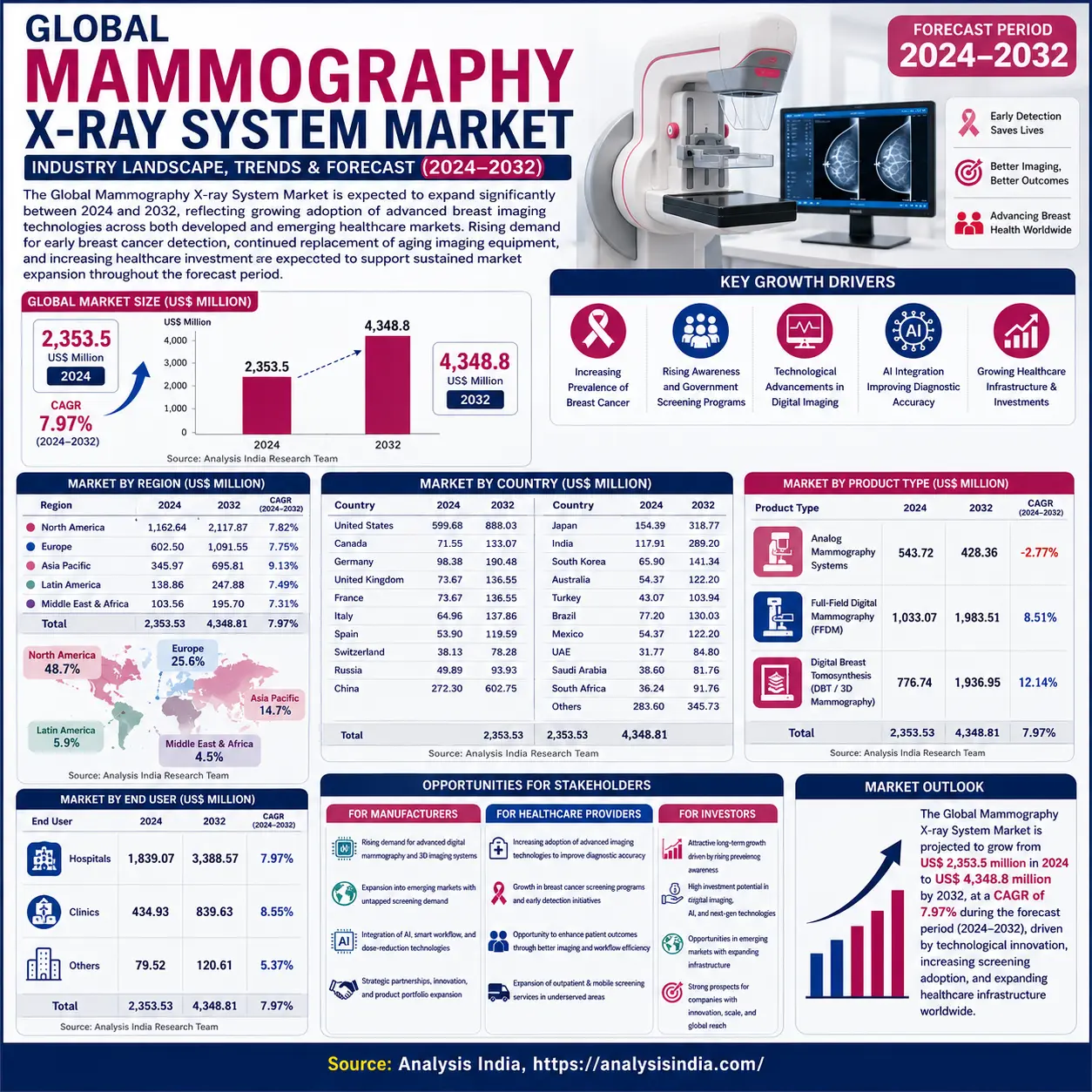
According to the Analysis India Research Team, the Global Mammography X ray System Market is projected to increase from US$ 2,353.53 million in 2024 to US$ 4,348.81 million by 2032. The market is undergoing a technology-driven transformation as healthcare providers replace conventional analog systems with Full-Field Digital Mammography (FFDM) and Digital Breast Tomosynthesis (DBT). These advanced imaging platforms improve image quality, diagnostic confidence, workflow efficiency, and patient experience, making them the preferred choice for new installations and equipment replacement projects.
North America currently leads the global market because of its well-established healthcare infrastructure, organised breast cancer screening programmes, and strong adoption of digital imaging technologies. Europe continues to benefit from government-supported screening initiatives, while Asia Pacific is expected to witness the fastest expansion during the forecast period as healthcare expenditure rises and access to diagnostic services improves across developing economies.
Hospitals account for the largest share of market demand owing to their comprehensive imaging capabilities and continuous investment in advanced diagnostic equipment. At the same time, specialised diagnostic centres and outpatient clinics are expanding breast imaging services to improve accessibility and reduce diagnostic delays. Looking ahead, artificial intelligence-assisted image analysis, mobile mammography systems, and broader access to preventive healthcare are expected to create new opportunities for manufacturers, healthcare providers, and investors operating in the Global Mammography X ray System Market.
Mammography represents one of the most specialised applications within the broader diagnostic X-ray industry. Advances in detector technology, digital imaging, artificial intelligence, and workflow optimisation are influencing both general radiography and breast imaging systems. Readers seeking a wider perspective on the diagnostic imaging industry can explore our comprehensive Global X-Ray System Market analysis.
Key Highlights
| Parameter | Details |
|---|---|
| Market Name | Global Mammography X ray System Market |
| Base Year | 2024 |
| Forecast Year | 2032 |
| Market Size (2024) | US$ 2,353.53 Million |
| Market Size (2032) | US$ 4,348.81 Million |
| Largest Region | North America |
| Fastest Growing Region | Asia Pacific |
| Leading Product Segment | Full-Field Digital Mammography (FFDM) |
| Fastest Growing Product Segment | Digital Breast Tomosynthesis (DBT) |
| Largest End User | Hospitals |
| Key Growth Drivers | Expansion of breast cancer screening programmes, digital imaging adoption, healthcare infrastructure development, technological innovation |
| Emerging Opportunities | AI-assisted imaging, mobile mammography, emerging healthcare markets, advanced breast imaging solutions |
Executive Summary
The Global Mammography X ray System Market is experiencing sustained growth as healthcare providers place greater emphasis on early diagnosis, preventive screening, and precision imaging. Breast cancer remains one of the leading causes of cancer-related illness among women worldwide, making timely detection a public health priority. Governments, hospitals, and private healthcare organisations are increasing investments in breast imaging infrastructure to improve screening coverage, enhance diagnostic accuracy, and reduce the long-term burden of cancer treatment. These initiatives are creating favourable conditions for continued market expansion.
Technology is reshaping the competitive landscape of the market. Healthcare providers are steadily replacing aging analog mammography systems with Full-Field Digital Mammography (FFDM) and Digital Breast Tomosynthesis (DBT), which offer higher image quality, faster examinations, and improved detection of breast abnormalities. At the same time, manufacturers are integrating artificial intelligence and advanced image processing tools to support radiologists in clinical decision-making and improve workflow efficiency. This shift towards intelligent imaging solutions is becoming a major competitive differentiator across the industry.
Regional demand patterns also reflect differences in healthcare infrastructure and screening policies. North America continues to lead the market through well-established screening programmes and high technology adoption, while Europe maintains stable growth supported by organised public healthcare systems. Asia Pacific is emerging as the most dynamic regional market due to expanding healthcare investment, increasing awareness of early breast cancer detection, and rapid modernisation of diagnostic facilities. These regional differences are encouraging manufacturers to adopt tailored market strategies that balance innovation, affordability, and service support.
Overall, the Global Mammography X ray System Market is expected to remain on a positive growth trajectory through 2032. Continued investment in digital healthcare infrastructure, technological innovation, and expanding access to breast cancer screening will create opportunities for equipment manufacturers, healthcare providers, and investors. Organisations that combine advanced imaging technologies with strong clinical support, local service capabilities, and cost-effective solutions are likely to strengthen their competitive position in the years ahead.
Market Data & Forecast
The Global Mammography X ray System Market is projected to demonstrate steady long-term growth through 2032, supported by increasing investments in breast cancer screening programmes, continuous advancements in digital imaging technologies, and expanding access to diagnostic healthcare services. The market data indicates not only overall revenue growth but also a significant transition toward digital mammography systems, broader regional adoption, and increasing demand from hospitals and specialised diagnostic facilities. These trends highlight the industry’s shift from equipment replacement to technology-driven expansion, creating new opportunities for manufacturers, healthcare providers, and investors.
Global Mammography X ray System Market Size (2024–2032)
| Year | Market Size (US$ Million) |
|---|---|
| 2024 | 2,353.53 |
| 2032 | 4,348.81 |
Source: Analysis India Research Team
The Global Mammography X ray System Market is expected to expand significantly between 2024 and 2032, reflecting growing adoption of advanced breast imaging technologies across both developed and emerging healthcare markets. Rising demand for early breast cancer detection, continued replacement of aging imaging equipment, and increasing healthcare investment are expected to support sustained market expansion throughout the forecast period.
Global Mammography X ray System Market by Region (2024–2032)
| Region | 2024 (US$ Million) | 2032 (US$ Million) |
|---|---|---|
| North America | 1,162.64 | 2,117.87 |
| Europe | 602.50 | 1,091.55 |
| Asia Pacific | 345.97 | 695.81 |
| Latin America | 138.86 | 247.88 |
| Middle East & Africa | 103.56 | 195.70 |
| Total | 2,353.53 | 4,348.81 |
Source: Analysis India Research Team
North America remains the largest regional market, accounting for nearly half of the global revenue in 2024, driven by advanced healthcare infrastructure, organised breast cancer screening programmes, and rapid adoption of digital mammography technologies. Europe continues to represent a mature market supported by national screening initiatives, while Asia Pacific is expected to register the strongest long-term growth as healthcare infrastructure expands, screening awareness improves, and governments increase investment in diagnostic imaging services.
Global Mammography X ray System Market by Country (2024–2032)
| Country | 2024 (US$ Million) | 2032 (US$ Million) |
|---|---|---|
| United States | 599.68 | 888.03 |
| Canada | 71.55 | 133.07 |
| Germany | 98.38 | 190.48 |
| United Kingdom | 73.67 | 136.55 |
| France | 73.67 | 136.55 |
| Italy | 64.96 | 137.86 |
| Spain | 53.90 | 119.59 |
| Switzerland | 38.13 | 78.28 |
| Russia | 49.89 | 93.93 |
| China | 272.30 | 602.75 |
| Japan | 154.39 | 318.77 |
| India | 117.91 | 289.20 |
| South Korea | 65.90 | 141.34 |
| Australia | 54.37 | 122.20 |
| Turkey | 43.07 | 103.94 |
| Brazil | 77.20 | 130.03 |
| Mexico | 54.37 | 122.20 |
| UAE | 31.77 | 84.80 |
| Saudi Arabia | 38.60 | 81.76 |
| South Africa | 36.24 | 91.76 |
| Others | 283.60 | 345.73 |
| Total | 2,353.53 | 4,348.81 |
Source: Analysis India Research Team
The United States continues to represent the largest national market due to its extensive screening programmes, high diagnostic imaging capacity, and strong investment in advanced healthcare technologies. China and India are projected to experience the fastest expansion among major economies, supported by increasing healthcare expenditure, growing awareness of preventive screening, and expanding diagnostic infrastructure. European countries continue to maintain stable demand, while several emerging markets are expected to create new growth opportunities as breast cancer screening services become more widely available.
Global Mammography X ray System Market by Product Type (2024–2032)
| Product Type | 2024 (US$ Million) | 2032 (US$ Million) |
|---|---|---|
| Analog Mammography Systems | 543.72 | 428.36 |
| Full-Field Digital Mammography (FFDM) | 1,033.07 | 1,983.51 |
| Digital Breast Tomosynthesis (DBT / 3D Mammography) | 776.74 | 1,936.95 |
Source: Analysis India Research Team
The product mix demonstrates a clear industry transition from conventional analog mammography systems toward advanced digital imaging technologies. Full-Field Digital Mammography (FFDM) remains the leading product category because of its widespread clinical adoption and established diagnostic performance. Digital Breast Tomosynthesis (DBT) is expected to experience the fastest growth during the forecast period as healthcare providers increasingly adopt three-dimensional breast imaging to improve cancer detection accuracy, particularly in patients with dense breast tissue.
Global Mammography X ray System Market by End User (2024–2032)
| End User | 2024 (US$ Million) | 2032 (US$ Million) |
|---|---|---|
| Hospitals | 1,839.07 | 3,388.57 |
| Clinics | 434.93 | 839.63 |
| Others | 79.52 | 120.61 |
Source: Analysis India Research Team
Hospitals account for the largest share of the Global Mammography X ray System Market because they operate comprehensive diagnostic imaging departments, perform high patient volumes, and invest regularly in advanced imaging technologies. Clinics are expected to record steady growth as outpatient breast screening services expand, while specialised healthcare facilities and research institutions continue to contribute to market development through targeted diagnostic and clinical research activities.
Analysis India Perspective
The market data suggests that the Global Mammography X ray System Market is entering a replacement-driven and innovation-led growth phase rather than relying solely on new equipment installations. While mature markets in North America and Europe continue upgrading existing breast imaging infrastructure, the next wave of expansion is increasingly expected to come from Asia Pacific, Latin America, and selected Middle Eastern countries where healthcare investment and organised cancer screening programmes are gaining momentum. This shift indicates that future competition will depend not only on technological leadership but also on a manufacturer’s ability to address the diverse requirements of both developed and emerging healthcare systems.
One of the most notable trends is the accelerating transition from analog mammography to digital imaging platforms. The decline in analog systems, alongside the rapid growth of Full-Field Digital Mammography (FFDM) and Digital Breast Tomosynthesis (DBT), reflects changing clinical expectations for higher diagnostic accuracy, improved workflow efficiency, and enhanced patient care. Healthcare providers are increasingly evaluating imaging solutions based on long-term clinical value, interoperability with hospital information systems, ease of software upgrades, and service support rather than equipment cost alone.
For investors and business decision-makers, the market presents opportunities beyond hardware sales. Recurring revenue from software upgrades, artificial intelligence-enabled diagnostic tools, maintenance services, training programmes, and digital workflow solutions is expected to become an increasingly important source of competitive advantage. Manufacturers that combine innovative imaging technologies with strong after-sales support, local service networks, and scalable digital platforms are likely to strengthen their market position over the forecast period.
From an Analysis India perspective, the next stage of market growth will be defined by how effectively manufacturers align technological innovation with healthcare accessibility. Companies that can deliver clinically advanced yet cost-effective mammography solutions for both high-income and emerging markets are expected to be better positioned to capture sustainable long-term growth as global demand for early breast cancer screening continues to expand.
Strategic Takeaways
- Manufacturers should prioritise digital mammography platforms, AI-enabled imaging software, and comprehensive service offerings as healthcare providers increasingly seek integrated diagnostic solutions rather than standalone equipment.
- Hospitals and diagnostic centres are expected to continue investing in advanced breast imaging technologies that improve diagnostic accuracy, patient throughput, and operational efficiency while supporting expanding breast cancer screening programmes.
- Investors may find the strongest long-term opportunities in companies with diversified product portfolios, recurring software and service revenues, and a growing presence in emerging healthcare markets where diagnostic infrastructure is rapidly developing.
- Policymakers and healthcare planners can accelerate early breast cancer detection by expanding organised screening programmes, improving access to digital imaging technologies, and strengthening diagnostic capacity in underserved regions.
- Technology providers that integrate artificial intelligence, cloud-enabled workflow management, cybersecurity, and data interoperability into mammography systems are likely to play an increasingly important role as healthcare organisations continue their digital transformation.
Introduction
The Global Mammography X ray System Market plays a vital role in the medical imaging industry by supporting the early detection, diagnosis, and management of breast cancer. Mammography systems use low-dose X-ray technology to generate detailed breast images, enabling healthcare professionals to identify suspicious abnormalities before clinical symptoms become apparent. Early diagnosis significantly improves treatment outcomes, making mammography one of the most widely adopted screening methods in modern healthcare. As governments and healthcare providers continue to strengthen cancer prevention programmes, demand for reliable and advanced breast imaging solutions continues to increase across both developed and emerging economies.
The industry has undergone significant transformation over the past decade as healthcare organisations modernise diagnostic infrastructure and adopt digital technologies. Conventional analog equipment is gradually being replaced by Full-Field Digital Mammography (FFDM) and Digital Breast Tomosynthesis (DBT), both of which offer improved image quality, faster examinations, and greater diagnostic confidence. At the same time, innovations such as artificial intelligence-assisted image interpretation, computer-aided detection, cloud-based image management, and workflow automation are improving clinical efficiency while helping radiologists deliver more accurate diagnoses.
Market expansion is also being supported by demographic and healthcare trends. Rising breast cancer incidence, ageing populations, increasing awareness of preventive healthcare, and expanding access to organised screening programmes are encouraging healthcare providers to invest in modern breast imaging equipment. Public health initiatives, favourable reimbursement policies in several countries, and growing healthcare expenditure are further accelerating the replacement of ageing imaging systems with advanced digital platforms. These developments are creating opportunities for manufacturers, software providers, healthcare institutions, and service companies throughout the breast imaging ecosystem.
The Global Mammography X ray System Market includes equipment manufacturers, component suppliers, software developers, healthcare providers, diagnostic centres, research institutions, and regulatory organisations that collectively contribute to improving breast cancer diagnosis and patient care. This report provides a comprehensive analysis of market trends, industry dynamics, technological advancements, product segmentation, regional performance, competitive developments, and future growth opportunities. The objective is to deliver reliable, data-driven insights that support industry professionals, business decision makers, investors, healthcare executives, researchers, and general readers seeking a clear understanding of this evolving market.
The mammography industry forms an important segment of the global medical device ecosystem, alongside diagnostic imaging, surgical equipment, patient monitoring, and other healthcare technologies. Long-term growth in breast imaging is closely linked to broader trends such as healthcare digitalisation, regulatory developments, and medical technology innovation. For a macro-level industry perspective, explore our Global Medical Device Market report.
Market Overview
The Global Mammography X ray System Market forms an integral part of the broader diagnostic imaging industry and supports healthcare systems in improving the early detection and diagnosis of breast cancer. Mammography has become the standard imaging modality for breast cancer screening because it enables clinicians to identify abnormalities at an early stage, often before physical symptoms appear. As healthcare providers increasingly focus on preventive medicine and value-based care, breast imaging has evolved from a specialised diagnostic service into a critical component of national cancer control strategies. This transition continues to strengthen demand for advanced mammography systems across hospitals, diagnostic centres, and specialised breast care facilities worldwide.
The market operates through a complex ecosystem involving equipment manufacturers, component suppliers, software developers, healthcare providers, distributors, regulatory agencies, and service organisations. Manufacturers invest heavily in research and development to improve imaging quality, reduce radiation exposure, enhance workflow efficiency, and expand system capabilities. Software companies complement these innovations by developing image management platforms, artificial intelligence applications, reporting solutions, and cybersecurity tools that improve clinical productivity and support digital healthcare integration. Healthcare providers evaluate new systems not only on imaging performance but also on reliability, interoperability, service support, regulatory compliance, and long-term operating costs.
The industry’s value chain begins with the design and manufacturing of imaging hardware, detectors, X-ray tubes, and supporting electronic components. These systems are integrated with specialised software before being distributed through direct sales teams, authorised distributors, and healthcare procurement partners. After installation, recurring revenue is generated through maintenance contracts, software upgrades, technical support, staff training, and equipment lifecycle management. As healthcare organisations increasingly seek long-term technology partners rather than one-time equipment suppliers, service quality and post-installation support have become important competitive differentiators within the market.
The market is also characterised by changing procurement priorities. Hospitals and diagnostic centres are increasingly adopting strategic purchasing models that consider total cost of ownership instead of initial acquisition costs alone. Decision makers evaluate factors such as equipment longevity, workflow efficiency, digital integration, upgrade flexibility, regulatory approvals, and vendor support before making investment decisions. This shift encourages manufacturers to offer comprehensive solutions that combine advanced imaging systems with software, training, maintenance, and clinical support services.
Competitive intensity within the Global Mammography X ray System Market continues to increase as manufacturers differentiate themselves through innovation, product performance, digital capabilities, and customer service. Established global companies compete alongside regional manufacturers that offer cost-effective solutions tailored to local healthcare requirements. At the same time, healthcare systems in emerging economies are investing in diagnostic infrastructure to improve access to breast cancer screening, creating additional opportunities for companies capable of balancing affordability with advanced clinical performance. These structural changes indicate that future market success will increasingly depend on innovation, service excellence, regulatory compliance, and the ability to meet diverse healthcare needs across global markets.
Medical imaging systems must comply with stringent regulatory requirements to ensure safety, performance, and clinical effectiveness. Regulatory agencies continue to evaluate innovations in digital mammography, artificial intelligence, and breast imaging technologies before they are introduced into clinical practice. Additional information regarding mammography regulations and device approvals is available through the U.S. Food and Drug Administration (FDA).
Market Dynamics
The Global Mammography X ray System Market is evolving in response to changing healthcare priorities, technological progress, and increasing investment in early disease detection. While breast cancer screening programmes remain the primary source of demand, the market is also influenced by healthcare infrastructure development, regulatory policies, reimbursement frameworks, and procurement strategies adopted by healthcare providers. Understanding these factors helps manufacturers, investors, healthcare executives, and policymakers identify both current opportunities and future challenges.
Market Driver: Expanding Breast Cancer Screening Programmes and Early Diagnosis Initiatives
The increasing emphasis on early breast cancer detection continues to be the most significant driver of the Global Mammography X ray System Market. Governments, public health agencies, and healthcare organisations are expanding organised screening programmes to improve early diagnosis and reduce breast cancer mortality. Routine mammography screening enables healthcare professionals to identify abnormalities at an early stage, improving treatment outcomes while reducing long-term healthcare costs.
Growing public awareness campaigns, stronger participation in preventive healthcare, and wider insurance coverage for screening services are encouraging more women to undergo regular mammography examinations. Hospitals and diagnostic centres are responding by expanding breast imaging capacity and upgrading diagnostic equipment to meet rising patient volumes. In addition, many healthcare systems are replacing ageing analog equipment with digital platforms capable of delivering faster examinations and higher-quality images. These developments continue to generate stable demand for new mammography systems across mature and developing healthcare markets.
Market Restraint: High Capital Investment and Unequal Healthcare Infrastructure
Despite favourable long-term growth prospects, high equipment acquisition costs remain a significant challenge for many healthcare providers. Advanced digital mammography systems require considerable investment not only for equipment purchase but also for installation, software integration, staff training, maintenance, and long-term technical support. Smaller hospitals, independent diagnostic centres, and healthcare facilities in low- and middle-income countries often face budget constraints that delay technology upgrades.
Infrastructure limitations further affect market expansion. Reliable electricity supply, digital storage capacity, secure network connectivity, and trained radiology professionals are essential for operating modern mammography systems efficiently. In several emerging economies, shortages of qualified personnel and uneven access to specialised healthcare services continue to restrict screening coverage. These factors create differences in technology adoption between developed healthcare markets and regions where diagnostic infrastructure is still developing.
Market Opportunity: Digital Transformation and Artificial Intelligence Integration
Digital transformation is creating substantial long-term opportunities across the Global Mammography X ray System Market. Healthcare providers increasingly seek imaging solutions that improve diagnostic accuracy while supporting efficient clinical workflows. This demand is encouraging manufacturers to integrate artificial intelligence, computer-aided detection, cloud-based image management, workflow automation, and advanced reporting capabilities into next-generation mammography platforms.
Beyond equipment sales, software subscriptions, remote diagnostics, cybersecurity solutions, predictive maintenance, and digital service contracts are becoming important sources of recurring revenue. As healthcare organisations continue adopting connected imaging environments, manufacturers capable of delivering integrated hardware, software, and lifecycle support are expected to strengthen customer relationships and improve long-term profitability. Emerging economies also represent significant growth opportunities as governments continue investing in modern diagnostic infrastructure and expanding national screening programmes.
Market Challenge: Balancing Innovation, Affordability, and Regulatory Compliance
Manufacturers operating in the Global Mammography X ray System Market face the ongoing challenge of delivering innovative technologies while maintaining affordability and meeting increasingly stringent regulatory requirements. Healthcare providers expect improved image quality, lower radiation exposure, seamless interoperability, and software upgrade flexibility without substantial increases in overall ownership costs. Meeting these expectations requires continuous investment in research, product development, quality assurance, and post-market support.
At the same time, regulatory approval processes have become more comprehensive as authorities place greater emphasis on clinical evidence, product safety, cybersecurity, and quality management. Companies must also adapt to varying reimbursement policies, procurement regulations, and healthcare standards across different countries. These complexities can extend product development timelines and increase compliance costs, particularly for organisations expanding into multiple international markets. Success will increasingly depend on balancing technological innovation with operational efficiency, regulatory expertise, and strong customer support capabilities.
Product Type Analysis
The product landscape of the Global Mammography X ray System Market has evolved considerably as healthcare providers prioritise diagnostic accuracy, workflow efficiency, and long-term clinical value. The market has transitioned from conventional analog systems to advanced digital imaging platforms that offer superior image quality, faster examinations, and seamless integration with modern healthcare information systems. Today, purchasing decisions are increasingly influenced by clinical performance, upgrade flexibility, interoperability, service support, and total cost of ownership rather than equipment price alone. As healthcare organisations modernise diagnostic infrastructure, manufacturers are focusing on product innovation that addresses both mature healthcare markets seeking technology upgrades and emerging economies expanding breast cancer screening capacity.
Analog Mammography Systems
Analog mammography systems laid the foundation for organised breast cancer screening and continue to operate in selected healthcare facilities, particularly where budget limitations or infrastructure constraints delay technology upgrades. Although these systems remain functional for routine examinations, they offer limited image processing capabilities, require film handling, and provide less flexibility for digital image storage and remote consultation.
Healthcare providers are gradually phasing out analog equipment as digital alternatives become more affordable and clinically advantageous. Replacement demand is expected to continue throughout the forecast period as hospitals and diagnostic centres modernise imaging departments to improve efficiency, reduce operational costs, and support integrated digital healthcare environments. Consequently, the analog segment is expected to continue its gradual decline, primarily serving facilities where capital investment remains constrained.
Full-Field Digital Mammography (FFDM)
Full-Field Digital Mammography (FFDM) has become the established standard for breast imaging in many developed healthcare markets. Its widespread adoption is driven by high-resolution image acquisition, rapid examination times, digital image storage, and compatibility with Picture Archiving and Communication Systems (PACS) and Electronic Health Records (EHR). These capabilities allow radiologists to review, manipulate, and share images more efficiently, improving diagnostic confidence and workflow productivity.
Healthcare organisations also value FFDM for its scalability and long-term upgrade potential. Many modern platforms allow software enhancements and integration with artificial intelligence applications without requiring complete equipment replacement. This flexibility enables providers to extend system life while continuously improving diagnostic capabilities. As a result, FFDM is expected to remain a core product category for hospitals, breast imaging centres, and multispecialty diagnostic facilities worldwide.
Digital Breast Tomosynthesis (DBT)
Digital Breast Tomosynthesis (DBT), commonly referred to as three-dimensional mammography, represents one of the fastest-growing product categories within the Global Mammography X ray System Market. By acquiring multiple low-dose images from different angles, DBT generates a three-dimensional representation of breast tissue, reducing the impact of tissue overlap and improving lesion visibility. These clinical advantages support earlier detection of breast abnormalities and reduce the likelihood of unnecessary follow-up examinations.
Healthcare providers are increasingly incorporating DBT into routine breast imaging programmes, particularly for women with dense breast tissue or individuals requiring comprehensive diagnostic evaluation. Growing clinical acceptance, favourable guideline updates in several healthcare systems, and continuous technological improvements are encouraging broader adoption across hospitals and specialised breast care centres. Manufacturers are also expanding DBT availability beyond premium product lines, making advanced three-dimensional imaging accessible to a wider range of healthcare providers.
Market Outlook by Product Type
The future product landscape will continue to be shaped by digital transformation and value-based healthcare. Demand is expected to shift further towards intelligent imaging platforms that combine advanced hardware with artificial intelligence, cloud connectivity, workflow automation, and cybersecurity features. Manufacturers that develop flexible product portfolios capable of serving both high-end healthcare institutions and cost-sensitive emerging markets are likely to strengthen their competitive position. Rather than competing solely on imaging performance, future success will increasingly depend on delivering comprehensive diagnostic ecosystems that improve clinical outcomes, operational efficiency, and long-term return on investment for healthcare providers.
Application Analysis
The Global Mammography X ray System Market serves multiple clinical applications that extend beyond routine breast cancer screening. Although screening remains the largest application area, mammography systems are increasingly used for diagnostic evaluation, post-treatment monitoring, and clinical research. The growing emphasis on personalised healthcare, early disease detection, and evidence-based clinical decision-making is expanding the role of mammography throughout the patient care pathway. Healthcare providers are also integrating breast imaging into comprehensive women’s health programmes, enabling earlier diagnosis, improved treatment planning, and continuous patient follow-up.
Breast Cancer Screening
Breast cancer screening represents the largest application segment and continues to be the primary source of demand for mammography systems worldwide. National screening programmes, employer-sponsored health initiatives, and preventive healthcare campaigns encourage women to undergo routine mammography examinations before symptoms develop. Early detection improves treatment success rates, increases survival outcomes, and reduces the need for more complex and costly medical interventions.
Healthcare systems across developed economies have established structured screening programmes supported by reimbursement policies and clinical guidelines. At the same time, many emerging countries are expanding awareness campaigns and investing in screening infrastructure to improve access to early diagnosis. As participation rates continue to improve, demand for high-capacity and digitally integrated mammography systems is expected to remain strong across hospitals, diagnostic centres, and specialised breast imaging facilities.
Diagnostic Evaluation
Beyond routine screening, mammography plays an essential role in the diagnostic evaluation of patients presenting with breast symptoms or abnormal screening findings. When a suspicious lesion is identified, additional mammographic imaging helps clinicians determine the size, location, and characteristics of the abnormality before recommending further investigations such as ultrasound, magnetic resonance imaging (MRI), or biopsy.
Modern digital mammography systems provide higher image clarity and advanced visualisation tools that support more accurate diagnostic assessments. This enables radiologists to make informed clinical decisions while reducing unnecessary repeat examinations. As healthcare providers continue prioritising precision diagnostics, diagnostic mammography will remain an essential component of multidisciplinary breast care services.
Follow-up Monitoring and Treatment Management
Mammography is also widely used to monitor patients following breast cancer treatment or surgical intervention. Regular follow-up examinations help clinicians evaluate treatment response, identify disease recurrence at an early stage, and monitor changes in breast tissue over time. These examinations form an important part of long-term survivorship care and support evidence-based treatment planning.
Healthcare providers increasingly adopt structured follow-up protocols that combine mammography with other imaging modalities based on individual patient risk profiles. This comprehensive approach enables clinicians to deliver personalised care while improving long-term patient management and clinical outcomes.
Research and Clinical Development
Research institutions, academic medical centres, and specialised cancer hospitals continue to use mammography systems to support clinical studies, imaging research, and the evaluation of emerging diagnostic technologies. Researchers investigate new image analysis techniques, artificial intelligence algorithms, advanced detector technologies, and screening methodologies aimed at improving diagnostic accuracy and workflow efficiency.
Clinical research also contributes to the development of evidence-based screening guidelines and supports regulatory evaluation of new imaging technologies. As innovation accelerates, collaboration between manufacturers, healthcare organisations, and research institutions is expected to play an increasingly important role in advancing breast imaging capabilities and improving patient care worldwide.
Application Outlook
The future growth of the Global Mammography X ray System Market will be supported by expanding applications across the entire breast cancer care continuum rather than screening alone. Healthcare providers are increasingly adopting integrated diagnostic pathways that combine early detection, accurate diagnosis, treatment monitoring, and data-driven clinical decision-making. Manufacturers that develop versatile imaging platforms capable of supporting multiple clinical applications, seamless digital integration, and future software upgrades will be well positioned to address evolving healthcare requirements while creating long-term value for providers and patients.
End User Analysis
The Global Mammography X ray System Market serves a diverse range of healthcare providers, each with unique clinical requirements, patient volumes, and investment priorities. Purchasing decisions are influenced not only by imaging performance but also by workflow efficiency, interoperability, service support, and long-term operational costs. As breast cancer screening programmes continue to expand worldwide, hospitals, diagnostic centres, and specialised healthcare facilities are investing in modern mammography systems to improve patient access, enhance diagnostic quality, and support integrated cancer care. This evolving demand is encouraging manufacturers to develop scalable solutions that address the needs of different healthcare environments.
Hospitals
Hospitals represent the largest end-user segment because they provide comprehensive diagnostic, surgical, and oncology services under one healthcare ecosystem. Large hospitals manage high patient volumes and require mammography systems that deliver consistent image quality, rapid examination workflows, and seamless integration with hospital information systems. These institutions often operate multidisciplinary breast care programmes where radiologists, surgeons, pathologists, and oncologists collaborate to deliver coordinated patient care.
Investment decisions within hospitals increasingly focus on long-term clinical value rather than initial equipment costs. Procurement teams evaluate system reliability, upgrade capabilities, artificial intelligence compatibility, maintenance support, cybersecurity, and interoperability with existing digital infrastructure. Hospitals also prefer technology partners capable of providing continuous software updates, technical training, and lifecycle management services. As healthcare systems continue their digital transformation, hospitals are expected to remain the primary drivers of demand for advanced mammography solutions.
Diagnostic Centres and Clinics
Diagnostic centres and specialised clinics are becoming increasingly important contributors to market growth by expanding access to breast imaging services outside large hospital settings. These facilities often provide faster appointments, shorter waiting times, and convenient outpatient services, making them an attractive option for routine screening and diagnostic evaluations.
Unlike hospitals, diagnostic centres typically prioritise operational efficiency, patient throughput, and cost-effective technology investments. Purchasing decisions focus on systems that deliver reliable performance, simplified workflows, minimal maintenance requirements, and flexible software capabilities. The growing demand for preventive healthcare, combined with the expansion of private diagnostic networks, is encouraging clinics to invest in modern digital mammography platforms that can support increasing examination volumes while maintaining high diagnostic standards.
Research Institutions and Specialised Healthcare Facilities
Research organisations, academic medical centres, and specialised breast care institutes also contribute to the development of the mammography market. These institutions use advanced imaging systems for clinical research, technology validation, radiology education, and the evaluation of new diagnostic techniques. Their work supports the development of evidence-based screening guidelines, improves clinical protocols, and accelerates the adoption of innovative imaging technologies.
Specialised breast care centres increasingly adopt comprehensive diagnostic solutions that combine mammography with complementary imaging modalities and digital workflow platforms. These facilities often participate in clinical trials and collaborative research projects, helping manufacturers evaluate emerging technologies before broader commercial adoption.
Changing Procurement Priorities
Procurement strategies across all end-user segments are evolving in response to value-based healthcare and digital transformation. Healthcare organisations increasingly assess mammography systems based on total cost of ownership, service quality, software scalability, regulatory compliance, and future upgrade potential rather than focusing solely on acquisition costs. Vendors that offer integrated solutions—including imaging hardware, artificial intelligence applications, cloud connectivity, training, maintenance, and technical support—are better positioned to build long-term partnerships with healthcare providers.
This shift from product-focused purchasing to solution-based procurement is reshaping competition within the Global Mammography X ray System Market. Manufacturers capable of addressing the operational, clinical, and financial priorities of different end users are likely to strengthen customer retention while expanding their presence across both established and emerging healthcare markets.
Regional Analysis
Regional performance in the Global Mammography X ray System Market reflects differences in healthcare infrastructure, breast cancer screening policies, healthcare expenditure, regulatory environments, and technology adoption. While developed regions continue to drive revenue through equipment replacement and digital innovation, emerging economies are expanding market opportunities by investing in diagnostic infrastructure and improving access to women’s healthcare services. These regional variations require manufacturers to adopt market-specific strategies that balance technological innovation, affordability, regulatory compliance, and long-term service support.
North America
North America continues to represent the most mature regional market, supported by well-established healthcare infrastructure, organised breast cancer screening programmes, and widespread adoption of advanced diagnostic imaging technologies. Healthcare providers across the region have largely completed the transition from analog systems to digital mammography platforms and are increasingly investing in Digital Breast Tomosynthesis (DBT), artificial intelligence-assisted image analysis, and integrated digital imaging workflows.
The United States remains the primary contributor to regional demand because of its extensive hospital network, advanced diagnostic capabilities, favourable reimbursement environment, and continuous investment in healthcare technology. Canada also maintains a stable market supported by publicly funded healthcare services and provincial breast cancer screening initiatives.
Market competition in North America increasingly focuses on technology differentiation rather than basic equipment availability. Healthcare providers evaluate vendors based on clinical performance, interoperability, cybersecurity, software upgrade capabilities, lifecycle support, and operational efficiency. Consequently, manufacturers are expanding service offerings that include artificial intelligence applications, cloud-enabled workflow management, predictive maintenance, and long-term technical support.
Although the region is highly competitive, opportunities continue to emerge through replacement demand, software innovation, and integrated digital healthcare solutions. Companies capable of delivering intelligent imaging ecosystems rather than standalone equipment are expected to strengthen their competitive position within this mature healthcare market.
Europe
Europe represents one of the most established markets for mammography systems, supported by organised national screening programmes, strong public healthcare systems, and high awareness of preventive healthcare. Many European countries have implemented population-based breast cancer screening initiatives that encourage regular examinations, creating stable long-term demand for breast imaging equipment.
Healthcare providers across Germany, the United Kingdom, France, Italy, Spain, and other European countries continue modernising imaging infrastructure while adopting advanced digital technologies that improve diagnostic quality and workflow efficiency. Hospitals increasingly prioritise equipment that integrates seamlessly with hospital information systems, supports multidisciplinary clinical collaboration, and complies with evolving European regulatory standards.
Procurement decisions are often influenced by clinical evidence, total cost of ownership, sustainability objectives, and long-term service agreements. Public healthcare organisations also emphasise equipment reliability, lifecycle management, and regulatory compliance during purchasing decisions.
Future growth across Europe is expected to be driven primarily by technology replacement cycles, software innovation, and the expansion of artificial intelligence-assisted diagnostic workflows rather than significant increases in screening participation. Manufacturers that deliver cost-effective digital solutions with strong post-installation support are likely to maintain competitive advantages throughout the region.
Asia Pacific
Asia Pacific is expected to remain the fastest-growing regional market due to rapid healthcare infrastructure development, increasing healthcare expenditure, expanding middle-class populations, and rising awareness of early breast cancer detection. Governments throughout the region are investing in diagnostic imaging capacity while strengthening public health programmes focused on women’s healthcare and cancer prevention.
China and India are expected to be major contributors to regional growth because of their large patient populations, expanding healthcare infrastructure, and increasing adoption of digital diagnostic technologies. Japan, South Korea, and Australia continue investing in advanced breast imaging systems supported by well-developed healthcare systems and continuous technological innovation.
Despite strong growth potential, significant differences remain between urban and rural healthcare access across many Asia-Pacific countries. Manufacturers therefore increasingly offer flexible product portfolios that combine premium digital platforms for tertiary hospitals with cost-effective solutions for regional healthcare facilities and community screening programmes.
The region also presents substantial opportunities for long-term partnerships involving equipment supply, clinical training, digital workflow implementation, maintenance services, and artificial intelligence integration. Organisations capable of adapting products to local healthcare requirements while maintaining affordability are expected to achieve sustainable growth across Asia Pacific.
Latin America
Latin America continues to experience gradual market expansion as governments and private healthcare providers improve access to diagnostic imaging services. Countries including Brazil and Mexico are investing in healthcare modernisation, expanding cancer awareness programmes, and strengthening diagnostic capabilities to support earlier breast cancer detection.
Although healthcare infrastructure varies considerably across the region, demand for digital mammography systems continues to increase as hospitals replace ageing equipment and private diagnostic centres expand service capacity. Economic conditions, healthcare funding, and reimbursement policies continue to influence purchasing decisions, encouraging healthcare providers to seek cost-effective imaging solutions with reliable long-term service support.
Manufacturers entering Latin American markets increasingly collaborate with regional distributors, healthcare institutions, and government agencies to improve market access and strengthen after-sales support. These partnerships play an important role in overcoming infrastructure challenges while improving technology adoption throughout the region.
Middle East & Africa
The Middle East & Africa represents an emerging market with significant long-term growth potential. Governments in several Gulf countries are investing heavily in healthcare infrastructure, women’s health programmes, and advanced diagnostic technologies as part of broader healthcare modernisation initiatives. Increasing awareness of breast cancer screening and improvements in specialised healthcare services are supporting demand for modern mammography systems.
The market remains diverse, with healthcare access varying substantially between high-income Gulf Cooperation Council countries and lower-income African nations. Limited diagnostic infrastructure, workforce shortages, and budget constraints continue to restrict technology adoption in several areas. Nevertheless, international healthcare investment, public-private partnerships, and capacity-building programmes are gradually improving access to diagnostic imaging services.
Manufacturers seeking long-term growth opportunities increasingly focus on affordable digital solutions, local distribution partnerships, workforce training, and technical support to strengthen their presence within the region. As healthcare infrastructure continues to improve, demand for advanced breast imaging technologies is expected to increase steadily across both public and private healthcare sectors.
Regional Outlook
The Global Mammography X ray System Market demonstrates distinct regional growth patterns shaped by healthcare maturity, policy frameworks, technology adoption, and investment priorities. North America and Europe are expected to maintain leadership through continuous technological upgrades and replacement demand, while Asia Pacific offers the strongest long-term expansion opportunities due to healthcare infrastructure development and increasing screening participation. Latin America and the Middle East & Africa are gradually strengthening their diagnostic capabilities, creating additional opportunities for manufacturers able to deliver affordable, scalable, and service-oriented imaging solutions tailored to regional healthcare needs.
Competitive Landscape
The Global Mammography X ray System Market is characterised by intense competition driven by technological innovation, product quality, regulatory compliance, and long-term customer relationships. Competition extends well beyond equipment performance, with manufacturers increasingly differentiating themselves through integrated software platforms, artificial intelligence (AI), service capabilities, digital connectivity, and lifecycle support. As healthcare providers seek comprehensive breast imaging solutions rather than standalone imaging devices, companies are adopting broader strategies that combine innovation, operational efficiency, and customer-centric services to strengthen their market position.
Competition Based on Innovation Rather Than Price
Innovation remains the primary competitive differentiator across the market. Healthcare providers increasingly prioritise mammography systems that offer high-resolution imaging, reduced examination time, lower radiation exposure, intuitive user interfaces, and seamless integration with hospital information systems. These requirements encourage manufacturers to invest continuously in research and development to improve both hardware and software capabilities.
Rather than competing solely on equipment specifications, companies are introducing intelligent imaging platforms that combine advanced detectors, AI-assisted image analysis, workflow automation, and cloud-enabled data management. These innovations help healthcare providers improve diagnostic confidence while increasing operational efficiency and patient throughput. As a result, continuous product development has become essential for maintaining competitiveness in both mature and emerging healthcare markets.
Expanding Value Through Integrated Healthcare Solutions
Customer expectations have evolved significantly over the past decade. Hospitals and diagnostic centres increasingly seek technology partners capable of delivering complete imaging ecosystems that include equipment, software, maintenance services, staff training, cybersecurity, and long-term technical support. This shift has encouraged manufacturers to expand their business models beyond hardware sales.
Many vendors now offer lifecycle management programmes that include preventive maintenance, software upgrades, remote diagnostics, and equipment performance monitoring. These services improve equipment reliability, reduce operational downtime, and strengthen long-term customer relationships. Recurring revenue generated through service contracts and software subscriptions is becoming an increasingly important contributor to business growth and profitability.
Strategic Partnerships and Collaborative Innovation
Strategic collaboration has become an important competitive strategy within the industry. Equipment manufacturers are partnering with software developers, artificial intelligence companies, academic institutions, and healthcare providers to accelerate innovation and improve clinical outcomes. These collaborations support the development of advanced diagnostic algorithms, workflow optimisation tools, cybersecurity solutions, and cloud-based imaging platforms.
Healthcare providers also benefit from collaborative product development because new technologies can be evaluated in real clinical environments before wider commercial deployment. Such partnerships enable manufacturers to refine product performance while ensuring that new solutions address evolving clinical and operational requirements.
Geographic Expansion and Market Diversification
As healthcare infrastructure improves across emerging economies, manufacturers are expanding their geographic presence through regional distribution networks, local service centres, and strategic partnerships with healthcare organisations. Companies recognise that purchasing priorities differ significantly between mature and developing markets. While hospitals in developed countries often prioritise advanced digital capabilities and software integration, healthcare providers in emerging economies may focus more on affordability, reliability, and long-term service support.
To address these diverse requirements, manufacturers increasingly develop flexible product portfolios that include premium imaging platforms for large tertiary hospitals alongside cost-effective digital systems designed for regional hospitals, diagnostic centres, and community healthcare facilities. This balanced approach enables companies to compete across multiple healthcare environments while reducing dependence on any single regional market.
Regulatory Excellence and Customer Trust
Regulatory compliance has become an increasingly important competitive advantage. Healthcare providers prefer manufacturers with established quality management systems, proven product reliability, and a strong track record of meeting international regulatory standards. Compliance with medical device regulations, cybersecurity requirements, and data protection frameworks strengthens customer confidence while supporting market expansion across multiple countries.
Beyond regulatory approval, healthcare organisations increasingly evaluate vendors based on training programmes, technical expertise, response times, software support, and overall customer experience. Manufacturers capable of providing consistent service quality throughout the equipment lifecycle are more likely to build long-term partnerships and secure repeat procurement opportunities.
Competitive Outlook
The Global Mammography X ray System Market is expected to become increasingly competitive as digital transformation accelerates across healthcare systems worldwide. Future market leadership will depend less on hardware performance alone and more on a company’s ability to deliver integrated diagnostic solutions, continuous software innovation, artificial intelligence capabilities, cybersecurity, and responsive customer support. Organisations that successfully combine technological innovation with strong service infrastructure, regulatory expertise, and region-specific market strategies are likely to strengthen their competitive position and capture sustainable long-term growth opportunities.
Latest Developments (Updated: July 2026)
The Global Mammography X ray System Market continues to evolve through advances in digital breast imaging, artificial intelligence (AI), workflow optimisation, and regulatory approvals. Manufacturers are focusing on improving diagnostic accuracy, enhancing radiologist productivity, and expanding the clinical capabilities of Digital Breast Tomosynthesis (DBT) and Full-Field Digital Mammography (FFDM). Recent developments indicate that the industry is shifting from standalone imaging equipment towards intelligent, software-enabled diagnostic platforms.
AI-Powered Image Reconstruction and Diagnostic Enhancement
One of the most notable developments is the continued integration of artificial intelligence into mammography systems. Manufacturers are increasingly incorporating deep learning algorithms to improve image reconstruction, reduce motion-related artefacts, enhance soft tissue visibility, and support more consistent image quality. These capabilities are designed to improve radiologist confidence while maintaining efficient clinical workflows. Regulatory updates during 2025 highlighted continued progress in AI-enhanced Digital Breast Tomosynthesis technology, reflecting the industry’s move towards intelligent imaging platforms.
Continued Expansion of Digital Breast Tomosynthesis
Digital Breast Tomosynthesis (DBT) continues to gain wider clinical acceptance because of its ability to provide three-dimensional breast imaging with improved lesion visualisation. Healthcare providers are increasingly adopting DBT as part of routine breast cancer screening, particularly for women with dense breast tissue. Regulatory guidance also continues to support broader implementation by defining certification and training requirements for facilities introducing DBT into clinical practice.
Greater Investment in AI-Assisted Screening
Healthcare organisations and technology developers continue investing in AI-assisted mammography solutions that support radiologists during image interpretation rather than replacing clinical expertise. Recent research has demonstrated the potential of AI systems to improve screening efficiency, reduce unnecessary recalls, and assist in identifying suspicious findings while maintaining high diagnostic performance. Although many of these technologies remain under ongoing clinical evaluation, they indicate the direction of future product development across the industry.
Expansion of Advanced Breast Imaging Infrastructure
Healthcare providers worldwide continue investing in advanced breast imaging infrastructure to improve access to early breast cancer detection. Recent hospital installations of advanced 3D mammography systems equipped with Digital Breast Tomosynthesis, contrast-enhanced imaging, and image-guided biopsy capabilities demonstrate ongoing investment in modern diagnostic services, particularly in emerging healthcare markets.
Industry Outlook
Recent developments demonstrate that future competition in the Global Mammography X ray System Market will increasingly be driven by software innovation, AI-assisted diagnostics, digital connectivity, and integrated clinical workflows rather than hardware improvements alone. Manufacturers that combine advanced imaging technologies with regulatory compliance, cybersecurity, service excellence, and continuous software enhancement are expected to strengthen their competitive position as healthcare providers continue modernising breast imaging services.
Frequently Asked Questions (FAQs)
What is the Global Mammography X ray System Market?
The Global Mammography X ray System Market refers to the worldwide industry involved in the development, manufacturing, distribution, and adoption of mammography imaging systems used for breast cancer screening and diagnosis. The market includes analog mammography, Full-Field Digital Mammography (FFDM), Digital Breast Tomosynthesis (DBT), related software, artificial intelligence applications, and imaging services.
What is driving the growth of the Global Mammography X ray System Market?
The market is primarily driven by the increasing prevalence of breast cancer, growing awareness of early detection, expansion of national screening programmes, rising healthcare expenditure, and continuous technological advancements in digital mammography and AI-assisted imaging. The transition from analog systems to advanced digital platforms is also contributing to long-term market growth.
Which product segment dominates the Global Mammography X ray System Market?
Full-Field Digital Mammography (FFDM) currently accounts for the largest market share because of its widespread clinical adoption, superior image quality, and compatibility with modern healthcare information systems. However, Digital Breast Tomosynthesis (DBT) is expected to record the fastest growth during the forecast period due to its improved diagnostic performance, particularly for women with dense breast tissue.
Which region holds the largest share of the Global Mammography X ray System Market?
North America remains the leading regional market, supported by well-established breast cancer screening programmes, advanced healthcare infrastructure, high technology adoption, and favourable reimbursement policies. Asia Pacific is expected to witness the fastest growth owing to expanding healthcare infrastructure, increasing screening awareness, and rising investments in diagnostic imaging
How is artificial intelligence transforming mammography systems?
Artificial intelligence is enhancing mammography by assisting radiologists in image interpretation, improving workflow efficiency, reducing reading time, prioritising suspicious cases, and supporting more consistent clinical decision-making. AI is expected to complement clinical expertise rather than replace healthcare professionals.
Who are the major end users in the Global Mammography X ray System Market?
Hospitals represent the largest end-user segment due to their comprehensive diagnostic capabilities and multidisciplinary breast care services. Diagnostic imaging centres and specialised clinics also account for a significant share as demand for outpatient breast screening and diagnostic services continues to increase.
What challenges does the Global Mammography X ray System Market face?
Key challenges include the high cost of advanced imaging equipment, limited access to screening services in developing regions, shortages of trained radiology professionals, regulatory compliance requirements, and the need for continuous investment in software upgrades, cybersecurity, and maintenance services.
What opportunities are expected to shape the future of the Global Mammography X ray System Market?
Future opportunities include broader adoption of Digital Breast Tomosynthesis, increased integration of artificial intelligence, expansion of organised breast cancer screening programmes, development of cloud-connected imaging platforms, and growing healthcare investments across emerging economies. Companies offering integrated imaging ecosystems and long-term service solutions are expected to benefit from these trends.
What is the forecast period covered in this Global Mammography X ray System Market report?
This report analyses historical market developments, evaluates the current industry landscape, and provides market forecasts for 2024-2032, covering key trends, regional performance, product segments, end users, competitive dynamics, and future growth opportunities.
Why is this Global Mammography X ray System Market report useful for businesses and investors?
This report provides strategic insights into market size, growth drivers, technology trends, regional opportunities, competitive landscape, and future industry developments. It helps manufacturers, healthcare providers, investors, policymakers, distributors, and researchers make informed business and investment decisions based on comprehensive market analysis.