📅 Published: October 24, 2026
🔄 Last Updated: October 24, 2026
Indian retail operates under commercial conditions that consistently defy traditional mathematical modeling. A localized temple festival in Madurai can deplete regional warehouse stock within forty-eight hours. Unseasonal rainfall across the Konkan belt can stall perishable cold chains without advance warning. Meanwhile flash discount sales on quick commerce applications can invalidate thirty-day sales targets before noon. For decades domestic merchants managed these sharp demand swings through merchant intuition and static spreadsheet templates. However operational margins across modern trade and direct-to-consumer networks have narrowed under climbing real estate expenses and customer acquisition overheads. Because of these tighter economics, AI forecasting tools have shifted from experimental software deployments into essential enterprise infrastructure.
The margin for error across the subcontinent has evaporated. Holding excess inventory ties up working capital in high-rent distribution hubs and leads to heavy markdowns. At the same time running out of stock immediately drives shoppers to competing storefronts or rapid delivery apps. Shoppers denied their preferred product lines rarely wait for the next stock intake because alternative fulfilment channels remain readily available. Forward-thinking retail executives are therefore moving away from historical sales averages toward predictive machine learning models. By processing point-of-sale telemetry alongside external variables, modern AI forecasting tools give store operators the precision needed to balance merchandise availability against working capital exposure.
Understanding how AI forecasting tools reshape supply chains requires examining the structural challenges of the domestic retail landscape. It also requires reviewing the architectural mechanics of demand sensing and evaluating the financial returns reported by early enterprise adopters across modern commerce channels.
Structural Realities and Operational Friction Across the Indian Retail Landscape
Managing merchandise inventory within India presents logistical challenges rarely encountered in culturally uniform Western consumer markets. The domestic trade ecosystem spans air-conditioned hypermarkets, direct-to-consumer dark stores, franchise-driven lifestyle outlets, and millions of unorganized neighborhood kirana stores. Each commercial format maintains different gross margin profiles, storage capacities, replenishment rhythms, and consumer delivery expectations.
The primary operational hurdle stems from intense demand volatility governed by variable cultural calendars. In India festive shopping peaks do not occur on fixed solar dates every year. Instead lunar calendars shift major holidays like Diwali, Eid, Durga Puja, Karwa Chauth, and Raksha Bandhan by several weeks from year to year. A traditional moving average calculation that projects future sales based on what sold the previous month will fail during festive ramp-ups. Retailers dependent on manual inventory heuristics find themselves caught between stockouts during high-margin peak shopping weeks and deep post-festive inventory gluts.
A secondary challenge involves supply chain fragmentation and lead-time variance. Moving freight from industrial manufacturing hubs in Gujarat or Tamil Nadu to consumer markets in tier-two and tier-three cities involves transport bottlenecks and unpredictable transit windows. Traditional enterprise resource planning software assumes static vendor lead times by treating supplier fulfillment as an unvarying five or seven days. In practice a supplier might deliver an order in four days during quiet months but require three weeks during peak pre-wedding periods. Without predictive lead-time tracking, procurement managers compensate by holding oversized safety stocks, trapping crores of rupees in idle products.
The rapid rise of omnichannel shopping and quick commerce networks has further stressed fulfillment systems. Modern Indian consumers expect immediate product availability across physical stores, native mobile applications, and ten-minute delivery networks. If inventory visibility across regional fulfillment centers and dark stores remains fragmented, businesses suffer from phantom stockouts. Products appear as available in central inventory ledgers but cannot be picked on time, which creates cancelled orders and consumer attrition. Resolving these operational hurdles requires computational engines that analyze market data in real time. This requirement explains why AI forecasting tools now anchor modern digital retail investments.
Beyond warehouse replenishment, intelligent platforms are transforming checkout automation, localized visual merchandising, and personalized customer recommendations across the domestic market. Integrating back-office demand sensing with customer-facing touchpoints allows merchants to build fully unified commerce channels. Learn how automation is overhauling the entire consumer journey in our deep dive on AI tools reshaping retail in India.
Algorithmic Architecture: How Modern Demand Sensing Operates
Predictive artificial intelligence fundamentally outperforms traditional inventory forecasting tools because of the advanced mathematics running behind the scenes. Traditional systems rely on linear time-series methods like moving averages and exponential smoothing. While these statistical approaches capture broad historical patterns, they treat past sales receipts as the absolute governing truth. If an apparel branch ran out of a popular shirt size last July, the legacy system records zero sales for that window and misinterprets a supply shortage as a lack of consumer appetite.
In contrast, modern AI forecasting tools deploy supervised machine learning architectures, gradient-boosted decision trees, deep learning recurrent networks, and temporal transformers. Rather than simply plotting trendlines across historical sales logs, these platforms ingest hundreds of multi-dimensional demand drivers at once. This distinction allows the system to separate genuine consumer demand from past stockout distortions, ensuring that historical inventory shortages do not compromise future purchasing plans.
The underlying process initiates continuous demand sensing. Unlike traditional enterprise planning that recalculates figures once a month, modern demand sensing models review incoming data feeds continuously. The software processes hourly checkout transactions, online cart additions, search queries on mobile apps, and localized footfall patterns. When an unexpected buying surge occurs for a specific consumer good in a particular pin code, the algorithm flags the shift immediately. It assesses whether the surge represents an isolated anomaly or an emerging trend, automatically recalibrating forward-looking inventory requirements across connected distribution hubs.
Furthermore, advanced machine learning engines run automated causal modeling. They incorporate external data layers like hyperlocal weather shifts, auspicious wedding dates, regional harvest cycles, and competitor pricing changes. For example, if an unseasonal heatwave sweeps northern India in March, the system immediately lifts replenishment targets for cold beverages, cooling fabrics, and sun care products across affected distribution hubs.
These platforms also evaluate non-linear product cannibalization, promotional pricing elasticity, and cross-category basket affinity. When an Indian supermarket discounts a specific brand of basmati rice, manual planners struggle to quantify how that promotion will impact competing rice brands or complementary cooking essentials. Advanced AI forecasting tools process cross-elasticities across the entire product catalog, enabling retail planners to see how adjusting the stock or pricing of one item ripples across the entire grocery aisle.
Retail AI Market Projections and Industry Benchmarks
The financial impact of deploying predictive machine learning within retail supply chains is validated by empirical research from global management consultancies and regional industry monitoring bodies. Implementing predictive forecasting generates verifiable improvements across forecasting accuracy, working capital conservation, and shelf availability.
The market data presented below illustrates the economic scale and operational performance improvements delivered by predictive retail technologies within India and comparable emerging retail markets.
| Operational Metric and Market Indicator | Legacy Planning Baseline | AI-Driven System Benchmark | Projected Industry Impact | Primary Research Source |
| Indian Retail AI Market Valuation | One billion eighty-seven million dollars in 2024 | Eight billion three hundred forty-three million dollars by 2029 | Over forty percent compound annual growth rate | MarketsandMarkets Research Report |
| Overall Indian Retail Sector Expansion | Nine hundred billion dollars in 2024 | Up to two trillion dollars between 2030 and 2035 | Sustained consumption and modern retail modernization | India Brand Equity Foundation Report |
| Demand Forecasting Accuracy Rate | Fifty to sixty percent on average | Eighty-two to ninety-two percent at SKU level | Eliminates manual guesswork and stabilizes ordering pipelines | McKinsey Global Institute Supply Chain Study |
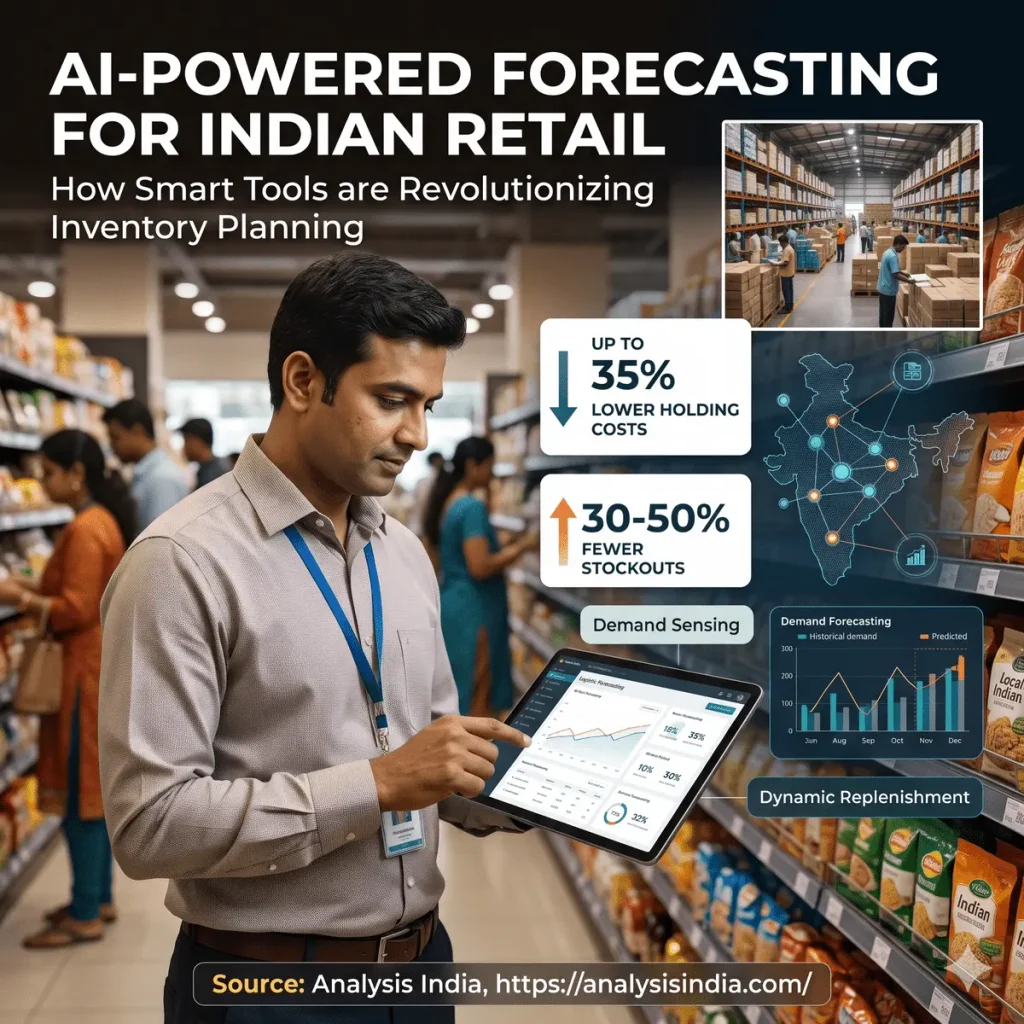
| Inventory Holding Cost Reduction | Standard baseline carrying expense | Twenty to thirty-five percent drop in holding costs | Unlocks significant multi-crore working capital reserves | Gartner Supply Chain Planning Guide |
| Retail Stockout and Lost Sales Rate | Eight to twelve percent average shelf loss | Three to five percent across core product lines | Substantial decrease in unfulfilled consumer purchases | IHL Group Retail Inventory Distortion Study |
| Global Retail Inventory Distortion Cost | Over one point eight trillion dollars annually | Algorithmic network rebalancing recovers lost margin | Substantial recovery of forfeited retail profits | IHL Group and Retailers Association of India |
| Supply Chain Planning Cycle Duration | Two to three weeks of manual compilation | Near real-time automated calculations | Ninety percent reduction in manual planning hours | Boston Consulting Group Retail Operations Study |
The commercial data compiled by institutions like MarketsandMarkets and McKinsey confirms that adopting AI forecasting tools delivers direct balance-sheet relief. It shrinks capital trapped in slow-moving merchandise while capturing sales that were previously forfeited to avoidable stock shortages.
The aggressive adoption of algorithmic retail planning coincides with record enterprise spending on predictive modeling and data engineering across the subcontinent. As businesses replace unorganized records with structured data pipelines, commercial analytics adoption is accelerating across supply chain logistics, banking, and consumer goods. Read our comprehensive industry article on the India analytics market to explore the revenue projections and macroeconomic factors driving this expansion.
Navigating Hyperlocal Variables: Pin Codes, Regional Seasons, and Cultural Shifts
India features vast demographic and geographic diversity, which makes broad national demand forecasting largely ineffective. A retail enterprise operating across Karnataka cannot apply the same stock models in coastal Mangalore as it does in central Bengaluru. Consumer buying power, dietary choices, language preferences, festive customs, and climate patterns vary sharply over short geographic distances.
Leading AI forecasting tools address this regional fragmentation by calculating demand down to individual pin codes, retail shelves, and micro-fulfillment hubs. By incorporating localized external data layers, predictive software anticipates demand changes that centralized purchasing teams would easily miss.
Consider the operational impact of regional weather patterns. In northern India the arrival of severe winter weather triggers sudden purchasing spikes in dry fruits, thermal clothing, room heaters, and intensive skincare products. Conversely southern states maintain warm temperatures throughout the year and require steady replenishment of light cotton textiles, sun protection formulas, and ambient beverages. Modern machine learning models monitor real-time weather forecasts and long-range meteorological patterns. If an unseasonal heatwave hits central India weeks ahead of historical averages, the software automatically raises replenishment orders for cold beverages and air coolers across affected distribution depots.
Algorithmic tools also process localized cultural and dietary nuances. During holy periods like Navratri or Shravan, millions of consumers across northern and western regions alter their dietary habits. They avoid meat, eggs, onions, and garlic while dramatically increasing consumption of dairy products, fresh fruits, and fasting ingredients like sago and water chestnut flour. Traditional enterprise software lacks contextual awareness and misinterprets these temporary consumption swings, which creates food spoilage in one aisle and bare shelves in another. Machine learning engines enriched with cultural calendars anticipate these consumption pivots, guiding store managers to lower perishable stock orders while increasing fasting staples weeks in advance.
The strategic application of AI forecasting tools ensures that physical stores do not stock generic corporate assortments. Instead retail shelves reflect the precise lifestyle habits and purchasing behaviors of their immediate neighborhoods. Modern inventory planning engines rely on foundational cloud infrastructure and neural network architectures developed by leading multinational technology vendors. Evaluating the developer ecosystem behind these enterprise tools helps technology officers choose partners with proven scalability and uptime. Review our comprehensive evaluation of the top AI companies in the global AI market to see which enterprise platforms dominate machine learning innovation.
Sector-Specific Operational Realities Across Key Retail Verticals
The operational value of automated demand forecasting varies across retail sectors because every product category involves distinct shelf lives, supply constraints, and consumer shopping habits.
The data below outlines how predictive inventory platforms operate across key retail sectors in the domestic Indian marketplace.
| Retail Industry Sector | Primary Inventory Friction Point | AI Implementation Approach | Measurable Sectoral Result | Authoritative Data Source |
| Grocery and Fresh Produce | High perishability and short 24-hour expiration windows | Hourly demand sensing tied to dynamic clearance pricing | Twenty-eight percent reduction in fresh produce spoilage | Food and Agribusiness Review India |
| Fashion and Apparel Retail | Complex size, fit, and seasonal color matrix obsolescence | Early-season sell-through tracking with hub-to-spoke rebalancing | Thirty-two percent fewer terminal clearance markdowns | Technopak Retail Advisors Report |
| Consumer Electronics and Appliances | High unit values and rapid product lifecycle obsolescence | Lead-time tracking combined with financing promotion lift | Twenty-one percent improvement in inventory turns | Bain and Company India Tech Report |
| Quick Commerce Dark Stores | Fast delivery mandates within restricted urban storage spaces | Real-time cart telemetry and automated micro-replenishment | Forty-five percent reduction in fast-moving line stockouts | Redseer Strategy Consultants Report |
| Pharmacy and Healthcare Retail | Non-substitutable medicine lines and strict batch expirations | Predictive epidemiological data and automated purchase orders | Over ninety-nine percent service availability on critical drugs | All India Origin Chemists and Distributors |
In grocery retail where product lifecycles are measured in hours, predictive algorithms prevent costly spoilage. Supermarket managers no longer have to guess how many crates of milk, fresh produce, or baked goods to stock for a rainy weekday morning. The software calculates required stock by correlating weekday trends, weather patterns, public holidays, and past shrinkage rates, which keeps merchandise fresh on shelves.
In fashion and lifestyle retail, the inventory challenge centers on style depth versus breadth. Apparel brands must manage complex size, color, and fit variations across hundreds of retail locations. An ethnic wear brand preparing for the wedding season cannot afford to place duplicate stock in every store. By utilizing AI forecasting tools, fashion merchandisers evaluate early consumer interest from initial collection drops. If an embroidery style shows strong sales velocity in Mumbai but moves slowly in Kolkata, the system halts planned factory production for slow lines and organizes stock transfers from eastern depots to western flagship stores, protecting full-price sell-through rates.
In consumer electronics retail, holding excess inventory carries high capital costs and technological obsolescence risks. Furthermore consumer demand in this category depends heavily on festive cashback schemes, device exchange bonuses, and financing programs. Modern predictive tools monitor promotional calendar shifts and competitor price moves across major online marketplaces. When consumer demand begins shifting toward newly introduced models, the forecasting platform systematically tapers replenishment of older generations, guiding retail teams to clear residual inventory without resorting to panic liquidations.
Multi-Echelon Network Optimization Across Warehouses and Dark Stores
Traditional inventory methods treat distribution centers, fulfillment warehouses, and physical storefronts as separate entities. When a store manager notices low inventory on a popular item, they place an order with the regional warehouse. If the regional warehouse runs short, it orders from the central mother warehouse, which then places an order with the manufacturing plant. This disconnected process generates the bullwhip effect, where small shifts in shopper purchases cause massive supply swings as orders travel upstream.
Modern AI forecasting tools resolve this systemic issue through Multi-Echelon Inventory Optimization. Instead of evaluating each node in isolation, multi-echelon algorithms assess the entire supply network at the same time. The software calculates how much reserve stock should remain upstream in central distribution centers versus how much inventory should sit downstream in frontline shops or urban dark stores.
By centralizing reserve inventory and running automated replenishment models, retailers reduce the total volume of safety stock required across their enterprise. If sudden demand strikes an urban dark store, the business does not need every surrounding store to hold oversized safety buffers. The system simply initiates an automated transfer from a regional transit depot. This balancing reduces warehouse leasing expenses and keeps high-velocity products within fast delivery range of consumer neighborhoods.
Multi-echelon platforms also adjust safety stock calculations dynamically. Rather than depending on static rules like keeping two weeks of inventory on hand regardless of market conditions, AI forecasting tools continually adjust buffers using real-time supplier reliability scores and localized demand variance. If a supplier regularly experiences delivery delays during monsoon months, the algorithm widens safety buffers for that specific partner while keeping buffers lean for dependable vendors.
Unlocking Working Capital and Protecting Operating Margins
The primary business justification for integrating machine learning into retail operations is financial performance. In retail environments where operating margins are thin, excessive capital locked in physical merchandise directly restricts enterprise growth.
When retail inventory sits unsold on shelves or inside warehouses, it accumulates significant carrying costs. These expenses include storage rent, warehouse labor, insurance coverage, physical shrinkage, and product obsolescence. Industry benchmarks published by retail associations confirm that annual inventory carrying costs for Indian enterprises consume between twenty and thirty percent of total inventory value. Holding fifty crore rupees in surplus inventory effectively costs an enterprise ten to fifteen crore rupees each year in dead capital and storage overhead.
By implementing AI forecasting tools, companies systematically lower these carrying costs. By matching replenishment volumes directly with expected local purchases, retailers safely operate with twenty to thirty-five percent less overall inventory without hurting fulfillment rates. The unlocked capital can be reinvested into retail footprint expansion, brand marketing campaigns, or balance-sheet debt reduction.
Equally important is protecting gross margins through intelligent price timing. Conventional retailers identify excess inventory late in the season during quarterly physical audits. By then consumer interest has faded, leaving clearance discounts as the only liquidation path. Stores cut prices deeply to recover liquidity, which damages operating profits.
In contrast, AI forecasting tools detect slowing sales velocity weeks before traditional methods notice the decline. If an algorithmic model finds that an electronics accessory or seasonal shoe line is falling behind its sales targets, it alerts planning teams immediately. The platform can recommend minor price promotions, suggest product bundles, or trigger inter-store inventory balancing long before heavy end-of-season clearance sales become necessary. This proactive oversight protects baseline margins throughout the commercial year.
Technical Integration with Legacy Enterprise Software
A common misconception among business leaders is that adopting artificial intelligence requires discarding existing enterprise software investments. In reality successful retail deployments run machine learning engines as intelligent analytical layers that connect directly with existing ERPs, warehouse software, and point-of-sale systems.
Enterprise integration relies on secure API connections that collect raw operational records, run cloud-based machine learning calculations, and push optimized replenishment orders back into transactional systems.
The initial phase of technical implementation focuses on enterprise data hygiene. In many legacy Indian retail companies, operational records are divided across regional servers, standalone cash registers, and manual spreadsheets. Product definitions often lack consistency, with identical items listed under differing codes across different regional branches. Before training predictive algorithms, retailers must standardize their master product catalogs, clean historical sales logs, and set up continuous data feeds.
Once data pipelines are active, the predictive engine executes automated feature engineering. The software transforms raw transaction records into structured predictive inputs by calculating price elasticities, identifying recurring promotional spikes, and measuring localized shopping intervals. The artificial intelligence model trains on this cleaned historical baseline, testing its predictions against actual sales outcomes and refining its calculations without requiring constant manual guidance from data engineers.
The final structural link is automated execution. Accurate forecasts offer little value if retail managers must spend days manually typing suggested quantities into purchase orders. Modern AI forecasting tools automate this administrative work entirely. The platform calculates optimal replenishment volumes, verifies them against minimum order rules and vendor terms, and creates ready-to-approve purchase orders inside systems like SAP, Oracle, or Microsoft Dynamics. Retail teams simply review and approve orders, eliminating thousands of hours of manual entry work.
Building Frontline Trust and Driving Internal Adoption
The primary barrier to successful AI implementation in retail operations is rarely technical. Instead it is organizational and behavioral. For generations retail buying, category planning, and store-level replenishment were guided by seasoned professionals who trusted their merchant instincts. When an enterprise introduces automated forecasting, category managers and store supervisors may view the software with skepticism, treating system recommendations as a challenge to their expertise.
If frontline employees do not understand how an algorithm calculates a replenishment number, they will routinely override the suggestions and return to manual ordering habits. Overcoming this friction requires explainable artificial intelligence. Advanced inventory planning tools must avoid operating as mysterious black boxes. Instead user interfaces must clearly present the business logic behind every inventory recommendation.
When a store manager opens their daily planning portal, the software should not simply instruct them to order extra crates of a beverage item. The dashboard should clearly display the underlying factors, such as an upcoming local heatwave, a scheduled cultural parade nearby, and historical records showing past sales jumps under similar conditions. When retail teams understand the context behind algorithmic forecasts, skepticism turns into operational trust.
Forward-looking retail enterprises also align internal performance metrics with automated workflows. Rather than judging category teams strictly on gross sales volume, leadership structures performance evaluations around inventory turns, forecast accuracy, and working capital efficiency. Structured training helps store managers transition from manual spreadsheet trackers into strategic operators who leverage predictive automation to drive local store profitability.
Critical Capabilities Checklist for Retail Technology Leaders
When auditing potential software providers, retail technology officers and supply chain directors must look beyond marketing claims and evaluate specific architectural capabilities designed for the Indian trade ecosystem.
A dependable predictive platform must deliver real-time data ingestion that handles millions of daily transactions without processing delays. The underlying systems must support multi-horizon forecasting, producing reliable projections for immediate daily replenishment, intermediate monthly stock planning, and long-range seasonal buying strategies.
The software must include automated anomaly detection to prevent distorted sales figures from corrupting future forecasts. If an isolated system error, transport strike, or unusual bulk purchase temporarily distorts sales numbers, the algorithm must identify the anomaly, clean the data point, and protect future replenishment calculations from error.
The platform should run on cloud infrastructure while supporting offline operational capabilities for retail branches situated in towns with intermittent internet access. When store systems lose network connectivity, local point-of-sale registers must continue recording customer sales and sync operational data with the central predictive platform the moment connections are restored.
Finally business leaders must verify that AI forecasting tools integrate smoothly with modern business intelligence platforms. Merchandising, finance, and logistics teams require unified visibility through clear dashboards that display operational bottlenecks, stockout risks, and working capital performance in real time.
Strategic Internal Playbooks for Unified Retail Operations
Building a responsive retail enterprise requires connecting inventory forecasting with broader digital transformation workflows across the organization. To support your operational improvements, explore these foundational implementation guides:
- To eliminate inventory discrepancies between physical stores and digital shopping apps, read our operational guide on omnichannel retail integration strategies to synchronize warehouse systems with point-of-sale terminals.
- To modernize your core transactional systems and prepare enterprise databases for machine learning algorithms, review our guide to cloud based ERP solutions for Indian enterprises.
- To improve supplier relationships, monitor regional transit delays, and raise on-time delivery rates, consult our practical manual on supply chain visibility and vendor management.
- To protect operating margins during off-peak periods without starting damaging price wars, implement our strategic framework on retail markdown optimization and pricing analytics.
Industry Research and Global Supply Chain References
Enterprise leadership teams seeking external operational benchmarks and economic data can review detailed findings published by international research firms and domestic trade associations:
Global supply chain studies by the McKinsey Global Institute on the State of AI in Supply Chain Operations document that organizations adopting machine-learning tools lower inventory holding expenses by up to thirty-five percent while reducing forecasting error rates by half. To analyze domestic retail developments, the Retailers Association of India regularly releases comprehensive market monitors tracking urban and rural consumer spending trends, festive shopping patterns, and modern retail technology investments. In addition, enterprise technology evaluations from Gartner Supply Chain Planning Solutions offer rigorous comparative assessments of multi-echelon inventory planning engines. Reviewing these industry benchmarks enables retail leaders to structure their digital transformation programs around proven operational frameworks.
The Path Forward: Building an Autonomous Retail Engine
The Indian retail economy is expanding rapidly under rising household incomes, digital payment adoption, and customer expectations for immediate merchandise availability. In this competitive landscape, managing inventory through static spreadsheets and subjective guesswork introduces severe operational vulnerability. Businesses that depend on outdated forecasting methods will find their capital trapped in unsold goods, their margins eroded by storage overheads, and their market share captured by agile competitors.
Modern AI forecasting tools are no longer optional software add-ons. Instead they represent the primary foundation for supply chain resilience and sustained retail profitability. By analyzing local market signals, predicting seasonal shopping surges, balancing stock across multi-echelon networks, and automating purchase order workflows, predictive platforms resolve the historic tension between customer service availability and lean capital efficiency.
For retail executives across the country, the operational path forward is clear. Success requires connecting separated data systems, modernizing core software platforms, and adopting machine learning systems that turn market data into accurate replenishment decisions. Organizations that execute this operational transition will run leaner, more profitable stores, while those that delay will see their margins and market relevance fade across an increasingly competitive landscape.
Frequently Asked Questions
How do AI-powered forecasting tools help Indian retailers plan inventory?
AI-powered forecasting tools help Indian retailers plan inventory by analyzing real-time sales alongside localized weather patterns, shifting festival dates, and supplier lead times. Machine learning algorithms predict consumer demand down to individual store shelves and pin codes rather than relying on static monthly spreadsheets. This allows retail businesses to eliminate stockouts during high-traffic periods while avoiding costly surplus inventory.
How do AI inventory tools handle shifting Indian festive demand?
AI inventory tools track shifting lunar calendars and regional holidays rather than relying on fixed solar dates. These systems evaluate festive shopping lift and promotional pricing elasticities weeks before major celebrations begin. Retailers can accurately stage inventory for events like Diwali or Durga Puja without getting stuck with dead stock once the holidays conclude.
How much can Indian retailers reduce inventory holding costs using AI?
Indian retailers typically reduce inventory holding costs by twenty to thirty-five percent within two quarters of deploying AI forecasting software. The technology dynamically updates safety stock buffers and automates reorders based on real-time supplier reliability. This unlocks trapped working capital from expensive distribution centers while maintaining high product availability on shelves.
What is the difference between traditional ERP planning and AI demand sensing?
Traditional ERP systems use static moving averages that assume rigid delivery timelines and misinterpret past stockouts as a lack of customer interest. In contrast, AI demand sensing evaluates continuous point-of-sale streams, online cart additions, and localized market factors in real time. This enables the platform to detect genuine demand shifts and automatically adjust replenishment targets across every distribution node.
Why is pin-code level inventory forecasting necessary for Indian retail chains?
Consumer preferences, dietary traditions, and spending habits in India vary sharply across short geographic distances. Pin-code level forecasting evaluates store-specific footfall and local purchase patterns to create customized product assortments for each neighborhood. This strategy ensures high-velocity goods occupy retail shelf space while preventing slow-moving items from crowding regional outlets.
Can small and mid-sized retailers adopt AI forecasting without replacing current POS software?
Small and mid-sized retailers can easily deploy AI forecasting platforms as analytical overlays without replacing their existing billing setups or ERPs. Modern tools integrate directly via secure APIs to ingest checkout logs and return automated purchase orders. This allows growing direct-to-consumer brands and regional supermarkets to automate stock planning without undertaking disruptive system overhauls.