📅 Published: February 13, 2026
🔄 Last Updated: August 23, 2026
Fixed DR vs Mobile DR Systems: Quick Summary
The global Fixed DR vs Mobile DR Systems market is entering an important transition period. Fixed digital radiography remains the larger segment because hospitals and diagnostic centers continue to depend on dedicated imaging rooms for routine and high-volume examinations. Mobile digital radiography is developing at a much faster pace because healthcare providers increasingly need imaging closer to the patient.
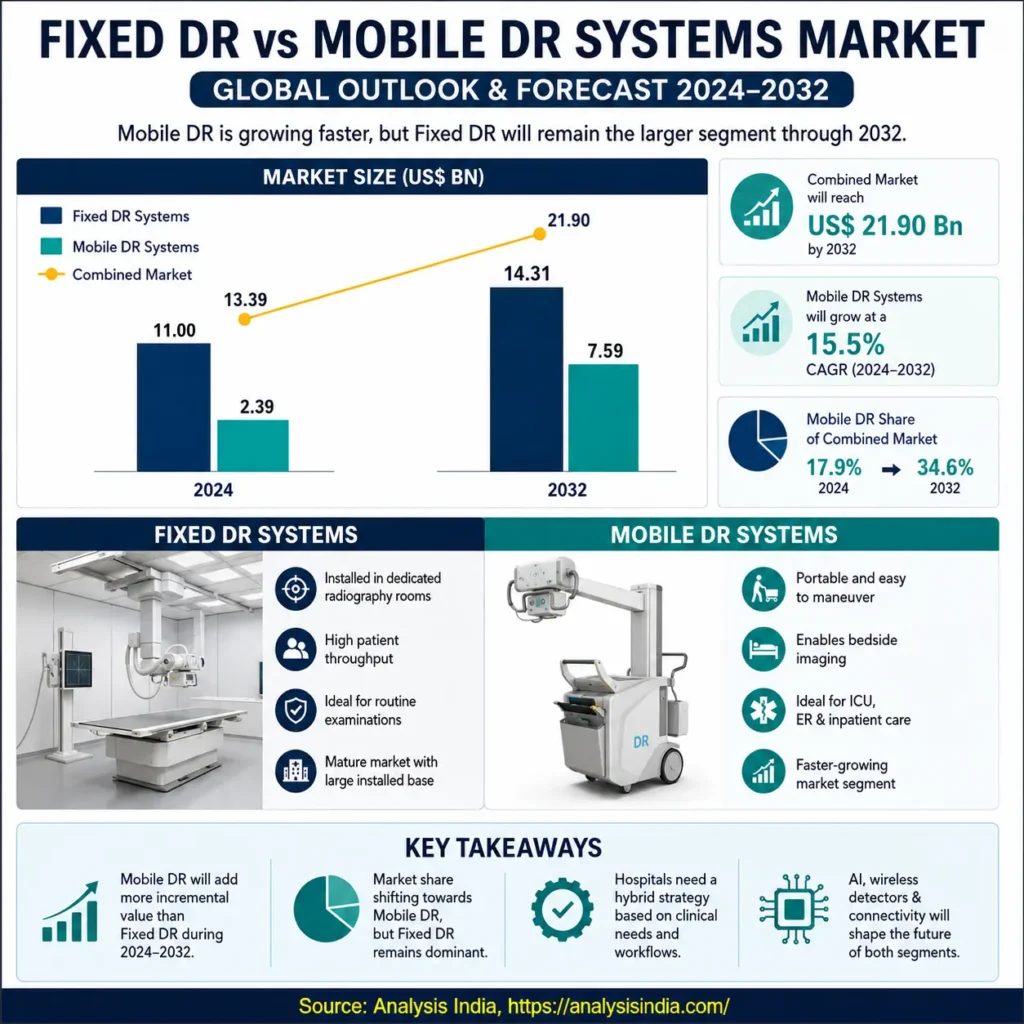
AnalysisIndia estimates that the combined market for fixed and mobile DR systems will increase from US$13.39 billion in 2024 to US$21.90 billion by 2032. This represents an increase of approximately US$8.51 billion over the forecast period. However, the growth will not be distributed evenly between the two segments.
The Fixed DR vs Mobile DR Systems market shows a clear difference in growth rates. Fixed DR revenue is projected to increase from US$11.00 billion in 2024 to US$14.31 billion in 2032, representing an estimated CAGR of about 3.3%. Mobile DR revenue is expected to rise from US$2.39 billion to US$7.59 billion, producing a much stronger estimated CAGR of about 15.5%.
This difference is gradually changing the structure of the market. Mobile DR represented approximately 17.9% of the combined market in 2024. Its share could reach about 34.6% by 2032. Mobile DR will still remain smaller than fixed DR in absolute revenue, but its contribution to future market growth will become much more significant. These market-share calculations are derived from the AnalysisIndia forecast dataset.
The central conclusion is that mobile technology is not simply replacing fixed radiography. Hospitals are moving toward a more flexible imaging model. Fixed systems continue to support centralized and high-volume examinations, while mobile systems extend imaging services to intensive care units, emergency departments, operating rooms and inpatient wards.
Fixed DR vs Mobile DR Systems: Key Market Highlights
- The combined fixed and mobile DR market is projected to reach US$21.90 billion by 2032.
- Fixed DR is expected to remain the larger segment throughout the forecast period.
- Fixed DR revenue could reach US$14.31 billion by 2032.
- Mobile DR revenue could reach US$7.59 billion by 2032.
- Mobile DR is projected to grow at approximately 15.5% CAGR from 2024 to 2032.
- Fixed DR is projected to grow at approximately 3.3% CAGR during the same period.
- Mobile DR’s market share could increase from 17.9% to 34.6%.
- Wireless detectors, battery-powered platforms and connected workflows are supporting the expansion of mobile imaging.
What Is Fixed Digital Radiography?
Fixed digital radiography refers to X-ray equipment that is permanently installed in a dedicated imaging room. A typical system includes an X-ray tube, generator, digital detector, patient table or wall stand and image acquisition workstation.
The main advantage of a fixed system is its ability to support a predictable imaging workflow. Patients are brought to the radiography room, positioned using dedicated equipment and examined under controlled conditions. This setup is particularly valuable for hospitals and diagnostic centers that handle a large number of routine examinations.
Fixed systems can also support standardized imaging protocols. Consistent room configuration and equipment positioning can help radiographers maintain an efficient workflow throughout the day.
For high-volume facilities, this operating model remains important because the equipment can be used continuously without the need to move between departments.
The Fixed DR vs Mobile DR Systems comparison therefore begins with a basic operational difference. Fixed DR is designed around a centralized imaging environment where equipment, staff and patient flow are organized around a dedicated room.
Fixed DR also represents the established part of the market. Its large installed base means that future demand will come from several sources, including replacement of aging equipment, hospital expansion and upgrades to newer digital platforms.
What Is Mobile Digital Radiography?
Mobile digital radiography uses a compact X-ray system that can be transported between hospital departments. Instead of requiring the patient to travel to a dedicated radiography room, the equipment can be taken to the patient’s location.
Mobile systems generally use a battery-powered platform and digital detector. Many modern systems also support wireless detectors, which provide greater flexibility when positioning the detector around a hospital bed.
This capability is particularly useful for patients who cannot be moved easily. Intensive care patients may be connected to monitoring equipment or other medical devices. Transporting them to another department can require additional staff and preparation.
Mobile DR can also support imaging in emergency departments, inpatient wards and selected operating room environments.
The Fixed DR vs Mobile DR Systems market is therefore influenced by the growing need for point-of-care imaging. Mobile equipment allows hospitals to extend diagnostic capability beyond the traditional radiology department.
Fixed DR vs Mobile DR Systems: Core Difference
The simplest way to understand the difference is through patient movement.
Fixed DR brings the patient to the imaging system. Mobile DR brings the imaging system to the patient.
Fixed DR is optimized for centralized, repeatable and high-volume imaging. Mobile DR is optimized for flexibility and access.
This does not make one technology universally better than the other. Their value depends on the clinical environment, patient condition, imaging volume and hospital workflow.
The Fixed DR vs Mobile DR Systems market is therefore better understood as a complementary market rather than a direct replacement cycle.
Fixed DR vs Mobile DR Systems: Market Size and Forecast 2024–2032
The Fixed DR vs Mobile DR Systems market is expected to expand significantly through 2032, but the growth pattern differs sharply between the two segments. Fixed DR starts from a much larger revenue base and continues to grow steadily. Mobile DR starts from a smaller base but records a much faster increase over the forecast period.
AnalysisIndia estimates that the combined market will increase from approximately US$13.39 billion in 2024 to US$21.90 billion in 2032. The following forecast uses the market values provided in the AnalysisIndia dataset.
| Year | Mobile DR Market (US$ Million) | Fixed DR Market (US$ Million) | Combined Market (US$ Million) |
|---|---|---|---|
| 2024 | 2,390.9 | 11,001.8 | 13,392.7 |
| 2025 | 2,596.3 | 11,506.2 | 14,102.5 |
| 2026 | 3,002.5 | 11,905.6 | 14,908.1 |
| 2027 | 3,510.4 | 12,209.3 | 15,719.7 |
| 2028 | 4,091.3 | 12,603.2 | 16,694.5 |
| 2029 | 4,795.1 | 13,004.5 | 17,799.6 |
| 2030 | 5,601.2 | 13,400.0 | 19,001.2 |
| 2031 | 6,597.6 | 13,800.3 | 20,397.9 |
| 2032 | 7,587.3 | 14,311.0 | 21,898.3 |
Source: AnalysisIndia Research Estimates
The forecast shows an important structural difference. Fixed DR remains the larger market in every year, but its annual increase is relatively gradual. Mobile DR gains more than three times its 2024 revenue by 2032. This makes mobile imaging the faster-growing part of the overall market even though fixed systems continue to generate the majority of revenue.
Fixed DR Market Outlook
The Fixed DR market is projected to increase from US$11.00 billion in 2024 to US$14.31 billion in 2032. This represents an estimated CAGR of approximately 3.3% during the forecast period.
The moderate growth rate reflects the maturity of fixed digital radiography. Many hospitals and diagnostic centers already have dedicated radiography infrastructure. As a result, future demand is unlikely to come only from first-time adoption.
Replacement demand will remain important. Hospitals need to replace aging X-ray generators, detectors and imaging platforms as equipment reaches the end of its useful operating life. Technology upgrades can also create demand when healthcare providers move to newer systems with better image processing, wireless detectors, improved workflow and stronger digital connectivity.
New hospital construction and expansion of diagnostic capacity provide another source of growth. In developing healthcare markets, additional imaging capacity can support the installation of new fixed systems.
The Fixed DR vs Mobile DR Systems forecast therefore points to a stable fixed segment rather than a declining one. Fixed DR should continue to provide the core infrastructure for centralized radiography because high-volume routine imaging still requires efficient and predictable workflows.
Mobile DR Market Outlook
Mobile DR has a considerably stronger growth trajectory. AnalysisIndia projects that the segment will increase from US$2.39 billion in 2024 to US$7.59 billion in 2032.
This implies an estimated 15.5% CAGR over the forecast period.
The difference in growth rate is significant. Mobile DR revenue is expected to increase by approximately US$5.20 billion between 2024 and 2032. Fixed DR is expected to add approximately US$3.31 billion during the same period.
The faster expansion reflects changing clinical requirements. Hospitals increasingly need imaging services for patients who cannot easily travel to a dedicated radiography room. Intensive care, emergency care and inpatient services are important examples.
Technology is also reducing some of the traditional limitations of mobile imaging. Wireless detectors make bedside positioning easier. Improved battery performance supports longer operating periods. Digital connectivity allows images acquired at the bedside to enter wider hospital imaging workflows.
The Fixed DR vs Mobile DR Systems market is therefore developing at two different speeds. Fixed DR provides the larger revenue base and stable replacement demand. Mobile DR provides the stronger incremental growth opportunity.
Fixed DR vs Mobile DR Systems: Mobile DR Market Share Shift
The change in market share provides a more useful picture of the market than revenue growth alone.
Mobile DR accounted for approximately 17.9% of the combined market in 2024. Based on the AnalysisIndia forecast, its share could reach approximately 34.6% by 2032.
Fixed DR would still account for the majority of the market in 2032. However, its share would decline from approximately 82.1% in 2024 to 65.4% in 2032.
This shift does not mean that fixed radiography is losing its clinical importance. Instead, it indicates that mobile imaging is capturing a growing portion of new spending within digital radiography.
The market is consequently becoming more balanced. Hospitals that previously relied heavily on centralized imaging are increasingly adding mobile capacity where bedside access provides greater clinical value.
What the Growth Gap Means for the Market
The most important finding from the forecast is the difference between market size and market growth.
Fixed DR remains the scale segment. It generates substantially more revenue than Mobile DR and is expected to remain the larger segment through 2032.
Mobile DR, however, is the growth segment. Its estimated 15.5% CAGR is far above the approximately 3.3% growth rate of Fixed DR.
This creates different opportunities for industry participants. Fixed DR manufacturers can continue to benefit from replacement cycles, hospital expansion and technology upgrades. Mobile DR manufacturers have a larger opportunity to capture incremental demand as hospitals expand bedside imaging.
For healthcare providers, the data suggests that investment decisions should not be based only on which segment is growing faster. A hospital with high routine imaging volumes may require substantial fixed capacity, while a facility with large intensive care and emergency departments may gain greater value from additional mobile units.
The Fixed DR vs Mobile DR Systems market is therefore moving toward a complementary model. Fixed systems provide scale and consistency. Mobile systems provide flexibility and access. The strongest market opportunity may come from technologies and workflows that allow both systems to operate as part of one connected imaging environment.
Why Mobile DR Is Growing Faster
The growth of Fixed DR vs Mobile DR Systems is increasingly being influenced by changes in hospital workflow. The demand for diagnostic imaging is not limited to dedicated radiology departments. Hospitals also need imaging in intensive care, emergency medicine, inpatient wards and other areas where moving the patient can be difficult.
Mobile DR addresses this requirement by bringing the imaging system directly to the patient. This can reduce the need for transportation and allow clinicians to obtain X-ray images without disrupting the patient’s location.
Bedside Imaging Is Expanding
Bedside imaging is one of the strongest demand drivers for mobile digital radiography.
Patients in intensive care may require repeated chest examinations during treatment. These patients can be connected to monitoring equipment, ventilators and other clinical devices. Moving them to a separate imaging department can require additional staff and preparation.
A mobile DR unit can perform the examination within the ICU. This does not eliminate the need for fixed radiography, but it creates additional imaging capacity where centralized equipment is less practical.
The same principle applies to inpatient wards. Patients recovering from surgery or those with limited mobility may benefit from imaging at the bedside.
This creates a clear operational advantage for mobile systems. The value comes not only from the image itself but also from reducing unnecessary movement within the hospital.
Critical Care Supports Mobile DR Demand
Critical care is likely to remain an important application area for mobile DR.
ICU patients can require frequent imaging as their clinical condition changes. A bedside system allows healthcare teams to obtain images without transferring the patient to another department.
For hospitals with large critical care facilities, this can influence equipment procurement decisions. A mobile system can complement fixed radiography by addressing cases where patient transportation is difficult.
The growing importance of critical care therefore supports the faster expansion of the mobile segment.
Emergency Care Creates Another Opportunity
Emergency departments require rapid access to diagnostic imaging.
Patient flow can change quickly, and some patients may not be suitable for movement to a conventional radiography room. Mobile DR can provide additional flexibility during periods of high demand.
Its value is particularly relevant when imaging needs to be performed close to the treatment area.
This does not mean every emergency examination should be performed using mobile equipment. Fixed DR remains highly effective for patients who can be transported safely. The opportunity lies in using mobile imaging selectively where it improves workflow.
Wireless Detectors Improve Mobility
Wireless detector technology is strengthening the mobile DR proposition.
A wireless detector can be positioned around or beneath a patient without requiring a physical cable between the detector and the main system. This can make bedside examinations easier and reduce restrictions on positioning.
The technology also supports faster image transfer after acquisition.
For healthcare providers, wireless operation needs to be considered alongside detector durability, battery requirements, network reliability and replacement costs.
As these technologies improve, the distinction between mobile imaging and conventional fixed digital workflows is becoming less significant from a data-management perspective.
Point-of-Care Imaging Is Becoming More Important
The broader movement toward point-of-care diagnostics is another structural driver.
Healthcare providers increasingly want diagnostic information closer to where treatment is taking place. This can improve access to imaging and reduce delays caused by patient transportation.
Mobile DR fits this model particularly well.
The opportunity is not limited to large hospitals. Smaller healthcare facilities can also use mobile systems where installing multiple dedicated imaging rooms would require substantial infrastructure investment.
This creates potential for mobile DR adoption across different healthcare settings.
Why Fixed DR Will Remain Important
The growth of mobile imaging does not reduce the fundamental importance of fixed radiography.
Fixed systems remain the preferred platform for many routine examinations because they are designed around a dedicated imaging environment. The equipment is always available in the same location and can support predictable patient flow.
High Throughput Supports Fixed DR
High-volume imaging is a major strength of fixed systems.
A dedicated radiography room can process patients continuously without requiring equipment movement between departments. This is particularly valuable for hospitals and diagnostic centers with large outpatient volumes.
Fixed DR can therefore provide greater efficiency when the main objective is to perform a high number of routine examinations within a controlled workflow.
Standardized Imaging Supports Consistency
Fixed installations also provide a consistent physical environment.
The patient table, wall stand, detector position and X-ray tube can be configured around established examination protocols. This supports repeatable positioning and standardized workflows.
Consistency is particularly important in facilities where radiography teams perform large numbers of similar examinations.
Replacement Demand Will Support the Market
The established installed base of fixed digital radiography creates an ongoing replacement opportunity.
X-ray systems have long operating lives, but hospitals eventually need to replace aging equipment. Replacement decisions may also be accelerated when newer systems provide meaningful improvements in workflow, image processing, detector technology or connectivity.
This gives manufacturers an established revenue base even when new hospital construction slows.
New Healthcare Infrastructure Creates Additional Demand
Healthcare infrastructure expansion will also support fixed DR.
New hospitals and diagnostic centers require dedicated imaging capacity. Expanding facilities may also add additional radiography rooms when existing equipment becomes insufficient for patient volumes.
This is particularly relevant in developing healthcare markets where diagnostic infrastructure continues to expand.
The Fixed DR vs Mobile DR Systems market therefore has two distinct demand foundations. Mobile DR benefits from the expansion of bedside and point-of-care imaging, while fixed DR benefits from established radiology infrastructure, replacement demand and high-volume diagnostic requirements.
Fixed and Mobile DR Serve Different Workflow Needs
The key market question is not whether hospitals will choose fixed or mobile equipment exclusively.
In many cases, hospitals need both.
A fixed system can handle routine examinations and high patient volumes. Mobile equipment can address patients who cannot easily travel to the radiography department.
This combination can improve the overall use of imaging resources.
It also creates an opportunity for hospitals to build a more flexible imaging network. Equipment can be allocated according to clinical need rather than forcing every patient through the same workflow.
This complementary model is likely to become increasingly important through 2032.
Fixed DR vs Mobile DR Systems: AnalysisIndia Insight
The growth pattern provides an important strategic signal.
Fixed DR represents market scale. Mobile DR represents market acceleration.
The fixed segment starts from a much larger base, so even moderate growth generates substantial revenue. Mobile DR starts from a smaller base, but its faster growth allows it to capture a much larger share of future spending.
The implication for manufacturers is significant. Companies focused on mobile DR can target the fastest-growing part of the market, while companies with strong fixed DR portfolios can continue to benefit from replacement and infrastructure demand.
For hospitals, the decision should be based on workflow rather than headline market growth. A high-volume diagnostic center may obtain greater value from fixed capacity. A tertiary hospital with extensive critical care services may require a stronger combination of fixed and mobile systems.
The Fixed DR vs Mobile DR Systems market is therefore developing around specialization and complementarity. The strongest long-term model is likely to combine centralized capacity with bedside flexibility.
Technology Trends in Fixed and Mobile DR Systems
Technology is becoming an increasingly important part of the Fixed DR vs Mobile DR Systems market. The basic X-ray imaging principle remains the same, but improvements in detectors, software, connectivity and system design are changing how hospitals use digital radiography.
The main technology developments are focused on three areas. Manufacturers are improving image acquisition, making equipment easier to operate and connecting imaging systems more closely with hospital information networks.
Flat-Panel Detector Technology
Digital flat-panel detectors are central to modern DR systems. They convert X-ray exposure into digital image information that can be processed and transferred electronically.
Detector performance affects image quality, workflow and equipment usability. Hospitals therefore consider detector design alongside the specifications of the X-ray generator and imaging workstation.
Wireless detectors have become particularly important for mobile systems because they provide greater flexibility during bedside examinations. They can be positioned around the patient without requiring a permanent physical connection to the mobile unit.
For fixed systems, detector technology also supports workflow improvements. Wireless configurations can provide additional positioning flexibility while maintaining the advantages of a dedicated imaging room.
Image Processing and Workflow Software
Software is becoming a larger part of digital radiography.
Modern systems can process images quickly and apply automated functions that support consistent image presentation. Workflow software can also help radiographers manage examinations and reduce unnecessary manual steps.
The commercial importance of software is increasing because hospitals are looking beyond basic image acquisition. They want equipment that can fit efficiently into existing clinical workflows.
This creates an opportunity for manufacturers to differentiate their products through software as well as hardware.
Artificial Intelligence
Artificial intelligence is becoming another technology layer within digital radiography.
AI applications can support areas such as image quality assessment, image processing, abnormality detection and workflow prioritization. The strongest value is likely to come from applications that address specific clinical or operational problems.
AI should be viewed as an assistive technology rather than a replacement for radiologists and radiographers. Human expertise remains important for image interpretation, clinical context and patient management.
For manufacturers, successful AI integration will depend on how well these tools work within existing imaging workflows.
PACS, DICOM and Digital Connectivity
Connectivity is becoming essential to the modern Fixed DR vs Mobile DR Systems market.
A digital X-ray image has greater operational value when it can move quickly into the hospital’s wider imaging environment. PACS allows authorized users to store, retrieve and review medical images across connected clinical systems.
DICOM provides standardized mechanisms for managing and exchanging medical imaging information. This makes interoperability an important consideration when hospitals purchase new DR equipment.
Hospitals should therefore evaluate more than image quality during procurement. They should also examine how easily the system can connect with existing PACS, radiology information systems and electronic medical record environments.
The IHE Radiology framework provides additional guidance on integrating imaging systems into clinical workflows. This is particularly relevant when hospitals operate multiple imaging platforms across different departments.
Fixed DR vs Mobile DR Systems: Hospital Workflow and Patient Movement
Workflow remains one of the clearest differences between fixed and mobile radiography.
A fixed system requires the patient to reach the imaging department. For ambulatory patients, this is usually straightforward. For critically ill or immobile patients, transportation can be more complicated.
Patient movement can involve nurses, attendants and other clinical staff. Medical equipment may also need to be managed during transportation.
Mobile DR reduces this requirement by allowing imaging to take place at the patient’s location.
The benefit is therefore broader than equipment mobility. It can affect staff utilization, patient flow and the time required to complete an examination.
The Fixed DR vs Mobile DR Systems decision should consequently consider the complete workflow rather than equipment specifications alone.
Fixed DR vs Mobile DR Systems: Procurement and Total Cost of Ownership
Equipment price is an important factor, but it should not be the only consideration when hospitals evaluate digital radiography systems.
Fixed DR may require dedicated infrastructure. This can include room preparation, electrical work, radiation protection and installation.
Mobile DR generally requires less permanent infrastructure. However, it introduces other operating considerations such as battery management, detector maintenance, mobility-related servicing and charging requirements.
Fixed DR Procurement Considerations
Hospitals evaluating fixed systems should consider:
- Expected examination volume
- Available radiography room capacity
- Detector configuration
- Automated positioning
- Image processing
- PACS compatibility
- Service support
- Upgrade options
- Expected operating life
The value of a fixed system is closely connected to utilization. A high-volume department can generate greater operational value from a dedicated system than a facility with low examination volumes.
Mobile DR Procurement Considerations
Mobile equipment requires a different evaluation.
Hospitals should consider:
- Battery operating time
- Charging requirements
- System weight and maneuverability
- Wireless detector performance
- Detector durability
- Network connectivity
- Service requirements
- Storage space
- Expected daily examination volume
Mobility itself should not be treated as the only purchasing criterion. A mobile system that is difficult to maneuver or requires frequent charging may reduce some of the workflow benefits that justified the purchase.
Total Cost Matters More Than Purchase Price
The Fixed DR vs Mobile DR Systems comparison should therefore be based on total cost of ownership.
For fixed systems, hospitals need to account for infrastructure, installation, maintenance, service contracts and eventual replacement.
For mobile systems, the calculation should include battery replacement, detector maintenance, service and equipment utilization.
Workflow savings should also be considered.
If a mobile system reduces the need to transport patients between departments, the hospital may save staff time and reduce operational disruption. These benefits may not appear in the equipment purchase price but can influence the long-term value of the system.
Hybrid Imaging Strategy
A combination of fixed and mobile equipment can provide a practical solution for hospitals with diverse clinical requirements.
Fixed DR can handle routine and high-volume examinations. Mobile DR can support patients who cannot easily travel to the radiography department.
Both systems can feed images into the same digital infrastructure when appropriate connectivity is available.
This creates a more flexible imaging environment without requiring every examination to be performed using the same type of equipment.
The Fixed DR vs Mobile DR Systems market is therefore increasingly connected to hospital-wide imaging strategy. Procurement decisions are moving beyond individual devices toward integrated systems that combine equipment, software, connectivity and service.
AnalysisIndia Insight
The technology direction suggests that competition will increasingly shift from hardware specifications toward workflow performance.
Image quality will remain essential, but hospitals will also evaluate how quickly a system can acquire, process, transfer and integrate images.
This creates opportunities for manufacturers that can combine reliable hardware with wireless detectors, software, AI capabilities and strong interoperability.
For healthcare providers, the same trend means procurement teams should evaluate the complete operating environment. The most expensive system is not necessarily the most valuable, and the cheapest system is not necessarily the most economical over its useful life.
The strongest procurement decisions will connect clinical requirements with expected utilization, workflow and total ownership cost.
Fixed DR vs Mobile DR Systems: Latest Developments in 2026
The Fixed DR vs Mobile DR Systems market is being influenced by several technology and workflow developments in 2026. The direction of the market is moving beyond basic digital image acquisition. Hospitals increasingly expect imaging equipment to provide greater mobility, faster workflows, reliable connectivity and better integration with clinical operations.
These developments are particularly important for mobile DR because the segment is expanding rapidly. However, many of the same technologies are also improving the value proposition of fixed systems.
Wireless Detector Technology Is Improving Mobile Imaging
Wireless flat-panel detectors are becoming increasingly important for bedside radiography. They allow radiographers to position the detector without maintaining a physical cable connection to the main unit.
This can make examinations easier in intensive care and inpatient environments where space around the patient may be limited.
Wireless technology also supports faster image transfer. Once an image is acquired, it can be sent electronically for processing and review.
However, hospitals need to evaluate battery life, detector durability and network reliability along with wireless capability. A wireless detector provides limited benefit if charging requirements or connectivity problems interrupt clinical workflow.
AI Is Becoming Part of the Imaging Workflow
Artificial intelligence is developing as a supporting technology in digital radiography.
AI can assist with image processing, quality assessment and selected image analysis applications. It can also help prioritize imaging studies in environments where radiology departments face increasing examination volumes.
The commercial opportunity is likely to focus on practical applications rather than complete automation.
For healthcare providers, AI tools need to demonstrate useful clinical or operational benefits. They also need to integrate with existing imaging workflows.
For manufacturers, AI therefore represents both a technology opportunity and a software integration challenge.
Battery Technology Matters More for Mobile Systems
Battery performance is a critical consideration for mobile DR.
A mobile unit may be required to perform multiple examinations across different hospital departments during a working day. Insufficient battery capacity or long charging periods can reduce equipment availability.
Manufacturers are therefore focusing on improving operating time and charging management.
Hospitals should evaluate battery performance as part of total ownership cost. Battery replacement can become a recurring expense during the operating life of the equipment.
This factor is less significant for fixed systems because they operate from permanent power infrastructure.
Point-of-Care Imaging Is Expanding
Point-of-care imaging is becoming an increasingly important part of hospital diagnostics.
The ability to perform an X-ray examination close to the patient can reduce transportation requirements and support faster clinical decisions in selected situations.
Intensive care remains a major application. Emergency departments and inpatient wards also provide opportunities for mobile imaging.
The broader trend is important because it changes where diagnostic imaging takes place.
The Fixed DR vs Mobile DR Systems market is therefore increasingly connected to the decentralization of hospital care. Imaging is no longer limited to a dedicated radiology department.
Cybersecurity Is Becoming More Important
Greater connectivity also creates additional cybersecurity requirements.
Modern DR systems can connect with hospital networks, PACS and other information systems. Mobile units may also operate through wireless networks across different clinical areas.
Hospitals therefore need to consider system security during procurement.
Manufacturers that provide secure software, controlled access and long-term update support can gain an advantage as healthcare providers become more cautious about connected medical devices.
Fixed DR vs Mobile DR Systems: Regional Market Outlook
The growth of Fixed DR vs Mobile DR Systems will differ across geographic markets because healthcare infrastructure, equipment replacement cycles and hospital workflows vary by region.
North America
North America represents a mature digital radiography market. Many hospitals already have established DR infrastructure.
Future demand is therefore likely to be driven significantly by replacement and modernization.
Hospitals may invest in newer fixed systems to improve workflow and replace aging equipment. Mobile DR can benefit from demand in intensive care, emergency medicine and other point-of-care environments.
The market opportunity is consequently more focused on upgrading existing capacity than introducing digital radiography for the first time.
Europe
European healthcare systems also have a substantial installed base of digital radiography equipment.
Efficiency, workflow optimization and modernization are likely to remain important purchasing factors.
Hospitals may increasingly evaluate systems based on their ability to integrate with existing digital infrastructure. Energy efficiency, service support and equipment lifecycle management can also influence procurement decisions.
Mobile DR can gain from demand for flexible imaging in hospitals with complex patient populations.
Asia Pacific
Asia Pacific provides a different growth opportunity.
Healthcare infrastructure continues to expand in several countries. New hospitals, diagnostic centers and expanding healthcare networks can create demand for additional radiography capacity.
The region also contains markets with very different levels of healthcare infrastructure.
Large hospitals may require multiple fixed systems for high-volume imaging while also adding mobile units for critical care and emergency services.
Smaller facilities may view mobile DR as a flexible way to expand diagnostic capacity without making the same level of permanent infrastructure investment required for additional fixed rooms.
China and India
China and India are particularly important markets because of their large patient populations and expanding healthcare systems.
Demand can come from both established hospitals upgrading existing equipment and new facilities adding diagnostic capacity.
The combination of fixed and mobile demand creates opportunities across multiple price and technology segments.
Fixed DR vs Mobile DR Systems: India Market Opportunity
India represents an important long-term opportunity for the Fixed DR vs Mobile DR Systems market.
The country’s healthcare system includes large tertiary hospitals, private hospital networks, diagnostic centers and smaller regional facilities. These different healthcare settings create different equipment requirements.
Large hospitals may need fixed DR systems for routine imaging while also requiring mobile units for intensive care and emergency departments.
Smaller healthcare facilities may have more limited infrastructure. In these settings, mobile systems can provide flexibility where installing multiple dedicated imaging rooms would require greater capital investment.
The opportunity is therefore not limited to one type of equipment.
Manufacturers that can provide different configurations, pricing options and service models may be better positioned to address India’s diverse healthcare market.
Fixed DR vs Mobile DR Systems: Competitive Landscape
Competition in digital radiography is increasingly moving beyond basic X-ray hardware.
Manufacturers compete across several areas, including detector technology, image quality, software, workflow integration, mobility, service support and connectivity.
For fixed systems, established installed bases can provide an important competitive advantage. Hospitals often prefer suppliers that can provide long-term maintenance, replacement parts and technical support.
Mobile systems create additional areas of competition.
Weight, maneuverability, battery performance and wireless detector capability can influence purchasing decisions. Hospitals may also consider how easily mobile equipment connects to existing digital imaging infrastructure.
Service is another important factor.
Radiography equipment is part of daily clinical operations. Extended downtime can affect patient scheduling and diagnostic capacity. Companies with strong service networks can therefore create value beyond the initial equipment sale.
The Fixed DR vs Mobile DR Systems market is consequently becoming more competitive at the system level. Product specifications remain important, but workflow and lifecycle support are becoming increasingly influential.
Adjacent Opportunities in the X-ray Market
The development of digital radiography also creates opportunities across related X-ray imaging segments.
Hospitals often invest in several types of X-ray equipment rather than treating radiography as a single product category.
The broader Global X-ray System Market provides the wider industry context for this development.
Specialized applications also create separate opportunities. The Global Mammography X-ray System Market represents an important application focused on breast imaging and screening.
C-arm technology provides another example of how X-ray systems can be designed around different clinical workflows. AnalysisIndia’s Fixed C-arm Market and Global Mobile C-arm Market analyses provide additional context on fixed and mobile imaging applications.
These adjacent markets demonstrate a broader industry trend. Healthcare providers increasingly select imaging technology according to clinical use, workflow requirements and the location where imaging needs to take place.
AnalysisIndia Market Perspective
The regional and competitive outlook supports the broader market forecast.
Fixed DR will remain the larger revenue segment because it is deeply established within hospital radiology infrastructure. Replacement demand and healthcare expansion should continue to support steady growth.
Mobile DR has a different opportunity profile.
Its faster growth is linked to changes in clinical workflow rather than replacement alone. Hospitals are adding imaging capacity in locations where conventional fixed equipment cannot provide the same level of flexibility.
This distinction is important for manufacturers and investors.
A company focused on fixed DR can continue to benefit from a large installed base. A company positioned strongly in mobile DR can target a faster-growing market segment.
The strongest opportunity may come from manufacturers that can participate in both segments and connect them through common software, service and digital infrastructure.
Fixed DR vs Mobile DR Systems: Market Risk Factors
The outlook for Fixed DR vs Mobile DR Systems remains positive through 2032, but several factors could affect the pace of market expansion. Healthcare providers do not make imaging equipment purchases only on the basis of clinical demand. Capital budgets, infrastructure requirements, regulatory conditions and technology cycles can all influence procurement decisions.
High Equipment and Infrastructure Costs
The initial investment can be significant for healthcare providers.
Fixed DR systems may require dedicated rooms, installation work, electrical infrastructure and radiation protection. These requirements can increase the total investment beyond the equipment purchase price.
Mobile DR generally requires less permanent infrastructure, but it has its own cost considerations. Batteries, wireless detectors, maintenance and mobility-related components can affect the long-term ownership cost.
Cost pressure may therefore delay equipment purchases in smaller hospitals and facilities with limited capital budgets.
Replacement Cycles Can Affect Demand
Digital radiography equipment typically remains in service for several years. Hospitals may continue using existing systems when budgets are constrained, even when newer technologies offer workflow improvements.
Longer replacement cycles can therefore delay revenue growth for manufacturers.
At the same time, an aging installed base creates future replacement opportunities. Once hospitals decide to upgrade, they may move directly to newer systems with better connectivity, detector technology and software capabilities.
Regulatory Requirements
Medical imaging equipment operates within regulatory frameworks that can vary by market.
Manufacturers need to meet applicable requirements for equipment safety, radiation protection and medical-device performance.
Regulatory changes can increase development and compliance costs. They can also affect the timing of product launches in different regions.
For healthcare providers, regulatory compliance is an important part of equipment procurement because imaging systems need to meet applicable standards throughout their operating life.
Supply Chain Risks
The digital radiography industry depends on several specialized components.
Detectors, electronic components, batteries and other parts can be affected by manufacturing disruptions or supply constraints.
Supply chain problems can increase equipment costs and extend delivery times.
Manufacturers with diversified sourcing and strong service infrastructure may be better positioned to manage these risks.
Cybersecurity Risks
Connectivity creates another area of risk.
Modern DR systems can connect to hospital networks and digital imaging platforms. A security weakness can potentially affect the wider clinical IT environment.
Hospitals are therefore paying greater attention to cybersecurity during medical equipment procurement.
Long-term software support and security updates can become important purchasing criteria.
Technology Convergence
The capabilities of mobile and fixed systems are also evolving.
As mobile platforms become more capable, some hospitals may use them for applications that previously required additional fixed capacity.
However, this does not necessarily mean that mobile DR will replace fixed systems.
Fixed equipment continues to offer important advantages for high-volume centralized imaging. The more likely outcome is a broader mix of technologies serving different clinical requirements.
AnalysisIndia Strategic Insight
The Fixed DR vs Mobile DR Systems market should be viewed as a structural shift rather than a competition in which one technology eliminates the other.
Fixed DR is the scale segment.
Mobile DR is the growth segment.
The distinction is visible in the forecast. Fixed DR is projected to increase from US$11.00 billion in 2024 to US$14.31 billion in 2032. Mobile DR is projected to increase from US$2.39 billion to US$7.59 billion over the same period.
The difference in growth creates two different strategic opportunities.
For manufacturers, fixed DR offers access to a large installed base and continuing replacement demand. Mobile DR offers faster expansion as hospitals add bedside imaging capacity.
For healthcare providers, the most effective strategy will depend on patient mix and workflow. A high-volume diagnostic center may prioritize fixed capacity. A tertiary hospital with substantial critical care activity may need a combination of fixed and mobile systems.
For investors, the market presents a similar contrast. Fixed DR provides scale and a relatively established revenue base. Mobile DR provides a stronger growth profile.
The most important opportunity may therefore be integration rather than replacement.
Manufacturers that can connect fixed and mobile systems through common software, digital infrastructure and service networks may be able to capture value from both segments.
Hospitals can also benefit from this approach. Fixed systems can handle routine imaging while mobile units address patients who cannot easily travel to the radiography department.
This complementary model is likely to shape the market through 2032.
Fixed DR vs Mobile DR Systems Outlook Through 2032
The Fixed DR vs Mobile DR Systems forecast points to continued expansion of the global market.
The combined market is projected to increase from approximately US$13.39 billion in 2024 to US$21.90 billion in 2032.
However, the most important change will be the composition of that market.
| Market Indicator | 2024 | 2032 | Change |
|---|---|---|---|
| Fixed DR | US$11.00 Bn | US$14.31 Bn | +US$3.31 Bn |
| Mobile DR | US$2.39 Bn | US$7.59 Bn | +US$5.20 Bn |
| Combined Market | US$13.39 Bn | US$21.90 Bn | +US$8.51 Bn |
| Mobile DR Share | 17.9% | 34.6% | +16.7 percentage points |
| Fixed DR Share | 82.1% | 65.4% | -16.7 percentage points |
Source: AnalysisIndia Research Estimates
The numbers show a clear change in market dynamics.
Fixed DR remains the larger segment in 2032. However, Mobile DR is expected to contribute more incremental market value during the forecast period.
This makes mobile imaging an important area for future product development and investment.
The market should therefore not be interpreted as a simple shift from fixed equipment to mobile equipment. Instead, healthcare providers are likely to build imaging capacity around a combination of centralized and bedside systems.
Fixed DR vs Mobile DR Systems: Conclusion
The global Fixed DR vs Mobile DR Systems market is entering a period of significant change.
Fixed DR will remain the backbone of centralized radiography. Its large installed base, high throughput and established hospital infrastructure will support steady growth through 2032.
Mobile DR has a much stronger growth trajectory. Its market value is projected to increase from US$2.39 billion in 2024 to US$7.59 billion by 2032. The expansion is supported by bedside imaging, critical care, emergency services, wireless detectors and the broader move toward point-of-care diagnostics.
The most important finding is the change in market mix. Mobile DR could increase its share of the combined market from approximately 17.9% in 2024 to 34.6% in 2032.
This does not indicate the decline of fixed radiography.
Instead, the market is moving toward a more flexible imaging model in which each technology serves a different operational purpose.
For hospitals, the strongest strategy may be to combine fixed capacity for routine and high-volume examinations with mobile capacity for patients who require bedside imaging.
For manufacturers, the opportunity lies in integrating hardware, software, connectivity and service.
For investors, Mobile DR offers the stronger growth opportunity, while Fixed DR remains the larger revenue segment.
The central AnalysisIndia conclusion is clear:
Fixed DR will remain the scale segment of digital radiography, while Mobile DR will increasingly become its growth engine through 2032.
Research Methodology
The market estimates in this report are based on the AnalysisIndia Research Estimates dataset covering the global Fixed DR and Mobile DR segments from 2024 to 2032.
The combined market value is calculated by adding the Fixed DR and Mobile DR values for each year.
CAGR calculations use the 2024 and 2032 market values. Market share is calculated by comparing each segment with the combined market in the relevant year.
The forecast is intended to provide a market perspective on segment size, growth and changing market structure. Actual market performance may differ because of changes in healthcare investment, technology adoption, regulatory conditions and broader economic factors.
Frequently Asked Questions
What is the difference between Fixed DR and Mobile DR Systems?
Fixed DR systems are permanently installed in dedicated radiography rooms and are designed mainly for routine and high-volume examinations. Mobile DR systems can be moved between hospital departments and used at the patient’s bedside.
The simplest difference is workflow. Fixed DR brings the patient to the imaging system, while mobile DR brings the imaging system to the patient.
Which is better, Fixed DR or Mobile DR?
Neither system is better for every clinical situation.
Fixed DR is generally more suitable for high-volume routine imaging. Mobile DR is more useful when patients cannot easily travel to a dedicated radiography room.
Hospitals with different patient populations may benefit from using both technologies.
Is Mobile DR replacing Fixed DR?
No. The market forecast indicates that Mobile DR is expanding rather than replacing Fixed DR.
Fixed DR is projected to remain the larger segment through 2032. Mobile DR is growing much faster and is expected to capture a larger share of new market demand.
The future is therefore more likely to involve complementary use of both technologies.
Why is Mobile DR growing faster than Fixed DR?
The main driver is increasing demand for bedside and point-of-care imaging.
Intensive care patients, emergency cases and some inpatient populations may be difficult to transport to a dedicated radiography room. Mobile DR allows imaging to be performed where the patient is located.
Wireless detectors, improved battery technology and digital connectivity are also supporting adoption.
What will the Mobile DR market be worth in 2032?
The global Mobile DR market is projected to reach approximately US$7.59 billion in 2032, compared with US$2.39 billion in 2024.
The AnalysisIndia forecast indicates an estimated CAGR of approximately 15.5% between 2024 and 2032.
What will the Fixed DR market be worth in 2032?
The global Fixed DR market is projected to reach approximately US$14.31 billion in 2032, compared with US$11.00 billion in 2024.
The estimated CAGR is approximately 3.3% during the forecast period.
What will the combined market be worth in 2032?
The combined Fixed DR and Mobile DR market is projected to reach approximately US$21.90 billion in 2032.
The corresponding 2024 market value is approximately US$13.39 billion.
This represents an increase of about US$8.51 billion during the forecast period.
What share will Mobile DR have by 2032?
Mobile DR is projected to account for approximately 34.6% of the combined market by 2032.
Its estimated share was approximately 17.9% in 2024.
This represents a significant increase in the contribution of mobile imaging to the overall market.
Where is Mobile DR mainly used?
Mobile DR is particularly useful in areas where patients cannot easily reach a dedicated radiography room.
Major applications include intensive care units, emergency departments, inpatient wards, operating rooms and selected postoperative settings.
Its primary advantage is the ability to provide imaging close to the patient.
Where is Fixed DR mainly used?
Fixed DR is mainly used in dedicated radiography departments and diagnostic centers.
Common applications include chest imaging, skeletal examinations, orthopedic imaging and routine outpatient radiography.
Its main advantage is efficient and consistent high-volume imaging.
How important are wireless detectors for Mobile DR?
Wireless detectors provide greater flexibility during bedside examinations.
They allow radiographers to position the detector around or beneath the patient without maintaining a physical cable connection to the main imaging unit.
Their value is particularly high in environments where space around the patient is limited.
What role will AI play in digital radiography?
AI is expected to support areas such as image processing, quality assessment, workflow prioritization and selected image analysis applications.
The main opportunity is to improve efficiency and support healthcare professionals rather than replace radiologists or radiographers.
Why is PACS connectivity important?
PACS allows medical images to be stored, accessed and reviewed through a connected digital imaging environment.
For hospitals using both fixed and mobile equipment, connectivity allows bedside images to become part of the same wider workflow as examinations performed in a dedicated radiography room.
What should hospitals consider when purchasing DR equipment?
Hospitals should consider patient volume, clinical requirements, infrastructure, workflow, detector technology, connectivity, service support and total cost of ownership.
Fixed DR may provide greater value for high-volume routine imaging, while Mobile DR may provide greater value in hospitals with significant intensive care, emergency or inpatient requirements.
What is the future of Fixed DR vs Mobile DR Systems?
Both technologies are expected to remain important through 2032.
Fixed DR will continue to provide centralized imaging capacity and high throughput. Mobile DR is expected to grow faster as hospitals expand bedside and point-of-care imaging.
The market is therefore moving toward integration rather than replacement.
What is the key market trend through 2032?
The most important trend is the increasing contribution of Mobile DR to overall market growth.
Fixed DR will remain the larger revenue segment, but Mobile DR is projected to grow much faster and increase its market share substantially.
This suggests that future hospital imaging strategies will increasingly combine centralized fixed systems with mobile equipment for patients who require bedside care.