📅 Published: November 15, 2026
🔄 Last Updated: November 16, 2026
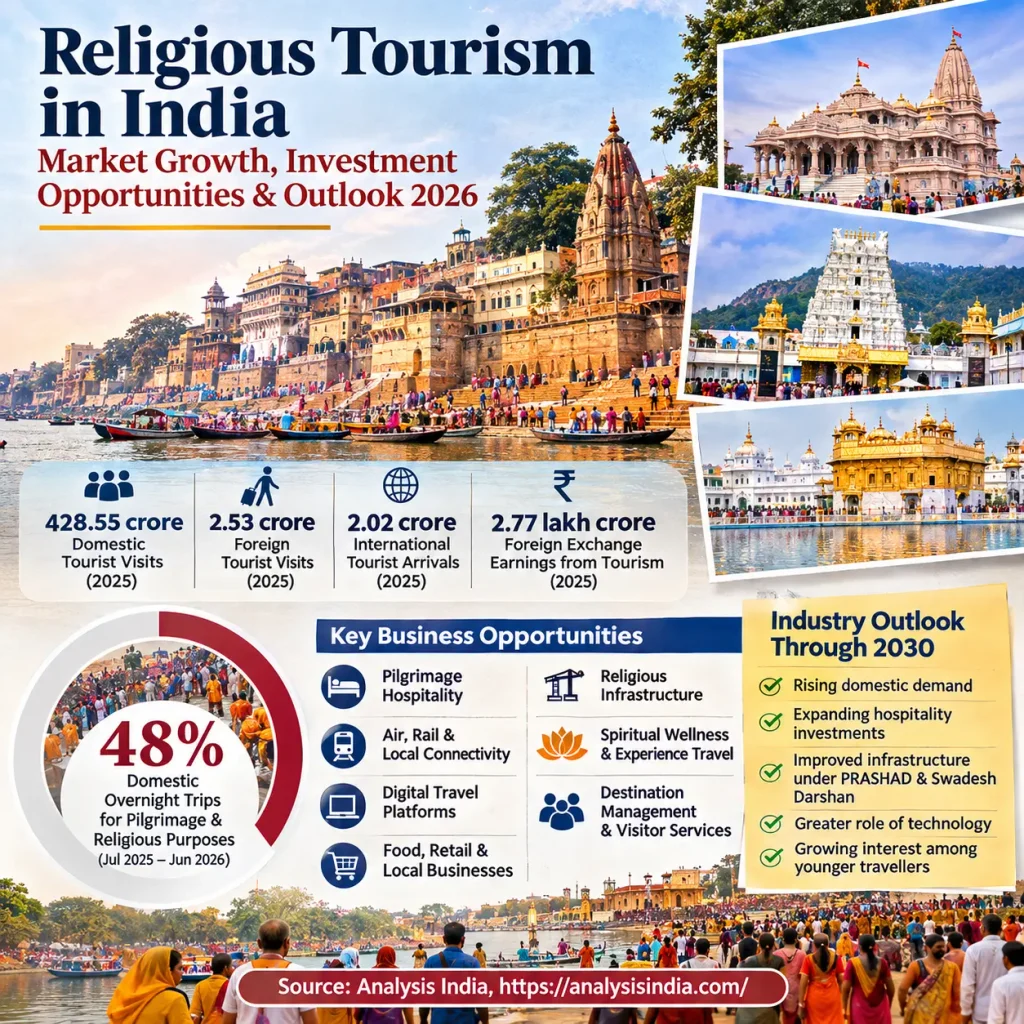
India’s religious tourism industry is becoming an important business opportunity for hospitality companies, airlines, railway operators, travel agencies, infrastructure developers and technology providers. Rising domestic travel, improved connectivity, government investment and changing traveller preferences are creating new opportunities across the country’s pilgrimage destinations.
Religious travel has always been an integral part of Indian society. Millions of people visit temples, gurudwaras, monasteries, mosques and other sacred destinations every year. However, the economic significance of these journeys extends far beyond religious activities. Accommodation, transportation, restaurants, retail, local businesses and destination management companies all benefit from visitor movement.
The transformation is also attracting younger consumers who increasingly combine spiritual experiences with cultural exploration, heritage tourism and wellness travel. A May 2025 Bloomberg report, titled India Sees Spiritual Tourism Boom as Religion Becomes Cool, examined this changing relationship between religion, travel and consumer behaviour.
Government statistics provide further evidence of the sector’s importance. The Ministry of Statistics and Programme Implementation reported in September 2026 that pilgrimage and religious activities accounted for approximately 48% of surveyed domestic overnight trips during the July 2025 to June 2026 reference period.
For businesses and investors, this development creates an important question. How can India’s religious tourism demand translate into sustainable commercial opportunities across hospitality, transport, infrastructure, technology and local services?
This analysis examines the latest Indian tourism statistics, industry developments, company expansion strategies and government initiatives to identify the opportunities available to different stakeholders through 2030.
1. Religious Tourism in India: Latest Market Statistics and Industry Overview
India has one of the world’s most extensive networks of religious and cultural destinations. Its pilgrimage ecosystem serves Hindu, Sikh, Buddhist, Jain, Islamic and other religious communities. Destinations such as Varanasi, Ayodhya, Tirupati, Amritsar, Bodh Gaya, Ajmer and Rameswaram attract visitors from different parts of India and abroad.
The commercial importance of these destinations is supported by the expansion of India’s wider tourism economy.
According to the Ministry of Tourism’s India Tourism Statistics 2026, India recorded approximately 428.55 crore domestic tourist visits in 2025, compared with 294.53 crore in 2024. This represented annual growth of 45.51%.
Foreign tourist visits increased from approximately 2.08 crore in 2024 to 2.53 crore in 2025, representing growth of 21.63%.
These figures demonstrate the expansion of visitor activity across Indian destinations. However, domestic tourist visits and foreign tourist visits are visit-based measures, not counts of unique travellers. The 2025 domestic figure also includes visits associated with the Maha Kumbh Mela.
India’s tourism industry: Key statistics for 2025
| Tourism indicator | 2025 figure |
|---|---|
| Domestic Tourist Visits | 428.55 crore |
| Foreign Tourist Visits | 2.53 crore |
| International Tourist Arrivals | 2.02 crore |
| Foreign Tourist Arrivals | 91.5 lakh |
| Indian National Arrivals | 110.7 lakh |
| Foreign exchange earnings from tourism | ₹2,76,831 crore |
| Domestic tourist visits growth | 45.51% |
| Foreign tourist visits growth | 21.63% |
Source: Ministry of Tourism, Government of India, India Tourism Statistics 2026.
The statistical definitions are important. Domestic Tourist Visits measure visits by domestic tourists to destinations within India. Foreign Tourist Visits are compiled by State and Union Territory tourism departments. International Tourist Arrivals include both Foreign Tourist Arrivals and Indian National Arrivals from abroad. Foreign Tourist Arrivals specifically refer to foreign nationals entering India.
Therefore, these indicators should not be combined to calculate a single tourism market size.
Religious travel becomes the leading purpose of domestic overnight trips
One of the most significant developments for the industry came on 23 September 2026, when the Ministry of Statistics and Programme Implementation released findings from the Domestic Tourism Expenditure Survey covering July 2025 to June 2026.
The survey found that approximately 48 out of every 100 domestic overnight trips completed during the previous 365 days were undertaken for pilgrimage and religious purposes. Health and medical travel represented approximately 30 out of every 100 overnight trips.
This makes religious travel the leading reported purpose of domestic overnight tourism in the survey.
| Purpose of domestic overnight trips | Approximate share |
|---|---|
| Pilgrimage and religious | 48% |
| Health and medical | 30% |
| Other surveyed purposes | Remaining share |
Source: National Statistics Office, Ministry of Statistics and Programme Implementation, Domestic Tourism Expenditure Survey 2025–26.
The survey also reported that approximately 80% of overnight visitors preferred stays of five days or less. The average overnight trip size was 2.03 visitors.
These findings have important commercial implications. Many religious journeys are relatively short, creating demand for organised transportation, budget accommodation, food services and packaged travel arrangements.
However, the 48% figure represents the distribution of surveyed overnight trips, not 48% of all domestic tourist visits or 48% of tourism revenue.
For investors, the distinction is important because the commercial value of a pilgrimage trip depends on accommodation preferences, travel expenditure, trip duration and the availability of paid services.
2. Why Religious Tourism in India Is Attracting Business Investment
Religious destinations generate economic activity across multiple industries. A visitor travelling to Varanasi, Ayodhya, Tirupati or Amritsar may require railway tickets, flights, hotels, local transportation, restaurants, shopping and other services.
Large pilgrimage gatherings also require sanitation, security, healthcare, temporary accommodation, crowd management and digital visitor information.
The Maha Kumbh Mela 2025 demonstrated the scale of infrastructure and service requirements associated with major religious gatherings. The event created demand across accommodation, transport, food supply, public facilities and temporary tourism services.
At the Global Spiritual Tourism Conclave held in Ujjain in August 2025, Anil Parashar, Chair of the Tourism Committee at PHDCCI, highlighted the scale of the sector.
He stated:
“Over 1.4 billion pilgrim visits took place in India in 2022 alone.”
Parashar also referred to the 66 crore devotees reported for Maha Kumbh 2025 and the preparations for Simhastha 2028 in Ujjain.
These figures are industry-referenced estimates and event-related visit counts, not unique-person counts or a consolidated current annual market-size estimate.
Nevertheless, they illustrate the scale of visitor activity that can support commercial services around major pilgrimage destinations.
The opportunity extends beyond hotels and travel operators. Construction companies, technology providers, restaurants, retail businesses, medical services and local entrepreneurs can also participate in the religious tourism value chain.
3. Seven Major Business and Investment Opportunities
3.1 Hotel Development and Pilgrimage Hospitality
Accommodation is among the most visible commercial opportunities in the Indian pilgrimage market.
Traditional religious destinations have historically relied on dharamshalas, guesthouses, temple accommodation and budget hotels. However, changing visitor expectations are encouraging the development of organised accommodation across multiple price categories.
Families, senior citizens, international visitors and premium travellers require different facilities. Some visitors prioritise proximity to religious sites, while others look for comfortable rooms, reliable food services, accessibility and organised transportation.
This creates opportunities for budget hotel operators, midscale hospitality companies, luxury hotel groups and specialised pilgrimage accommodation providers.
Indian Hotels Company Limited, which operates the Taj, Vivanta, SeleQtions and Ginger brands, has already established a significant presence in spiritual destinations.
In February 2024, IHCL Managing Director and CEO Puneet Chhatwal discussed the growing importance of spirituality in the hospitality sector.
He stated:
“I think spiritual destination and spirituality is going to play a more significant role across the globe.”
At that time, the company reported 66 hotels either operational or under development at spiritual destinations. It also discussed expansion in Ayodhya and other religious locations.
The company has identified destinations such as Katra, Tirupati and Ayodhya as part of its spiritual hospitality strategy.
A more recent development emerged in June 2026 when Tamara Leisure Experiences introduced Raé by Tamara, a hospitality brand specifically designed for spiritual travellers.
The company announced a target of approximately 25 properties signed or operational by 2030. Its expansion plans include destinations such as Guruvayur, Kumbakonam, Velankanni, Tirupati, Palani and Tiruvannamalai.
Samir MC, CEO of Tamara Leisure Experiences, explained the company’s approach:
“With Rae our vision is not just to build hotels near places of worship but to build a trust system that the faithful turn to every time they undertake a sacred journey, across all faiths, across the country, across a lifetime of pilgrimage.”
The strategy demonstrates that hospitality companies are beginning to view religious destinations as specialised accommodation markets rather than simply locations for conventional hotel expansion.
Smaller hotel operators can also benefit through property management, branded guesthouses, accommodation partnerships and online distribution.
3.2 Airlines, Railways and Ground Transportation
Transport connectivity is fundamental to pilgrimage development.
Religious destinations often experience concentrated visitor demand during festivals, religious calendars, weekends and school holidays. This creates opportunities for airlines, railway operators, bus companies, taxi aggregators and local transportation businesses.
Improved airport infrastructure near pilgrimage destinations can make travel easier for visitors from distant Indian states and international markets.
Railways remain particularly important because a significant proportion of domestic pilgrims depend on affordable long-distance transportation.
IRCTC’s Bharat Gaurav tourist train programme illustrates how organised railway packages can combine transport, accommodation, meals and local transfers.
Its religious travel offerings include packages such as the 07 Jyotirlinga Yatra and Guru Kripa Yatra.
The opportunity is not limited to increasing transport capacity. Companies can also develop services around station transfers, luggage management, senior-citizen assistance, local sightseeing and multilingual travel support.
For airlines, religious travel can support passenger demand on selected routes. However, route expansion should be based on sustainable passenger demand, aircraft utilisation and seasonal economics rather than temporary festival traffic alone.
3.3 Digital Pilgrimage Platforms and Religious Travel Technology
Technology is becoming an increasingly important part of religious travel.
Visitors frequently require information about temple timings, darshan bookings, accommodation, transportation, festivals, registration and crowd conditions.
These requirements create opportunities for digital platforms that simplify pilgrimage planning.
A specialised religious travel platform could combine accommodation booking, railway and flight information, local transportation, temple schedules and verified visitor guidance.
Digital services can also help religious administrations manage visitor movement and communicate changes in entry arrangements.
The opportunity is relevant to startups developing travel applications, payment services, mapping systems, multilingual information platforms and AI-powered itinerary planning.
Technology providers can also supply software to temple trusts, religious organisations and destination management authorities.
For example, digital systems could help visitors plan multi-destination journeys by comparing travel duration, transport connections and accommodation availability.
Artificial intelligence could improve itinerary recommendations and customer support, while digital payments can simplify transactions at hotels, transport services and retail outlets.
However, accuracy and trust are essential. Religious schedules, entry information and booking availability should come from authorised institutions. Unverified booking services can expose travellers to fraud and misinformation.
The commercial opportunity lies in building reliable services that improve the entire pilgrimage journey.
3.4 Food Services, Retail and Local Businesses
Religious travel supports demand for food, traditional products, religious merchandise, clothing, local guides and transportation.
Small businesses frequently participate in this economy. Restaurants, sweet shops, flower vendors, local guides, handicraft sellers and taxi operators benefit from visitor movement.
Large pilgrimage gatherings can create significant temporary demand, while established destinations provide recurring commercial activity throughout the year.
Ayodhya, Varanasi, Tirupati, Shirdi, Amritsar and Ujjain offer examples of destinations where religious activity supports wider local business ecosystems.
Organised businesses can explore regional food brands, hygienic food courts, packaged local products, retail outlets and online sales of authentic regional merchandise.
There is also an opportunity for local entrepreneurs to participate in organised supply chains.
Hotels can procure food and products locally, tour operators can work with regional guides, and retail companies can develop partnerships with local manufacturers.
This approach can distribute tourism revenue beyond large hospitality and transportation companies.
3.5 Religious Infrastructure and Destination Development
Infrastructure development is essential for converting high visitor demand into sustainable tourism activity.
Pilgrimage destinations require roads, railway stations, airport access, drinking water, sanitation, public lighting, pedestrian pathways, accommodation and emergency services.
Government schemes are playing an important role in supporting this development.
The PRASHAD scheme, or Pilgrimage Rejuvenation and Spiritual, Heritage Augmentation Drive, is one of the central government initiatives focused on pilgrimage infrastructure.
According to government information published in February 2026, the Ministry of Tourism had sanctioned 54 PRASHAD projects across 28 States and Union Territories at an estimated cost of ₹1,726.74 crore.
The government also reported progress under its wider destination development programmes.
| Government programme | Sanctioned projects | Sanctioned amount |
|---|---|---|
| PRASHAD | 54 | ₹1,726.74 crore |
| Swadesh Darshan | 76 | ₹5,290.33 crore |
| Swadesh Darshan 2.0 | 53 | ₹2,208.31 crore |
| Challenge Based Destination Development | 38 | ₹697.94 crore |
Source: Ministry of Tourism, Government of India, parliamentary and official programme updates available in 2026.
These programmes have different objectives and project scopes. They should not be added together and presented as a dedicated religious tourism investment total because several projects cover wider tourism themes.
The programmes nevertheless demonstrate the government’s focus on improving destination infrastructure.
For private companies, this creates opportunities in construction, engineering, public facilities, waste management, lighting, digital infrastructure, security systems and long-term facility operations.
Public-private partnerships can also support the maintenance and management of completed facilities, subject to government regulations and site-specific arrangements.
3.6 Spiritual Wellness and Experience-Led Travel
Religious journeys are increasingly overlapping with other forms of travel.
Visitors may combine pilgrimage with yoga, meditation, Ayurveda, traditional food, heritage exploration and wellness experiences.
This creates a broader commercial category combining religious tourism, cultural travel and wellness hospitality.
Destinations such as Rishikesh, Varanasi, Bodh Gaya and Dharamshala can attract visitors interested in more than a short religious visit.
Hotels and travel operators can develop packages that include meditation sessions, guided heritage walks, traditional cuisine and local cultural experiences.
The opportunity is particularly relevant for hospitality operators seeking to increase average booking value and extend visitor stays.
However, religious traditions should be represented respectfully. Businesses should distinguish genuine cultural and spiritual experiences from purely commercial entertainment products.
3.7 Destination Management, Safety and Tourism Services
The expansion of pilgrimage activity creates a growing requirement for professional destination management.
Large gatherings can place considerable pressure on roads, public facilities, emergency services and local authorities.
Crowd management, visitor information, emergency communication, waste collection and healthcare support are essential components of a well-managed pilgrimage destination.
Technology companies can develop crowd-monitoring tools, digital queue systems, real-time transport information and visitor communication platforms.
Security and facility-management companies can provide operational services during festivals and peak pilgrimage periods.
Medical providers can also support temporary healthcare facilities and emergency response arrangements.
For investors and service providers, this market is different from ordinary leisure tourism. It requires the ability to manage large visitor volumes, seasonal peaks and complex public infrastructure requirements.
4. India’s Major Religious Destinations and Commercial Opportunities
India’s religious tourism opportunity is geographically distributed across several states and religious traditions.
Different destinations have different commercial characteristics. Some attract very large domestic pilgrimage volumes, while others have stronger international heritage and Buddhist tourism potential.
| Destination | State | Religious category | Major commercial opportunities |
|---|---|---|---|
| Varanasi | Uttar Pradesh | Hindu | Hotels, river tourism, food services, heritage experiences |
| Ayodhya | Uttar Pradesh | Hindu | Hotels, transport, retail, pilgrimage packages |
| Prayagraj | Uttar Pradesh | Hindu | Temporary accommodation, transport, event services |
| Mathura and Vrindavan | Uttar Pradesh | Hindu | Hotels, local transport, devotional retail |
| Tirupati | Andhra Pradesh | Hindu | Hospitality, transport, organised pilgrimage services |
| Somnath | Gujarat | Hindu | Accommodation, coastal tourism, travel packages |
| Dwarka | Gujarat | Hindu | Hotels, religious circuits, local transportation |
| Ujjain | Madhya Pradesh | Hindu | Hospitality, infrastructure, crowd management |
| Bodh Gaya | Bihar | Buddhist | International accommodation, tour operators, cultural experiences |
| Sarnath | Uttar Pradesh | Buddhist | Heritage tourism, international visitor services |
| Amritsar | Punjab | Sikh | Hotels, food, heritage tours, transport |
| Ajmer | Rajasthan | Sufi | Accommodation, local retail, cultural tourism |
| Shirdi | Maharashtra | Hindu | Hotels, transport, pilgrimage packages |
| Rameswaram | Tamil Nadu | Hindu | Hotels, religious circuits, transport |
These destinations should not be treated as identical commercial markets.
Varanasi and Ayodhya have strong domestic pilgrimage demand, while Bodh Gaya and Sarnath have particular relevance for international Buddhist visitors.
Amritsar combines religious travel with heritage tourism. Ajmer has a distinctive Sufi pilgrimage market. Tirupati and Shirdi have established pilgrimage ecosystems supported by organised transportation and hospitality services.
For companies considering expansion, destination-level demand, seasonality, land costs, infrastructure availability and local regulations should be assessed before making investment decisions.
5. What Industry Leaders Are Saying About Religious Tourism in India
Statements from industry leaders provide useful insight into how businesses are interpreting the market opportunity.
Several companies have already begun positioning themselves around pilgrimage accommodation, travel services and religious destination development.
Ritesh Agarwal, Founder and CEO of OYO
Speaking at the TiEcon Mumbai 2025 summit, OYO founder Ritesh Agarwal described religious travel as a significant business opportunity.
He stated:
“Around 20 percent of our revenue comes from religious destinations.”
He also reported that more than five lakh people stayed with OYO during the Maha Kumbh in Prayagraj.
Agarwal identified Varanasi and Tirupati as important performing markets for the company and discussed emerging hotel development in destinations such as Kanyakumari and Somnath.
He also estimated that religious tourism could generate between $150 billion and $200 billion in three to four years. This should be understood as his industry forecast, not an independently established market-size projection.
His comments are particularly relevant because they provide an operator-level perspective on accommodation demand.
They also indicate that religious destinations can support organised hotel businesses beyond traditional leisure markets.
Puneet Chhatwal, Managing Director and CEO of IHCL
IHCL has identified spiritual destinations as an important part of its hospitality strategy.
Puneet Chhatwal stated:
“Spiritual destinations are a safer bet because people in good or in bad times go to get the blessings of the Lord.”
The comment reflects the recurring nature of religious travel demand.
Unlike some leisure destinations that depend heavily on holiday seasons, established pilgrimage destinations may attract visitors throughout the year, although demand varies according to religious calendars and festivals.
IHCL’s expansion across destinations such as Ayodhya, Katra and Tirupati illustrates how major hospitality groups are approaching this market.
Samir MC, CEO of Tamara Leisure Experiences
The launch of Raé by Tamara in June 2026 provides a more recent example of specialised hospitality investment.
Samir MC stated:
“With Rae our vision is not just to build hotels near places of worship but to build a trust system that the faithful turn to every time they undertake a sacred journey, across all faiths, across the country, across a lifetime of pilgrimage.”
The company plans to have approximately 25 properties signed or operational by 2030.
The initiative demonstrates that businesses are beginning to design accommodation around the requirements of religious travellers rather than relying exclusively on conventional hotel formats.
Anil Parashar, Chair of the Tourism Committee at PHDCCI
At the 2025 Global Spiritual Tourism Conclave in Ujjain, Anil Parashar highlighted the scale of religious travel in India.
He stated:
“Spiritual tourism is one of the largest collective movements in the world.”
He also referred to the Maha Kumbh 2025 and preparations for Simhastha 2028 in Ujjain.
The industry association’s comments underline the importance of coordinated investment in roads, bridges, ghats, crowd management and destination infrastructure.
These statements are industry perspectives rather than independently verified market forecasts. Their importance lies in showing how hospitality operators, travel companies and industry associations are responding to the changing religious travel landscape.
6. Why Younger Travellers Are Becoming Relevant to the Spiritual Tourism Market
One of the interesting developments highlighted in Bloomberg’s May 2025 report is the increasing visibility of spirituality among younger Indian consumers.
Religious travel is no longer discussed only in the context of traditional pilgrimage practices. Some younger visitors are combining religious journeys with cultural discovery, heritage experiences, photography, wellness and social travel.
This creates an opportunity for companies to develop services that are more relevant to different generations.
Digital discovery plays an important role. Younger travellers frequently use social media, travel platforms, online reviews and digital maps when selecting destinations.
However, the commercial opportunity should not be confused with a complete change in religious behaviour. Traditional pilgrims remain an important customer segment, and younger visitors may have different motivations from older devotees.
Hotels, travel agencies and destination managers should therefore develop multiple customer segments rather than assume that all visitors seek the same experience.
7. What the 2025 Pilgrimage Traveller Data Reveals
The 2025 Bureau of Immigration dataset supplied for this analysis provides another useful perspective on religious travel.
It covers foreign pilgrimage arrivals to India and Indian outbound pilgrimage travellers.
These figures are particularly useful for understanding age, gender and average length of stay. However, they should not be used as a measure of India’s total domestic religious tourism market.
Foreign and Indian outbound pilgrimage travel
| Indicator | Foreign pilgrimage arrivals | Indian outbound pilgrimage travellers |
|---|---|---|
| Total travellers | 3,660 | 12,08,110 |
| Male | 1,589 | 6,26,284 |
| Female | 2,071 | 5,81,826 |
| Female share | 56.6% | 48.2% |
| Male share | 43.4% | 51.8% |
| Average length of stay | 52.55 days | 23.76 days |
Source: Bureau of Immigration, Government of India, 2025 pilgrimage data supplied for Analysis India research.
The data reveals a higher female share among foreign pilgrimage arrivals, while Indian outbound pilgrimage travel has a slight male majority.
Another important finding concerns average length of stay. Foreign pilgrimage visitors recorded an average stay of 52.55 days, compared with 23.76 days for Indian outbound travellers.
This difference could have implications for accommodation and local service demand. However, longer stays do not automatically indicate higher expenditure. Additional information about spending, accommodation type and visitor origin would be needed to establish the economic impact.
Age distribution and target customer segments
Indian outbound pilgrimage travellers aged 45–64 represented approximately 37.5% of the total.
The 55–64 age group was the largest individual segment, accounting for approximately 19.6%.
This indicates that middle-aged and older travellers are an important customer segment for outbound pilgrimage operators.
For businesses, this may create opportunities in comfortable transportation, accessible accommodation, travel assistance and organised packages.
The foreign pilgrimage arrivals shows a different pattern. Children aged 0–14 accounted for approximately 36% of reported arrivals.
This could be relevant to family-oriented travel services, although further research is required to understand the reasons behind the age distribution.
8. Government Policies and Investment Support for Religious Tourism
Government infrastructure programmes are important because many religious destinations require significant investment before private businesses can expand their operations.
The Ministry of Tourism supports destination development through several schemes.
PRASHAD focuses on improving pilgrimage and heritage infrastructure. Its projects include visitor amenities, access arrangements, public facilities and destination improvements.
Swadesh Darshan supports theme-based tourism development, including spiritual and Buddhist circuits. Its revised version, Swadesh Darshan 2.0, focuses on sustainable and responsible destination development.
The Challenge Based Destination Development programme provides another framework for improving tourism experiences at selected destinations.
The government has also encouraged State and Union Territory administrations to maintain completed infrastructure and explore public-private partnerships where appropriate.
Why government investment matters to private businesses
Public investment can reduce some of the infrastructure limitations that prevent commercial tourism services from developing.
Better roads and railway access can improve visitor movement. Public sanitation and drinking water facilities can improve destination quality. Lighting, pedestrian infrastructure and visitor information can support safety and convenience.
These improvements can create better conditions for hotels, restaurants, travel agencies, retail businesses and transport operators.
However, government project sanctions should not be interpreted as completed infrastructure or guaranteed private-sector returns. Investors should examine actual project progress, land availability, operating arrangements and local demand.
9. Major Challenges Facing India’s Religious Tourism Industry
Despite its substantial potential, religious tourism in India faces several structural challenges.
Overcrowding and visitor management
Popular pilgrimage destinations can experience extremely high visitor concentrations during festivals and religious events.
Overcrowding creates pressure on transportation, sanitation, emergency services and local infrastructure.
Destination managers need better visitor forecasting, queue management, transport coordination and emergency response systems.
Accommodation quality and price transparency
Some destinations have an uneven distribution of organised accommodation.
Visitors may face limited availability during peak periods, inconsistent service quality and unclear pricing.
Standardised information and transparent booking systems can help improve customer confidence.
Environmental pressure
Large visitor volumes can increase waste generation, water consumption and pressure on rivers, forests and fragile mountain ecosystems.
Sustainable tourism planning must include waste management, water conservation, local participation and environmental monitoring.
Uneven infrastructure development
Infrastructure development is concentrated in some major pilgrimage centres, while smaller religious destinations may continue to face connectivity and service limitations.
Improving regional connectivity can help distribute tourism activity more widely.
Data availability
India needs more comprehensive destination-level information on pilgrimage visitors, average spending, accommodation, length of stay and foreign visitor origins.
Without comparable data, investors and policymakers may find it difficult to evaluate the actual economic performance of individual religious tourism markets.
10. Religious Tourism in India: Market Outlook and Opportunities Through 2030
The outlook for India’s religious tourism industry is supported by several structural factors.
The country has an extensive network of sacred destinations, a large domestic travel market and growing participation from organised hospitality and travel companies.
Government infrastructure investment is also creating opportunities for improved connectivity and destination services.
The next stage of development is likely to involve greater participation from specialised hospitality brands, digital travel platforms, transportation companies and local entrepreneurs.
Several areas deserve particular attention between 2026 and 2030.
| Opportunity area | Potential growth drivers | Main stakeholders |
|---|---|---|
| Pilgrimage accommodation | Demand for organised and comfortable stays | Hotel groups, property developers |
| Digital religious travel | Online booking and visitor information | Travel technology companies |
| Air and rail connectivity | Improved access to pilgrimage centres | Airlines, IRCTC, transport operators |
| Local food and retail | Visitor spending and regional products | SMEs, restaurants, retailers |
| Destination infrastructure | Government-supported development | Construction and engineering companies |
| Wellness and spiritual experiences | Interest in cultural and spiritual travel | Resorts, wellness operators |
| Crowd management | Large gatherings and peak visitor demand | Technology and facility-management companies |
The market opportunity should be assessed through commercial viability rather than visitor numbers alone.
Hotels need to understand occupancy, average daily rates and operating costs. Travel platforms should monitor customer acquisition and repeat bookings. Infrastructure companies must evaluate project funding and execution risks.
For local businesses, the most important consideration is whether increased visitor movement translates into recurring income and sustainable employment.
The broader opportunity is to build an integrated religious tourism ecosystem in which infrastructure, hospitality, technology and local services develop together.
Conclusion: Religious Tourism in India Is Becoming a Wider Business Opportunity
India’s religious tourism industry is developing beyond the traditional pilgrimage model. The latest government survey shows that pilgrimage and religious purposes account for approximately 48% of surveyed domestic overnight trips, making it the leading reported purpose of overnight domestic travel.
The expansion of organised hospitality, specialised accommodation brands, railway packages and government-supported infrastructure indicates that businesses are recognising the commercial potential of religious destinations.
The market also presents opportunities for startups, local entrepreneurs, digital service providers and infrastructure companies.
However, the long-term success of the sector will depend on more than attracting large numbers of pilgrims. Reliable accommodation, efficient transportation, safe visitor management, environmental protection and transparent services will determine whether tourism growth creates lasting economic benefits.
For investors and industry stakeholders, the most attractive opportunities may emerge from services that solve practical problems across the pilgrimage journey.
India’s next phase of religious tourism development will be shaped not only by the number of people visiting sacred destinations, but also by how effectively the tourism industry serves them.
Frequently Asked Questions
1. What is the size of religious tourism in India?
There is no single consolidated official market-size figure covering all religious tourism expenditure in India. However, the Ministry of Statistics and Programme Implementation’s 2025–26 Domestic Tourism Expenditure Survey found that approximately 48% of domestic overnight trips were undertaken for pilgrimage and religious purposes. This demonstrates the importance of religious travel within India’s domestic tourism market.
2. What are the biggest opportunities in religious tourism in India?
The major opportunities include pilgrimage accommodation, hotels, transportation, digital booking platforms, food services, religious retail, destination infrastructure, crowd management and spiritual wellness experiences. These segments can benefit from domestic travel demand and improved connectivity.
3. Which Indian companies are investing in spiritual tourism?
Indian Hotels Company Limited, OYO and Tamara Leisure Experiences are examples of businesses participating in this market. IHCL has expanded its hospitality presence across spiritual destinations, OYO has reported significant accommodation demand from religious locations, and Tamara launched its dedicated Raé by Tamara hospitality brand in 2026.
4. How much has the Indian government invested in religious tourism infrastructure?
The Ministry of Tourism reported 54 sanctioned PRASHAD projects across 28 States and Union Territories, with an estimated cost of ₹1,726.74 crore. The government also supports tourism infrastructure through Swadesh Darshan, Swadesh Darshan 2.0 and Challenge Based Destination Development.
5. How does religious tourism benefit local businesses?
Religious visitors generate demand for accommodation, restaurants, transportation, local guides, religious merchandise, handicrafts and other services. Small businesses can benefit through partnerships with hotels, travel agencies, religious administrations and destination management organisations.
6. What role does technology play in pilgrimage tourism?
Technology supports online booking, digital payments, visitor information, queue management, crowd monitoring, transport coordination and multilingual travel assistance. AI-powered itinerary planning can also help visitors organise journeys across multiple destinations.
7. Which Indian states have strong religious tourism potential?
Uttar Pradesh, Andhra Pradesh, Gujarat, Madhya Pradesh, Tamil Nadu, Maharashtra, Punjab, Bihar and Uttarakhand have important pilgrimage destinations. Their commercial opportunities differ according to religious significance, visitor volumes, connectivity and available infrastructure.
8. What is the outlook for India’s religious tourism industry through 2030?
The outlook is supported by domestic travel demand, infrastructure development and increasing private-sector participation. Hospitality, digital travel services, transport, destination management and local businesses could benefit. Actual growth will depend on investment quality, service standards, environmental management and sustainable visitor demand.
Sources and Research Methodology
Primary government sources
- Ministry of Tourism, Government of India, India Tourism Statistics 2026.
- Ministry of Statistics and Programme Implementation, Domestic Tourism Expenditure Survey, July 2025 to June 2026, released September 2026.
- Ministry of Tourism, Government of India, PRASHAD and Swadesh Darshan project updates, 2025–2026.
- Bureau of Immigration, Government of India, 2025 pilgrimage traveller data supplied for Analysis India research.
Industry and media sources
- Bloomberg, India Sees Spiritual Tourism Boom as Religion Becomes Cool, 23 May 2025.
- Moneycontrol, OYO’s Ritesh Agarwal Calls Religious Tourism a Startup Opportunity, 12 March 2025.
- Business Standard, IHCL Aims to Strengthen Position in Spiritual Tourism, 18 February 2024.
- ETTravelWorld, Tamara Expands into Faith-Based Hospitality with New Brand, 4 June 2026.
- Press Information Bureau, Ministry of Tourism, Global Spiritual Tourism Conclave, 27 August 2025.
Research methodology and limitations
Domestic Tourist Visits, Foreign Tourist Visits, International Tourist Arrivals, pilgrimage visits and overnight trip purposes are different statistical indicators. They are not interchangeable.
The 2025 Bureau of Immigration pilgrimage figures used in the demographic section represent foreign pilgrimage arrivals and Indian outbound pilgrimage travellers. They do not represent total domestic pilgrimage visits.
The approximately 48% figure refers to the share of surveyed domestic overnight trips undertaken for pilgrimage and religious purposes during the specified reference period. It should not be interpreted as 48% of all domestic tourist visits or 48% of tourism revenue.
Industry leaders’ statements are attributed to their respective speakers and companies. Company expansion targets and market projections are not treated as independently verified industry-wide forecasts.
Analysis India focuses on data-driven research, industry trends and emerging opportunities across healthcare, technology, tourism and business.