📅 Published: October 4, 2026
🔄 Last Updated: October 4, 2026
Apple Pay has entered India at a very different stage of payment-market development than the stage at which it became important in many other markets. India already has a highly developed digital payment ecosystem dominated by UPI, while credit cards have developed into a large and increasingly sophisticated consumer-finance market. The real Apple Pay India Market Impact therefore cannot be measured simply by asking how many people will use Apple’s wallet.
The more important question is what Apple’s entry means for the economics of India’s existing payment ecosystem. The Apple Pay India Market Impact could emerge through banks, card issuers, Visa, Mastercard, RuPay, payment gateways, acquiring banks, POS terminals and merchants even if UPI remains the dominant payment infrastructure.
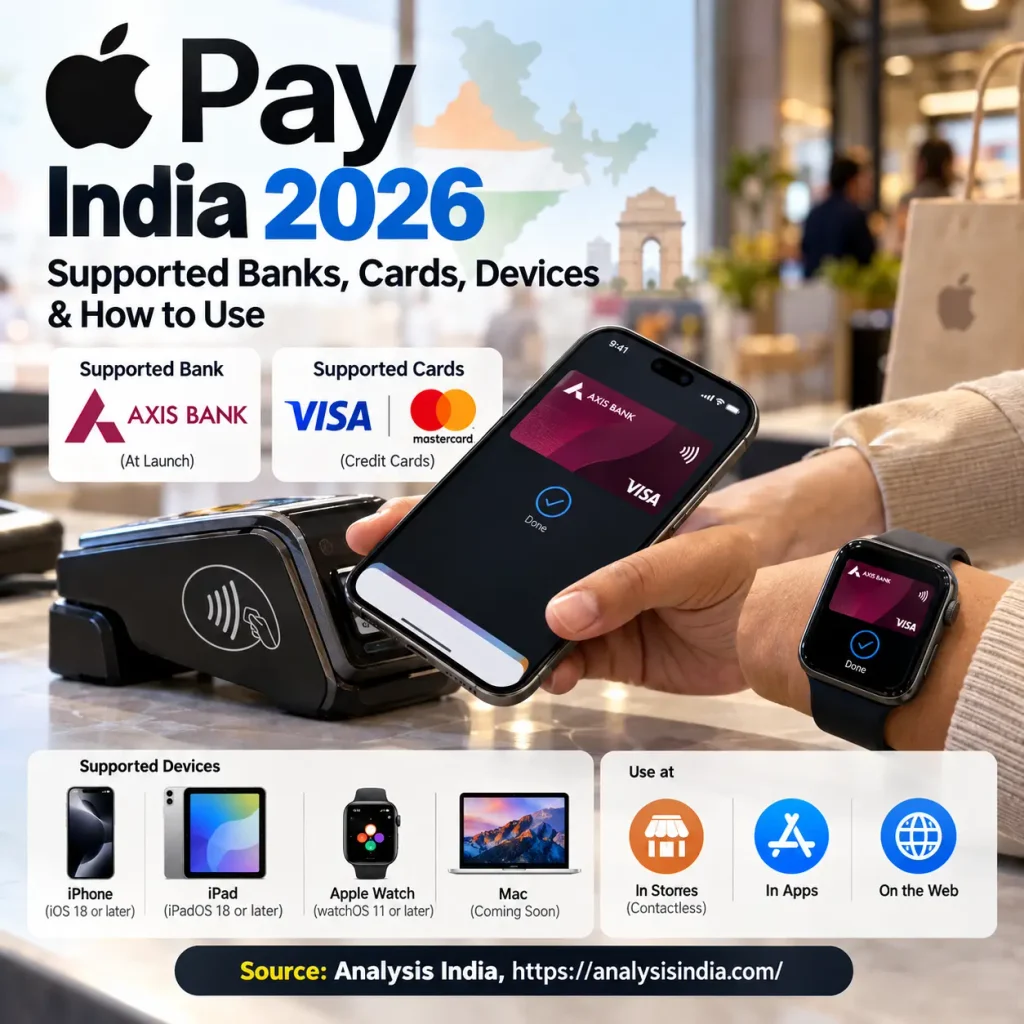
Apple Pay officially launched in India on September 30, 2026, initially supporting eligible Axis Bank Visa and Mastercard credit cards on iPhone, iPad and Apple Watch. Apple has also said that the service is available across thousands of in-store and online merchants and that Mac support is coming later.
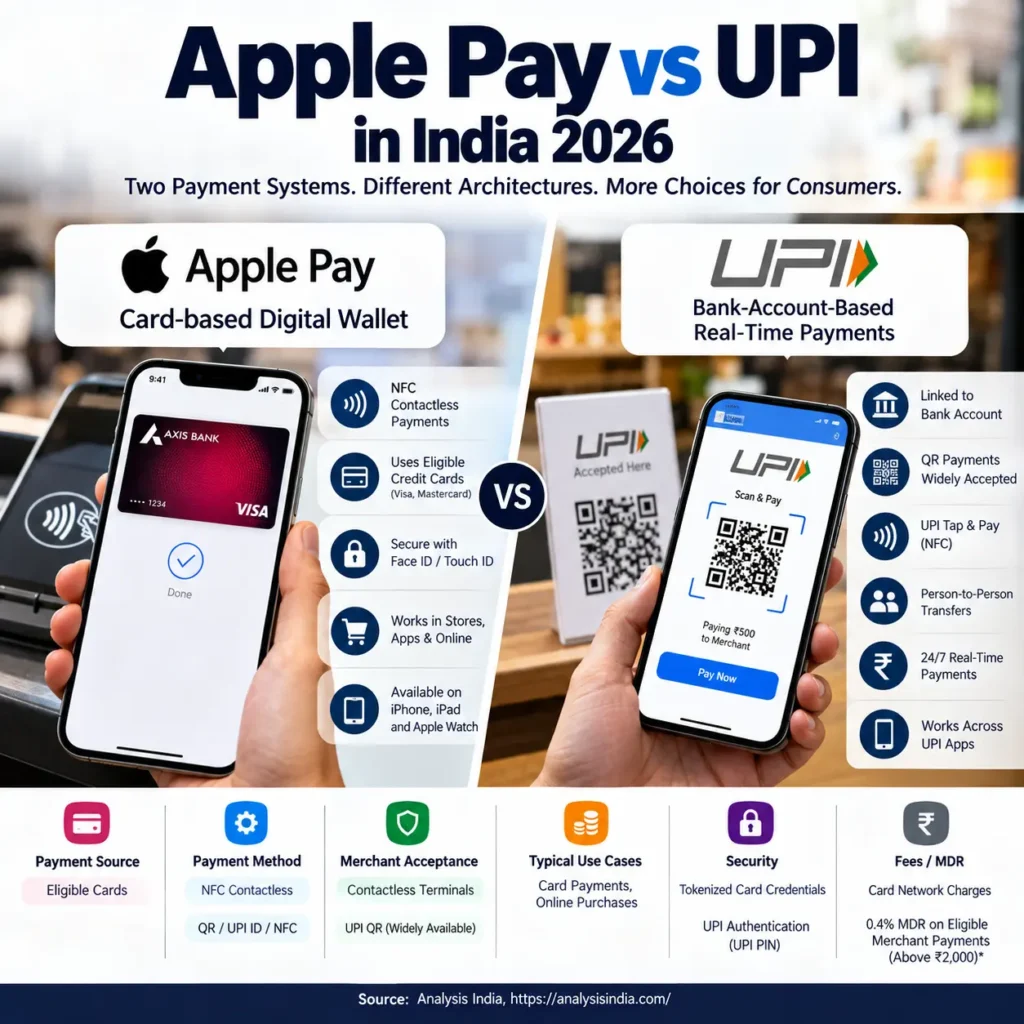
For a broader discussion of the launch, including the question of Apple Pay UPI support in India, readers can also refer to our detailed analysis of the Apple Pay India launch and its potential relationship with UPI.
The initial structure is important because Apple is not entering India by creating a new payment rail that directly competes with UPI. Instead, the company is adding a device-based payment interface on top of the existing card ecosystem. That makes the Apple Pay India Market Impact primarily a question of card utilization, payment behavior and ecosystem economics rather than a simple UPI-versus-Apple contest.
Apple Pay India Market Impact Is Primarily a Card-Market Story
The first mistake in analysing the Apple Pay India Market Impact would be to treat Apple Pay as another UPI competitor. UPI and Apple Pay operate at different layers of the payment system, with UPI providing account-to-account payment infrastructure while Apple Pay initially provides a device-based interface for supported cards.
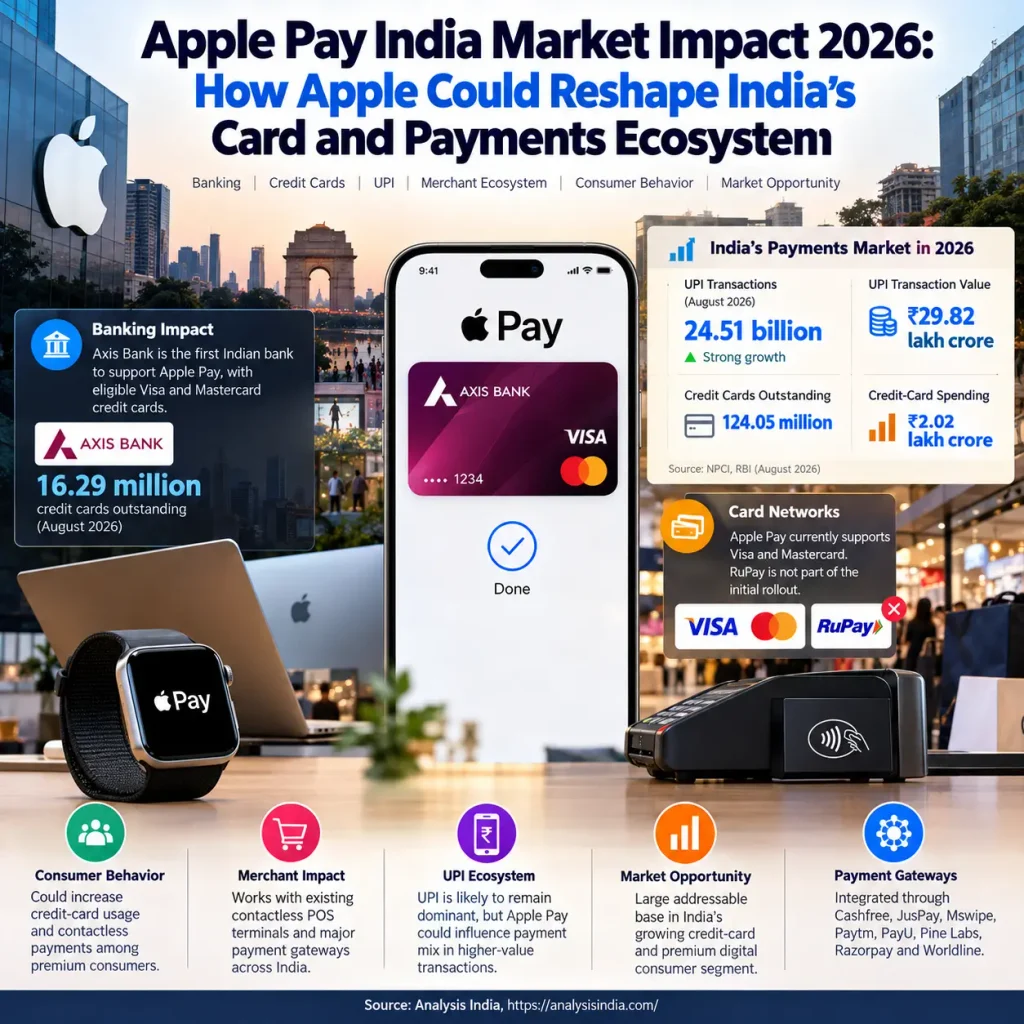
That distinction becomes clearer when the scale of the two ecosystems is compared. NPCI data shows that UPI processed 24.51 billion transactions worth ₹29.82 lakh crore in August 2026, with 752 banks live on the network. NPCI
India’s credit-card market is much smaller in transaction volume but economically important. RBI data showed 124.05 million credit cards outstanding in August 2026, while monthly credit-card spending reached approximately ₹2.02 lakh crore. Business Standard
India’s Digital Payment Market in 2026
| Indicator | August 2026 | What it means for Apple Pay |
|---|---|---|
| UPI transactions | 24.51 billion | Massive competing payment infrastructure |
| UPI transaction value | ₹29.82 lakh crore | Shows UPI’s economic scale |
| UPI live banks | 752 | Deep banking integration |
| Credit cards outstanding | 124.05 million | Large potential card base |
| Credit-card spending | ₹2.02 lakh crore | Significant addressable spending pool |
| Axis Bank credit cards | 16.29 million | Initial Apple Pay banking base |
| Apple Pay launch | September 30, 2026 | Beginning of Indian rollout |
Sources: NPCI UPI Statistics; RBI data reported by Business Standard; Apple; Axis Bank. NPCI
The scale difference makes a direct displacement thesis difficult to support. The more realistic Apple Pay India Market Impact is a change in the composition of digital payments, particularly within the credit-card segment.
If Apple Pay makes Visa and Mastercard credit cards easier to use for iPhone customers, card utilization could increase even while UPI continues to dominate routine and lower-value digital payments. This creates a market in which UPI can continue to dominate transaction volume while cards potentially gain additional value and frequency among premium consumers.
That is why the Apple Pay India Market Impact should be evaluated using card spending, active cards, transactions per card, average transaction value, contactless usage and merchant acceptance rather than simply wallet-registration numbers.
India’s Credit-Card Market Creates a Large Addressable Opportunity
The Apple Pay India Market Impact becomes more meaningful when the size of India’s credit-card market is considered. India had 124.05 million credit cards outstanding in August 2026, compared with 112.34 million a year earlier, showing that the underlying card market is still expanding. Business Standard
Apple therefore does not need to persuade consumers to adopt credit cards from scratch. Its immediate opportunity is to make an existing financial instrument more convenient and more deeply integrated into the consumer’s device.
This changes the economics of adoption. A customer who already owns an eligible credit card only needs a supported Apple device and an acceptance environment to begin using Apple Pay.
The addressable market is consequently narrower than India’s overall digital-payment market. However, it may also be economically more attractive because credit-card users tend to have higher spending capacity and cards are particularly important in travel, hotels, premium retail, dining, electronics and online commerce.
The Apple Pay India Market Impact could therefore be disproportionately concentrated among consumers who generate above-average card spending.
Axis Bank’s First-Mover Position Could Become Strategically Valuable
The first major banking implication of the Apple Pay India Market Impact is Axis Bank’s first-mover position. Axis Bank became the first Indian bank to offer Apple Pay, with eligible Visa and Mastercard credit cards available through Apple Wallet. AxisBank
Axis had 16.29 million credit cards outstanding in August 2026, compared with 124.05 million cards across the Indian market. That gives Axis an immediate customer base through which Apple Pay can begin establishing payment behavior.
Readers looking for the current Apple Pay India supported banks and cards can refer to our detailed guide, while this article focuses specifically on the implications of issuer participation for India’s banking and card markets.
Leading Credit-Card Issuers in India
| Bank / issuer | Credit cards outstanding, August 2026 | Strategic relevance |
|---|---|---|
| HDFC Bank | 27.09 million | Largest potential future Apple Pay issuer |
| SBI Card | 22.96 million | Large premium and mass card base |
| ICICI Bank | 19.83 million | Major private-sector card issuer |
| Axis Bank | 16.29 million | First Apple Pay partner |
Source: RBI data reported by Business Standard. Business Standard
The Apple Pay India Market Impact for Axis is therefore not simply about publicity. The more important opportunity is to increase the visibility and convenience of Axis credit cards among Apple customers.
This could influence top-of-wallet behavior. A consumer with three credit cards may continue to own all three but could increasingly use the card that is most conveniently available through the device.
That creates a potentially valuable competitive position for Axis. The real test will not be how many Axis cards are added to Apple Wallet, but whether active Apple Pay users increase their card spending or transaction frequency.
The Real Banking Impact Is Higher Card Utilization
The Apple Pay India Market Impact becomes more significant if other banks decide that Apple Pay participation is strategically necessary. India’s leading issuers already compete aggressively on rewards, lounge access, travel benefits, merchant offers, annual fees and credit limits.
Apple Pay introduces another dimension to that competition.
The question for HDFC Bank, ICICI Bank, SBI Card and other issuers is not simply whether Apple Pay is popular. It is whether their most valuable customers increasingly expect their preferred credit card to work seamlessly inside Apple’s ecosystem.
Reuters reported that Apple had been in discussions with HDFC Bank and ICICI Bank, although agreements had not been finalized at launch. Reuters
If additional issuers join, the Apple Pay India Market Impact could expand rapidly because the addressable card base would increase substantially.
The competitive structure could eventually change from “Apple Pay with Axis” to “which Indian credit cards offer the strongest Apple ecosystem experience?”
That would make digital-wallet compatibility part of the product proposition.
Apple Pay India Banking Impact Could Extend Beyond Payments
The Apple Pay India Market Impact on banks should not be measured only through transaction volume. Credit cards are recurring financial relationships, and banks benefit when customers continue using their cards frequently instead of shifting spending to competing issuers.
Apple Pay could strengthen this relationship by reducing friction at the point of payment. Once a supported card becomes part of a customer’s device ecosystem, the physical card becomes less important to the transaction experience.
This creates a possible retention effect. A customer may continue owning several cards but gradually concentrate more spending on the card that is easiest to access through the preferred device.
The Apple Pay India banking impact could therefore extend into customer retention, card activation and spending per customer. This is potentially more valuable than simply adding another payment option.
Visa and Mastercard Gain a New Distribution Layer
The Apple Pay India Market Impact also extends to card networks. At launch, Apple Pay supports eligible Axis Bank Visa and Mastercard credit cards, giving both networks access to Apple’s device ecosystem from the beginning. Apple
This matters because payment networks increasingly compete not only on transaction processing but also on how effectively their cards remain relevant across digital interfaces.
Visa and Mastercard do not need to build an independent consumer wallet if Apple provides the interface. Their existing card rails can continue processing transactions while Apple becomes the consumer-facing payment layer.
The structure is therefore distributed across multiple participants.
Apple Pay Payment Ecosystem
| Layer | Main participant | Role |
|---|---|---|
| Device interface | Apple | Wallet and payment authentication |
| Issuer | Axis Bank initially | Credit relationship |
| Card network | Visa / Mastercard | Network processing |
| Tokenization | Apple + network technology | Secure payment credential |
| Acquirer | Merchant’s acquiring bank / provider | Merchant transaction processing |
| Payment gateway | Razorpay, PayU, JusPay and others | Digital payment integration |
| Merchant | Retailer / online business | Accepts payment |
| Consumer | Apple device user | Initiates payment |
Source: Apple, Axis Bank and Apple developer documentation. Apple
The Apple Pay India Market Impact therefore does not mean Apple replaces the existing financial infrastructure. Apple adds another powerful interface to that infrastructure.
This is one of the most important structural conclusions of the Indian launch.
RuPay’s Exclusion Creates a Significant Market Question
The Apple Pay India Market Impact cannot be fully analysed without discussing RuPay. Apple Pay launched with eligible Axis Bank Visa and Mastercard credit cards, while RuPay cards were not supported at launch. Apple
RuPay has developed a distinctive position in India because eligible RuPay credit cards can participate in UPI transactions. That creates a different distribution advantage from the one Visa and Mastercard now receive through Apple Pay.
The resulting market structure is unusual.
Visa and Mastercard have an early advantage within Apple’s hardware ecosystem. RuPay retains an important advantage in the UPI ecosystem.
This means the Apple Pay India Market Impact may eventually become a competition between different distribution environments rather than simply between card networks.
RuPay Could Face a Different Kind of Competitive Pressure
The initial exclusion of RuPay is not necessarily a major threat to the network because Apple Pay’s initial addressable market is still limited. The situation could become more significant if Apple adds several major issuers while continuing to exclude RuPay.
At that point, Visa and Mastercard could become increasingly visible among Apple users even if those customers continue using UPI for everyday payments.
Visa, Mastercard and RuPay: Different Strategic Positions
| Network | Current Apple Pay position | Major Indian advantage | Potential issue |
|---|---|---|---|
| Visa | Supported at launch | Global acceptance | Competes with UPI for selected use cases |
| Mastercard | Supported at launch | Global network and tokenization | Same competitive pressure |
| RuPay | Not supported at launch | UPI-linked credit-card ecosystem | Limited Apple-device presence |
| UPI | Not a card network | Massive account-to-account acceptance | Higher-value merchant economics changing |
Sources: Apple, NPCI, Reuters. Apple
The Apple Pay India Market Impact will become considerably more interesting if RuPay eventually joins the ecosystem. RuPay participation could reduce the network-level differentiation between Apple’s payment interface and India’s domestic card ecosystem.
Until that happens, Apple’s launch gives Visa and Mastercard an additional route to remain relevant among Apple users.
Merchant Impact Is About Existing Infrastructure
Apple’s merchant documentation also indicates that merchants can work with existing contactless acceptance infrastructure, request an EMV contactless terminal where required, or use Tap to Pay on iPhone where supported. Apple says it does not charge merchants an incremental fee for accepting Apple Pay, while normal payment-processing fees continue to apply. This makes the merchant decision less about building a new payment rail and more about enabling another interface for an existing card-payment capability.
The transaction structure also explains why the economics are distributed across several participants. The payment service provider processes the tokenized transaction, the card network validates the token and maps it to the underlying account, and the issuing bank ultimately approves or declines the payment. Apple therefore becomes important at the consumer interface without replacing the issuer, network or merchant-side infrastructure.
The Apple Pay India Market Impact on merchants is different from its impact on banks. Apple is not asking every merchant to build a completely separate payment infrastructure.
Apple says Apple Pay works with compatible contactless terminals and has worked with payment service providers and merchant technology companies to support acceptance across India. Apple’s launch announcement names Cashfree, JusPay, Mswipe, Paytm, PayU, Pine Labs, Razorpay and Worldline among the providers involved. Apple
This is important because it lowers the incremental infrastructure requirement.
A merchant that already accepts contactless card transactions may be able to support Apple Pay without creating an entirely separate payment rail. That makes the Apple Pay merchant impact more evolutionary than revolutionary.
The most relevant merchants are therefore likely to be organized retail, hotels, restaurants, airports, travel companies, electronics stores and digitally integrated businesses.
POS Terminals Could Gain Greater Strategic Importance
India has developed enormous QR acceptance through UPI, but card transactions remain dependent on POS and contactless acceptance infrastructure. Apple Pay could potentially increase the utilization of existing contactless terminals without needing to challenge the QR ecosystem directly.
This is an important part of the Apple Pay India Market Impact because the value may come from increasing transactions through infrastructure that already exists.
For acquiring banks and payment processors, greater utilization can improve the economics of deployed terminals. For merchants, the more important question will be whether Apple Pay creates incremental spending or simply changes the way existing card transactions are initiated.
Potential Merchant Impact
| Merchant segment | Potential Apple Pay relevance | Main reason |
|---|---|---|
| Premium retail | High | Higher-value card customers |
| Hotels | High | Travel and premium spending |
| Airports | High | Contactless and international consumers |
| Restaurants | Medium to high | Fast contactless checkout |
| Electronics | High | Higher ticket values |
| Small QR merchants | Lower initially | UPI remains highly convenient |
| Online commerce | High | Faster card checkout |
The Apple Pay India Market Impact is therefore likely to be uneven across merchant categories. The strongest early effects should occur where card acceptance, premium customers and contactless infrastructure already overlap.
Payment Gateways Could Become Important Beneficiaries
The online portion of the Apple Pay India Market Impact deserves separate attention. Apple Pay can be used in apps and on websites, potentially reducing the need for repeated manual entry of card details during checkout. Apple
This creates an opportunity for payment gateways to integrate another payment interface into existing merchant infrastructure.
Apple has already identified several payment service providers supporting its Indian rollout. Apple
For gateways, the commercial opportunity is not simply processing another transaction type. The larger opportunity is providing merchants with a unified payment environment that can manage UPI, cards, Apple Pay and other payment methods.
That makes the Apple Pay India Market Impact relevant to payment orchestration as well as consumer payments.
Online Card Spending Could Become an Important Test
The Apple Pay India Market Impact could become particularly visible in online commerce because a substantial share of credit-card spending already takes place digitally.
RBI data reported in September showed total credit-card spending of ₹2.02 lakh crore in August 2026. Online credit-card spending was approximately ₹1.23 lakh crore, while e-commerce spending was around ₹79,355 crore. Business Standard
India’s Credit-Card Spending Structure
| Measure | August 2026 |
|---|---|
| Total credit-card spending | ₹2.02 lakh crore |
| Online spending | ₹1.23 lakh crore |
| E-commerce spending | ₹79,355 crore |
| Outstanding cards | 124.05 million |
Source: RBI data reported by Business Standard. Business Standard
These numbers provide an important context for the Apple Pay India Market Impact. If Apple Pay improves checkout conversion among Apple users, it could increase the value generated by existing card infrastructure.
However, the distinction between substitution and incremental spending will be crucial.
If a customer simply moves from manually entering a credit card to Apple Pay, the transaction method changes but the underlying spending may not. If Apple Pay encourages additional purchases or increases card frequency, the economic effect becomes considerably more meaningful.
Apple Pay India UPI Impact Will Probably Be Indirect
The Apple Pay India Market Impact should not be interpreted as an immediate threat to UPI. NPCI data shows that UPI processed 24.51 billion transactions in August 2026, worth ₹29.82 lakh crore, establishing an enormous installed payment ecosystem. NPCI’s official UPI statistics provide the clearest measure of the scale of India’s account-to-account payment ecosystem, with monthly transaction volume demonstrating why Apple Pay is unlikely to replace UPI directly.
A consumer can therefore use UPI for everyday payments and Apple Pay for selected credit-card transactions without seeing a contradiction between the two systems.
This is why the Apple Pay India UPI impact is more likely to appear through payment mix than total UPI volume. UPI can continue to dominate transaction count while Apple Pay helps credit cards capture a greater share of higher-value or premium transactions. The competitive picture becomes clearer when Apple Pay vs PhonePe in India is examined from the perspective of payment interfaces, consumer reach and the different payment ecosystems operating behind them.
The coexistence model is more realistic than a replacement model.
The difference in average transaction characteristics also matters. UPI’s extraordinary scale is built around a very broad range of everyday payments, while credit-card usage is more concentrated in higher-value consumer spending. This allows the two systems to coexist even when one dominates transaction volume. A change in card share within premium transactions would therefore not necessarily translate into a visible decline in total UPI activity.
UPI’s Changing Merchant Economics Add Another Variable
The Apple Pay India Market Impact also needs to be considered against changes in UPI merchant economics. From October 15, 2026, eligible UPI person-to-merchant transactions above ₹2,000 are subject to a 0.4% MDR, with the applicable framework retaining exemptions for smaller transactions. Business Standard
This does not fundamentally weaken UPI because most transactions by volume are still below the threshold. However, it introduces another cost variable for selected higher-value merchant payments.
That matters because higher-value payments are also where credit cards can offer rewards, discounts and other benefits.
The Apple Pay India Market Impact could therefore receive a modest tailwind in selected higher-value transactions if merchants and consumers begin comparing payment economics more closely.
However, UPI’s enormous acceptance network means this should be considered a marginal opportunity rather than a structural replacement scenario.
Consumer Behavior Could Change Before Market Share Does
The Apple Pay India Market Impact may initially appear through behavior rather than market share. A relatively small group of consumers could change the way they use their existing credit cards without significantly changing India’s overall payment rankings.
Apple Pay removes several friction points from card usage. Consumers can use an eligible card through a device they already carry, while online payments can avoid repeated manual card-entry steps.
This can make credit-card payments feel like a native function of the device rather than a separate banking activity.
The effect could be particularly relevant among premium consumers. Apple’s installed user base in India is more concentrated in affluent urban segments than the mass-market smartphone base, and these consumers are also more likely to hold multiple cards and spend across travel, dining, retail and digital services.
While Apple Pay is primarily entering India’s card ecosystem, its broader competitive position can also be understood by comparing Apple Pay vs Google Pay in India, particularly in terms of device ecosystems, payment behavior and consumer adoption.
The Real Battle Could Be for Top-of-Wallet Position
The Apple Pay India Market Impact becomes especially interesting when viewed through top-of-wallet behavior. Consumers with multiple credit cards rarely distribute spending equally across every card.
Rewards, convenience, merchant offers and card availability can influence which card becomes the default choice.
Apple Pay adds another variable to that decision. A card that is already available inside the user’s preferred device can become easier to access than a competing card that remains physical.
For issuers, this could make Apple Pay participation strategically valuable even if the absolute number of Apple Pay users remains relatively small.
The Apple Pay India Market Impact should therefore be evaluated through spending per active card rather than simply registered users.
A New Layer of Competition for Indian Banks
The Apple Pay India Market Impact could eventually alter how banks compete for premium customers. Historically, banks have differentiated credit cards through rewards, travel benefits, lounge access, fees, credit limits and merchant offers.
Digital wallet compatibility introduces another product attribute.
If a customer prefers Apple devices and regularly uses Apple Pay, a bank whose card is unavailable through the platform may become less attractive at the point of purchase.
That creates an incentive for major issuers to participate.
HDFC Bank, SBI Card and ICICI Bank collectively had a much larger card base than Axis Bank in August 2026. Business Standard Their eventual participation could therefore materially increase the scale of the Apple Pay India Market Impact.
Apple Becomes Part of the Payment Distribution Chain
The Apple Pay India Market Impact also highlights a broader structural shift in financial services. Apple does not become the card issuer or merchant acquirer when a customer uses Apple Pay, but it becomes a major part of the consumer-facing payment experience.
The bank retains the customer and credit relationship. Visa or Mastercard continues to provide network infrastructure, while the merchant’s payment provider continues to process acceptance.
Apple sits between these layers as the device and wallet interface.
This means Apple can influence how consumers interact with financial products without becoming a conventional bank.
The Apple Pay India Market Impact is therefore also part of a wider trend in which technology companies increasingly control the consumer-facing layer of financial services.
The Economics of Apple Pay Are Important for Banks
The Apple Pay India Market Impact is not only about adoption. The economics of participation matter just as much.
Industry reporting around the launch suggested that Axis Bank could pay Apple a portion of interchange economics for Apple Pay transactions. Business Standard reported estimates from industry sources of approximately 10–15 basis points from the interchange fee. Business Standard
That creates an important banking question.
If Apple Pay increases card spending sufficiently, an issuer could potentially accept some additional wallet economics in exchange for higher transaction value and customer engagement.
But if Apple Pay merely shifts existing transactions from physical cards to digital tokens, the economics become less attractive.
This is another reason why incremental spending will be the critical measure of the Apple Pay India Market Impact.
Three Possible Market Outcomes
The Apple Pay India Market Impact can be considered through three broad scenarios rather than a single forecast.
| Scenario | Bank participation | Consumer adoption | Likely market effect |
|---|---|---|---|
| Limited rollout | Axis remains dominant | Concentrated among Apple users | Premium card-wallet feature |
| Broad card adoption | Major Visa/Mastercard issuers join | Wider premium adoption | Higher card utilization |
| Ecosystem expansion | More banks plus broader acceptance | Strong device-based payment adoption | Important mobile-card layer |
In the limited scenario, the Apple Pay India Market Impact would remain concentrated among Axis customers and premium Apple users. Apple would have a presence in India, but the service would not materially change the overall payment structure.
In the broader adoption scenario, additional banks would expand the addressable card base. This could make Apple Pay a meaningful distribution channel for credit-card issuers.
The third scenario would create the most significant Apple Pay India Market Impact. If more issuers, merchants and payment providers participate and Apple expands functionality, the service could become a major mobile interface for India’s premium card transactions.
What the Market Should Measure
The Apple Pay India Market Impact should not be judged through launch-day publicity or application registrations. Investors, banks and payment companies should instead monitor active cards, transactions per active card, average spending per active card and incremental card spending.
Merchant acceptance is another important indicator. The expansion of Apple Pay across organized retail, hotels, travel, restaurants and online commerce would show whether the ecosystem is moving beyond an initial technology launch.
Key Apple Pay India Market Impact Metrics
| Metric | Why it matters |
|---|---|
| Eligible cards | Measures addressable base |
| Active Apple Pay cards | Measures real adoption |
| Transactions per card | Measures frequency |
| Spend per active card | Measures economic value |
| Incremental card spending | Measures true market expansion |
| Contactless share | Measures behavioral change |
| Online checkout conversion | Measures digital commerce impact |
| Merchant acceptance | Measures ecosystem depth |
| Bank participation | Measures market expansion |
| RuPay participation | Measures network competition |
This measurement framework is more useful than simply asking how many people have added a card to Apple Wallet.
The Most Important Question Is Incremental Spend
For banks and card networks, the most important question behind the Apple Pay India Market Impact is whether Apple Pay creates incremental spending.
If a customer moves a ₹5,000 transaction from a physical Axis card to an iPhone, the interface has changed but the underlying spending has not.
If the same customer starts using the credit card more frequently because payment becomes easier, Apple Pay has created additional economic value.
That distinction will determine whether the service becomes a genuine card-growth channel or remains primarily a convenience layer.
The Apple Pay India Market Impact should therefore ultimately be measured through incremental transaction value rather than wallet adoption alone.
Implications for India’s Payment Infrastructure
The Apple Pay India Market Impact also demonstrates how India’s payment system is becoming increasingly multi-layered. UPI provides account-to-account infrastructure, card networks provide card-payment infrastructure, banks provide financial products, payment gateways connect merchants, and technology companies increasingly control payment interfaces.
Apple Pay fits into this architecture rather than replacing it.
This makes Apple’s Indian strategy different from a conventional digital-wallet strategy.
Apple does not need to become India’s largest payment application to create an economic impact.
The Apple Pay India Market Impact could be substantial even if Apple controls only a small percentage of India’s total payment transactions, provided those transactions are concentrated among valuable credit-card users.
What Analysts Should Watch in 2027
The Apple Pay India Market Impact will become much easier to assess once several data points become available.
The first is bank participation.
The second is RuPay support.
The third is active Apple Pay usage.
The fourth is spending per active card.
The fifth is contactless transaction growth.
The sixth is merchant acceptance.
The seventh is online checkout conversion.
Together, these indicators will show whether Apple Pay is becoming a genuine market layer or remaining a premium feature for a relatively small customer group.
Conclusion: Apple Pay Could Reshape India’s Card Ecosystem Without Replacing UPI
The Apple Pay India Market Impact should ultimately be understood as a card-market development rather than a direct attack on UPI.
India’s UPI infrastructure is already too large and too deeply integrated into everyday commerce for a new card wallet to become a direct substitute in the near term. The more realistic outcome is that Apple Pay increases the convenience, visibility and utilization of credit cards among Apple users.
The Apple Pay India Market Impact could therefore be strongest inside India’s credit-card ecosystem.
Axis Bank has gained the first-mover position, while Visa and Mastercard have gained early access to Apple’s Indian device ecosystem. RuPay, meanwhile, retains an important advantage through its relationship with India’s domestic payment infrastructure and UPI-linked credit-card payments.
The Apple Pay India Market Impact will become considerably larger if major issuers such as HDFC Bank, ICICI Bank and SBI Card eventually join the ecosystem. Their combined card bases are substantially larger than Axis Bank’s current 16.29 million cards. Business Standard
Merchant acceptance will then determine whether this expanded card base translates into meaningful transaction volume.
Payment gateways, acquirers and POS providers are already positioned to support the expansion because Apple is building on existing payment infrastructure rather than replacing it.
The Apple Pay India Market Impact may therefore be reflected in payment mix rather than payment dominance.
UPI can continue to dominate everyday account-to-account payments while credit cards capture a greater share of higher-value transactions.
Apple Pay can sit between those two systems as a device-based interface for card payments.
The Apple Pay India Market Impact would then be structural even without becoming dominant.
Apple would not need to beat UPI.
It would need to make the Indian credit card more useful.
If it succeeds, the biggest change could occur not in India’s overall digital-payment rankings but in the economics of banks, card networks, payment gateways and merchants competing for India’s premium digital consumer.
Frequently Asked Questions
What is the Apple Pay India Market Impact in 2026?
The immediate Apple Pay India Market Impact is concentrated in the credit-card ecosystem rather than the broader UPI infrastructure. Apple Pay initially provides eligible Axis Bank Visa and Mastercard credit-card customers with a device-based payment interface.
Will Apple Pay challenge UPI in India?
The Apple Pay India Market Impact is unlikely to challenge UPI directly at the infrastructure level. Apple Pay’s initial Indian rollout is based on eligible credit cards, while UPI remains an account-to-account payment infrastructure with enormous transaction volume.
Which bank launched Apple Pay first in India?
Axis Bank is the first Indian bank to support Apple Pay. Eligible Axis Bank Visa and Mastercard credit cards can be added to Apple Wallet.
Does Apple Pay support RuPay in India?
RuPay is not supported in the initial Apple Pay India launch. Apple’s current India participating-bank page lists Axis Bank Visa and Mastercard credit cards.
How could Apple Pay affect India’s credit-card market?
The Apple Pay India Market Impact could come through higher card utilization, increased contactless transactions and greater top-of-wallet concentration among Apple users. The most important measure will be incremental spending rather than the number of registered cards.
What is the Apple Pay India market opportunity for banks?
The opportunity is primarily around card usage, customer engagement, retention and premium customers. The Apple Pay India Market Impact could become substantially larger if additional major banks participate.
Could Apple Pay increase contactless payments?
Potentially. Apple Pay provides a device-based interface for contactless card payments, allowing existing compatible POS infrastructure to serve Apple users without necessarily requiring a new payment rail.
What should investors watch after the launch?
The most important Apple Pay India Market Impact indicators are additional bank participation, RuPay support, active users, transactions per card, spending per active card, online checkout conversion, contactless usage and merchant acceptance.