📅 Published: April 14, 2026
🔄 Last Updated: October 1, 2026
China has become one of the most important markets for gastric cancer screening because of its substantial disease burden, expanding healthcare infrastructure and growing focus on earlier cancer detection. The China Gastric Cancer Screening Market is also being influenced by the expansion of screening initiatives, improvements in diagnostic technology and increasing attention to high-risk populations. Unlike markets where gastric cancer screening remains relatively limited, China has a stronger public health rationale for developing screening capacity because of its large population and significant gastric cancer burden.
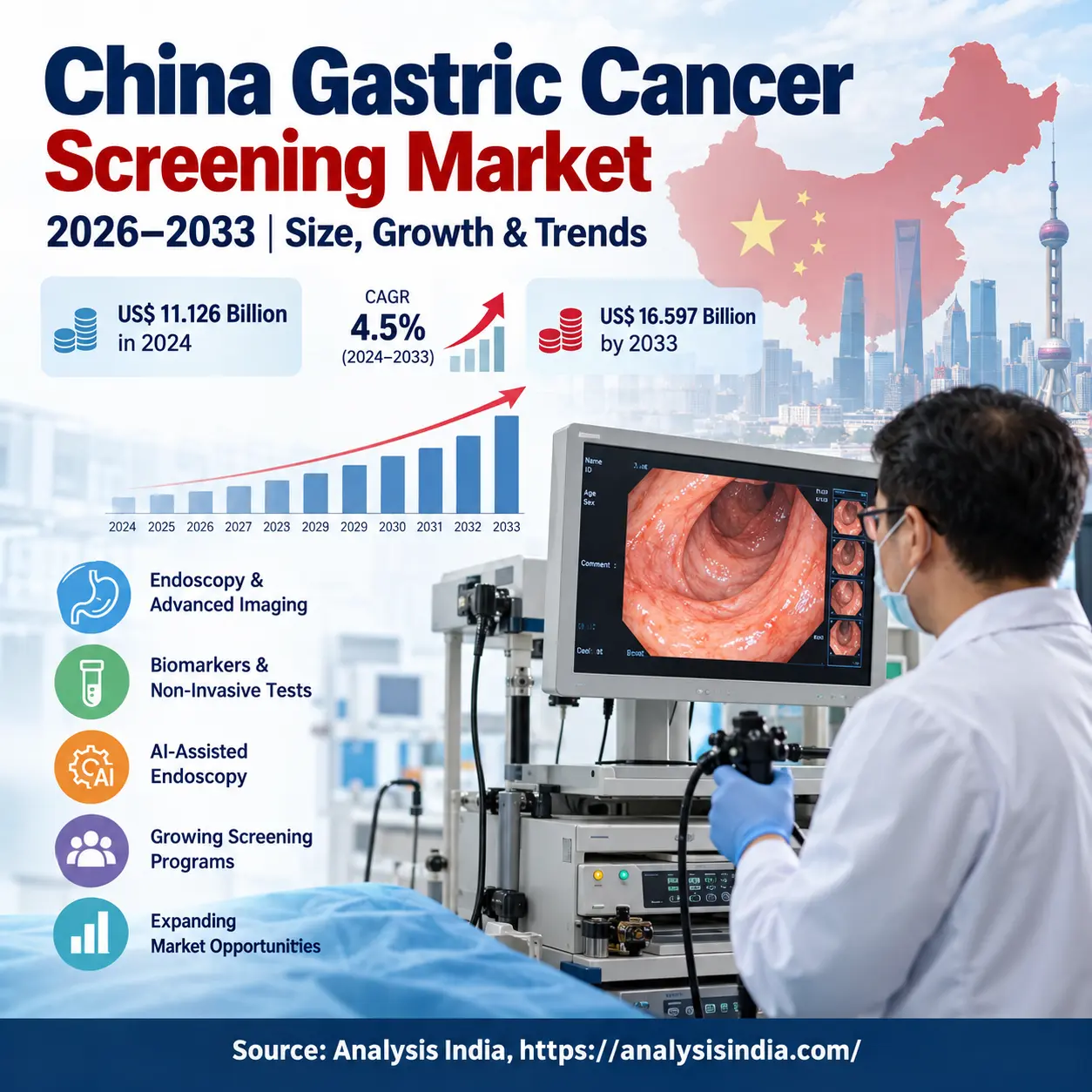
The China Gastric Cancer Screening Market was valued at approximately US$11.126 billion in 2024 and is projected to reach about US$16.597 billion by 2033, representing an estimated compound annual growth rate of around 4.5%. This expansion reflects continued demand for endoscopic screening, diagnostic testing, biomarkers and other technologies that can support earlier identification of gastric abnormalities. The market opportunity extends beyond screening procedures themselves and includes diagnostic laboratories, hospitals, medical technology providers and emerging digital health solutions.
China is the largest market within the selected regional dataset, while the broader Global Gastric Cancer Screening Market is shaped by differences in disease burden, screening adoption, healthcare infrastructure and diagnostic technology across major regions.
A major characteristic of the China Gastric Cancer Screening Market is the interaction between disease burden and healthcare system development. Screening demand is not determined only by the number of people at risk. It also depends on the availability of endoscopy services, trained healthcare professionals, diagnostic laboratories, screening programs and pathways for follow-up evaluation. Regional differences within China are therefore important because screening capacity and healthcare access can vary between major urban centers and less-developed areas.
Technology is another important component of China’s evolving screening landscape. Endoscopy remains central to the diagnostic pathway, while image-enhanced techniques, serological biomarkers, risk-stratification approaches, liquid biopsy research and artificial intelligence are creating additional opportunities. These technologies may help improve screening efficiency, identify individuals who require further evaluation and expand access to diagnostic services. The future development of the market will therefore depend on how effectively clinical needs, technology adoption, public health programs, regulation and healthcare procurement come together.
This article examines the market size and forecast through 2033, screening programs, technology adoption, regulatory conditions, reimbursement and procurement, regional differences, competitive opportunities and the future outlook for gastric cancer screening in China.
China Gastric Cancer Screening Market Size and Forecast 2024–2033
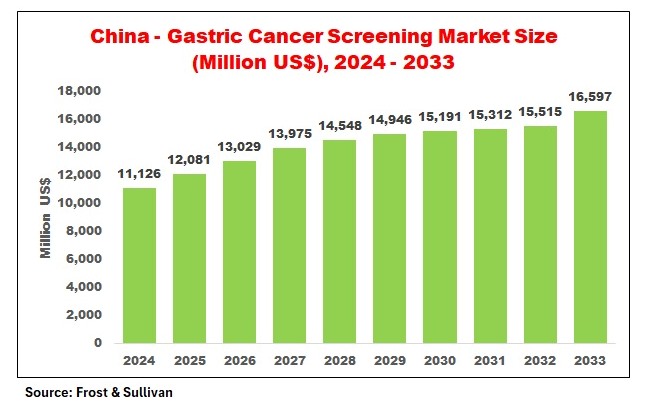
The China Gastric Cancer Screening Market was valued at approximately US$11.126 billion in 2024. Based on the underlying market dataset used for this analysis, the market is projected to reach approximately US$16.597 billion by 2033. This represents an absolute increase of about US$5.47 billion over the forecast period. The estimated compound annual growth rate is approximately 4.5% between 2024 and 2033, indicating steady expansion rather than a short-term surge.
2024 Market Size
The 2024 market size provides a substantial base for future expansion. China’s large population and significant gastric cancer burden create a considerable requirement for screening and diagnostic services. However, market value is also influenced by the availability of screening infrastructure, diagnostic capacity and the adoption of different testing approaches. Hospitals, screening centers and diagnostic laboratories therefore represent important components of the China Gastric Cancer Screening Market.
Endoscopy represents an important part of the screening and diagnostic pathway, particularly where further clinical evaluation is required. At the same time, serological testing, biomarkers, risk-stratification methods and emerging non-invasive approaches can contribute to identifying people who may require additional assessment. As these technologies develop, the composition of market demand may gradually change.
2033 Market Forecast
By 2033, the China Gastric Cancer Screening Market is expected to reach approximately US$16.597 billion. The projected increase reflects the continuing development of screening capacity, diagnostic technology and healthcare infrastructure. Expansion is also connected with efforts to identify gastric cancer and precancerous abnormalities earlier, particularly among populations with elevated risk.
The forecast should not be interpreted as uniform growth across every province or screening technology. China’s healthcare system contains substantial regional differences in infrastructure, specialist availability and access to diagnostic services. Consequently, market development is likely to vary between major urban healthcare centers and areas where screening capacity remains more limited.
Growth Interpretation
The approximately 4.5% CAGR indicates a market characterized by sustained development through 2033. The opportunity extends beyond conventional screening procedures to include diagnostic equipment, laboratory testing, biomarkers, digital technologies and AI-supported clinical workflows. The interaction between public health initiatives, technology adoption and healthcare procurement will therefore remain important in determining how the market evolves.
Overall, the forecast indicates that China’s gastric cancer screening sector will remain a major component of the broader global market. Its large starting base means that even moderate percentage growth can translate into substantial additional market value by 2033. This creates opportunities for healthcare providers and technology companies while also increasing the importance of clinical validation, cost-effectiveness and scalable screening infrastructure.
Why Gastric Cancer Screening Matters in China
Gastric cancer remains an important public health concern in China, making early detection an important factor in the development of the China Gastric Cancer Screening Market. The country’s substantial disease burden creates demand for screening capacity, diagnostic services and follow-up pathways. As healthcare systems continue to expand their focus on earlier cancer detection, screening can play a greater role in identifying abnormalities before disease becomes more advanced. This creates a broader need for accessible and scalable diagnostic infrastructure.
High Gastric Cancer Burden
China’s large gastric cancer burden is one of the fundamental factors supporting screening demand. A substantial number of patients require diagnostic evaluation and follow-up, placing continued pressure on hospitals, endoscopy services and diagnostic laboratories. The scale of the population also means that even targeted screening among higher-risk groups can generate significant demand for healthcare services. Consequently, disease burden remains closely connected with the long-term development of the China Gastric Cancer Screening Market.
Aging and High-Risk Populations
Population aging is another factor influencing future screening requirements. Older adults generally represent an important population for cancer detection and healthcare utilization. At the same time, individuals with elevated gastric cancer risk may require greater attention from healthcare providers and screening programs. Identifying appropriate populations for screening can help healthcare systems direct limited diagnostic resources toward people who are more likely to benefit from further evaluation.
Regional Differences in Disease Burden
China should not be viewed as a completely uniform screening market. Disease burden, healthcare infrastructure and access to specialist services can differ between regions. Large urban healthcare centers generally have greater access to advanced diagnostic facilities, while less-developed areas may face limitations involving equipment, trained personnel and referral pathways. These differences can influence the pace at which screening services expand across the country.
Need for Earlier Detection
Earlier identification is central to the long-term opportunity for gastric cancer screening in China. Screening programs and diagnostic pathways can help identify suspicious lesions or individuals requiring additional assessment. The resulting demand extends from initial screening to endoscopy, laboratory testing, pathology and follow-up care. As China continues developing its cancer prevention and diagnostic infrastructure, the China Gastric Cancer Screening Market is therefore likely to remain closely connected with efforts to improve early detection and healthcare access.
Gastric Cancer Screening Programs in China
Gastric cancer screening in China is increasingly connected with public health planning, hospital-based services and targeted approaches for populations with elevated risk. These different channels contribute to the development of the China Gastric Cancer Screening Market by creating demand for screening procedures, diagnostic testing and follow-up evaluation. The structure of screening activity can vary according to local disease burden, healthcare capacity and the availability of trained specialists. As a result, understanding how screening programs operate is important for assessing future market development.
National Screening Initiatives
China’s efforts to strengthen cancer prevention and early detection provide an important foundation for gastric cancer screening. China’s National Health Commission has issued a 2024 gastric cancer screening and early diagnosis and treatment program covering high-risk populations, screening methods, screening frequency, early diagnosis and follow-up management. Public health initiatives can support awareness, risk identification and referral for diagnostic evaluation. Large-scale programs can also help establish standardized approaches to screening and follow-up. Their market impact depends on program coverage, available funding, healthcare capacity and the ability to connect screening with appropriate diagnostic services.
Provincial Screening Programs
Provincial and local healthcare systems play an important role because disease burden and medical infrastructure differ across China. Regional programs can be designed around local population characteristics and healthcare resources. Areas with higher levels of gastric cancer risk may have greater incentives to expand screening capacity, while urban regions can benefit from established hospitals and diagnostic centers. These differences contribute to varied adoption patterns within the China Gastric Cancer Screening Market.
High-Risk Population Screening
Targeting people with elevated risk can help healthcare providers use screening resources more efficiently. Risk factors and relevant clinical characteristics can be considered when determining who may require further evaluation. Such approaches can also create demand for risk-assessment tools, laboratory testing, endoscopy and pathology services. The development of more precise risk-stratification methods could further influence how screening programs identify individuals for additional investigation.
Hospital-Based Screening
Hospitals remain important locations for screening, diagnosis and follow-up because they can connect initial evaluation with specialist care. Tertiary hospitals can provide endoscopy, imaging, pathology and other diagnostic services within integrated clinical pathways. Hospital networks can therefore support both public screening initiatives and opportunistic screening among patients who already interact with the healthcare system.
Public Health and Opportunistic Screening
Not all screening activity needs to occur through a single nationwide program. Opportunistic screening can take place when individuals interact with healthcare providers for other reasons and are identified as potentially requiring gastric evaluation. This approach can complement organized programs, particularly where healthcare systems are expanding their ability to identify high-risk populations. Together, organized initiatives, provincial programs and hospital-based services can support continued development of the China Gastric Cancer Screening Market.
China Gastric Cancer Screening Technology Landscape
Technology is becoming an increasingly important component of the China Gastric Cancer Screening Market. The market is not dependent on a single screening method. Instead, different technologies can serve different stages of the screening and diagnostic pathway, from initial risk assessment to endoscopic evaluation and follow-up diagnosis. The most relevant technologies include endoscopy, image-enhanced techniques, serological biomarkers, risk-stratification tests, liquid biopsy and artificial intelligence.
Endoscopy and Image-Enhanced Endoscopy
Endoscopy remains a central technology for direct examination of the upper gastrointestinal tract. It allows clinicians to visually assess the stomach and obtain tissue samples when further pathological evaluation is required. Image-enhanced endoscopic technologies can provide additional visualization capabilities and may support the identification and characterization of suspicious lesions. Their adoption is therefore closely associated with the availability of trained endoscopists, hospital infrastructure and appropriate follow-up pathways.
Serological Biomarkers
Blood-based biomarkers provide an opportunity to assess gastric cancer risk without immediately relying on an invasive procedure. Serological approaches can potentially help identify individuals who may benefit from additional clinical evaluation. Their role is particularly relevant in large populations where healthcare systems need methods that can support risk assessment before more resource-intensive diagnostic procedures. However, clinical performance and appropriate use within screening pathways remain important considerations.
Risk-Stratification Tests
Risk stratification can help healthcare providers differentiate between people with different levels of gastric cancer risk. Such approaches may incorporate demographic, clinical or laboratory information to identify individuals who require closer evaluation. The development of more precise risk models could help improve the efficiency of screening programs by directing diagnostic resources toward populations with greater potential need.
Liquid Biopsy
Liquid biopsy represents an emerging area within the China Gastric Cancer Screening Market. Research into circulating biomarkers and other molecular signals could eventually support non-invasive approaches to cancer detection or risk assessment. The development of liquid biopsy cancer screening technologies in China could therefore create additional opportunities for risk assessment, early detection research and non-invasive diagnostic strategies. However, liquid biopsy should currently be treated as an emerging technology rather than a direct replacement for established endoscopic evaluation. Its future market role will depend on clinical validation, diagnostic performance, regulatory acceptance and integration into practical screening pathways.
Research into liquid biopsy technologies could eventually support non-invasive approaches to cancer risk assessment and screening, although their clinical role will depend on further validation.
AI-Assisted Endoscopy
Artificial intelligence is creating another area of technological development. The broader adoption of AI across healthcare diagnostics is also increasing interest in automated image analysis and intelligent diagnostic workflows, including applications that can support cancer detection and clinical decision-making. AI-based image analysis can potentially assist clinicians by identifying suspicious areas during endoscopic examinations and supporting more consistent image interpretation. The technology may be particularly relevant in settings where screening volumes are high and healthcare systems are seeking ways to improve workflow efficiency.
Non-Invasive Screening Technologies
Non-invasive approaches are receiving attention because they could help expand access to screening and reduce dependence on invasive procedures for initial assessment. Blood-based biomarkers, molecular tests and other emerging methods may eventually complement established screening pathways. However, adoption will depend on evidence demonstrating clinical value and reliable integration with follow-up diagnostic services.
Overall, the technology landscape is moving toward a more integrated model in which different tools can perform complementary roles. Endoscopy remains important for direct evaluation, while biomarkers, risk-stratification methods and AI may increasingly support population assessment, triage and clinical decision-making. This combination could shape the next stage of development in the China Gastric Cancer Screening Market.
China Gastric Cancer Screening Market – Regulatory Environment
The regulatory environment is an important part of the China Gastric Cancer Screening Market because screening technologies must demonstrate appropriate clinical performance and meet applicable regulatory requirements before broader commercialization. This is particularly relevant as the market expands beyond conventional endoscopy into biomarkers, molecular diagnostics, artificial intelligence and other emerging technologies. Regulatory requirements can therefore influence both the timing and scale of technology adoption.
NMPA Regulatory Pathway
The National Medical Products Administration (NMPA) is an important regulatory authority for medical products and diagnostic technologies in China. Companies introducing new screening-related products need to understand the applicable classification, evidence requirements and approval pathway. The regulatory process can influence commercialization timelines and the ability of emerging technologies to enter hospitals and diagnostic networks.
For companies targeting the China Gastric Cancer Screening Market, regulatory planning is therefore an important component of product development. Technologies that involve diagnostic testing, medical devices or software may face different requirements depending on their intended use and classification.
Clinical Validation Requirements
Clinical evidence is particularly important for emerging screening technologies. Biomarkers, molecular tests and AI-supported diagnostic tools need appropriate evidence to demonstrate their intended clinical value. Validation can involve assessment of diagnostic performance, reproducibility and suitability for the intended patient or screening population.
For screening technologies, evidence generation is also important because a test may perform differently when used across diverse populations and healthcare settings. Technologies intended for broader adoption may therefore require evidence that supports their use within practical clinical workflows.
Diagnostic Test Approval
Diagnostic products entering the Chinese market must comply with applicable regulatory requirements before commercial deployment. For developers of biomarkers and other non-invasive approaches, regulatory approval can become a significant milestone because it helps determine whether a technology can move from research or pilot settings into routine healthcare use.
The regulatory pathway can also influence investment decisions. Companies developing new screening technologies may need to consider clinical evidence, manufacturing quality, regulatory classification and post-market requirements as part of their commercialization strategy.
AI and Software Regulation
Artificial intelligence introduces additional considerations because AI-assisted screening tools may function as medical software or as components of medical devices. Developers need to establish appropriate evidence for the intended clinical application and demonstrate that the technology can operate reliably within healthcare workflows.
As AI-assisted endoscopy and digital diagnostic tools continue to develop, regulatory clarity and clinical validation will remain important for wider adoption. The interaction between regulation, evidence generation and commercialization will therefore be a significant factor shaping the future China Gastric Cancer Screening Market.
Reimbursement and Procurement in China Gastric Cancer Screening Market
Reimbursement and procurement mechanisms can strongly influence how screening technologies move from clinical development into broader healthcare adoption. Within the China Gastric Cancer Screening Market, the commercial opportunity therefore depends not only on clinical performance but also on whether hospitals, healthcare providers and patients can access and finance the relevant screening services.
National Reimbursement Framework
China’s national reimbursement framework can influence the affordability and utilization of healthcare services and diagnostic technologies. For screening-related products, reimbursement decisions may depend on clinical value, economic evidence and the applicable healthcare payment framework. Technologies that demonstrate meaningful clinical benefits may have greater potential to secure wider adoption when they can also demonstrate an appropriate economic value.
However, reimbursement should not be viewed as uniform across all screening technologies. Different diagnostic tests, procedures and medical technologies can face different coverage and payment conditions. Developers therefore need to understand the specific reimbursement pathway relevant to their product or service.
Provincial Procurement
Provincial healthcare systems are important because procurement and purchasing practices can influence access to medical technologies at the regional level. Screening providers and technology companies may need to adapt their commercial strategies according to local procurement structures, healthcare budgets and hospital requirements.
For the China Gastric Cancer Screening Market, provincial variation can create both opportunities and challenges. Successful adoption in one region does not necessarily guarantee immediate expansion across the entire country. Local evidence, provider relationships and demonstrated clinical value can influence purchasing decisions.
Public Hospital Procurement
Public hospitals represent an important channel for screening-related technologies. Procurement decisions can involve considerations such as product quality, clinical evidence, cost, technical support and compatibility with existing diagnostic infrastructure. Companies entering this market may therefore need to establish relationships with hospitals and demonstrate how their technologies fit into existing screening workflows.
Private Screening Programs
Private hospitals and diagnostic centers can provide another route for market development. These providers may have greater flexibility in introducing new services, particularly in urban markets where patients have access to a wider range of healthcare options. Private screening can therefore complement public-sector programs and contribute to demand for diagnostic equipment, laboratory testing and emerging technologies.
Cost-Effectiveness Evidence
Cost-effectiveness is becoming increasingly relevant as healthcare systems evaluate new diagnostic technologies. A screening technology must not only demonstrate analytical or clinical performance but also provide a credible value proposition for healthcare providers and payers.
This is particularly important for emerging biomarkers, molecular diagnostics and AI-based technologies. Evidence showing that a technology can improve screening efficiency, support earlier evaluation or reduce unnecessary procedures could strengthen its commercial case. Consequently, reimbursement, procurement and economic evidence will remain important factors influencing the future China Gastric Cancer Screening Market.
Regional Adoption of Gastric Cancer Screening in China
The development of the China Gastric Cancer Screening Market is not uniform across the country. Differences in disease burden, healthcare infrastructure, specialist availability and access to diagnostic services can influence screening adoption from one region to another. Major urban healthcare centers generally have greater access to advanced hospitals, endoscopy units and diagnostic laboratories, while less-developed areas may face limitations in equipment, trained personnel and referral infrastructure.
High-Incidence Regions
Regions with a comparatively higher gastric cancer burden can have stronger public health incentives to expand screening and early detection services. Higher-risk populations may generate greater demand for endoscopy, laboratory testing and follow-up diagnosis. Screening activity in these areas can also support the development of specialized healthcare services and diagnostic networks.
Urban Screening Markets
Large cities represent important markets because they typically have greater concentrations of tertiary hospitals, specialist physicians, diagnostic laboratories and private healthcare providers. Urban patients may also have better access to advanced diagnostic technologies and preventive healthcare services.
These characteristics can accelerate adoption of new screening technologies. Hospitals in major metropolitan areas may serve as early adoption centers for AI-assisted endoscopy, advanced imaging, biomarkers and other diagnostic approaches. As technologies become more established, they may subsequently expand into broader healthcare networks.
Rural and Underserved Areas
Rural and underserved communities face different challenges. Limited availability of specialist physicians, endoscopy facilities and diagnostic laboratories can make access to screening more difficult. Travel distance and healthcare costs may also affect participation in screening and follow-up services.
For the China Gastric Cancer Screening Market, expanding access beyond major urban centers could therefore represent an important long-term opportunity. Mobile diagnostic services, improved referral systems, centralized laboratory testing and digital healthcare tools may help connect underserved populations with appropriate screening pathways.
Tertiary Hospital Networks
Tertiary hospitals play an important role in China’s screening and diagnostic ecosystem because they can provide specialized endoscopy, pathology and follow-up services. They can also function as referral centers for patients identified through community or primary healthcare screening.
Hospital networks can therefore help connect initial screening with specialist diagnosis and treatment. Greater integration between primary healthcare providers, screening programs, diagnostic laboratories and tertiary hospitals could improve the continuity of care while supporting the expansion of the China Gastric Cancer Screening Market across different regions.
China Gastric Cancer Screening Market Competitive Landscape and Business Opportunities
The China Gastric Cancer Screening Market includes a diverse group of participants ranging from domestic diagnostic companies and international medical technology providers to hospitals, laboratories and digital health companies. Competition is increasingly influenced by the ability to provide clinically useful technologies while also meeting regulatory, procurement and healthcare delivery requirements. This creates a market in which product performance alone may not determine commercial success.
Domestic Diagnostic Companies
Domestic diagnostic companies can benefit from their understanding of China’s healthcare system, local procurement structures and clinical requirements. Diagnostic providers may participate in laboratory testing, biomarker development and other screening-related services. Local relationships with hospitals and healthcare networks can also support the commercialization and deployment of diagnostic technologies.
International Medical Technology Companies
International medical technology companies contribute expertise in areas such as endoscopy, imaging and diagnostic equipment. Their opportunities can be particularly relevant in major hospitals and advanced healthcare centers where sophisticated diagnostic technologies are already available.
However, international companies operating in China need to consider local regulatory requirements, procurement processes, pricing conditions and competition from domestic providers. Local partnerships and evidence generation can therefore become important components of market-entry strategies.
AI and Digital Health Providers
AI companies are developing tools that may support image analysis, endoscopic lesion detection and clinical decision-making. Digital health providers can also contribute to patient identification, referral management and data integration.
The commercial opportunity depends on whether these technologies can demonstrate practical clinical value rather than simply technical capability. Integration with existing hospital systems and workflows is particularly important for successful adoption.
Hospital and Laboratory Partnerships
Partnerships between hospitals, diagnostic laboratories and technology companies can help connect screening technologies with real-world clinical pathways. Hospitals can provide access to patient populations and clinical expertise, while laboratories and technology companies can contribute testing capabilities and analytical tools.
Emerging Business Opportunities in China
The China Gastric Cancer Screening Market offers opportunities across both established and emerging areas of healthcare delivery. One important opportunity is the development of technologies that can help identify individuals who may benefit from further diagnostic evaluation.
Non-Invasive Triage
Non-invasive tests could potentially help prioritize individuals for additional investigation, particularly where healthcare systems need scalable approaches for large populations. Their commercial potential will depend on clinical validation, regulatory acceptance and integration with established screening pathways.
AI-Assisted Endoscopy
AI-assisted endoscopy represents another opportunity because China has substantial demand for diagnostic services. Tools that support image interpretation or help identify suspicious lesions could potentially improve workflow efficiency when appropriately validated and integrated into clinical practice.
Centralized Laboratories
Centralized laboratory services can support screening programs by providing standardized testing and processing capabilities. They may be particularly useful for biomarker-based approaches that require consistent laboratory infrastructure.
Screening Infrastructure
Investment in endoscopy capacity, diagnostic laboratories, trained personnel and referral networks can create opportunities for healthcare providers and technology companies. Infrastructure expansion is particularly relevant in regions where access to screening remains limited.
Rural Expansion
Expanding screening services beyond major urban centers represents a longer-term opportunity. Digital referral systems, centralized testing and scalable diagnostic models could help connect underserved populations with appropriate healthcare services.
Overall, competitive opportunities in the China Gastric Cancer Screening Market will increasingly depend on the combination of clinical evidence, regulatory readiness, affordability, healthcare partnerships and scalable delivery models.
Future Outlook for the China Gastric Cancer Screening Market
The China Gastric Cancer Screening Market is expected to continue expanding through 2033 as screening capacity, diagnostic technology and healthcare infrastructure develop. Future growth will depend on how effectively China combines population risk assessment, endoscopic capacity, laboratory testing and emerging technologies within practical healthcare pathways.
Technology is likely to remain an important growth factor. AI-assisted endoscopy, biomarkers, risk-stratification tools and molecular diagnostics could support more targeted and efficient screening models. However, wider adoption will depend on clinical evidence, regulatory requirements, reimbursement conditions and the ability of healthcare providers to integrate these technologies into existing workflows.
Another important factor will be the expansion of screening access beyond major urban healthcare centers. Improving diagnostic infrastructure, referral networks and laboratory capacity could help address regional differences in healthcare access. At the same time, public health programs and hospital networks can support greater identification and follow-up of people at elevated risk.
By 2033, the market is projected to reach approximately US$16.597 billion, compared with US$11.126 billion in 2024. The forecast indicates steady rather than explosive expansion, with an estimated CAGR of about 4.5%. This trajectory suggests that both established screening technologies and emerging diagnostic approaches may contribute to market development.
Conclusion: China Gastric Cancer Screening Market
The China Gastric Cancer Screening Market is positioned around a combination of substantial disease burden, expanding screening infrastructure, technology development and healthcare system investment. Its future will depend not only on new diagnostic technologies but also on regulation, reimbursement, clinical validation and the ability to deliver screening services across different regions of China.
Frequently Asked Questions: China Gastric Cancer Screening Market
What is the China Gastric Cancer Screening Market size in 2024?
The China Gastric Cancer Screening Market was valued at approximately US$11.126 billion in 2024, based on the market dataset used for this analysis. The market includes screening-related procedures, diagnostic technologies and associated healthcare services.
What will the China Gastric Cancer Screening Market be worth by 2033?
The market is projected to reach approximately US$16.597 billion by 2033, representing an estimated CAGR of around 4.5% from 2024 to 2033.
What factors are driving gastric cancer screening in China?
Key factors include the country’s substantial gastric cancer burden, population aging, development of screening programs, expansion of healthcare infrastructure and increasing adoption of diagnostic technologies. Regional differences in healthcare access may also influence future market development.
What technologies are used for gastric cancer screening in China?
Endoscopy remains an important technology within the screening and diagnostic pathway. Other approaches include image-enhanced endoscopy, serological biomarkers, risk-stratification tests, liquid biopsy research, molecular diagnostics and AI-assisted endoscopy.
How does NMPA regulation affect gastric cancer screening technologies?
The National Medical Products Administration plays an important role in the regulatory pathway for applicable medical products and diagnostic technologies. Clinical evidence, product classification and regulatory requirements can influence the commercialization and adoption of new screening technologies.
Can liquid biopsy replace endoscopy for gastric cancer screening in China?
Liquid biopsy is an emerging technology and may have potential roles in risk assessment, triage or non-invasive testing. However, it should not currently be presented as a direct replacement for endoscopic evaluation. Its broader role will depend on clinical validation, diagnostic performance and regulatory acceptance.