📅 Published: April 15, 2026
🔄 Last Updated: October 1, 2026
Japan represents a mature gastric cancer screening market supported by established screening infrastructure, long-term clinical experience and a healthcare system that has incorporated gastric cancer screening into organized preventive health services. The Japan Gastric Cancer Screening Market is therefore different from emerging markets where the primary challenge is establishing basic screening capacity. In Japan, future development is increasingly connected with improving screening efficiency, maintaining diagnostic quality, addressing workforce pressures and integrating newer technologies into established clinical workflows.
Japan’s national screening framework provides an important foundation for this market. The Ministry of Health, Labour and Welfare states that people aged 50 and older should undergo gastric cancer screening every two years, with gastric X-ray and gastric endoscopy recognized among the evidence-supported screening methods. This organized approach creates continuing demand for screening services, diagnostic equipment, endoscopy infrastructure and supporting healthcare professionals. Gastric cancer remains an important part of Japan’s cancer burden, with stomach cancer accounting for 12.6% of new cancer cases in 2022, according to the International Agency for Research on Cancer
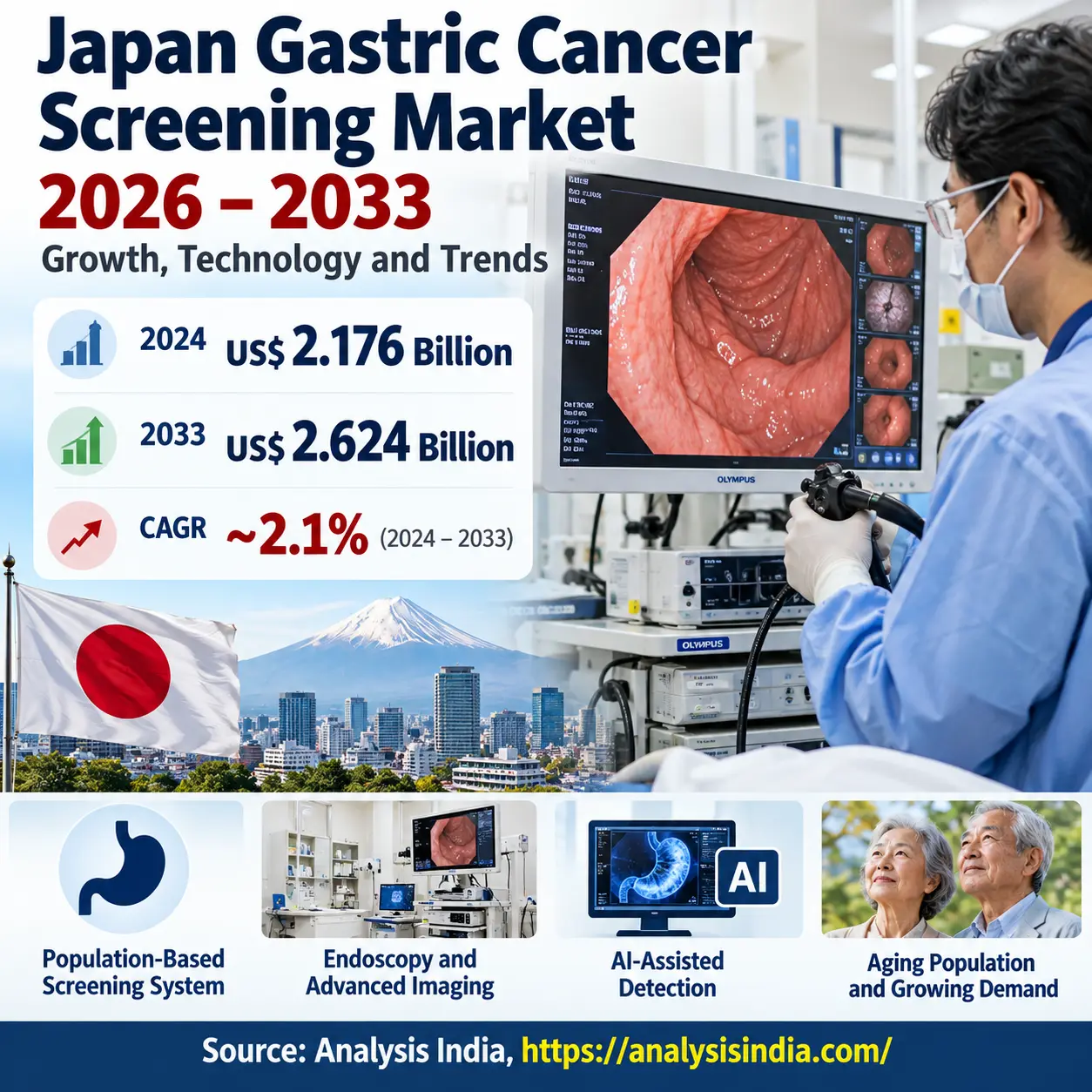
The Japan Gastric Cancer Screening Market was valued at approximately US$2.176 billion in 2024 and is projected to reach about US$2.624 billion by 2033. This represents an estimated compound annual growth rate of approximately 2.1% between 2024 and 2033. Compared with faster-growing markets such as Southeast Asia, Japan’s relatively moderate growth reflects the characteristics of a more established screening ecosystem.
| Japan Gastric Cancer Screening Market | Value |
|---|---|
| 2024 Market Size | US$2.176 billion |
| 2033 Market Forecast | US$2.624 billion |
| Estimated CAGR | ~2.1% |
| Market Increase | ~US$448 million |
The significance of the Japan Gastric Cancer Screening Market therefore lies not simply in percentage growth. Its importance is also linked to the scale and maturity of its existing screening infrastructure. Endoscopy, imaging, screening centers and specialist healthcare services already form important parts of the ecosystem, while artificial intelligence and other digital technologies may increasingly support diagnostic efficiency.
Japan’s mature screening infrastructure represents one important component of the broader Global Gastric Cancer Screening Market, where differences in disease burden, screening policies, healthcare infrastructure and technology adoption shape regional growth.
The following analysis examines Japan’s market size and forecast, screening system, endoscopy infrastructure, aging-related demand, AI adoption, emerging technologies, competitive landscape, challenges and long-term outlook. The focus is on how a mature screening market can evolve through technology and operational optimization rather than simply through expansion of basic screening access.
Japan Gastric Cancer Screening Market Size and Forecast 2033
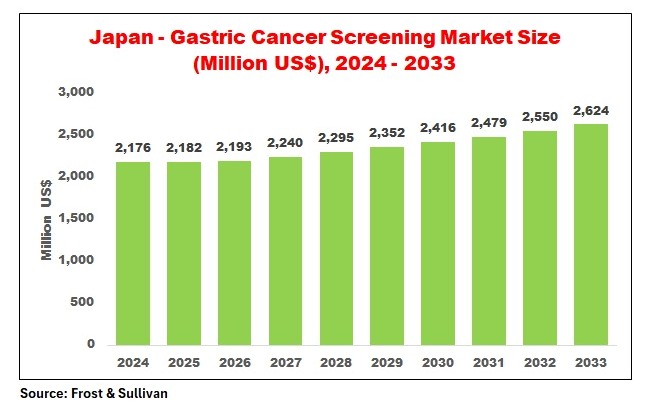
The Japan Gastric Cancer Screening Market is projected to grow steadily between 2024 and 2033. According to industry data, the market is expected to expand from US$ 2,176 million in 2024 to US$ 2,624 million by 2033.The Japan Gastric Cancer Screening Market was valued at approximately US$2.176 billion in 2024 and is projected to reach about US$2.624 billion by 2033. This represents an increase of approximately US$448 million during the forecast period. The market is expected to expand at an estimated compound annual growth rate of around 2.1% between 2024 and 2033, indicating relatively steady development within an already established screening ecosystem.The Japan Gastric Cancer Screening Market is projected to grow steadily between 2024 and 2033. According to industry data, the market is expected to expand from US$ 2,176 million in 2024 to US$ 2,624 million by 2033.
2024 Market Size
The 2024 market size reflects Japan’s established position in gastric cancer screening and diagnostic services. Unlike emerging markets where market expansion may depend primarily on building basic screening infrastructure, Japan already has an extensive network of healthcare providers, screening centers and diagnostic facilities. This established base supports continuing demand for endoscopy, imaging, laboratory services and related screening technologies.
The Japan Gastric Cancer Screening Market is also influenced by the country’s screening framework and the continued need to evaluate populations eligible for screening. Established screening pathways create recurring demand for equipment, trained healthcare professionals and follow-up diagnostic services. As the healthcare system evolves, technology adoption may increasingly focus on improving the efficiency and quality of existing screening processes.
2033 Market Forecast
By 2033, the Japan Gastric Cancer Screening Market is expected to reach approximately US$2.624 billion. The relatively moderate growth rate reflects the maturity of the Japanese screening environment. Future market expansion is therefore likely to come from a combination of continued screening demand, replacement and upgrading of diagnostic equipment, adoption of advanced endoscopic technologies and integration of digital tools.
The forecast also highlights an important distinction between market size and market maturity. A market does not need to record very high percentage growth to remain commercially significant. In Japan, the established screening infrastructure creates opportunities for technology providers focused on improving diagnostic performance, workflow efficiency and quality management.
Growth Interpretation
The approximately 2.1% CAGR suggests a gradual expansion through 2033 rather than rapid infrastructure-led growth. Aging demographics, continued demand for gastric cancer screening and technology upgrades are likely to influence this trajectory. At the same time, workforce availability, healthcare costs and the efficient use of screening resources will affect future development.
Overall, the forecast indicates that the Japan Gastric Cancer Screening Market will evolve primarily through optimization of an established system. Endoscopy, image-enhanced technologies, artificial intelligence and emerging biomarkers may contribute to this transition, while healthcare providers will continue to focus on maintaining screening quality and improving the efficiency of diagnostic pathways.
Japan’s Gastric Cancer Screening System
Japan’s approach to gastric cancer screening has developed within a healthcare environment where population screening is already an established part of preventive care. This makes the Japan Gastric Cancer Screening Market different from markets where the primary challenge is creating basic screening capacity. In Japan, the central market question is increasingly how existing screening services can maintain quality while becoming more efficient, accessible and technologically advanced.
Population-Based Screening in Japan
The Japanese screening framework provides a stable foundation for continued demand. According to Japan’s Ministry of Health, Labour and Welfare, gastric cancer screening is recommended for people aged 50 years and older, with screening generally conducted once every two years. Gastric X-ray and gastric endoscopy are recognized screening approaches under the current framework.
This framework has an important commercial implication. Screening demand is not dependent entirely on individual patients deciding to seek testing after symptoms appear. Instead, an established preventive screening pathway creates recurring requirements for imaging equipment, endoscopy systems, screening facilities, trained professionals and diagnostic support services. This contributes to the stability of the Japan Gastric Cancer Screening Market.
From Screening to Diagnostic Evaluation
Another important characteristic of Japan is the connection between screening and subsequent diagnostic evaluation. A screening examination can identify abnormalities that require additional investigation. Endoscopic examination can then provide more detailed visualization and, where clinically appropriate, support further diagnostic procedures.
This creates a broader ecosystem around screening rather than a single test-based market. Equipment manufacturers, endoscopy providers, imaging technology companies, pathology services and healthcare institutions can all participate in different stages of the pathway. Consequently, the Japan Gastric Cancer Screening Market extends beyond the initial screening examination.
Endoscopy and X-Ray Screening
Japan’s screening system has historically included both gastric X-ray and endoscopic approaches. The continued presence of these modalities is significant because they represent different technological and operational requirements.
X-ray-based screening depends on imaging equipment and established examination workflows, while endoscopy requires specialized instruments, trained personnel and facilities capable of performing examinations and follow-up procedures. The increasing importance of endoscopy also creates opportunities for manufacturers developing higher-resolution imaging, image-enhancement technologies and workflow-support tools.
A Mature System With New Optimization Needs
The maturity of Japan’s screening infrastructure changes the nature of future market development. Expansion is not simply about adding more screening centers. Providers also need to consider examination efficiency, equipment replacement, workforce availability, quality control and the integration of digital technologies.
As a result, the Japan Gastric Cancer Screening Market is likely to evolve through optimization of existing services alongside gradual adoption of new technologies. This provides the foundation for understanding why endoscopy, artificial intelligence and digital workflow tools are becoming increasingly important to Japan’s future screening landscape.
Why Japan Represents a Mature Gastric Cancer Screening Market
The Japan Gastric Cancer Screening Market represents a mature screening environment where market development is increasingly driven by optimization rather than the creation of basic screening infrastructure. Japan has accumulated substantial experience in gastric cancer screening, creating established pathways for screening, diagnostic evaluation and follow-up care. This maturity gives healthcare providers a different set of priorities compared with countries where screening programs are still expanding.
Established Screening Infrastructure
A major characteristic of the Japanese market is the presence of an established network of healthcare facilities capable of supporting gastric cancer screening. Screening centers, hospitals and other healthcare providers participate in examination and follow-up pathways, while diagnostic technologies are integrated into routine clinical workflows.
For technology suppliers, this creates a replacement and upgrading market in addition to demand from new installations. Providers may require newer endoscopy systems, imaging equipment and digital technologies to improve examination quality and operational efficiency. Therefore, growth in the Japan Gastric Cancer Screening Market does not necessarily depend on a large increase in the number of screening facilities.
Focus on Screening Quality
Maturity also shifts attention toward the quality of screening. When a screening system has operated for many years, improvements can come from better visualization, more consistent examination procedures, improved image documentation and stronger follow-up pathways.
This creates opportunities for technologies that can support healthcare professionals without fundamentally changing the screening model. High-resolution imaging, image-enhanced endoscopy and computer-assisted analysis can potentially improve the information available during examinations. However, their value depends on clinical validation, workflow integration and appropriate use within established healthcare settings.
Workforce and Efficiency Considerations
A mature screening system also faces operational challenges. Endoscopic screening requires trained healthcare professionals and appropriate facilities. As healthcare systems manage workforce constraints and increasing demand for services, improving examination efficiency becomes an important consideration.
The Japan Gastric Cancer Screening Market can therefore benefit from technologies that reduce unnecessary workload while maintaining diagnostic quality. Digital documentation, automated image analysis and AI-assisted tools may support this objective. The adoption of such technologies, however, is likely to depend on clinical evidence, regulatory requirements, reimbursement considerations and acceptance by healthcare professionals.
A Market Focused on Optimization
The defining feature of Japan is therefore not simply the existence of a large screening system. It is the transition from capacity building to system optimization. Future opportunities are increasingly connected with replacing older equipment, improving diagnostic workflows and integrating advanced technologies into established screening pathways.
This mature-market characteristic will shape the next stage of the Japan Gastric Cancer Screening Market, particularly as endoscopy and artificial intelligence become more closely integrated with routine gastric cancer screening.
Endoscopy in Japan’s Gastric Cancer Screening System
Endoscopy occupies an important position in the Japan Gastric Cancer Screening Market because it provides direct visualization of the stomach and can support detailed examination of suspicious areas. In a mature screening environment, the role of endoscopy extends beyond simply increasing the number of examinations. Market development increasingly depends on improving image quality, examination efficiency, workflow management and the ability to identify early abnormalities.
Endoscopy as an Established Screening Modality
Japan’s gastric cancer screening framework recognizes gastric endoscopy alongside gastric X-ray as a screening method for eligible populations. This provides an established clinical pathway for endoscopic screening rather than limiting endoscopy to symptomatic patients or specialized diagnostic centers.
The continued use of endoscopy creates demand for gastroscopes, video processors, imaging systems, accessories and related equipment. It also supports replacement demand as healthcare facilities upgrade existing systems. For manufacturers, this makes the Japan Gastric Cancer Screening Market an important environment for advanced endoscopic equipment and supporting technologies.
Image Quality and Early Lesion Detection
One area of technological development is improved visualization. Modern endoscopic systems can provide higher-quality images and may incorporate image-enhancement capabilities that help clinicians examine mucosal structures more closely.
These technologies are particularly relevant in a mature screening market because the objective is not simply to perform more examinations. Screening quality and the ability to recognize abnormalities at an early stage are also important. Better visualization can therefore contribute to the broader evolution of gastric cancer screening workflows.
Endoscopy Workflow and Efficiency
The increasing use of advanced endoscopy also creates a need to improve workflow efficiency. Screening centers and hospitals must manage examination preparation, procedures, image documentation, reporting and follow-up within existing healthcare resources.
Digital systems can support parts of this workflow by organizing examination images, assisting documentation and improving access to previous records. These capabilities can become increasingly relevant as screening providers attempt to manage larger volumes without compromising examination quality.
AI-Assisted Endoscopy
Artificial intelligence represents another emerging area within Japanese endoscopy. AI-based systems can analyze endoscopic images and provide computer-assisted indications of potentially suspicious areas. Such tools are being investigated as support mechanisms for clinicians rather than replacements for professional judgment.
The integration of AI into endoscopic workflows could become an important development for the Japan Gastric Cancer Screening Market. However, adoption will depend on clinical evidence, regulatory requirements, compatibility with existing equipment and the ability of healthcare providers to incorporate these systems without creating additional workflow complexity.
Overall, endoscopy is likely to remain a central component of Japan’s screening ecosystem. Future market development will increasingly involve better visualization, digital workflow integration and AI-assisted examination, rather than simply expanding conventional endoscopy capacity.
AI and Digital Technology in Japanese Gastric Cancer Screening
Artificial intelligence is becoming an important area of technological development within the Japan Gastric Cancer Screening Market. However, its role should be viewed as an extension of Japan’s established screening infrastructure rather than a replacement for conventional endoscopy. The main opportunity lies in using digital tools to improve image interpretation, workflow efficiency and consistency while keeping clinical decision-making with trained healthcare professionals.
AI-Assisted Endoscopic Image Analysis
AI systems can analyze endoscopic images and identify visual patterns that may require closer examination. In gastric cancer screening, such systems are being developed to support the detection and characterization of suspicious lesions during examinations.
For Japanese healthcare providers, this technology has particular relevance because it can potentially be integrated into an existing endoscopy workflow. Instead of requiring an entirely new screening pathway, AI can function as an additional layer of computer-assisted analysis within conventional examinations.
Supporting Clinicians During Screening
The potential value of AI is not limited to identifying suspicious areas. Computer-assisted systems may also help clinicians review large numbers of images, document findings and maintain consistency across examinations.
This could become increasingly relevant as screening providers manage workforce constraints and seek greater efficiency. The Japan Gastric Cancer Screening Market therefore has an opportunity to develop around technologies that complement specialist expertise rather than attempting to automate the entire diagnostic process.
Digitalization of Screening Workflows
Digital technology is also changing how screening information is captured and managed. Electronic records, digital image storage and computer-assisted reporting can make examination information easier to organize and review.
For hospitals and screening facilities, these systems can support longitudinal patient records and improve communication between screening and follow-up services. Better digital integration can also help reduce administrative workload and make diagnostic information more accessible to healthcare professionals.
AI Adoption Will Depend on Clinical Evidence
Despite the potential benefits, AI adoption is unlikely to occur simply because the technology is available. Healthcare providers need evidence that AI tools perform reliably under real clinical conditions. Regulatory requirements, compatibility with existing endoscopy equipment, workflow integration and clinician acceptance will also influence adoption.
Consequently, the Japan Gastric Cancer Screening Market is likely to see gradual rather than automatic AI deployment. Technologies that demonstrate measurable clinical and operational value are more likely to become integrated into routine screening.
From Automation to Clinical Support
The broader trend is therefore toward AI-assisted screening rather than fully automated screening. Japan’s mature healthcare infrastructure provides an environment where digital technologies can be tested and integrated into established workflows.
Over the longer term, the combination of advanced endoscopy, digital documentation and AI-based image analysis could help Japanese screening providers improve efficiency while maintaining the established clinical role of endoscopists. This transition will be an important component of the market’s technological evolution.
Aging Population and Future Screening Demand
Demographic change is an important factor shaping the Japan Gastric Cancer Screening Market. Japan has one of the world’s oldest populations, and the increasing share of older adults has implications for preventive healthcare, screening capacity and diagnostic services. As the population structure changes, maintaining appropriate screening access while managing healthcare resources becomes increasingly important.
Aging Population and Screening Requirements
Age is an important consideration in gastric cancer screening because screening recommendations in Japan specifically include adults aged 50 years and older. This creates a substantial population base for screening services and supports continuing demand for examination facilities, endoscopy systems and diagnostic technologies.
However, an aging population also creates operational challenges. Older individuals may have greater healthcare needs and may require more careful assessment before undergoing certain procedures. Screening providers therefore need to balance participation, clinical suitability and available healthcare resources.
Demand for Efficient Screening
Demographic aging can increase pressure on healthcare systems even when the overall market is growing at a moderate rate. Hospitals and screening facilities may need to manage more examinations while maintaining appropriate quality standards.
This creates opportunities for technologies that can improve productivity without reducing clinical oversight. Digital patient records, automated documentation and AI-assisted image analysis could potentially support healthcare professionals as screening volumes and complexity change.
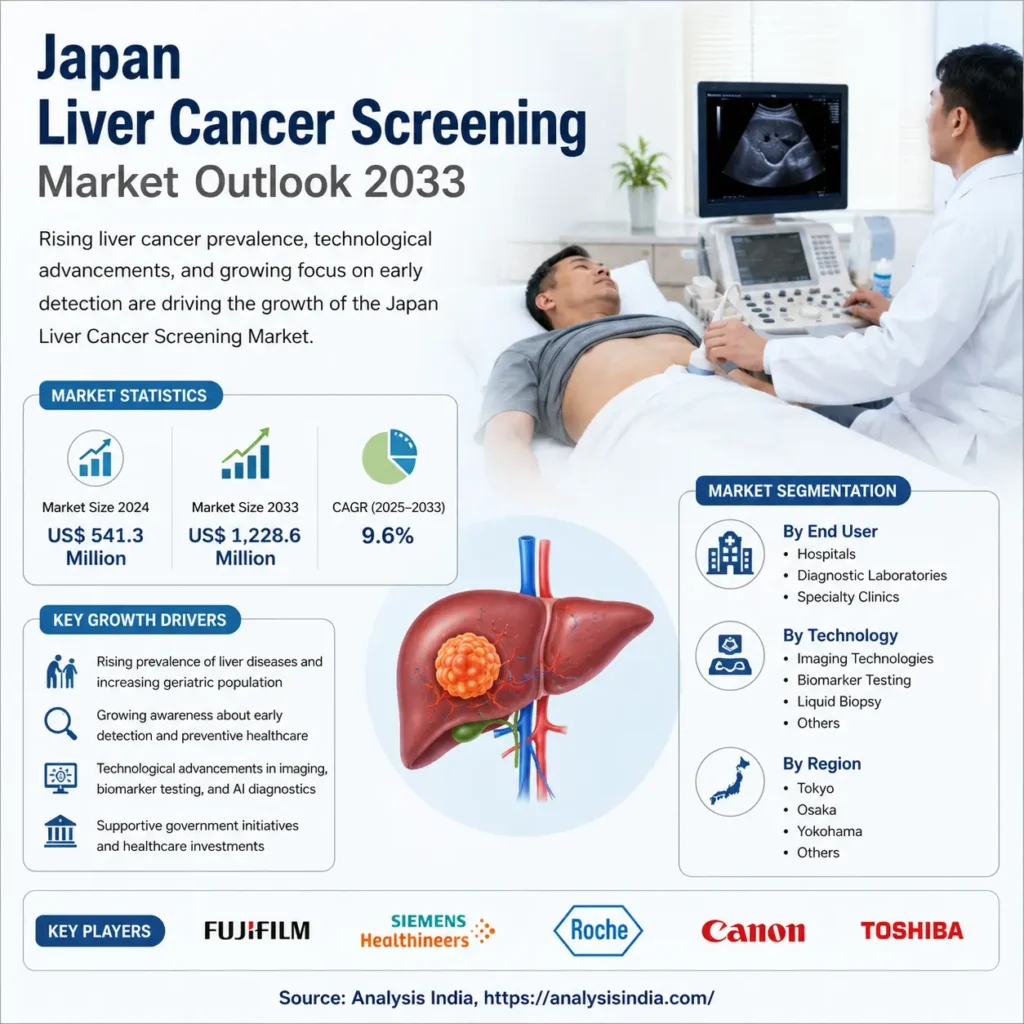
Japan’s aging population is also influencing demand across other cancer screening segments, including the Japan Liver Cancer Screening Market, where early detection and advanced diagnostic technologies are becoming increasingly important.
Role of Preventive Healthcare
The aging of Japan’s population also strengthens the importance of preventive healthcare. Earlier identification of abnormalities can support timely diagnostic evaluation and treatment pathways. For the Japan Gastric Cancer Screening Market, this means future demand will depend not only on the number of people eligible for screening but also on how effectively the healthcare system maintains participation and follow-up.
Demographic Change and Market Evolution
Japan’s demographic structure is therefore likely to influence the market more through service requirements and technology adoption than through rapid expansion in screening infrastructure. Providers may increasingly prioritize efficient examination workflows, improved diagnostic support and technologies that help healthcare professionals manage an aging patient population.
The interaction between demographics, screening demand and healthcare capacity will remain an important factor in the long-term development of the Japan Gastric Cancer Screening Market.
Emerging Technologies Beyond Conventional Screening
The next phase of the Japan Gastric Cancer Screening Market is likely to involve technologies that complement established endoscopy rather than immediately replace it. Japan’s mature screening infrastructure provides a practical environment for introducing new diagnostic approaches, particularly when they can improve convenience, risk assessment or the efficiency of follow-up evaluation.
Biomarkers and Non-Invasive Approaches
Biomarker-based testing is an area of continued interest in gastric cancer detection and risk assessment. Blood-based and other molecular approaches could potentially provide additional information before or alongside conventional diagnostic procedures.
However, these technologies should be distinguished from established population screening methods. A promising biomarker does not automatically become a replacement for endoscopy or other recognized screening approaches. Clinical validation, sensitivity, specificity and evidence from real-world populations are important before broader implementation.
For the Japan Gastric Cancer Screening Market, the near-term opportunity may therefore involve using biomarkers as complementary tools rather than as standalone replacements for established screening pathways.
Molecular and Liquid Biopsy Research
Liquid biopsy is another emerging area that could influence future gastric cancer diagnostics. The approach uses biological signals found in blood or other body fluids and is being investigated for applications including cancer detection, molecular characterization and monitoring.
Its potential attraction is the possibility of less invasive testing. However, the technology remains an evolving field, and its role in routine population-level gastric cancer screening depends on further clinical evidence and validation.
Advanced Imaging Technologies
Improvements in imaging are likely to remain more immediately relevant to the Japanese market. Enhanced endoscopic imaging, higher-resolution systems and computer-assisted image interpretation can build upon existing clinical workflows rather than requiring an entirely new screening infrastructure.
This makes advanced imaging particularly compatible with the Japan Gastric Cancer Screening Market, where healthcare providers already have experience with endoscopic examination and diagnostic imaging.
Digital Risk Assessment
Digital technologies may also support more individualized approaches to screening. Patient information, previous examination results and other clinical variables can potentially be combined to help healthcare professionals assess risk and determine appropriate follow-up pathways.
Such systems could become increasingly useful as healthcare providers attempt to allocate screening resources efficiently. The objective would be to support clinical decision-making while maintaining appropriate professional oversight.
Gradual Integration Rather Than Disruption
Japan’s mature screening environment means that emerging technologies will need to demonstrate clear practical value before achieving widespread adoption. Technologies that integrate smoothly with existing endoscopy, imaging and healthcare information systems may have an advantage over approaches requiring completely new infrastructure.
As a result, the future Japan Gastric Cancer Screening Market is likely to combine established screening modalities with advanced imaging, AI, digital systems and selected emerging molecular technologies. The transition is expected to be evolutionary, with clinical evidence and healthcare-system compatibility determining which innovations move from research into routine practice.
Challenges and Competitive Landscape: Japan Gastric Cancer Screening Market
Despite its mature infrastructure, the Japan Gastric Cancer Screening Market faces several challenges that could influence future adoption of screening technologies and healthcare services. These challenges are less related to establishing basic screening capacity and more connected with workforce availability, healthcare costs, technology integration and maintaining screening quality across an aging population.
Workforce and Capacity Constraints
Endoscopic screening requires trained healthcare professionals, appropriate facilities and supporting staff. As healthcare demand changes with population aging, maintaining sufficient clinical capacity can become increasingly important.
For screening providers, this creates pressure to improve examination efficiency without compromising diagnostic quality. Technologies that support image interpretation, documentation and workflow management may therefore become increasingly relevant.
Healthcare Cost and Resource Management
A mature screening system also needs to balance clinical benefits with healthcare expenditure. Upgrading endoscopy systems, introducing AI platforms and maintaining digital infrastructure can require significant investment.
Healthcare organizations may therefore evaluate new technologies based on their ability to demonstrate practical value. Equipment suppliers and technology companies will need to consider not only technical performance but also workflow efficiency, clinical evidence and long-term operating costs.
Technology Integration
Another challenge is integrating new technologies with existing clinical systems. Hospitals and screening centers may already operate established endoscopy equipment, information systems and reporting processes. New AI or digital solutions must work effectively within these environments rather than creating isolated technology platforms.
Interoperability, data management and staff training can therefore influence the speed of adoption.
Competitive Landscape
Competition within the Japan Gastric Cancer Screening Market extends across several technology categories. Endoscopy and imaging equipment manufacturers compete through image quality, system functionality, ergonomics and workflow capabilities. Digital health and AI developers are increasingly focused on computer-assisted image analysis and clinical decision support.
The competitive environment also includes diagnostic laboratories, healthcare providers and technology companies developing molecular and biomarker-based approaches. Because the market is mature, competition is not necessarily limited to increasing screening volumes. Product replacement, system upgrades, software integration and specialized diagnostic capabilities can also create commercial opportunities.
Differentiation Through Technology
For established suppliers, differentiation may increasingly depend on how effectively their technologies address practical clinical requirements. High-quality imaging, AI assistance, data integration and efficient workflow design can become important factors in purchasing decisions.
As a result, the Japan Gastric Cancer Screening Market is likely to remain competitive while gradually shifting toward technology-enabled optimization. Companies that can integrate innovation into existing screening workflows will participate in a market where clinical usability and evidence are important alongside technological capability.
Future Outlook for the Japan Gastric Cancer Screening Market
The Japan Gastric Cancer Screening Market is expected to develop through gradual modernization rather than rapid expansion of basic screening infrastructure. The market already operates within an established screening framework, so future opportunities are likely to come from technology upgrades, improved screening efficiency and better integration between examination, diagnosis and follow-up services.
Technology-Led Market Development
Endoscopy is expected to remain an important component of gastric cancer screening in Japan. At the same time, advanced imaging, digital documentation and AI-assisted image analysis can increasingly support endoscopic workflows.
The adoption of these technologies could help screening providers address practical challenges such as examination efficiency, image interpretation and workforce availability. However, clinical evidence and integration into existing healthcare workflows will remain important factors in determining the pace of adoption.
Opportunities From an Aging Population
Japan’s aging population will continue to influence healthcare demand. Maintaining appropriate screening access for older adults while managing healthcare capacity will require efficient use of personnel, facilities and diagnostic technologies.
This environment may create opportunities for companies offering technologies that improve productivity without reducing the quality of screening. AI-assisted systems, digital workflow tools and advanced endoscopic equipment could therefore become increasingly relevant.
Market Outlook Through 2033
The market is projected to increase from approximately US$2.176 billion in 2024 to US$2.624 billion by 2033, representing an estimated CAGR of around 2.1%. The relatively moderate growth rate reflects the maturity of Japan’s screening ecosystem rather than an absence of technological opportunities.
The Japan Gastric Cancer Screening Market is therefore likely to remain commercially important through 2033, with growth increasingly associated with replacement demand, technology upgrades and optimization of established screening services.
Japan’s experience also provides useful context for understanding broader developments across Screening & Diagnostics, including the adoption of advanced imaging, biomarkers and AI-assisted diagnostic technologies.
Conclusion: Japan Gastric Cancer Screening Market
Japan provides an example of how a mature cancer screening market can evolve beyond basic infrastructure expansion. Established screening pathways, continued demand from an aging population and technological development are likely to shape the market’s next phase.
Over the longer term, the Japan Gastric Cancer Screening Market will increasingly connect conventional endoscopy with advanced imaging, AI-assisted analysis, digital healthcare systems and selected emerging diagnostic technologies. The companies and healthcare providers participating in this ecosystem will need to balance innovation with clinical evidence, usability, cost and integration into Japan’s established screening system.
Frequently Asked Questions: Japan Gastric Cancer Screening Market
What is the Japan Gastric Cancer Screening Market size?
The Japan Gastric Cancer Screening Market was valued at approximately US$2.176 billion in 2024 and is projected to reach around US$2.624 billion by 2033, representing an estimated CAGR of about 2.1% during 2024–2033.
How often is gastric cancer screening recommended in Japan?
Japan’s Ministry of Health, Labour and Welfare recommends gastric cancer screening for people aged 50 years and older, generally once every two years. Gastric X-ray and gastric endoscopy are recognized screening methods under the current framework.
What are the main gastric cancer screening methods used in Japan?
The principal screening approaches include gastric X-ray and gastric endoscopy. Endoscopy is particularly important because it enables direct visualization of the stomach and can support detailed evaluation of suspicious findings.
Why is Japan considered a mature gastric cancer screening market?
Japan has an established screening framework, healthcare infrastructure and long-term experience with gastric cancer detection. Consequently, future market development is increasingly associated with equipment upgrades, screening efficiency, advanced imaging and digital technologies rather than basic infrastructure creation.
How is AI influencing gastric cancer screening in Japan?
AI is being developed as a support technology for endoscopic image analysis, potentially helping clinicians identify suspicious areas and improve workflow efficiency. Adoption will depend on clinical evidence, regulatory requirements, interoperability and integration into existing healthcare workflows.
What factors will shape the market through 2033?
The major factors include population aging, continued screening demand, endoscopy adoption, equipment replacement, AI-assisted technologies, digitalization and emerging diagnostic approaches. Workforce availability and healthcare resource management will also influence future development of the Japan Gastric Cancer Screening Market.