📅 Published: May 1, 2026
🔄 Last Updated: May 1, 2026
Introduction
The South East Asia colorectal cancer screening market is emerging as a high-growth segment within the global cancer diagnostics landscape. The region, comprising rapidly developing economies, is witnessing increasing awareness about cancer prevention and early detection. As healthcare infrastructure improves and governments invest in screening programs, colorectal cancer screening is becoming a critical component of public health strategies across South East Asia.
Colorectal cancer incidence is rising across countries such as Indonesia, Thailand, Malaysia, Vietnam, and the Philippines. Factors such as urbanization, dietary changes, and aging populations are contributing to the growing disease burden. As a result, the demand for effective screening solutions is increasing, positioning the South East Asia colorectal cancer screening market as a key opportunity for healthcare providers and diagnostic companies.
From a broader perspective, this regional growth aligns with global trends discussed in the Cancer Screening Market Growth Trends Insights, where emerging economies are expected to drive future expansion in cancer diagnostics.
South East Asia Colorectal Cancer Screening Market Size and Forecast (2024–2033)
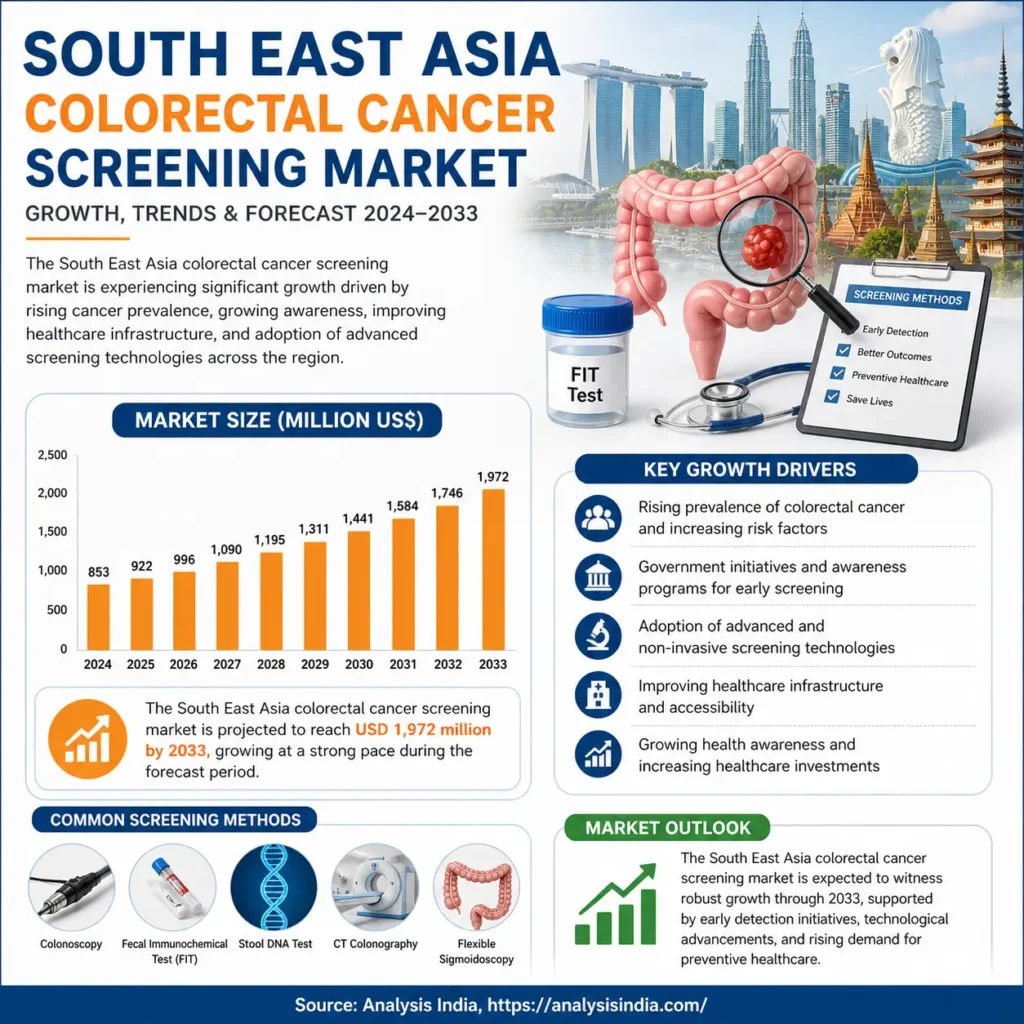
The South East Asia colorectal cancer screening market is projected to experience strong growth over the forecast period, driven by expanding healthcare access, increasing awareness, and adoption of advanced diagnostic technologies.
The market was valued at USD 853 million in 2024 and is expected to reach approximately USD 1,972 million by 2033, reflecting significant growth across the region.
South East Asia Colorectal Cancer Screening Market Size (2024–2033)
| Year | Market Size (Million US$) |
|---|---|
| 2024 | 853 |
| 2025 | 922 |
| 2026 | 996 |
| 2027 | 1,090 |
| 2028 | 1,195 |
| 2029 | 1,311 |
| 2030 | 1,441 |
| 2031 | 1,584 |
| 2032 | 1,746 |
| 2033 | 1,972 |
Source: World Health Organization, Frost & Sullivan
The data highlights a strong upward trajectory in the South East Asia colorectal cancer screening market, reflecting increasing adoption of screening programs and improvements in healthcare systems. The growth rate in this region is higher compared to mature markets, indicating significant untapped potential.
This expansion complements trends observed in developed markets such as the United States Colorectal Cancer Screening Market, where screening adoption is already high. It also aligns with growth patterns seen in the China Colorectal Cancer Screening Market and Japan Colorectal Cancer Screening Market, highlighting regional differences in market maturity.
Key Growth Drivers
The South East Asia colorectal cancer screening market is driven by multiple factors that collectively support long-term expansion. One of the primary drivers is the rising prevalence of colorectal cancer. Changing lifestyles, increased consumption of processed foods, and reduced physical activity are contributing to higher cancer incidence.
Another important factor is improving healthcare infrastructure. Governments across the region are investing in hospitals, diagnostic centers, and screening programs to enhance healthcare accessibility. These investments are enabling wider adoption of screening services.
Increasing awareness is also playing a critical role. Public health campaigns are encouraging individuals to undergo regular screening, particularly among high-risk populations.
According to the World Health Organization, early detection through screening significantly reduces mortality rates, emphasizing the importance of expanding screening programs in South East Asia.
Technological Advancements
Technology is transforming the South East Asia colorectal cancer screening market, enabling more efficient and accessible diagnostic solutions. Traditional methods such as colonoscopy remain widely used, particularly in urban healthcare facilities.
However, non-invasive screening methods are gaining popularity across the region. Fecal immunochemical tests and stool-based diagnostics are being increasingly adopted due to their affordability and ease of use.
Molecular diagnostics is also emerging as a key trend. Advanced technologies that detect genetic markers are improving screening accuracy. This trend is consistent with developments in the United States Lung Cancer Molecular Screening Market, where molecular diagnostics are reshaping cancer detection.
Digital health technologies are further enhancing screening accessibility. Telemedicine platforms and mobile health applications are enabling remote diagnostics and improving patient engagement.
Market Segmentation Analysis
The South East Asia colorectal cancer screening market can be segmented based on screening type, technology, and end-user. Colonoscopy continues to dominate due to its effectiveness, but non-invasive tests are gaining traction.
Hospitals and diagnostic centers account for the largest market share. However, community healthcare centers and mobile screening units are becoming increasingly important in expanding access to screening services.
Role of Government Policies and Healthcare Initiatives
Government policies play a crucial role in shaping the South East Asia colorectal cancer screening market. National healthcare programs are focusing on preventive care and early detection.
Subsidized screening programs and partnerships with private healthcare providers are improving accessibility. These initiatives are helping increase screening participation rates across the region.
Competitive Landscape and Market Dynamics
The South East Asia colorectal cancer screening market is highly competitive, with both local and international players investing in research and development. Companies are focusing on innovation to introduce cost-effective screening solutions.
Strategic collaborations and partnerships are driving market growth. These efforts are enabling the development of scalable screening programs across the region.
The competitive dynamics are similar to trends observed in the United States Liquid Biopsy Cancer Screening Market, where innovation plays a critical role.
Challenges
Despite strong growth potential, the market faces challenges such as limited awareness in rural areas, disparities in healthcare access, and cost constraints.
Addressing these challenges will be essential for improving screening coverage and achieving long-term market growth.
Emerging Trends
The South East Asia colorectal cancer screening market is witnessing several emerging trends, including the adoption of non-invasive screening methods, digital health integration, and personalized medicine.
These trends are improving patient compliance and expanding access to screening services.
Regional Insights Across South East Asia
The South East Asia colorectal cancer screening market shows variation across different countries. Urban regions have higher screening rates, while rural areas face challenges.
Government initiatives and international collaborations are helping bridge these gaps and improve healthcare accessibility.
Future Outlook and Opportunities
The future of the South East Asia colorectal cancer screening market is highly promising. Increasing healthcare investments, technological advancements, and growing awareness will drive market growth.
Opportunities exist in developing cost-effective screening solutions and expanding access to underserved populations.
Conclusion
The South East Asia colorectal cancer screening market is poised for significant growth, driven by rising disease prevalence, improving healthcare infrastructure, and increasing awareness of early detection.
As the region continues to evolve, colorectal cancer screening will play a critical role in reducing cancer burden and improving healthcare outcomes.
For global insights, refer to the Colorectal Cancer Screening Market Growth, which highlights broader industry trends.
Frequently Asked Questions (FAQ)
What is the South East Asia colorectal cancer screening market size in 2033?
The South East Asia colorectal cancer screening market is projected to reach approximately USD 1,972 million by 2033, driven by increasing screening adoption, healthcare investments, and rising awareness of early cancer detection across the region.
What factors are driving the South East Asia colorectal cancer screening market growth?
The growth of the South East Asia colorectal cancer screening market is driven by rising colorectal cancer cases, improving healthcare infrastructure, government screening initiatives, and increasing awareness about early detection. Rapid urbanization and lifestyle changes are also contributing to higher demand for screening services.
Which screening methods are commonly used in the South East Asia colorectal cancer screening market?
Common screening methods include colonoscopy, fecal immunochemical tests (FIT), stool-based tests, CT colonography, and flexible sigmoidoscopy. Non-invasive tests are becoming increasingly popular due to affordability and ease of use, especially in large-scale screening programs.
Why is colorectal cancer screening important in South East Asia?
Colorectal cancer screening is important because it enables early detection of cancer, which improves treatment outcomes and survival rates. Screening also helps identify precancerous polyps, reducing the risk of cancer development.
How is technology transforming the South East Asia colorectal cancer screening market?
Technology is transforming the South East Asia colorectal cancer screening market through the adoption of non-invasive screening methods, molecular diagnostics, and digital health platforms. These advancements improve accessibility, accuracy, and patient compliance.
What are the latest trends in the South East Asia colorectal cancer screening market?
Key trends include the shift toward non-invasive screening methods, increased use of telemedicine, expansion of community-based screening programs, and growing adoption of personalized medicine for targeted diagnostics.
How do government initiatives impact the South East Asia colorectal cancer screening market?
Government initiatives play a significant role by promoting awareness campaigns, funding screening programs, and improving healthcare infrastructure. These policies help increase accessibility and encourage early diagnosis across the region.
Who are the key end-users in the South East Asia colorectal cancer screening market?
The primary end-users include hospitals, diagnostic laboratories, specialty clinics, and community healthcare centers. Hospitals and diagnostic centers dominate due to better infrastructure and availability of skilled professionals.
What challenges affect the South East Asia colorectal cancer screening market?
Challenges include limited awareness in rural areas, unequal healthcare access, and cost barriers for advanced screening technologies. Addressing these issues is essential for expanding screening coverage.
What is the future outlook of the South East Asia colorectal cancer screening market?
The future outlook of the South East Asia colorectal cancer screening market is highly positive, with strong growth expected due to increasing healthcare investments, technological advancements, and rising focus on preventive healthcare through 2033.