📅 Published: April 29, 2026
🔄 Last Updated: April 29, 2026
Introduction: Japan Colorectal Cancer Screening Market Overview
The Japan colorectal cancer screening market represents a mature yet steadily evolving segment within the global cancer diagnostics landscape. Japan has one of the most advanced healthcare systems in the world, and its strong focus on preventive care has significantly contributed to the widespread adoption of colorectal cancer screening programs. With a rapidly aging population and increasing cancer incidence, screening has become a critical component of national healthcare strategies.
Colorectal cancer is among the most common cancers in Japan, and early detection remains a key priority for reducing mortality rates. The Japan colorectal cancer screening market is driven by a combination of government initiatives, advanced diagnostic technologies, and high public awareness. Screening methods such as fecal immunochemical tests, colonoscopy, and emerging molecular diagnostics are widely utilized across the country.
From a global perspective, Japan’s screening ecosystem aligns with trends discussed in the Cancer Screening Market Growth Trends Insights, where developed nations demonstrate strong adoption of early detection technologies. Japan also serves as a benchmark for preventive healthcare practices in Asia.
Japan Colorectal Cancer Screening Market Size and Forecast (2024–2033)
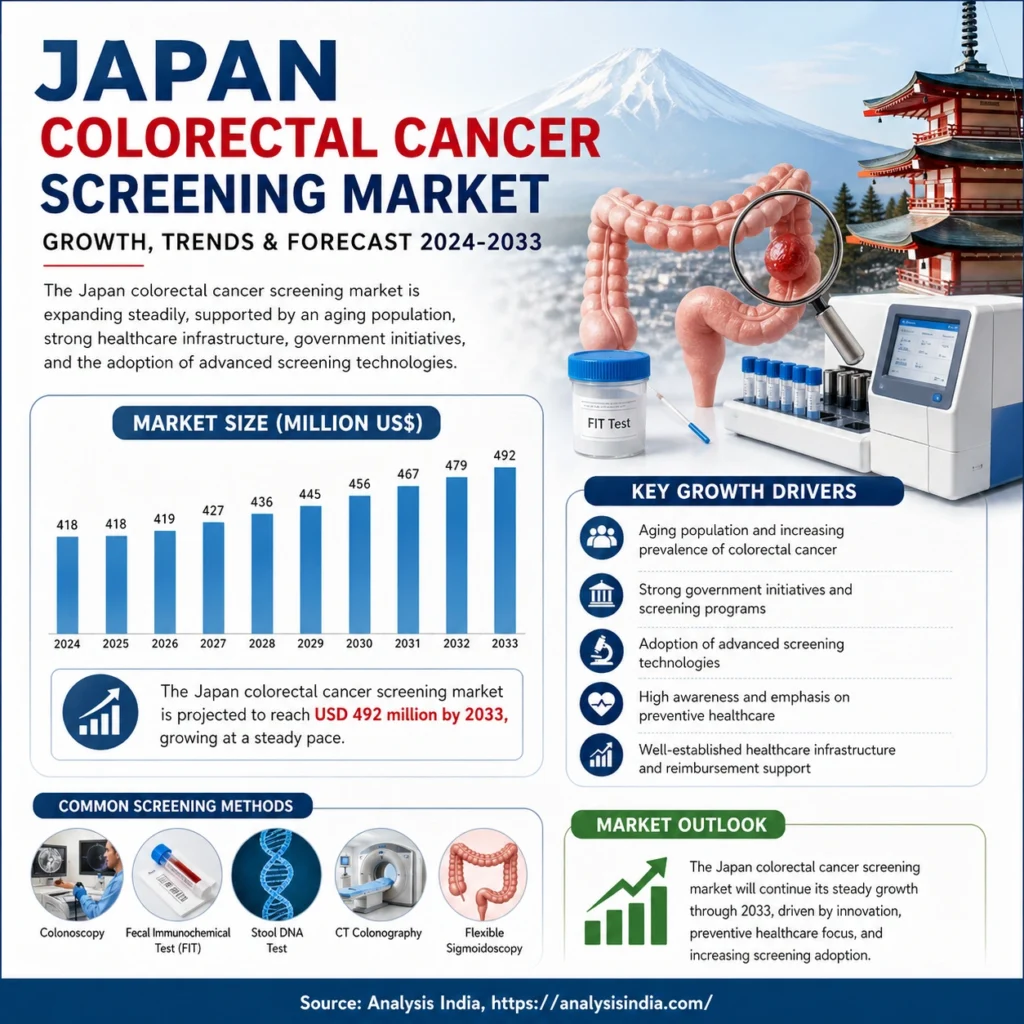
The Japan colorectal cancer screening market demonstrates stable and consistent growth, reflecting the country’s well-established healthcare infrastructure and strong emphasis on preventive care. Unlike emerging markets, Japan shows a more gradual growth pattern, indicating market maturity and high baseline screening coverage.
The Japan colorectal cancer screening market size was valued at USD 418 million in 2024 and is projected to reach approximately USD 492 million by 2033, highlighting steady expansion driven by technological advancements and ongoing screening initiatives.
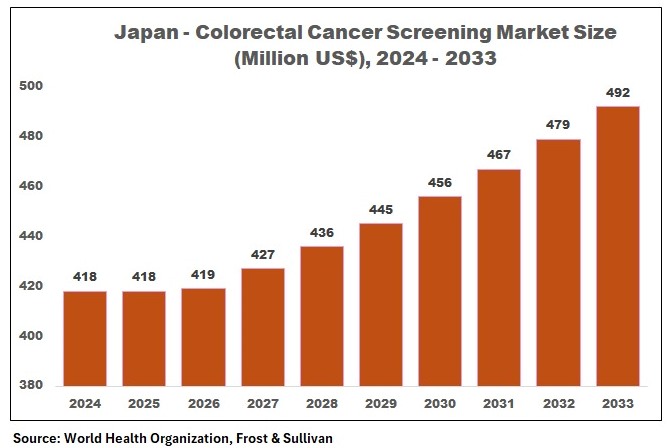
The data highlights a gradual but steady increase in the Japan colorectal cancer screening market, reflecting sustained demand for screening services and continuous improvements in diagnostic technologies. The relatively stable growth trajectory indicates a mature market where screening adoption is already high, and further growth is driven by innovation and demographic factors.
According to the World Health Organization, early detection remains one of the most effective strategies for reducing colorectal cancer mortality. Industry insights from Frost & Sullivan suggest that Japan’s focus on preventive healthcare and technological innovation will continue to support market expansion.
This growth pattern contrasts with emerging markets such as the China Colorectal Cancer Screening Market, where rapid expansion is driven by increasing awareness and healthcare development. Similarly, comparisons with the United States Colorectal Cancer Screening Market highlight differences in market dynamics and adoption rates.
Key Growth Drivers of Japan Colorectal Cancer Screening Market
The Japan colorectal cancer screening market is driven by a combination of demographic, technological, and policy-related factors. One of the most significant drivers is the aging population. Japan has one of the highest proportions of elderly individuals globally, and this demographic trend directly increases the demand for cancer screening services.
Another important factor is the strong emphasis on preventive healthcare. Japan’s healthcare system prioritizes early detection and regular health check-ups, which has led to high screening participation rates. Government-supported screening programs and public awareness campaigns have further strengthened this trend.
The Ministry of Health, Labour and Welfare Japan plays a crucial role in promoting cancer screening initiatives. Policies aimed at improving accessibility and affordability have significantly contributed to market growth.
Technological advancements also act as a major driver. The adoption of advanced screening technologies, including high-resolution imaging and molecular diagnostics, is enhancing detection accuracy and efficiency.
Technological Advancements in Japan Colorectal Cancer Screening Market
Technology continues to play a transformative role in the Japan colorectal cancer screening market. Traditional screening methods such as colonoscopy remain widely used due to their effectiveness. However, Japan has also been at the forefront of adopting innovative screening technologies.
Fecal immunochemical tests are commonly used as a first-line screening method due to their non-invasive nature and ease of use. These tests are widely accepted among the population and are often included in routine health check-ups.
Molecular diagnostics is another area of growth. Advanced screening tools that analyze genetic markers are improving early detection rates. This aligns with global trends observed in the United States Lung Cancer Molecular Screening Market, where molecular technologies are reshaping cancer diagnostics.
Artificial intelligence is also being integrated into screening processes. AI-powered systems are assisting healthcare professionals in detecting abnormalities more accurately, improving overall diagnostic outcomes.
Market Segmentation Analysis
The Japan colorectal cancer screening market can be segmented based on screening type, technology, and end-user. Colonoscopy remains the dominant screening method, supported by its high accuracy and ability to detect and remove polyps.
Non-invasive screening methods are also gaining traction. These methods are particularly useful for large-scale screening programs and improving patient compliance.
Hospitals and diagnostic centers represent the primary end-users. However, workplace health programs and community screening initiatives are also contributing to market growth.
Role of Government Policies and Healthcare System
Government policies play a central role in shaping the Japan colorectal cancer screening market. Japan’s healthcare system emphasizes preventive care, with regular screening programs integrated into national health policies.
Insurance coverage and reimbursement policies ensure that screening services are accessible to a large portion of the population. Public health campaigns further encourage participation in screening programs.
These initiatives are aligned with global best practices and contribute to Japan’s high screening rates.
Competitive Landscape and Market Dynamics
The Japan colorectal cancer screening market is characterized by strong competition among healthcare providers, diagnostic companies, and technology developers. Innovation remains a key competitive factor, with companies focusing on developing advanced screening solutions.
Collaborations between research institutions and healthcare providers are driving technological advancements. These partnerships are enabling the development of more efficient and cost-effective screening methods.
The competitive landscape shares similarities with the United States Liquid Biopsy Cancer Screening Market, where innovation plays a critical role.
Challenges in Japan Colorectal Cancer Screening Market
Despite its maturity, the market faces certain challenges. One of the primary challenges is maintaining high screening participation rates among younger populations.
Cost pressures and healthcare system sustainability are also important considerations. As the population ages, the demand for screening services continues to increase, placing pressure on healthcare resources.
Emerging Trends in Japan Colorectal Cancer Screening Market
The Japan colorectal cancer screening market is witnessing several emerging trends. Non-invasive screening methods and digital health technologies are gaining popularity.
Personalized medicine is also becoming increasingly important. Tailored screening strategies based on individual risk factors are improving outcomes.
Regional Insights in Japan
Regional variations exist within Japan, although disparities are less pronounced compared to other countries. Urban areas have slightly higher screening rates due to better access to healthcare facilities.
Government initiatives ensure that screening services are widely available across the country.
Future Outlook and Opportunities
The future of the Japan colorectal cancer screening market remains stable and promising. Continuous technological advancements and strong healthcare policies will support market growth.
Opportunities exist in developing innovative screening technologies and improving efficiency within the healthcare system.
Conclusion
The Japan colorectal cancer screening market represents a mature and well-established segment within the global cancer diagnostics industry. With strong government support, advanced technologies, and high awareness levels, the market is expected to continue its steady growth trajectory through 2033.
For broader insights, explore the Colorectal Cancer Screening Market Growth, which highlights global trends and opportunities.
Frequently Asked Questions (FAQ)
What is the Japan colorectal cancer screening market size in 2033?
The Japan colorectal cancer screening market is projected to reach approximately USD 492 million by 2033, reflecting steady growth driven by advanced healthcare systems and high screening adoption rates.
What factors are driving the Japan colorectal cancer screening market growth?
The growth of the Japan colorectal cancer screening market is driven by an aging population, strong government healthcare policies, high awareness of preventive care, and widespread adoption of advanced screening technologies. Continuous innovation in diagnostics also supports market expansion.
Which screening methods are commonly used in the Japan colorectal cancer screening market?
Common screening methods include fecal immunochemical tests (FIT), colonoscopy, stool DNA testing, CT colonography, and flexible sigmoidoscopy. FIT is widely used for routine screening due to its non-invasive nature, while colonoscopy remains the most accurate method.
Why is colorectal cancer screening important in Japan?
Colorectal cancer screening is important in Japan because it enables early detection of cancer, improving treatment outcomes and survival rates. Early screening also helps in identifying and removing precancerous polyps, reducing overall cancer risk.
How is technology transforming the Japan colorectal cancer screening market?
Technology is transforming the Japan colorectal cancer screening market through the use of molecular diagnostics, AI-based imaging systems, and non-invasive screening methods. These innovations improve detection accuracy and patient compliance.
What are the latest trends in the Japan colorectal cancer screening market?
Key trends include increased adoption of non-invasive screening methods, integration of artificial intelligence in diagnostics, expansion of routine health check-up programs, and growth in personalized screening approaches.
How do government initiatives impact the Japan colorectal cancer screening market?
Government initiatives play a crucial role by promoting nationwide screening programs, providing insurance coverage, and raising public awareness. Policies from national health authorities ensure accessibility and encourage regular screening participation.
Who are the key end-users in the Japan colorectal cancer screening market?
The primary end-users include hospitals, diagnostic laboratories, specialty clinics, and workplace health programs. Hospitals and diagnostic centers dominate due to advanced infrastructure and availability of skilled professionals.
What challenges affect the Japan colorectal cancer screening market?
Challenges include maintaining screening participation among younger populations, managing healthcare costs due to an aging population, and ensuring continued efficiency in screening programs.
What is the future outlook of the Japan colorectal cancer screening market?
The future outlook of the Japan colorectal cancer screening market remains stable and positive, with continued growth expected due to technological advancements, strong healthcare infrastructure, and increasing focus on preventive healthcare.