📅 Published: September 30, 2026
🔄 Last Updated: September 30, 2026
Apple Pay India Launch 2026
Apple Pay India Has Finally Launched
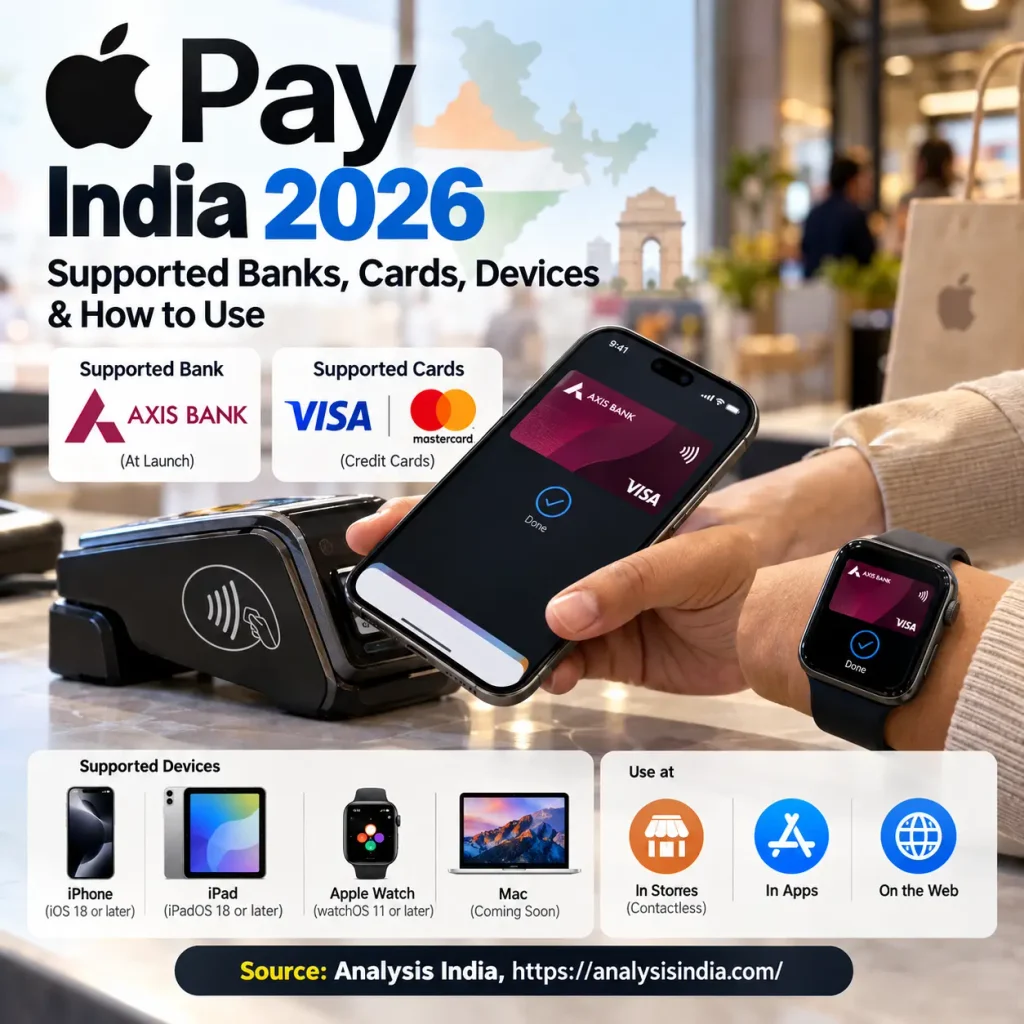
After years of anticipation, Apple Pay India has officially become a reality. Apple launched its payment service in India on September 30, 2026, marking the company’s entry into one of the world’s largest and fastest-growing digital payments markets. Apple’s official announcement provides the latest details on the Apple Pay India launch, supported Apple devices and where Apple Pay can be used. The initial rollout is being conducted with Axis Bank, Visa and Mastercard, giving eligible Axis Bank credit card customers a new way to make contactless payments through Apple devices. For Indian consumers, the launch is significant because Apple Pay enters a market where digital payments are already deeply established through UPI, cards, mobile banking and QR-based payments.
The arrival of Apple Pay India also represents a shift in Apple’s approach to the Indian market. Until now, iPhone users in India have largely depended on third-party payment applications and conventional card payment methods for digital transactions. Apple Pay brings Apple’s own payment infrastructure into that ecosystem by allowing eligible cards to be stored in Apple Wallet and used through compatible Apple devices. The service is designed to work across physical stores, supported applications and websites, allowing users to authenticate payments through Face ID, Touch ID or their device passcode rather than repeatedly entering card details or payment credentials. The growing interest in Apple Pay in India had already generated significant search and fintech attention before the official launch, a trend examined in our article on why Apple Pay is trending in India.
However, the initial Apple Pay India rollout is narrower than the company’s presence in many other markets. At launch, eligible Axis Bank Visa and Mastercard credit cards are supported, while India’s domestic RuPay card network is not currently supported. Apple has indicated that the service will expand over time, while reports say discussions with other major Indian banks have taken place but additional bank partnerships are not yet confirmed. This means the September 2026 launch should be viewed as the beginning of Apple’s Indian payments strategy rather than a complete nationwide replacement for existing payment methods.
Apple Pay India 2026 at a Glance
| Feature | Current status |
|---|---|
| Launch date | September 30, 2026 |
| First confirmed Indian bank partner | Axis Bank |
| Supported card networks at launch | Visa and Mastercard |
| Initial supported cards | Eligible Axis Bank credit cards |
| RuPay cards | Not supported at launch |
| iPhone | Supported |
| iPad | Supported |
| Apple Watch | Supported |
| Mac | Support coming soon |
| In-store payments | Supported at participating contactless terminals |
| Apps | Supported where Apple Pay is offered |
| Websites | Supported where Apple Pay is offered |
| UPI | Separate payment system |
| Setup | Apple Wallet or supported Axis Bank mobile banking flow |
| Consumer Apple Pay fee | No additional Apple Pay fee from Axis Bank |
The information above represents the September 30, 2026 launch position. Supported banks, cards and features can change as Apple expands the service in India. Axis Bank currently states that eligible Visa and Mastercard credit cards can be used with Apple Pay.
What Apple Pay India Means for Indian Consumers
The most important change for Apple users is that payments can now be integrated more closely into the Apple device ecosystem. An eligible card can be added to Apple Wallet, after which customers can use supported iPhones, iPads or Apple Watch devices for transactions. Apple says the service is available across stores, apps and the web, while support for Mac is expected to follow. This creates a payment experience that is closely connected to the hardware, operating system and authentication technologies already used by Apple customers.
The launch also introduces a different payment proposition from the dominant UPI model in India. Apple Pay India is primarily card-based, meaning the payment is linked to an eligible card issued by a participating bank. UPI, by comparison, enables direct bank-account-to-bank-account payments and has become deeply embedded in everyday transactions across the country. Reuters reported on September 30 that UPI accounts for about 84% of India’s digital payment volumes, highlighting the scale of the ecosystem into which Apple Pay is entering.
This distinction is important when evaluating the future of Apple Pay India. Apple is not entering an empty payments market where consumers are searching for their first digital payment solution. Instead, it is entering an ecosystem where consumers already have multiple payment options, including UPI applications, contactless cards, mobile banking applications and QR payments. The potential opportunity for Apple therefore lies in making card-based payments more convenient for its device users while expanding the use of contactless payments and digital wallets among eligible customers.
The initial launch also shows why bank partnerships are central to the growth of Apple Pay India. Unlike a standalone payment application, Apple Pay depends on participating card issuers and payment networks to make their cards available through the platform. Axis Bank is currently the first Indian banking partner, with eligible Visa and Mastercard credit cards supported at launch. Apple has said that the timing for additional issuers will depend on factors such as technical readiness, card portfolios and the work required to bring the service to customers.
For this reason, the next stage of Apple Pay India will be closely connected to the expansion of supported banks and cards. A broader selection of issuers would substantially increase the number of Indian consumers who can actually use the service. Until that happens, Apple Pay’s reach will remain concentrated among customers who own compatible Apple devices and qualifying cards from participating issuers. For a broader analysis of Apple’s payment ecosystem and its potential role in India’s digital payments market, see our detailed Apple Pay India digital payments analysis.
Which Banks and Cards Support Apple Pay India in 2026?
Which Bank Supports Apple Pay India?
At the time of the September 30, 2026 launch, Axis Bank is the first and only confirmed Indian banking partner for Apple Pay India. The initial rollout is available to eligible Axis Bank credit card customers whose cards operate on the Visa or Mastercard payment networks. This makes the first phase relatively focused rather than a nationwide rollout covering cards issued by every major Indian bank.
The importance of the Axis Bank partnership goes beyond simply adding another payment option for its customers. A payment wallet such as Apple Pay requires coordination between the technology provider, card issuer and payment network before customers can add and use their cards. In the Indian launch, Apple has therefore started with a defined combination of Axis Bank, Visa and Mastercard rather than attempting to make every card network and issuer available from day one. This approach allows the company to establish its payment infrastructure and merchant acceptance before potentially expanding the list of participating banks.
Which Axis Bank Cards Work With Apple Pay?
The initial Apple Pay India rollout covers eligible Axis Bank Visa and Mastercard credit cards. Axis Bank’s own Apple Pay information states that its Visa and Mastercard credit cards can be used with Apple Pay on supported Apple devices. Customers can add an eligible card through Apple Wallet or through the Axis Bank mobile banking experience and complete the required verification process.
This distinction between the card issuer and payment network is important. Having an Axis Bank credit card does not mean that the physical card network can be ignored. The current rollout specifically covers Visa and Mastercard credit cards, while India’s domestic RuPay network is not supported at launch. Reuters and other launch-day reports have confirmed that RuPay cards are currently outside the Apple Pay rollout.For current card eligibility, setup instructions and payment requirements, users can also check the official Axis Bank Apple Pay information.
The limitation is particularly relevant in India because RuPay has developed a significant position in the domestic card market. Consequently, Apple Pay India is initially entering the market through the international Visa and Mastercard networks rather than through all three major card networks used by Indian consumers. Future expansion to additional networks would increase the addressable customer base, but Apple has not announced a confirmed timeline for RuPay support.
It is also important to distinguish credit cards from debit cards when discussing the current launch. The confirmed initial offering is centered on eligible Axis Bank credit cards. Consumers should therefore check the specific card eligibility information provided by Axis Bank instead of assuming that every Axis Bank card can automatically be added to Apple Wallet. Axis Bank currently states that its eligible Visa and Mastercard credit cards can be used with Apple Pay.
Is RuPay Supported by Apple Pay India?
RuPay is not supported by Apple Pay India at launch. This is one of the most important limitations for Indian consumers because it means that an eligible Apple device alone is not enough to use the service. The customer also needs a supported card from a participating issuer and payment network. At present, the supported combination is an eligible Axis Bank Visa or Mastercard credit card.
The absence of RuPay also creates an interesting difference between Apple Pay and India’s broader digital payment ecosystem. RuPay was developed as India’s domestic card payment network, while Visa and Mastercard operate global payment networks. Apple has initially chosen to establish its Indian service through the latter two networks, leaving RuPay outside the first phase of the rollout.
For Apple’s Indian strategy, this could become an important area to watch. If Apple eventually adds RuPay cards, the service could become relevant to a considerably broader group of Indian cardholders. However, until Apple or a participating bank officially confirms such an expansion, it would be premature to describe RuPay support as part of the current Apple Pay India offering.
What About HDFC Bank, ICICI Bank and SBI Card?
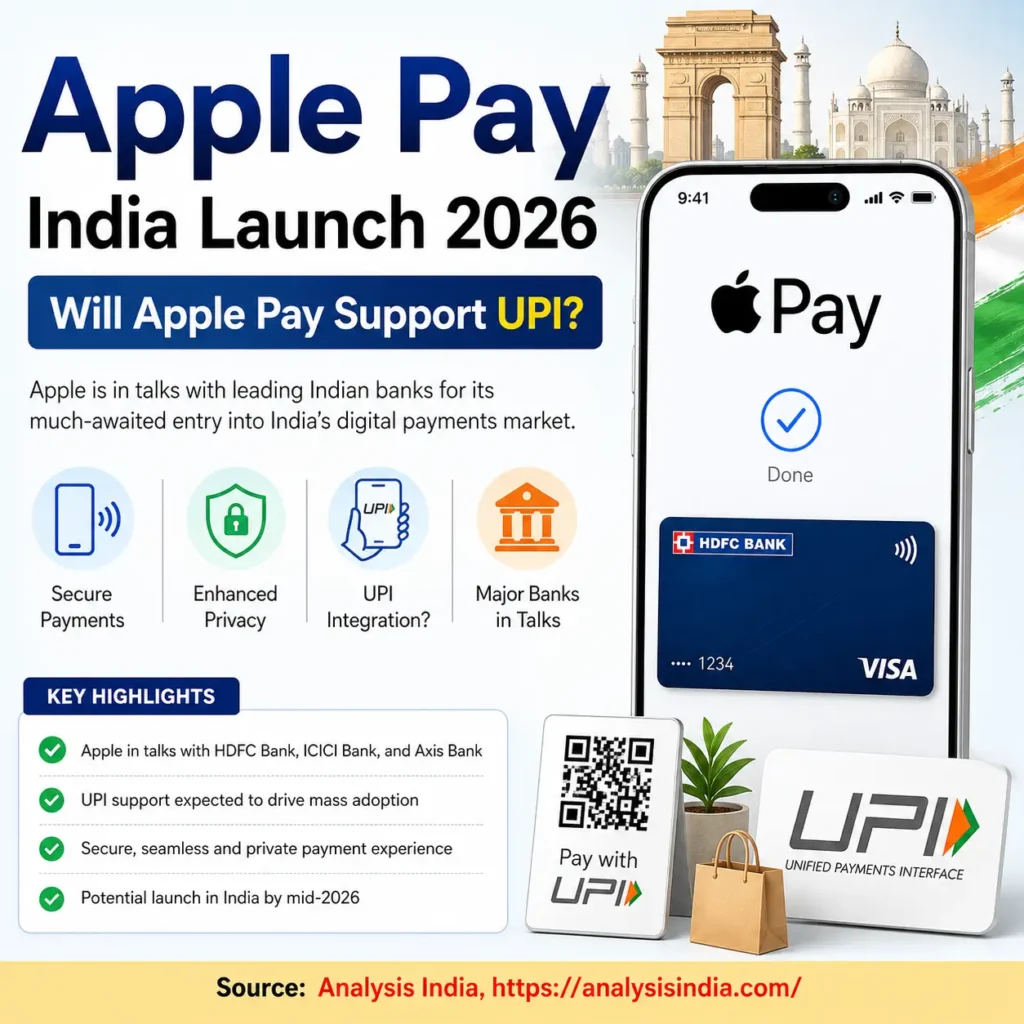
Customers of HDFC Bank, ICICI Bank, SBI Card and other Indian issuers cannot currently assume that their cards are supported simply because those institutions have large credit card businesses. The September 30 launch is centered on Axis Bank, and reports on launch day stated that Apple had not finalized agreements with HDFC Bank and ICICI Bank.
This makes bank expansion one of the most important developments to monitor after the launch. The broader the issuer network becomes, the more useful Apple Pay can become for Indian consumers. Conversely, if participation remains limited to a small number of banks, the service will remain a relatively narrow card-based payment option alongside India’s much larger UPI ecosystem.
For Apple Pay India, therefore, the number of supported banks may ultimately matter as much as the technology itself. Apple already has a large installed base of iPhones and other devices in India, but device ownership alone does not determine payment adoption. Users need an eligible card, a participating issuer and merchants or online platforms that support the relevant payment technology.
Apple Pay India Supported Banks and Cards at Launch
| Category | Status in India |
|---|---|
| Axis Bank | Supported |
| Visa credit cards issued by Axis Bank | Supported |
| Mastercard credit cards issued by Axis Bank | Supported |
| RuPay cards | Not supported at launch |
| HDFC Bank cards | Not currently supported |
| ICICI Bank cards | Not currently supported |
| SBI Card | Not currently supported |
| Other bank cards | Not currently supported unless officially added |
The table should be treated as a September 30, 2026 launch snapshot, because Apple’s supported-bank ecosystem can change as additional issuers join the service. Axis Bank’s official information also notes that features and availability can change and that card eligibility depends on the participating issuer.
Apple Pay India Supported Devices in 2026
Which Apple Devices Support Apple Pay India?
The launch of Apple Pay India is not limited to the latest iPhone models. Apple has made the service available across several compatible devices, including iPhone, iPad and Apple Watch. This means customers who already own a supported Apple device do not necessarily need to purchase a new iPhone or Apple Watch to use the payment service. However, the exact features available can vary depending on the device, operating system and payment method being used. Apple has also stated that Mac support is coming soon. Apple’s official Apple Pay device compatibility guide provides the latest information on supported iPhone, iPad, Apple Watch and Mac models.
For most consumers, the iPhone is likely to be the primary device for Apple Pay India. Apple integrates the payment service with Apple Wallet, allowing an eligible card to be added and subsequently used for contactless transactions at supported payment terminals. The iPhone’s built-in authentication system provides an additional layer between the payment card and the transaction, allowing users to authorize payments using Face ID, Touch ID or the device passcode, depending on the model.
Apple Watch provides another important option. Once a compatible card has been added to Apple Wallet, users can make payments through a supported Apple Watch without necessarily taking their iPhone out at the point of purchase. This can be particularly useful for customers who prefer using their smartwatch for everyday transactions. The Apple Watch therefore extends the Apple Pay experience beyond the smartphone and makes contactless payment part of Apple’s broader wearable ecosystem.
Does Apple Pay Work on iPad in India?
Apple has included iPad among the devices supported by Apple Pay in India. However, the role of an iPad is different from that of an iPhone or Apple Watch because the typical payment experience depends on the specific transaction environment. iPad users can use Apple Pay for supported online purchases and within compatible applications, while the contactless payment experience associated with NFC terminals is primarily relevant to compatible iPhone and Apple Watch devices.
This distinction is important because simply having Apple Pay available on a device does not mean that every payment feature works in exactly the same way. Apple’s device-specific functionality determines whether a user can make an in-store contactless payment, authorize an online purchase or use Apple Pay within an application. Consumers should therefore consider both their device and the type of transaction they want to make.
Is Mac Supported by Apple Pay in India?
Mac support is another area that deserves attention in the initial Apple Pay India rollout. Apple has announced that Mac support is coming soon rather than presenting it as part of the complete launch-day experience. This means Mac users should not assume that every Apple Pay function available on an iPhone or Apple Watch is immediately available on their computer.
Once Mac functionality is available, it could make Apple Pay more useful for online shopping and application-based purchases. A user could potentially select Apple Pay during checkout on a compatible website or application and authenticate the transaction through the Apple ecosystem. This would extend Apple’s payment platform from physical contactless transactions into a wider digital commerce environment.
What Software Is Required?
Device compatibility is only one part of the setup process. Users also need a compatible version of Apple’s operating software and must meet the requirements of the participating bank. Apple recommends keeping devices updated because payment services and security features depend on the latest supported software. The card issuer may also require additional verification before a card can be activated in Apple Wallet.
This means that a customer who owns an apparently compatible iPhone could still encounter problems when attempting to add a card. The issue may not necessarily be the phone itself. It could be related to the card type, issuing bank, payment network, account status or verification process. For Apple Pay India, checking card eligibility should therefore be treated as an equally important step alongside checking device compatibility.
How Apple Pay Works Across Apple Devices
The basic concept is consistent across the Apple ecosystem. A supported payment card is added to Apple Wallet and associated with the user’s Apple device. When the customer initiates a transaction, the device uses Apple’s security and authentication mechanisms to authorize the payment. The merchant’s compatible payment terminal or online checkout then processes the transaction through the relevant payment network.
Apple says its payment system uses a device-specific account number and a unique transaction security code rather than sending the customer’s actual card number to the merchant. This tokenization-based approach is an important part of Apple’s security model and is one of the features that distinguishes a digital wallet from simply storing card information in an application.
The practical implication is that Apple Pay India does not simply turn an iPhone into a digital version of a physical card. Instead, the payment credentials are represented through a protected digital token associated with the device. Authentication is then performed through the device’s security system before the transaction is authorized.
Apple Pay India Device Compatibility at a Glance
| Apple device | Apple Pay availability | Main use |
|---|---|---|
| Compatible iPhone | Supported | Contactless and online payments |
| Compatible Apple Watch | Supported | Contactless payments and supported transactions |
| Compatible iPad | Supported | Apps and online purchases |
| Mac | Coming soon | Online purchases and supported apps |
This device expansion gives Apple an important advantage in terms of ecosystem integration, but it does not eliminate the other requirements for using the service. A compatible device must still be paired with an eligible payment card and a participating issuer. In the initial Indian rollout, that means eligible Axis Bank Visa and Mastercard credit cards remain central to the user experience.
How to Set Up Apple Pay India
How to Set Up Apple Pay India on iPhone
Setting up Apple Pay India starts with adding an eligible payment card to Apple Wallet. For the initial Indian rollout, consumers need a supported Axis Bank Visa or Mastercard credit card and a compatible Apple device. The card must also be eligible for digital wallet activation under the bank’s current requirements. This means that simply having an Axis Bank credit card does not automatically guarantee that every card can be added. Customers should confirm eligibility with Axis Bank before beginning the setup process.
On a compatible iPhone, the user can open the Wallet app and select the option to add a new card. The card can then be scanned using the iPhone camera or its details can be entered manually, depending on the available options. Apple Wallet uses the information to begin the card-enrollment process, but the bank remains responsible for confirming that the card can be activated for Apple Pay.
The next stage is verification. The issuing bank may ask the customer to complete an authentication process before the card becomes active. This additional step is important because Apple Pay does not simply copy a physical card into the Wallet app. The bank and payment network need to approve the digital representation of the card before it can be used for transactions.
Once the verification process has been completed, the eligible card becomes available in Apple Wallet. The user can then select it as the preferred payment card or choose between available cards when making a payment. Apple’s system is designed to keep the physical card number protected by using a device-specific account number and unique transaction security code for payments.
How to Add an Axis Bank Card to Apple Wallet
For eligible Axis Bank customers, the process can also be initiated through the bank’s supported digital channels. Axis Bank states that eligible Visa and Mastercard credit cards can be added to Apple Pay, subject to the bank’s eligibility and verification requirements. The bank has also published specific information for customers explaining its Apple Pay integration.
The process generally involves selecting the eligible card, confirming the required details and completing the authentication requested by the bank. Customers should use the latest version of the relevant Apple and banking applications where applicable. If verification fails, the customer should check whether the card is eligible, whether the registered mobile number and account information are correct and whether the bank has placed any restriction on digital wallet activation.
This bank-level verification is particularly important during the initial Apple Pay India rollout because the service currently depends on a relatively limited set of participating cards. A failed setup does not necessarily mean that the iPhone or Apple Wallet is malfunctioning. The card itself may simply fall outside the current eligibility criteria.
How to Make a Payment With Apple Pay
After the card has been activated, making a contactless payment is designed to be relatively simple. At a compatible contactless payment terminal, an iPhone user can authenticate the transaction and hold the device near the terminal. Depending on the iPhone model, authentication can be performed using Face ID, Touch ID or the device passcode.
Apple Watch users can similarly use their watch at a supported contactless terminal. This makes the Apple Watch an important part of Apple’s payment ecosystem because the customer does not necessarily need to take out the iPhone or physical card for every transaction.
The payment terminal must support the relevant contactless technology for the transaction to work. Therefore, Apple Pay India availability should not be interpreted as meaning that every merchant terminal in the country will automatically accept the service. Merchant acceptance depends on the payment terminal, payment network and transaction configuration.
Does Apple Pay India Require an Internet Connection?
A common question for consumers is whether an internet connection is required every time they make a contactless payment. Apple Pay is designed so that the device can use securely stored payment credentials and transaction security mechanisms rather than transmitting the actual card number to the merchant during every transaction. However, specific circumstances can affect the availability of individual features, including card activation, account verification and certain online transactions.
For this reason, users should not confuse contactless payment capability with complete offline functionality. Adding a card, activating it and maintaining the account relationship may require connectivity. The merchant terminal also needs to process the transaction through the relevant payment infrastructure.
Is Apple Pay India Safe to Use?
Security is one of the central elements of Apple’s payment system. Apple says that the actual card number is not stored on Apple’s servers and is not shared with merchants when a transaction is made. Instead, Apple Pay uses a device-specific account number and a unique transaction code to process payments. This approach is intended to reduce the exposure of the underlying card information during a transaction.
Device authentication provides another layer of protection. A payment can require Face ID, Touch ID or a passcode, depending on the device. If an iPhone or Apple Watch is lost, Apple provides mechanisms that allow users to suspend or remove payment capabilities associated with the device. These protections are important because the security of a digital wallet depends not only on the payment network but also on the security of the device itself. Apple provides additional technical information about Apple Pay security, tokenization and payment-data protection in its official security documentation.
For Indian consumers, this creates an important distinction between Apple Pay India and simply entering card details into an online application. The physical card credentials are not exposed in the same way during a supported transaction. Instead, the transaction is authenticated through Apple’s device and security architecture before being processed through the underlying card network.
What If Apple Pay Does Not Work?
If a card cannot be added, the first step is to verify eligibility. During the initial Indian rollout, the most important requirements are a compatible Apple device and an eligible Axis Bank Visa or Mastercard credit card. A RuPay card or a card issued by a bank that has not yet joined the service cannot currently be assumed to work.
If the card is eligible but activation still fails, the customer should check the bank’s verification requirements and ensure that the Apple device is updated. Persistent problems may require contacting Axis Bank because the bank controls the card’s eligibility and activation on its side of the payment ecosystem.
This distinction will remain important as the service expands. As more banks and cards join Apple Pay India, troubleshooting will increasingly depend on the specific issuer, card network and Apple device being used.
Apple Pay India Setup Process
The overall process can therefore be understood as a chain involving three main participants: Apple, the card issuer and the payment network. Apple provides the Wallet and device security infrastructure. The bank confirms the cardholder and authorizes the card for digital wallet use. Visa or Mastercard provides the underlying card payment network through which the transaction is processed.
That structure explains why Apple’s Indian launch cannot be evaluated purely as a smartphone feature. It is also a banking and payment-network integration. The ability to expand the service to additional customers will depend heavily on Apple bringing more issuers and card products into the ecosystem.
Where Can You Use Apple Pay India?
Where Can Apple Pay India Be Used?
The practical value of Apple Pay India will ultimately depend on where consumers can use it. Apple has confirmed that the service can be used at participating merchants in physical stores, within apps and on websites. The company says Apple Pay can be used by customers at retailers of different sizes, provided the merchant supports the required payment infrastructure. This means the launch is not restricted to Apple’s own stores or a small group of technology-focused retailers.
For physical stores, the most important requirement is a contactless-enabled payment terminal. Customers should look for the familiar contactless payment symbol or Apple Pay logo at checkout. Apple’s merchant guidance says businesses that already accept contactless cards can generally enable Apple Pay through their payment provider, while Axis Bank’s customer guidance specifically tells users to look for the Apple Pay or contactless symbol before attempting a payment.
This makes existing card-payment infrastructure particularly important for Apple Pay India. Apple does not need every merchant to install an entirely new payment machine. Instead, Apple Pay can work through compatible contactless payment terminals that are already part of the merchant’s card acceptance infrastructure. As a result, adoption can potentially expand faster where contactless card acceptance is already established.
Apple Pay India at Physical Stores
At a participating store, the payment process is based on near-field communication, commonly known as NFC. The customer authenticates the payment on the iPhone or Apple Watch and holds the device near the contactless payment reader. The terminal then processes the transaction through the underlying card network.
Axis Bank states that its customers do not need mobile data or Wi-Fi to make an in-store contactless payment using Apple Pay. This is an important practical difference because the transaction does not depend on the customer’s phone having an active internet connection at the exact moment of payment. The merchant’s payment terminal still needs its own connection to the payment infrastructure to process the transaction.
This could make Apple Pay India particularly convenient for everyday card transactions. A customer does not need to remove the physical card from a wallet, remember a card PIN for every eligible transaction or open a separate payment application. The device itself becomes the interface between the customer’s card and the merchant’s contactless terminal.
Can Apple Pay India Be Used in Apps and Websites?
The service is not limited to physical stores. Apple has confirmed that Apple Pay can also be used in apps and on the web at participating merchants. This gives the service a second use case beyond NFC-based payments and allows eligible customers to use their stored payment credentials when shopping digitally.
For online transactions, customers may see an Apple Pay button or payment option during checkout. Instead of manually entering card information, the customer can select Apple Pay and authenticate the transaction through the Apple device. Axis Bank also confirms that its eligible cards can be used for purchases online and within apps.
This creates a broader proposition for Apple Pay India because the same payment credential can potentially be used across multiple shopping environments. The customer can use the card at a compatible physical terminal, in a supported application or on a participating website without repeatedly entering the underlying card details.
Does Every Contactless Terminal Accept Apple Pay?
Not necessarily. A contactless terminal is an important requirement, but acceptance can also depend on the merchant’s acquiring bank, payment provider and configuration. Apple’s merchant documentation explains that businesses need compatible EMV contactless acceptance to support Apple Pay at the point of sale.
This distinction is important for Indian consumers because the presence of a card machine does not automatically mean that Apple Pay will work. Some terminals may support conventional card tapping but have other configuration or acceptance limitations. If a payment does not work, checking for the contactless symbol and confirming that the merchant accepts contactless payments is a sensible first step.
The merchant ecosystem could therefore become one of the key factors determining the growth of Apple Pay India. Apple’s technology may be ready from day one, but consumer adoption depends on the number of locations where customers can actually use it.
PayU Expands Merchant Acceptance
One development that could help expand the Indian acceptance network is the involvement of payment infrastructure companies. PayU announced on September 30 that it had enabled Apple Pay across its merchant network, allowing eligible users to make contactless payments at supported stores as well as payments through participating apps and websites.
This type of integration is significant because payment gateways and merchant-service providers sit between businesses and the broader payments ecosystem. If major providers enable Apple Pay through their existing infrastructure, individual merchants may not need to build an entirely separate payment system.
The broader opportunity is therefore not simply about how many Indian consumers own an iPhone. It is also about how quickly payment processors, acquiring banks, gateways and merchants make Apple Pay available at checkout.
Apple Pay India vs QR-Based Payments
The user experience is also fundamentally different from India’s dominant QR-based payment model. With UPI, consumers frequently scan a QR code using a payment application and authorize the transaction through their bank-linked UPI credentials. With Apple Pay India, an eligible card is stored in Apple Wallet and the customer typically uses the device itself at a compatible contactless terminal.
This difference means Apple Pay should not be viewed simply as another version of a UPI application. It represents a card-based digital wallet experience, while UPI is primarily an account-to-account payment system. The two systems can therefore coexist rather than necessarily competing for exactly the same transaction.
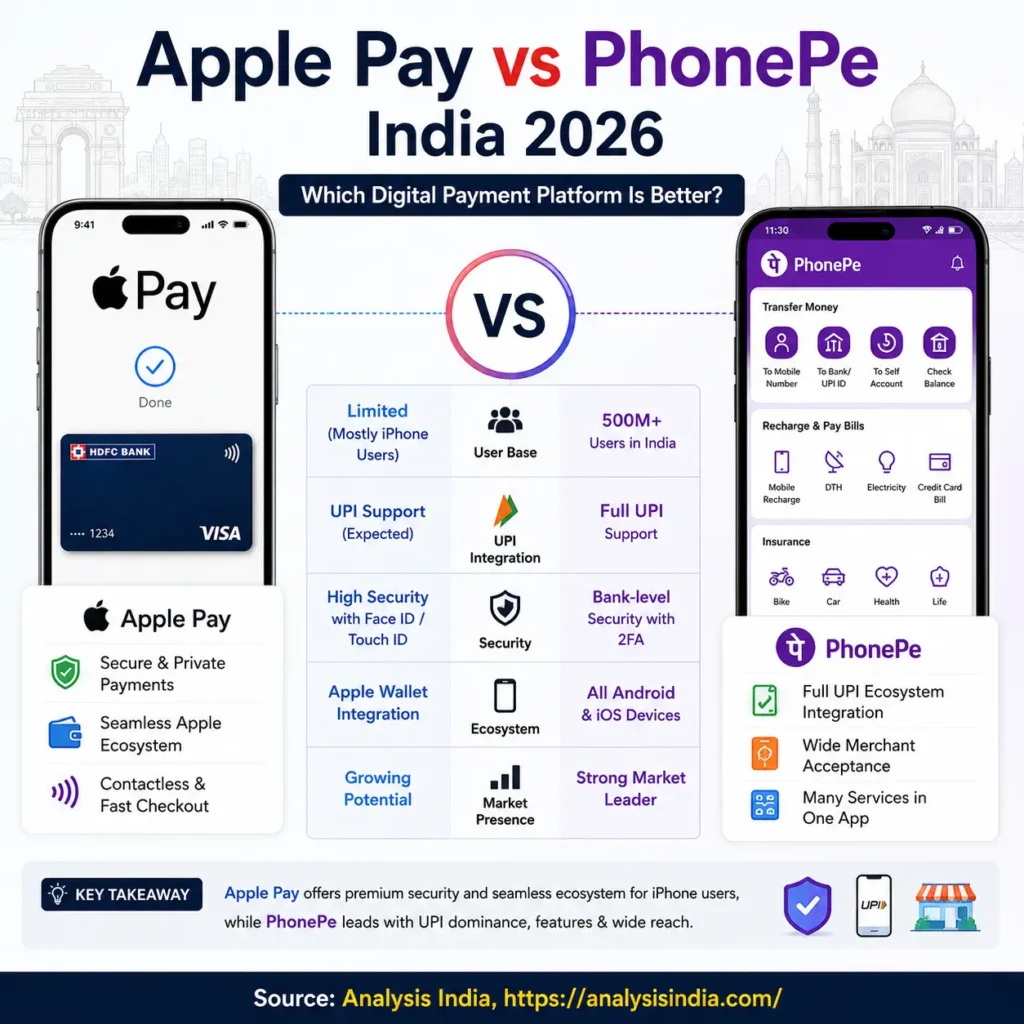
India’s merchant infrastructure already supports multiple payment methods. Modern POS terminals can accept cards, contactless transactions and, depending on the terminal and configuration, QR-based payments. Axis Bank’s merchant infrastructure, for example, supports card payments as well as QR and UPI acceptance. The difference becomes even clearer when Apple Pay is compared with India’s major UPI-based platforms, including PhonePe, which we examine separately in our Apple Pay vs PhonePe India 2026 comparison.
That interoperability could be important for Apple Pay India. Consumers may choose different payment methods depending on the transaction, available rewards, credit requirements, merchant acceptance and personal preference. A customer could use UPI for one purchase, a physical card for another and Apple Pay for a contactless card transaction.
For a detailed comparison of Apple’s payment ecosystem with Google Pay in India, read our analysis of Apple Pay vs Google Pay in India 2026.
Where Apple Pay India Can Be Used
| Payment environment | Apple Pay availability |
|---|---|
| Contactless physical stores | Yes, at participating merchants |
| Contactless POS terminals | Yes |
| Apps | Yes, where supported |
| Websites | Yes, where supported |
| Apple retail stores | Available subject to supported payment setup |
| QR-based UPI payment | Not the same payment mechanism |
| Non-contactless card terminal | Apple Pay contactless payment may not work |
The key point is that Apple Pay India availability is merchant-dependent. Apple’s launch announcement says the service is designed to work at retailers of all sizes, but individual merchants still need compatible payment acceptance.
As more payment providers and merchants integrate the service, the distinction between Apple’s wallet and India’s existing payment infrastructure will become clearer. The more interesting question is no longer whether Apple can technically process a payment in India. It is whether consumers will find enough situations where Apple Pay offers a meaningful advantage over UPI and conventional card payments.
Apple Pay India: What Users Should Know Before Signing Up
The biggest point to understand is that Apple Pay is available in India, but its initial reach is limited.
If you have an eligible Axis Bank Visa or Mastercard credit card and a compatible Apple device, you can begin using the service. If you have a RuPay card or a card from a bank that has not yet joined the Indian rollout, you currently need to continue using other available payment methods.
Merchant acceptance is another consideration. Apple Pay works at participating contactless terminals and supported online checkouts, but users should not assume that every payment terminal in India will automatically accept it.
The service is therefore best viewed as an additional payment option within the Apple ecosystem. Its usefulness will increase as more banks, card networks, payment providers and merchants participate.
Analysis India View: What Matters Most for Apple Pay Users
For consumers, the most important development after the launch is not simply that Apple Pay has arrived. It is how quickly the supported ecosystem expands.
The initial partnership with Axis Bank gives Apple a starting point, but the service’s broader consumer reach will depend on additional banks and cards. Reuters reported that Apple had been in discussions with other major banks, including HDFC Bank and ICICI Bank, although those agreements were not finalized at launch.
Merchant integration will also determine how useful the service becomes. PayU’s launch-day integration shows that Apple’s strategy can make use of existing payment infrastructure rather than requiring every merchant to build a completely separate system.
For now, the most practical way to understand Apple Pay in India is as a card-based digital wallet for eligible Apple users, not as a replacement for India’s wider digital-payment ecosystem.
The service gives Apple users a new way to access an existing credit card through their devices. Whether it becomes a much broader payment platform will depend on future bank partnerships, card-network support and merchant adoption.
Conclusion
Apple Pay India is now officially available, marking an important expansion of Apple’s payment ecosystem into the Indian market. The September 30, 2026 launch begins with Axis Bank and eligible Visa and Mastercard credit cards. RuPay cards are not supported at launch, while Apple has made the service available across iPhone, iPad and Apple Watch, with Mac support coming soon.
For eligible users, setting up the service is relatively straightforward. An Axis Bank credit card can be added through Apple Wallet or the bank’s supported mobile banking process, followed by the required verification. Once activated, users can make contactless payments at participating terminals and use Apple Pay in supported apps and websites.
The next stage will be important. More banks, cards, payment networks and merchants could significantly expand the reach of the service. Until then, Apple Pay should be viewed as a new card-based payment option for eligible Apple users, rather than a replacement for UPI or India’s broader digital-payment ecosystem.
Frequently Asked Questions
Is Apple Pay available in India in 2026?
Yes. Apple officially launched Apple Pay in India on September 30, 2026. The initial rollout supports eligible Axis Bank Visa and Mastercard credit cards.
Which bank supports Apple Pay in India?
Axis Bank is the first confirmed Indian banking partner at launch. Eligible Axis Bank Visa and Mastercard credit cards are supported.
Which Axis Bank cards work with Apple Pay?
Axis Bank currently states that its eligible Visa and Mastercard credit cards can be used with Apple Pay. Customers must complete the required card verification before making payments.
Does Apple Pay support RuPay cards in India?
No. RuPay cards are not supported in the initial September 2026 launch.
Does Apple Pay support UPI in India?
No. Apple Pay’s initial Indian implementation is based on eligible payment cards and does not provide UPI payments.
Which Apple devices support Apple Pay in India?
Apple Pay is available on compatible iPhone, iPad and Apple Watch devices in India. Apple says Mac support is coming soon.
What software is required for Apple Pay?
Axis Bank currently specifies iOS 18 or later for iPhone, iPadOS 18 or later for iPad and watchOS 11 or later for Apple Watch for its Apple Pay implementation.
Can I use Apple Pay without internet?
Yes. Axis Bank states that in-store contactless Apple Pay payments do not require mobile data or Wi-Fi at the time of payment. Other functions, such as setup, verification and online transactions, can require connectivity.
Where can I use Apple Pay in India?
You can use Apple Pay at participating physical stores with compatible contactless terminals and at supported websites and apps. Look for the Apple Pay or contactless payment symbol at checkout.
Is Apple Pay free in India?
Axis Bank currently states that Apple Pay is free for its customers, with no separate setup fee, transaction fee or annual charge for using the service. Normal terms and charges associated with the underlying credit card continue to apply.
Is Apple Pay safe to use in India?
Apple Pay uses device authentication and tokenized payment credentials. Apple says the actual card number is not stored on Apple servers or shared with merchants during Apple Pay transactions. Axis Bank also states that payments require Face ID, Touch ID or a device passcode.
Why can’t I add my Axis Bank card to Apple Wallet?
Check whether your card is eligible, whether your Apple device meets the requirements and whether additional verification is pending. If the problem continues, Axis Bank recommends contacting its customer support.
Can I use Apple Pay with HDFC Bank or ICICI Bank cards?
Those banks were not confirmed as Apple Pay issuers at the September 30, 2026 launch. Apple had reportedly been in discussions with additional banks, but users should wait for an official announcement before assuming that their cards are supported.
Do Apple Pay purchases earn credit-card rewards?
Yes. Axis Bank states that eligible Apple Pay purchases continue to receive applicable EDGE Reward points, cashback and card benefits according to the underlying card’s normal terms.
Can I use Apple Pay internationally?
Axis Bank states that Apple Pay can be used with eligible Axis Bank credit cards at participating merchants internationally where Apple Pay or contactless payments are accepted, subject to the applicable card terms and conditions.