📅 Published: April 24, 2026
🔄 Last Updated: April 24, 2026
Japan Lung Cancer Molecular Screening Market Overview
The Japan Lung Cancer Molecular Screening Market is steadily gaining momentum as the country strengthens its position in advanced oncology diagnostics and precision medicine. Japan’s healthcare ecosystem is widely recognized for its structured screening programs, high technological adoption, and strong clinical research infrastructure. These factors are creating a favorable environment for the expansion of molecular screening technologies in lung cancer detection.
Lung cancer continues to be one of the most critical health challenges in Japan, remaining a leading cause of cancer-related mortality despite improvements in treatment and detection methods . The increasing burden of lung cancer, combined with an aging population, is driving the need for more accurate and early diagnostic solutions. Molecular screening is emerging as a key solution because it focuses on identifying biomarkers, genetic mutations, and early biological signals that indicate disease risk before clinical symptoms appear.
This transformation is closely aligned with global developments highlighted in the Lung Cancer Molecular Screening Market Growth, where precision diagnostics are reshaping early detection strategies. In Japan, the integration of molecular screening into existing healthcare pathways is enabling clinicians to move beyond conventional imaging-based screening methods.
The Japan Lung Cancer Molecular Screening Market is also supported by the country’s strong emphasis on preventive healthcare. National screening programs cover a significant portion of the population, with more than 90 percent of individuals having access to cancer screening services . This widespread access provides a strong foundation for the adoption of advanced molecular screening technologies.
Japan Lung Cancer Molecular Screening Market Size and Forecast
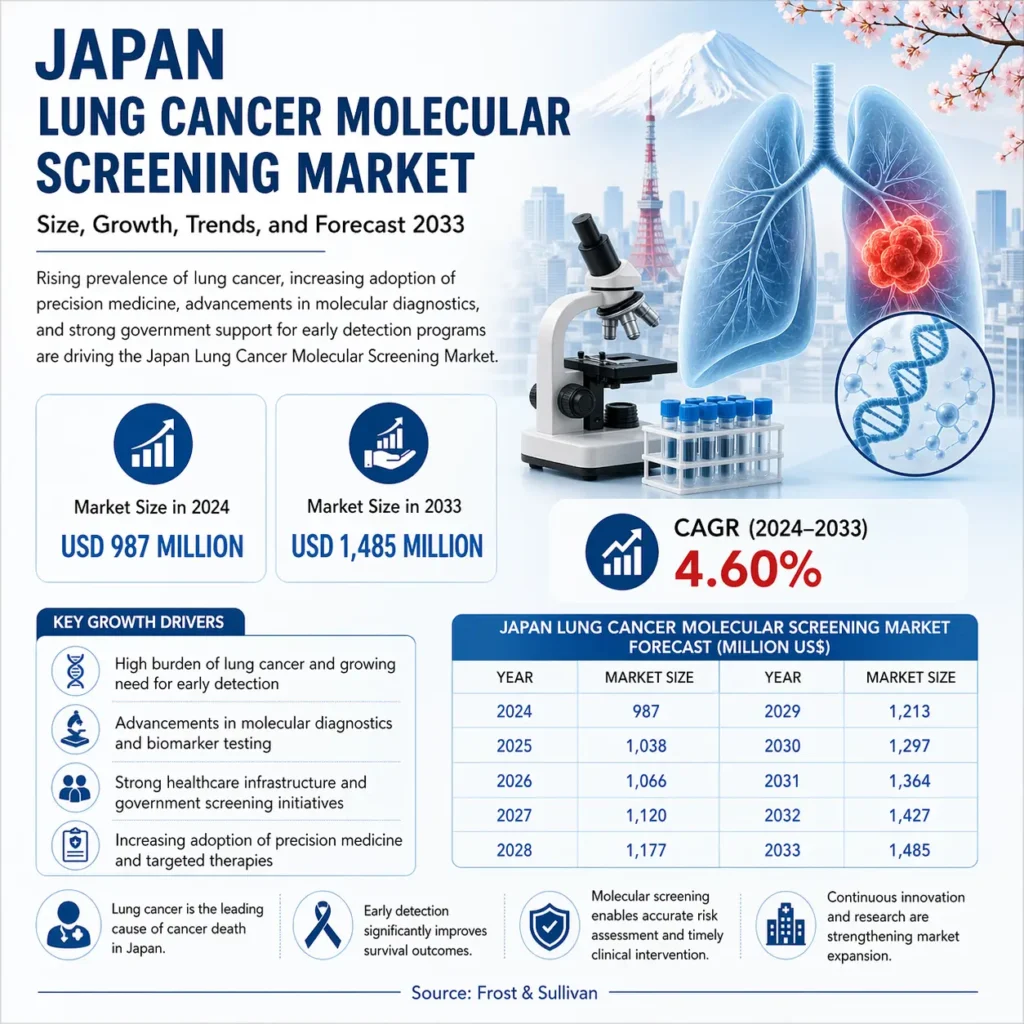
The Japan Lung Cancer Molecular Screening Market was valued at USD 987 Million in 2024 and is projected to reach USD 1,485 Million by 2033, reflecting steady and sustainable growth.
Japan Lung Cancer Molecular Screening Market Forecast (Million US$)
| Year | Market Size |
|---|---|
| 2024 | 987 |
| 2025 | 1,038 |
| 2026 | 1,066 |
| 2027 | 1,120 |
| 2028 | 1,177 |
| 2029 | 1,213 |
| 2030 | 1,297 |
| 2031 | 1,364 |
| 2032 | 1,427 |
| 2033 | 1,485 |
Source: Frost & Sullivan
The steady upward trajectory reflects growing adoption of molecular diagnostics and increasing awareness of early detection. This growth trend is consistent with broader developments in the Lung Cancer Screening Market Growth, where healthcare systems are prioritizing early-stage diagnosis.
Key Growth Drivers of the Japan Lung Cancer Molecular Screening Market
The Japan Lung Cancer Molecular Screening Market is driven by multiple interconnected factors that support its long-term expansion.
Rising Lung Cancer Burden and Early Detection Demand
Lung cancer remains one of the most commonly diagnosed cancers in Japan, with over 126,000 cases reported in recent years . This high disease burden is creating a strong demand for early detection technologies that can improve survival rates.
Japan has already made progress in early-stage detection, with a higher proportion of cases diagnosed at stage I compared to many other countries . Molecular screening is expected to further enhance this capability by identifying disease at an even earlier stage.
Strong Healthcare Infrastructure and Screening Programs
Japan’s healthcare system plays a critical role in supporting the Japan Lung Cancer Molecular Screening Market. The country has a well-established network of cancer centers and screening programs, ensuring broad access to diagnostic services.
Government initiatives aimed at increasing screening participation are also contributing to market growth. Although overall screening participation is still below 50 percent in some areas, efforts are being made to increase this rate to improve early detection outcomes .
Expansion of Precision Medicine
Precision medicine is a key driver of the Japan Lung Cancer Molecular Screening Market. The discovery of genetic mutations such as EGFR and ALK has transformed lung cancer diagnosis and treatment in Japan .
Molecular screening technologies enable clinicians to identify these mutations early, allowing for more targeted and effective treatment strategies. This integration of diagnostics and therapeutics is a major factor supporting market growth.
Technological Advancements in Molecular Diagnostics
Advancements in molecular diagnostics, including liquid biopsy and next-generation sequencing, are significantly improving screening accuracy. These technologies allow for non-invasive detection of cancer-related biomarkers, making screening more accessible and patient-friendly.
The growing adoption of these technologies is accelerating the development of the Japan Lung Cancer Molecular Screening Market.
Role of Non-Invasive Screening Technologies
Non-invasive diagnostic methods are playing an increasingly important role in the Japan Lung Cancer Molecular Screening Market. Liquid biopsy technologies, in particular, are gaining widespread attention due to their ability to detect cancer biomarkers through blood samples.
These methods offer several advantages, including reduced patient discomfort, faster turnaround times, and the ability to perform repeat testing. As healthcare providers prioritize patient-centered care, non-invasive screening solutions are becoming more widely adopted.
Market Challenges and Restraints
Despite strong growth potential, the Japan Lung Cancer Molecular Screening Market faces several challenges.
High Cost of Advanced Diagnostics
Molecular screening technologies often require expensive equipment and specialized expertise. This can limit adoption in smaller healthcare facilities and rural areas.
Regulatory and Approval Barriers
Japan’s regulatory environment, while ensuring safety and quality, can sometimes delay the introduction of new technologies. This may slow down the adoption of innovative molecular screening solutions.
Variability in Screening Participation
Although Japan has strong screening programs, participation rates vary across regions. Increasing awareness and accessibility will be essential to achieving widespread adoption.
Technology Trends in the Japan Lung Cancer Molecular Screening Market
The Japan Lung Cancer Molecular Screening Market is being shaped by several key technological trends.
Multi-Biomarker Testing Panels
Multi-biomarker testing is becoming increasingly important in lung cancer screening. These panels analyze multiple genetic and molecular markers simultaneously, improving detection accuracy and providing comprehensive insights into disease risk.
Integration of Artificial Intelligence
Artificial intelligence is being integrated into diagnostic workflows to analyze complex molecular data. AI tools help improve accuracy, reduce interpretation time, and support clinical decision-making.
Growth of Digital Healthcare Platforms
Digital health technologies are improving data management and workflow efficiency. These platforms enable seamless integration of molecular screening into clinical practice.
Competitive Landscape
The Japan Lung Cancer Molecular Screening Market is highly competitive, with a mix of domestic and international players. Companies are focusing on innovation, strategic partnerships, and research and development to strengthen their market position.
Key players are investing in advanced molecular diagnostics and expanding their product portfolios. Collaboration between healthcare providers and diagnostic companies is accelerating the adoption of new technologies.
Regional and Institutional Adoption Trends
Adoption of molecular screening technologies varies across different regions in Japan. Urban areas with advanced healthcare infrastructure are leading the adoption, while rural areas are gradually catching up.
Major cancer centers and research institutions play a key role in driving innovation and adoption. These institutions often serve as early adopters of new technologies.
Role of Awareness and Preventive Healthcare
Awareness is a critical factor in the growth of the Japan Lung Cancer Molecular Screening Market. Public health initiatives aimed at increasing awareness of lung cancer risk and screening importance are driving demand for advanced diagnostic solutions.
According to the National Cancer Institute, early detection significantly improves survival outcomes. Similarly, the World Health Organization emphasizes the importance of screening in reducing cancer-related mortality.
These insights highlight the importance of molecular screening in improving healthcare outcomes.
Future Outlook of the Japan Lung Cancer Molecular Screening Market
The Japan Lung Cancer Molecular Screening Market is expected to continue its steady growth trajectory through 2033. The market will be driven by increasing adoption of precision medicine, advancements in diagnostic technologies, and growing awareness of early detection.
Molecular screening is expected to become a standard component of lung cancer detection in Japan. As healthcare systems continue to evolve, the integration of molecular diagnostics into routine clinical practice will improve patient outcomes and drive market expansion.
The Japan Lung Cancer Molecular Screening Market is closely connected with broader oncology and screening markets. For example, the evolution of molecular diagnostics is strongly linked with the United States Lung Cancer Molecular Screening Market, where similar trends in precision medicine are shaping growth.
Additionally, the increasing focus on early detection aligns with developments in the Lung Cancer Screening Market Growth, where preventive healthcare strategies are expanding globally.
For a broader perspective, the market also connects with the Cancer Screening Market Growth Trends & Insights, which highlights the rising importance of early diagnosis across multiple cancer types.
Conclusion
The Japan Lung Cancer Molecular Screening Market is poised for steady growth, driven by advancements in molecular diagnostics, increasing demand for early detection, and strong healthcare infrastructure. With the market projected to reach USD 1,485 Million by 2033, it represents a significant opportunity for healthcare providers, diagnostic companies, and investors.
As Japan continues to lead in precision medicine and oncology research, molecular screening will play a critical role in improving lung cancer outcomes. The integration of advanced technologies into routine screening practices will further enhance the effectiveness of early detection strategies.
FAQs: Japan Lung Cancer Molecular Screening Market
What is the Japan Lung Cancer Molecular Screening Market?
It refers to advanced diagnostic methods that use biomarkers and genetic data to detect lung cancer early in Japan.
What is the market size of the Japan Lung Cancer Molecular Screening Market?
The market was valued at USD 987 Million in 2024 and is projected to reach USD 1,485 Million by 2033.
What drives the growth of this market?
Growth is driven by early detection demand, precision medicine, and advancements in molecular diagnostics.
Why is molecular screening important?
It helps detect lung cancer earlier by analyzing biological signals, improving diagnosis and treatment outcomes.
What are the key challenges?
High costs, regulatory barriers, and variability in screening participation are major challenges.