📅 Published: April 25, 2026
🔄 Last Updated: April 25, 2026
South East Asia Lung Cancer Molecular Screening Market Overview
The South East Asia Lung Cancer Molecular Screening Market is emerging as a rapidly growing segment within the broader oncology diagnostics landscape. The region, which includes countries such as Indonesia, Thailand, Malaysia, Vietnam, and the Philippines, is witnessing a significant shift toward early detection and precision medicine. This transformation is driven by increasing cancer burden, expanding healthcare infrastructure, and rising awareness about preventive healthcare.
Lung cancer remains one of the leading causes of cancer-related deaths across South East Asia, with variations in epidemiology, risk factors, and access to treatment across countries. Studies indicate that lung cancer patterns in the region differ significantly due to environmental exposure, smoking prevalence, and genetic variations, which directly influence screening and treatment approaches . This complexity is increasing the demand for molecular screening technologies that can provide more personalized and accurate diagnostic insights.
The South East Asia Lung Cancer Molecular Screening Market is also benefiting from advancements in molecular diagnostics, including next-generation sequencing and liquid biopsy. These technologies enable early detection of cancer through biomarker analysis, allowing clinicians to identify high-risk individuals and initiate timely intervention.
The growth of this market is closely aligned with global trends observed in the Lung Cancer Molecular Screening Market Growth, where precision diagnostics are becoming a key component of oncology care. Additionally, the expansion of regional healthcare systems is supporting the adoption of advanced screening technologies.
South East Asia Lung Cancer Molecular Screening Market Size and Forecast
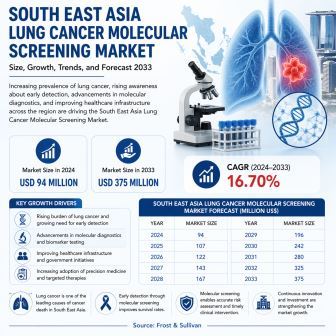
The South East Asia Lung Cancer Molecular Screening Market was valued at USD 94 Million in 2024 and is projected to reach USD 375 Million by 2033, reflecting strong growth potential over the forecast period.
South East Asia Lung Cancer Molecular Screening Market Forecast (Million US$)
| Year | Market Size |
|---|---|
| 2024 | 94 |
| 2025 | 107 |
| 2026 | 122 |
| 2027 | 143 |
| 2028 | 167 |
| 2029 | 196 |
| 2030 | 242 |
| 2031 | 280 |
| 2032 | 325 |
| 2033 | 375 |
Source: Frost & Sullivan
The significant growth trajectory highlights the increasing adoption of molecular screening technologies across the region. This trend is consistent with the broader expansion of the cancer diagnostics market in South East Asia, which is projected to grow substantially due to advancements in diagnostic technologies and increasing healthcare investments .
Key Growth Drivers of the South East Asia Lung Cancer Molecular Screening Market
The South East Asia Lung Cancer Molecular Screening Market is driven by several critical factors that are shaping its long-term growth.
Rising Cancer Burden and Late Diagnosis Challenges
One of the primary drivers is the increasing burden of lung cancer across the region. Many countries in South East Asia face challenges related to late-stage diagnosis due to limited access to advanced screening facilities. Molecular screening offers a solution by enabling early detection through biomarker analysis.
Early detection is particularly important in this region because it can significantly improve treatment outcomes and reduce healthcare costs. The growing awareness of these benefits is driving demand for molecular screening technologies.
Expansion of Healthcare Infrastructure
Healthcare infrastructure in South East Asia is rapidly improving, with governments investing in diagnostic facilities and cancer care programs. Countries such as Singapore, Malaysia, and Thailand are leading in adopting advanced diagnostic technologies, while other nations are gradually expanding their capabilities.
The expansion of healthcare infrastructure is creating opportunities for the adoption of molecular screening technologies, particularly in urban areas where access to advanced healthcare services is higher.
Growth of Precision Medicine
Precision medicine is playing a significant role in the development of the South East Asia Lung Cancer Molecular Screening Market. Molecular screening technologies enable clinicians to identify specific genetic mutations and biomarkers associated with lung cancer.
This approach allows for personalized treatment strategies, improving patient outcomes and increasing the effectiveness of cancer therapies. The shift toward precision medicine is a major factor driving market growth.
Technological Advancements in Molecular Diagnostics
Advancements in molecular diagnostics, including next-generation sequencing and liquid biopsy, are transforming the screening landscape. These technologies offer high accuracy, faster results, and non-invasive testing options.
The integration of these technologies into healthcare systems is accelerating the growth of the South East Asia Lung Cancer Molecular Screening Market.
Role of Non-Invasive Screening Technologies
Non-invasive diagnostic methods are becoming increasingly important in the South East Asia Lung Cancer Molecular Screening Market. Liquid biopsy technologies allow clinicians to detect cancer-related biomarkers through blood samples, reducing the need for invasive procedures.
These technologies are particularly valuable in regions with limited healthcare infrastructure, as they simplify the screening process and improve accessibility. The adoption of non-invasive screening methods is expected to drive market growth over the forecast period.
Market Challenges and Restraints
Despite strong growth potential, the South East Asia Lung Cancer Molecular Screening Market faces several challenges.
Limited Access to Advanced Diagnostics
Access to advanced molecular diagnostics remains uneven across the region. While urban centers have access to advanced technologies, rural areas often lack the necessary infrastructure.
High Cost of Molecular Testing
The cost of molecular screening technologies can be a barrier to adoption, particularly in lower-income countries. Efforts to reduce costs and improve affordability will be critical for market expansion.
Regulatory and Policy Challenges
Regulatory frameworks vary across countries, which can slow down the adoption of new technologies. Harmonizing regulations and improving policy support will be essential for market growth.
Technology Trends in the South East Asia Lung Cancer Molecular Screening Market
The South East Asia Lung Cancer Molecular Screening Market is being shaped by several key technological trends.
Multi-Biomarker Testing
Multi-biomarker testing is gaining traction as it allows for the analysis of multiple genetic markers simultaneously. This improves diagnostic accuracy and provides comprehensive insights into disease risk.
Integration of Artificial Intelligence
Artificial intelligence is being integrated into diagnostic workflows to analyze complex molecular data. AI tools help improve accuracy and support clinical decision-making.
Digital Health Platforms
Digital health platforms are enhancing data management and improving workflow efficiency. These platforms enable better integration of molecular screening into clinical practice.
Competitive Landscape
The South East Asia Lung Cancer Molecular Screening Market is competitive, with both regional and international players operating in the market. Companies are focusing on innovation, partnerships, and expansion strategies to strengthen their market presence.
Collaboration between healthcare providers, diagnostic companies, and research institutions is driving innovation and improving access to advanced screening technologies.
Regional Insights and Adoption Trends
Adoption of molecular screening technologies varies across South East Asia. Countries with advanced healthcare systems, such as Singapore and Malaysia, are leading the adoption, while other nations are gradually expanding their capabilities.
Urban areas are the primary drivers of market growth, as they have better access to healthcare infrastructure and advanced diagnostic technologies.
Awareness and Preventive Healthcare
Awareness is a critical factor in the growth of the South East Asia Lung Cancer Molecular Screening Market. Governments and healthcare organizations are increasing efforts to promote early detection and preventive healthcare.
According to the World Health Organization, early detection is essential for reducing cancer-related mortality. These initiatives are driving demand for advanced screening technologies in the region.
Future Outlook of the South East Asia Lung Cancer Molecular Screening Market
The South East Asia Lung Cancer Molecular Screening Market is expected to experience strong growth through 2033, driven by increasing adoption of precision medicine and advancements in diagnostic technologies.
The market is projected to grow from USD 94 Million in 2024 to USD 375 Million by 2033, reflecting significant opportunities for healthcare providers and diagnostic companies.
As healthcare infrastructure continues to improve and awareness increases, molecular screening is expected to become a standard component of lung cancer detection in the region.
The South East Asia Lung Cancer Molecular Screening Market is closely connected with global and regional markets. For example, similar growth patterns are observed in the United States Lung Cancer Molecular Screening Market, and Japan Lung Cancer Molecular Screening Market where precision medicine is driving adoption.
Additionally, the market aligns with trends in the Lung Cancer Screening Market Growth and the Cancer Screening Market Growth Trends & Insights, which highlight the increasing importance of early detection.
Conclusion
The South East Asia Lung Cancer Molecular Screening Market is poised for strong growth, supported by increasing cancer burden, advancements in molecular diagnostics, and expanding healthcare infrastructure. With a projected market size of USD 375 Million by 2033, the region presents significant opportunities for innovation and investment.
The adoption of molecular screening technologies will play a critical role in improving early detection and patient outcomes, making this market a key focus area within the global oncology diagnostics landscape.
FAQs: South East Asia Lung Cancer Molecular Screening Market
What is the South East Asia Lung Cancer Molecular Screening Market?
It refers to advanced diagnostic technologies that use biomarkers and genetic data to detect lung cancer early across South East Asia.
What is the market size of this market?
The market was valued at USD 94 Million in 2024 and is projected to reach USD 375 Million by 2033.
What drives market growth?
Growth is driven by increasing cancer burden, advancements in molecular diagnostics, and rising awareness of early detection.
What are the key challenges?
Limited access to advanced diagnostics, high costs, and regulatory challenges are key barriers.